 TaxTMI
Login

Login
Loading...
Press 'Enter' to add multiple search terms. Rules for Better Search

Press 'Enter' after typing page number.
Press 'Enter' after typing page number.


No Folders have been created
Are you sure you want to delete "My most important" ?
NOTE:
Press 'Enter' after typing page number.












Press 'Enter' after typing page number.

All TMI Notes
Press 'Enter' after typing page number.
Press 'Enter' after typing page number.
All TMI Notes

Note

Bookmark

Share


Download

This is a neutral professional article. The judgment is analysed in the context of its factual background, issues framed, and conclusions reached by the Court.
2026 (8) TMI 85 - DELHI HIGH COURT
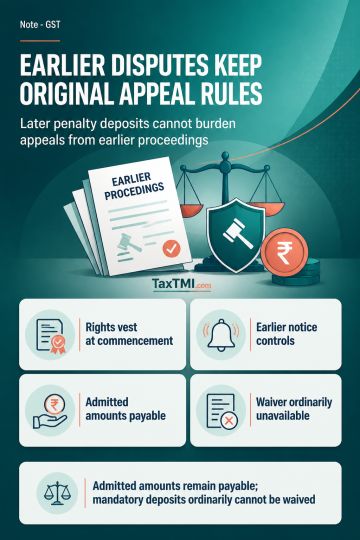
The central question is whether a statutory amendment that introduces a burdensome pre-deposit for a penalty-only appeal can apply where adjudication had already commenced before the amendment, but the adverse order and proposed appeal arise afterwards. In 2026 (8) TMI 85 - DELHI HIGH COURT, the court held that the substituted proviso to Section 107(6) of the Central Goods and Services Tax Act, 2017, effective from 1 October 2025, does not govern an appeal arising from a show-cause notice issued before that date.
The ruling proceeds on the established principle that the right of appeal is a substantive right. Although its exercise awaits an adverse adjudication order, the appellate right and the conditions forming part of its appellate "package" vest when the lis commences. A subsequent provision which imposes a more onerous condition cannot impair that right unless the legislature has expressed that consequence expressly or by necessary intendment.
For a penalty-only order, the substituted proviso bars filing unless ten per cent of the penalty is deposited. The court characterised this as a threshold condition affecting access to the appellate forum, rather than a merely procedural regulation. Where the underlying adjudicatory proceedings had commenced before the substituted proviso became operative, and no contrary legislative intention was discernible, the earlier regime continued to govern the appeal.
Section 107 of the CGST Act creates the first appellate remedy against an order passed by an adjudicating authority. The provision prescribes both the period for filing an appeal and the monetary conditions that must be met before the appeal can be instituted. The controversy arose because the statutory pre-deposit framework was altered after initiation of penalty proceedings but before their culmination in an order.
Before the substitution, Section 107(6)(b) required payment of "a sum equal to ten per cent of the remaining amount of tax in dispute arising from the said order", subject to the stated statutory ceiling. The earlier proviso separately applied to an order under Section 129(3), requiring a deposit equal to twenty-five per cent of the penalty. It did not prescribe a percentage-based pre-deposit for a wholly disputed penalty-only order under Section 122(1A).
The substituted proviso was introduced by Section 129 of the Finance Act, 2025. Its operative text is: "in case of any order demanding penalty without involving demand of any tax, no appeal shall be filed against such order unless a sum equal to ten per cent. of the said penalty has been paid by the appellant." The amendment consequently reduced the deposit for one category of detention-related penalty order, while creating a ten per cent deposit obligation for other penalty-only orders.
The distinction matters acutely in proceedings under Section 122 of the Central Goods and Services Tax Act, 2017. Section 122(1A) provides that a person who retains the benefit of a transaction covered by specified clauses of Section 122(1), and at whose instance the transaction is conducted, "shall be liable to a penalty of an amount equivalent to the tax evaded or input tax credit availed of or passed on." Such proceedings can result in a substantial penalty without a corresponding tax demand against that person. The new proviso therefore creates a potentially substantial financial condition for access to the appellate remedy.
Section 107 of the Central Goods and Services Tax Act, 2017 permits an aggrieved person to appeal within three months from communication of the decision or order. Section 107(4) authorises the Appellate Authority, on sufficient cause, to permit filing within a further period of one month.
Section 107(6) begins with mandatory language: "No appeal shall be filed under sub-section (1), unless the appellant has paid" the admitted amount under clause (a), and the stipulated deposit under clause (b). The substituted proviso specifically covers "any order demanding penalty without involving demand of any tax" and requires payment of ten per cent of that penalty before the appeal is filed. Section 107(7) then provides that, where the appellant has paid the amount under Section 107(6), recovery proceedings for the balance amount "shall be deemed to be stayed."
The connection between Sections 107(6) and 107(7) is important. The former identifies the conditions for filing an appeal; the latter grants a deemed stay for the balance after the applicable deposit has been made. The deemed-stay consequence cannot itself determine whether the old or substituted version of Section 107(6) governs a particular appellate right.
The issue is not whether an appeal can be filed before an order is made. It cannot. The issue is whether the law governing the eventual appeal is fixed when the statutory adjudication commences. The court held that a formal show-cause notice that asserts a defined penal liability, identifies the person proceeded against and requires a response commences the lis for this purpose. The order and appeal are subsequent stages of that connected proceeding.
Section 6 of the General Clauses Act, 1897 states that, unless a different intention appears, repeal does not affect "any right, privilege, obligation or liability acquired, accrued or incurred" under the repealed enactment, or "any investigation, legal proceeding or remedy" concerning it. It further states that such investigation, proceeding or remedy may be instituted, continued or enforced "as if the repealing Act or Regulation had not been passed."
Though the immediate controversy concerned substitution of a proviso, rather than repeal of an entire enactment, the saving principle reinforces the broader interpretative rule: an accrued substantive right is not displaced merely because the legislation uses general language of substitution. A contrary intention must emerge expressly or by necessary implication from the new enactment.
The words "no appeal shall be filed" attach the ten per cent payment to institution itself. The condition is not deferred to final hearing, nor does it operate upon the appellate authority's discretionary order after admission. Non-compliance prevents filing. In the context of a penalty-only order, this converts a previously unavailable percentage-based burden into a mandatory entry condition. The court accordingly treated the alteration as one that diminishes the appellate package, not as a neutral procedural change.
The fact that an amendment is beneficial for one statutory category does not answer its operation for another. The replacement of the earlier twenty-five per cent requirement for Section 129(3) orders with a ten per cent requirement may benefit appellants in that category. But the same amendment is onerous for persons challenging a wholly disputed penalty-only order where no comparable percentage-based pre-deposit was previously prescribed. Temporal operation must therefore be assessed with reference to the precise appellate right affected.
In 1953 (2) TMI 35 - Supreme Court, an amended law required proof of payment of assessed tax as a condition for admission of an appeal. The Supreme Court held that a pre-deposit which can prevent an appeal from being entertained is a substantial restriction upon the right of appeal. Where the original proceedings had begun before the amendment, the new burden could not apply without express words or necessary implication. This authority directly supports the conclusion that the filing-stage formulation of a pre-deposit provision does not, by itself, decide its temporal reach.
In 1957 (2) TMI 54 - Supreme Court, the Supreme Court described the legal pursuit of a remedy through the original proceeding and successive appeals as one connected proceeding. The right of appeal is substantive, vests upon institution of the original proceeding, and can be taken away only by express enactment or necessary intendment. The principle supplies the doctrinal basis for treating the date of commencement of the lis, rather than the date of appellate filing, as decisive.
In 1960 (4) TMI 70 - Supreme Court, a later increase in court-fee liability for an appeal was held incapable of governing appeals from suits instituted before the amendment. A condition that makes appellate pursuit more onerous affects a substantive right. The decision confirms that a financial burden imposed at the appellate stage may impair a vested right even if it is described as a filing requirement.
In 2015 (2) TMI 735 - Supreme Court, the Supreme Court explained that an appellate remedy is a composite "package", encompassing the forum, scope and limitations applicable to its exercise. An amendment that narrows that package cannot ordinarily govern a lis that had commenced earlier. The decision is especially relevant because it rejects the proposition that the date of filing or hearing of an appeal alone determines the applicable regime.
In 2022 (2) TMI 1219 - Supreme Court, a more onerous fifty per cent pre-deposit under a repealing consumer statute was held inapplicable to complaints instituted under the earlier enactment. The Court applied the vested-right doctrine along with the saving principle in Section 6 of the General Clauses Act. The ruling closely supports the proposition that an enhanced pre-deposit cannot govern an earlier lis without a clear statutory command.
In 2021 (9) TMI 1155 - Supreme Court, the Supreme Court held that proceedings validly instituted under a repealed consumer statute continued before the corresponding fora absent express words or necessary implication requiring their transfer. While a change of forum is ordinarily procedural, the decision emphasises that statutory repeal and transition must be read in light of preserved accrued rights and pending proceedings.
In 2004 (3) TMI 720 - PUNJAB AND HARYANA HIGH COURT, pending tax appeals remained governed by the earlier appellate condition despite repeal and transfer to authorities constituted under the new law. A transfer provision did not, without more, retrospectively impose the new pre-deposit requirement. The decision is consistent with the view that procedural transfer does not erase the substantive appellate conditions applicable when the lis commenced.
In 2005 (12) TMI 528 - MADRAS HIGH COURT, the court held that, in the relevant sales-tax setting, the right of appeal crystallised when assessment proceedings began, identified there with filing of the return or issuance of a notice where no return was filed. A later mandatory pre-deposit could not govern an appeal arising from a pre-amendment lis. The principle supports the significance of identifying the true initiating event in the statutory scheme.
In 2018 (12) TMI 1279 - BOMBAY HIGH COURT, a ten per cent pre-deposit introduced after review proceedings had begun was held inapplicable. The court treated initiation of the proceedings, rather than the date of the eventual decision, as the relevant point for determining the appellate regime. It also recognised that premature recovery should not defeat a live appellate remedy.
In 2001 (7) TMI 1243 - Supreme Court, the Supreme Court reiterated the wider proposition that a statute affecting substantive rights is presumed prospective unless retrospective operation is expressed or necessarily implied. Although the context was a statutory pre-emption right, the decision reinforces the interpretative presumption applied to an onerous appellate condition.
There are divergent judicial approaches where the amending statute itself identifies a transitional line based on appeals already pending, or where the legislative scheme indicates that appeals filed after commencement must satisfy the new condition. In 2015 (7) TMI 304 - ALLAHABAD HIGH COURT, an amended pre-deposit was held applicable to appeals filed after commencement. The statutory second proviso expressly preserved only appeals and stay applications already pending before the appellate authority. That express saving was treated as demonstrating the intended dividing line.
Similarly, 2016 (5) TMI 672 - MADRAS HIGH COURT held that a fixed pre-deposit applied to appeals filed after commencement where the amendment replaced a discretionary waiver arrangement. The court regarded the lost possibility of discretionary waiver as a hope rather than a vested right. These authorities turn upon their statutory text and the nature of the prior condition.
The present ruling distinguishes those approaches. Section 107(6), as substituted, contains no transitional clause declaring that the new penalty-only pre-deposit applies to all future-filed appeals arising from pending adjudication. Further, the new proviso imposes a percentage-based deposit where none existed for the relevant category. The court therefore found neither an express command nor necessary intendment to impair the appellate right attached to a pre-substitution show-cause proceeding.
The court held that the substituted proviso does not apply to appeals arising from adjudication initiated before 1 October 2025. Such appeals remain governed by Section 107(6) as it stood when the lis commenced. The appellants were not required to make the ten per cent deposit of disputed penalties, subject to payment of any amount admitted under Section 107(6)(a).
The constitutional challenge to the substituted proviso was left open because it became unnecessary after the court determined its temporal inapplicability. The ruling also accepts that an Appellate Authority, being a creature of statute, has no inherent power to waive or reduce an applicable mandatory pre-deposit. Relief followed not from waiver, but from identification of the correct statutory regime.
Full Text:

