 TaxTMI
Login

Login
Loading...
Press 'Enter' to add multiple search terms. Rules for Better Search

Press 'Enter' after typing page number.
Press 'Enter' after typing page number.


No Folders have been created
Are you sure you want to delete "My most important" ?
NOTE:
Press 'Enter' after typing page number.









Press 'Enter' after typing page number.

All TMI Notes
Press 'Enter' after typing page number.
Press 'Enter' after typing page number.
All TMI Notes
 Get Daily Updates

Note

Bookmark

Share


Download

This commentary provides doctrinal analysis and practical insights on the legal issue discussed below. The judgment is analysed in the context of its factual background, issues framed, and conclusions reached by the Court.
2026 (9) TMI 1186 - GSTAT BENGALURU
A mismatch between input tax credit claimed in Form GSTR-3B and credit reflected in Form GSTR-2A may justify verification and determination of the correct liability. It does not, without more, establish the conditions for invoking Section 74 of the Central Goods and Services Tax Act, 2017. The distinction matters because Section 74 combines an extended limitation period with a penalty equivalent to the tax involved.
In 2026 (9) TMI 1186 - GSTAT BENGALURU, the tribunal invalidated a 100% penalty where the appellant had paid the disputed credit amount and interest before the show-cause notice, and the authorities had not established a connection between the mismatch and fraud, wilful misstatement or suppression of facts. The governing principle is not that pre-notice payment invariably excludes penalty. It is that the statutory basis for Section 74 must first be established independently of the payment history.
Section 73 of the Central Goods and Services Tax Act, 2017 addresses tax defaults and wrongly availed or utilised credit arising for reasons other than fraud, wilful misstatement or suppression of facts to evade tax. Conversely, Section 74 of the Central Goods and Services Tax Act, 2017 applies where the default occurs "by reason of fraud, or any wilful-misstatement or suppression of facts to evade tax".
The words "by reason of" require a causal connection between the wrongful credit and the specified misconduct. Under Section 74(1), the notice requires payment of tax, interest under Section 50 and "a penalty equivalent to the tax specified in the notice". An eligibility failure and the aggravated circumstances attracting that penalty are therefore distinct matters requiring examination.
Sections 73(12) and 74(12) confine these provisions to determination of tax pertaining to periods up to Financial Year 2023-24. Their application must remain within that express temporal scope.
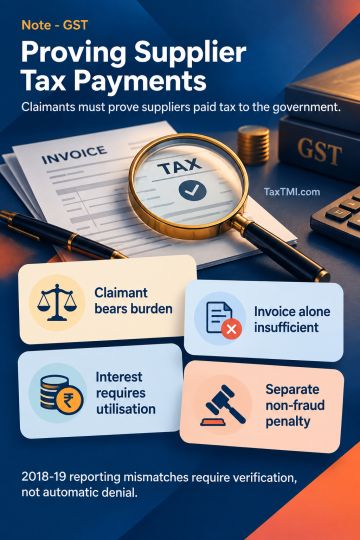
Section 16 of the Central Goods and Services Tax Act, 2017 makes credit entitlement subject to statutory conditions. Relevant conditions in Section 16(2) include possession of the prescribed tax document, receipt of goods or services, actual payment of the tax charged to the Government, subject to the statutory qualification, and furnishing the return under Section 39. Failure to satisfy an applicable condition may affect entitlement; it does not itself establish fraudulent conduct.
The supplier-reporting condition in Section 16(2)(aa) requires invoice or debit-note details to have been furnished by the supplier and communicated to the recipient in the specified manner. Section 16(2)(ba) requires that communicated credit details have not been restricted. These later-inserted conditions must not be retrospectively imported into earlier periods merely because they appear in a consolidated provision.
Historically, Section 42 of the Central Goods and Services Tax Act, 2017 contemplated matching inward-supply details with corresponding outward-supply details. Its former sub-section (3) required a discrepancy involving excess recipient credit or non-declaration by the supplier to be communicated to both persons. Section 42 was omitted with effect from 1 October 2022. Its historical relevance does not make every mismatch a Section 74 violation.
Sections 73(5) and 74(5) both recognise payment "on the basis of his own ascertainment of such tax or the tax as ascertained by the proper officer". Departmental ascertainment is thus expressly contemplated; payment need not originate entirely from an unsolicited disclosure.
Under Sections 73(5) and 73(6), payment of tax and applicable interest before service of notice, accompanied by written intimation, ordinarily prevents notice concerning the tax so paid or any penalty. Section 73(7) preserves proceedings for a shortfall. Section 73(11) separately preserves the prescribed penalty where self-assessed tax or tax collected remains unpaid beyond thirty days from its payment due date. The closure rule is consequently not universal.
Where Section 74 is validly attracted, its payment consequences differ:
| Stage | Statutory requirement | Consequence |
|---|---|---|
| Before service of notice: Sections 74(5)-(7) | Tax, Section 50 interest and 15% penalty, with written intimation | No notice concerning the amount properly paid; a shortfall may be pursued |
| Within thirty days of issue of notice: Section 74(8) | Tax, interest and 25% penalty | Proceedings in respect of the notice are deemed concluded |
| Adjudication: Sections 74(1) and 74(9) | Determination after considering the representation | The statutory penalty is equivalent to the tax |
| Within thirty days of communication of the order: Section 74(11) | Tax, interest and 50% penalty | Proceedings in respect of the notice are deemed concluded |
The reduced-payment provisions presuppose a legally sustainable Section 74 case. Failure to pay the 15% amount cannot independently establish the fraud-related conditions necessary to invoke that section.
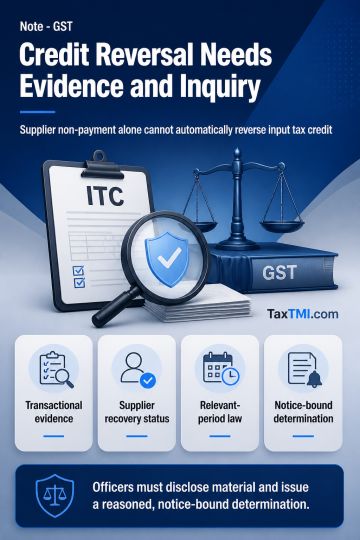
Form GSTR-2A is a portal statement reflecting supplier-furnished particulars. A difference between that statement and Form GSTR-3B identifies a reconciliation issue; it does not necessarily identify deliberate concealment by the recipient.
The tribunal applied the historical definition in Explanation 2 to Section 74, under which "suppression" meant "non-declaration of facts or information which a taxable person is required to declare" in the prescribed return, statement, report or other document, or failure to furnish information when asked in writing by the proper officer. It required deliberate non-disclosure or a relevant failure to furnish information, rather than treating the mismatch itself as suppression.
Explanation 2 was omitted with effect from 1 November 2024. The tribunal's reliance concerned a notice issued before that omission. The definition should accordingly be identified as historical wording relevant to that controversy, not presented as an unqualified continuing provision.
The fact that payment followed departmental intervention answers how the discrepancy was detected. It does not necessarily answer why the discrepancy arose. The distinction between detection and culpability is reinforced by the express recognition of officer-ascertained payment in both Sections 73(5) and 74(5).
Nor does an admission of excess availment necessarily amount to an admission of fraud. Section 74 requires examination of the conduct causing the wrongful claim. This follows from its express ingredients, not from a general proposition that every civil tax penalty requires proof of criminal intent.
The appellant faced a mismatch between credit claimed in Form GSTR-3B and credit available in Form GSTR-2A. During verification, the appellant furnished information, accepted excess availment and paid the disputed amount with interest before the show-cause notice. The appellant attributed the lapse to oversight and stated that the excess credit had not been utilised.
The adjudicating authority treated detection through departmental verification as supporting suppression. It imposed a penalty equal to the disputed tax because the appellant had not paid the 15% pre-notice penalty. The first appellate authority adopted substantially the same reasoning: payment followed detection, and the appellant had not independently declared the excess credit.
The tribunal rejected that approach. The authorities had not established a link between the mismatch and the alleged suppression. The genuineness of the transactions or suppliers was not disputed, and the tribunal attributed the discrepancy to third-party supplier default rather than deliberate non-disclosure by the appellant.
The reasoning separates three questions: whether credit was wrongly availed; whether that wrong arose through the misconduct specified in Section 74; and what payment or penalty consequences follow under the applicable provision. The authorities effectively moved from the first question to the third without establishing the second.
The tribunal held that supplier default could not, on the facts, be attributed to the appellant to sustain suppression. This is not an unrestricted immunity for recipients whenever a supplier defaults. Evidence of recipient participation, conscious misstatement or deliberate withholding of required information would require separate consideration. What was absent was evidence connecting the appellant to such conduct.
The tribunal treated the pre-notice payment of tax and interest as governed by Section 73 because the necessary intention to evade tax was absent. It set aside the appellate order, held the Section 74 penalty invalid and unjustified, and allowed the appeal. The decision did not hold that the underlying credit was necessarily admissible, or direct a refund of the tax and interest already paid.
For an ITC demand, Section 73(10) ordinarily prescribes an order within three years from the relevant annual-return due date, while Section 73(2) requires notice at least three months before that deadline. Section 74(10) prescribes five years from the corresponding annual-return due date, with Section 74(2) requiring notice at least six months before the order deadline.
These paired provisions show why the fraud-related threshold is jurisdictionally significant. Section 74 cannot be selected merely because the ordinary period is unavailable. Equally, failure of a Section 74 case does not itself establish that a fresh Section 73 demand would be within limitation.
In 2026 (8) TMI 1587 - Supreme Court, the issue was whether an ITC-mismatch demand could use extended limitation without pleaded facts establishing fraud, wilful misrepresentation or suppression. The Supreme Court required the officer's independent satisfaction; an audit objection could not substitute for it. The notice had to disclose the "foundational facts" supporting the inference, rather than mechanically reproduce statutory expressions.
The notice and consequential order were set aside, with liberty to proceed afresh through a properly founded notice within the available extended period. The court also rejected reliance on the omitted Explanation 2 in those proceedings. The relevance is twofold: jurisdiction depends on factual allegations, not labels; and invalid invocation does not necessarily confer substantive immunity from a properly constituted proceeding.
In 2026 (4) TMI 784 - ORISSA HIGH COURT, proceedings rested substantially on an investigative alert and a supplier's statement, without independent examination of the recipient's complicity. The disputed credit had already been reversed before notice. The court found no material establishing conscious involvement in a fraudulent arrangement and held Section 74 unsustainable. For mismatch penalties, the important principle is that third-party material may trigger inquiry, but cannot replace findings connecting the recipient with the statutory misconduct. Reversal was relevant to the factual assessment, not an unconditional bar to Section 74.
In 2025 (9) TMI 53 - ALLAHABAD HIGH COURT, the adverse inference arose from a later inspection showing the supplier absent from its business premises. The transactions preceded cancellation of the supplier's registration, and relevant returns were available for verification. With no finding of fraud, wilful misstatement or suppression, the orders were set aside for reconsideration. The court also required compliance with administrative circular guidance demanding supporting material before Section 74 invocation. Its contribution is evidentiary: later supplier circumstances cannot automatically establish recipient misconduct during an earlier transaction.
In 2026 (2) TMI 1387 - GUJARAT HIGH COURT, the recipient had reversed inadvertently utilised credit and discharged the output liability in cash. The court found no material establishing fraud, wilful misstatement or suppression and quashed the Section 74 notice for absence of the statutory prerequisite. Although arising from a different credit dispute, the decision is relevant because actual utilisation did not dispense with proof of the aggravating conduct. Correction of an error and the reason for its original occurrence remained distinct questions.
In 2021 (10) TMI 880 - JHARKHAND HIGH COURT, a format notice failed to specify the applicable charge or foundational allegations. The court held that the punitive consequences of Section 74 required clear particulars enabling an effective defence. The summary in Form GST DRC-01 under Rule 142(1), although mentioning a mismatch, could not substitute for a proper notice or cure its vagueness. Both were quashed, with liberty for fresh proceedings. The court expressly left open whether Form GST ASMT-10 was a necessary precondition; the decision cannot be used to assert such a universal requirement.
In 2024 (9) TMI 1644 - ALLAHABAD HIGH COURT, Section 73 proceedings had been concluded before a Section 74 notice alleged excessive credit without the necessary fraud-related basis. The court held that reopening required prima facie satisfaction of the conditions peculiar to Section 74, disclosed in the notice itself. It quashed the notice and recognised writ maintainability where the jurisdictional ingredients were absent. The practical distinction is between a disagreement over credit computation and a notice that fails to disclose the legal foundation for invoking the aggravated provision.
The Telangana High Court authority considered by the tribunal applied Sections 73(5) and 73(6) where tax and interest had been paid, emphasising that the officer "shall not initiate any further proceedings" concerning the payment covered by those provisions. Its further observation linking Section 74 to non-compliance with Section 73 must be read alongside the tribunal's express insistence on fraud-related conditions. Failure to satisfy a payment mechanism cannot, by itself, replace those conditions.
One Madras High Court authority considered by the tribunal held that Section 74 could not be invoked merely because payment followed investigation by the investigating agency. Its relevance lies in separating the source of detection from the character of the default. The department may discover an error before the taxpayer corrects it; that sequence alone does not establish that fraud or suppression caused the error.
A separate Madras High Court authority considered by the tribunal reached the same stated conclusion concerning investigation-led payment. Its independent significance is that payment following investigation remains compatible with a non-fraud classification. The legal inquiry must therefore remain directed to the evidence explaining wrongful availment, rather than an assumption that every payment made after investigative intervention is an admission of deliberate evasion.
The other tribunal authority considered in the decision addressed transgressions of Sections 16(2) and 42(1). It required "clear and categorical evidence" that the transgression resulted from fraud, wilful misstatement or suppression with intent to evade tax. Its relevance is substantive: even an established credit-condition violation does not automatically attract Section 74. The evidence must establish the additional misconduct, which cannot be presumed merely from failure to comply with the credit framework.
The authorities support an issue-specific approach to mismatch disputes rather than a single inference drawn from the existence of excess credit.
Remedies must also be distinguished. The tribunal invalidated an adjudicated penalty on the merits of the Section 74 invocation. Other authorities quashed notices for jurisdictional or procedural defects, sometimes reserving fresh proceedings. Neither category creates a general immunity from lawful credit verification.
An ITC mismatch is a starting point for inquiry, not a statutory substitute for fraud, wilful misstatement or suppression of facts to evade tax. Section 74 requires a factually supported connection between wrongful credit and the specified misconduct.
Where that connection is absent and tax with interest has been paid before notice, the Section 73 framework may prevent further notice concerning the payment covered by its closure provisions. Conversely, validly established Section 74 liability retains its distinct penalty conditions. The decisive sequence is therefore classification first, payment consequences second-not the reverse.
Full Text:

