 TaxTMI
Login
 TaxTMI

Login
Loading...
Press 'Enter' to add multiple search terms. Rules for Better Search

Press 'Enter' after typing page number.
Press 'Enter' after typing page number.


No Folders have been created
Are you sure you want to delete "My most important" ?
NOTE:
Press 'Enter' after typing page number.
















Press 'Enter' after typing page number.

All TMI Notes
Press 'Enter' after typing page number.
Press 'Enter' after typing page number.
All TMI Notes

Note

Bookmark

Share


This is a neutral professional article. The judgment is analysed in the context of its factual background, issues framed, and conclusions reached by the Court.
2026 (10) TMI 201 - BOMBAY HIGH COURT
The reassessment process has two distinct components. The first concerns the authority to reopen: whether income has escaped assessment and whether the statutory conditions for invoking reassessment jurisdiction are fulfilled. The second concerns the merits of the proposed reassessment after jurisdiction has been validly assumed. The procedure for objections to reopening protects the distinction between these two stages.
Section 147 authorises assessment, reassessment or recomputation of income chargeable to tax that has escaped assessment, subject to Sections 148 to 153. Under the reassessment regime considered in the decision, the jurisdictional foundation was the Assessing Officer's recorded "reason to believe" that income had escaped assessment. The assessee was entitled to seek those recorded reasons and to object to the proposed reopening.
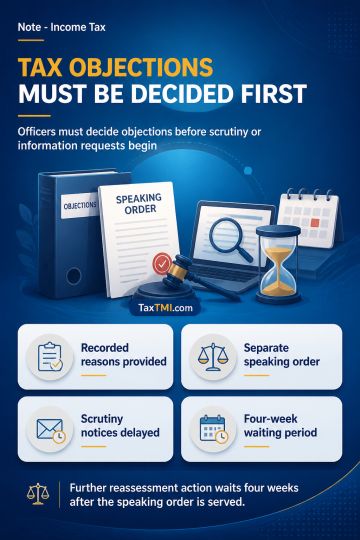
The decision in 2026 (10) TMI 201 - BOMBAY HIGH COURT addresses the procedural consequence of proceeding to scrutiny before deciding such objections, and of conducting inquiry within four weeks after their rejection. Its holding is expressly confined to a notice governed by the law as it stood before the amendment referred to in the judgment. The differently worded text of Section 148 appearing in the supplied statutory material is therefore not treated as determinative of the procedural question decided here.
The central concern is practical as well as jurisdictional. If scrutiny notices, information requisitions or an assessment order follow immediately upon rejection of objections, the assessee's opportunity to seek judicial review of the reopening may become illusory. The procedural sequence consequently requires a meaningful pause between the decision on objections and further reassessment action.
The relevant portion of Section 148, as reproduced in the judgment for the applicable regime, required the Assessing Officer, before making an assessment, reassessment or recomputation under Section 147, to serve a notice requiring the assessee to furnish a return within the specified period. Crucially, it further stated that the provisions of the Act would apply "so far as may be" as if that return were a return required under Section 139.
This statutory assimilation is decisive. A return filed in answer to a Section 148 notice is to be processed as a Section 139 return for the relevant assessment machinery. If the return is selected for scrutiny, the machinery of Section 143(2) is engaged. That does not, however, permit the scrutiny process to overtake the prior jurisdictional stage of deciding objections to reopening.
Section 143(2) provides that where a return has been furnished, the Assessing Officer may issue a notice if it is considered necessary or expedient to ensure that the assessee has not understated income, computed excessive loss, or underpaid tax. The notice may require attendance or production of evidence in support of the return.
The court treated this notice as the starting point of scrutiny assessment. It is not confined to the ultimate act of passing an order under Section 143(3). Once a Section 143(2) notice is issued in reassessment proceedings, the Assessing Officer has commenced the process of examining the returned income on merits. That step cannot precede a speaking decision on the assessee's challenge to the very assumption of reassessment jurisdiction.
Section 142(1) permits the Assessing Officer, for the purpose of making an assessment, to require production of accounts or documents and to require written information on specified matters. In the reassessment sequence, a Section 142(1) notice is an inquiry step directed towards assessment on the merits. It is therefore equally covered by the prohibition against proceeding with reassessment before objections are decided and during the protected four-week period following service of their rejection.
The governing procedural principle, as applied in the decision, is that the Assessing Officer must dispose of objections to reopening through a speaking order before proceeding with assessment. A speaking order must disclose consideration of the material objections and reasons for accepting or rejecting them. It cannot be a mechanical conclusion or a later justification incorporated only in the reassessment order.
Where objections are rejected, the Assessing Officer must not "proceed further in the matter" for four weeks from the date on which the rejection order is served on the assessee. The period runs from service, not merely from the date typed on, signed on, or internally uploaded in the order. The judgment proceeded on an assumption of same-day service only for evaluating the facts before it.
The court rejected the proposition that the expression "before proceeding with the assessment" only prohibits the passing of the final reassessment order. Such a narrow construction would deprive the objection procedure of substantive effect. Since a Section 143(2) notice initiates scrutiny of the return, its issue is itself a step in assessment. Similarly, a Section 142(1) notice seeking details is an inquiry in aid of assessment. Both must await the speaking disposal of objections.
The rationale is straightforward. Objections may demonstrate that the foundational conditions for reopening are absent. If those objections are accepted, reassessment must be dropped. The Assessing Officer can therefore enter the merits stage only after determining the jurisdictional challenge. Initiating scrutiny first was described as putting "the cart before the horse".
On the facts decided, a Section 143(2) notice had been issued even before the reasons recorded for reopening were furnished to the assessee. Objections were later filed and rejected. A Section 142(1) notice was then issued before expiry of four weeks from the rejection. The court set aside both notices and all action taken in furtherance of them. Importantly, it did not rule upon the remaining challenges to the reassessment notice itself; those questions were left open.
The four-week interval is designed to preserve a real remedy against an adverse decision on objections. An assessee may challenge the reopening at that stage because the objection order records the revenue authority's decision on jurisdiction. If assessment is immediately advanced through evidence calls, hearings, or a final order, the assessee may be forced to contest both jurisdiction and merits in a compressed or ineffective manner.
The safeguard extends beyond a bar on finalisation of reassessment. The operative formulation is that the Assessing Officer shall not proceed further in the matter. In the present decision, that formulation was applied to invalidate a Section 142(1) notice issued within the protected interval. It follows that the authority should refrain from substantive scrutiny steps during this period, unless a competent court otherwise permits action.
2006 (9) TMI 123 - BOMBAY HIGH COURT held that delayed supply of reasons, a common order combining objections and reassessment, or an omission to decide objections separately defeats the procedural protection available to an assessee. The reassessment orders were set aside, with a direction to pass separate speaking orders and to defer assessment for four weeks after rejection. It establishes both the separateness of the jurisdictional decision and the remedial purpose of the interval.
2009 (3) TMI 64 - GUJARAT HIGH COURT held that framing reassessment without first passing a speaking order on preliminary objections is unsustainable. The remand directions permitted reassessment only after the objection stage was completed, while preserving the assessee's right to challenge an adverse disposal. The authority reinforces that objection disposal is a prior condition, not an issue that can be absorbed into the ultimate reassessment order.
2018 (9) TMI 102 - ITAT DELHI applied the four-week protection where the reassessment order itself was passed within that period. The order was held invalid because the assessee had not been afforded adequate time to pursue legal remedies after rejection of objections. This authority addresses the consequence of premature finalisation.
2021 (1) TMI 95 - ITAT DELHI similarly held that a reassessment framed within 23 days of rejection of objections was invalid. It specifically recognised the four-week period as time for the assessee to seek legal remedies and treated its denial as fatal to the reassessment proceedings.
2012 (8) TMI 614 - BOMBAY HIGH COURT concerned reassessment finalised without prior disposal of objections. The reassessment was quashed, and the authority directed a fresh decision on objections after hearing the assessee. If adverse, the decision could not be given effect to for four weeks, thereby connecting a fair hearing, a speaking order and the protected remedy period.
2021 (5) TMI 702 - GUJARAT HIGH COURT clarifies the required quality of the objection order. A perfunctory treatment that does not deal with specific objections is not a speaking disposal. The matter was remitted for fresh consideration, with at least four weeks available to seek a remedy if the fresh decision was adverse.
2019 (8) TMI 23 - DELHI HIGH COURT characterises the decision on objections as a quasi-judicial function. Simultaneous rejection in the final reassessment order does not satisfy the procedural requirement. The authority is significant because it explains why the order must be reasoned and anterior to reassessment.
2017 (10) TMI 1598 - ITAT BANGALORE required disposal of preliminary objections through a separate speaking order before reassessment could continue. It further directed that, if objections were rejected, four weeks had to be allowed before the reassessment order could be passed. The decision illustrates that procedural remand may also encompass substantive jurisdictional objections raised by the assessee.
2012 (8) TMI 612 - BOMBAY HIGH COURT held that reassessment could not stand where reasons were not communicated and the assessee was denied the opportunity to object. The directions required communication of reasons, filing and reasoned disposal of objections, followed by a four-week deferment after an adverse order. The sequence demonstrates that the waiting period is meaningful only after the prior rights to reasons and objections have been honoured.
2021 (5) TMI 926 - GUJARAT HIGH COURT reiterates that consideration of objections is quasi-judicial and requires consideration of each material objection with cogent reasons. Although the immediate relief was remand for a fresh speaking order, the reasoning supports the proposition that a mechanical rejection cannot trigger valid further reassessment action.
2010 (3) TMI 706 - BOMBAY HIGH COURT set aside a reassessment and the defective disposal of objections for non-compliance with the governing procedural rule. It directed a fresh hearing and decision on objections, prohibited giving effect to an adverse decision for four weeks, and preserved the parties' substantive contentions. This is a direct illustration of remedial protection after procedural breach.
2018 (2) TMI 1900 - ITAT PUNE held that a one-line order-sheet rejection, and an absence of any reasoned objection order, did not satisfy the speaking-order requirement. Assessment completed on the following day also violated the four-week protection. The reassessments were set aside rather than restored, reflecting the seriousness attributed to non-compliance with the jurisdictional procedure.
2021 (8) TMI 1294 - MADRAS HIGH COURT recognises that a challenge to reopening may be premature while the objection process remains incomplete. It required furnishing of reasons and a speaking decision on objections. The authority underlines that the prescribed sequence should ordinarily be completed before judicial scrutiny of the reopening is sought.
2015 (2) TMI 862 - GUJARAT HIGH COURT held that failure to consider and dispose of objections before reassessment vitiates the reassessment process. While it also concerned an independent limitation issue, its procedural holding confirms that non-disposal of objections is itself a sufficient ground for intervention.
2022 (1) TMI 1228 - BOMBAY HIGH COURT set aside an objection order for non-application of mind and directed fresh consideration after personal hearing. It illustrates that a speaking order must be the product of genuine consideration, and that procedural compliance may require a meaningful opportunity of hearing where the facts warrant it.
2021 (4) TMI 1175 - ORISSA HIGH COURT held that issuance of a show-cause notice without first deciding written objections breached the mandatory reassessment procedure. Its relevance lies in treating a subsequent merits-stage notice as impermissible when the jurisdictional objections remain undecided.
2020 (1) TMI 1318 - ANDHRA PRADESH HIGH COURT reiterates the need to furnish reasons and dispose of objections through a speaking order. Although the reopening was also invalidated on other jurisdictional grounds, the decision confirms that procedural compliance remains an independent requirement in reassessment.
2021 (10) TMI 577 - MADRAS HIGH COURT treated failure to properly adjudicate objections as a factor vitiating the reassessment jurisdiction. It demonstrates that an objection order must meaningfully address the grounds on which reopening is challenged; a merely formal disposal will not suffice.
2021 (8) TMI 130 - MADRAS HIGH COURT provides an important qualification. Judicial review does not entail a roving reappraisal of the evidentiary record merely because an assessee disagrees with a speaking rejection. Where reasons are given and there is no demonstrable non-application of mind, the assessee may be required to place further factual material in reassessment. Thus, the speaking-order obligation does not transform the objection stage into a full merits assessment.
For an assessee, the procedural record should be organised chronologically: the Section 148 notice, return filed in response, request for reasons, date of actual receipt of reasons, objections, proof of service of the objection order, and every subsequent notice. Proof of service is particularly material because the four-week period begins on service of the rejection order.
Objections should distinctly raise jurisdictional grounds, including any challenge to the recorded reasons, statutory conditions, sanction, limitation, change of opinion, or full and true disclosure, where applicable. They should also specifically request a reasoned and separate speaking order. A general reply on merits may not adequately preserve the jurisdictional issue.
For the revenue authority, the compliant sequence is: issue the reassessment notice; receive the return; furnish reasons when sought; permit objections; decide each material objection through a speaking order; ensure service of that order; wait for four weeks without commencing or advancing merits-stage reassessment; and thereafter, absent a judicial restraint, issue scrutiny or inquiry notices and proceed under the ordinary assessment machinery.
A Section 143(2) notice should not be issued before objections are decided merely to preserve or commence scrutiny. Nor should a Section 142(1) notice be used during the four-week period to obtain accounts, explanations or other evidence. Under the decision analysed, both are impermissible steps in reassessment before completion of the jurisdictional stage and the protected interval.
The consequence of breach depends on the action taken and the relief sought. The decision under discussion set aside the premature Section 143(2) and Section 142(1) notices, together with consequential action, while leaving unadjudicated objections to the reopening notice itself. Other authorities show that courts and tribunals may quash a reassessment order, remit objections for fresh disposal, or preserve reassessment jurisdiction through tightly framed directions. The precise remedy remains fact-sensitive.
Full Text:

