Loading...

⚠ ✕
❮ Top
☎ Help
☰
×

By creating an account you can:

Logo TaxTMI
Call Us / Help / Feedback✕

Contact Us At :

✉ E-mail: [email protected]

✆ Call / WhatsApp at: +91 99117 96707

For more information, Check Contact Us

FAQs :

To know Frequently Asked Questions, Check FAQs

Most Asked Video Tutorials :

For more tutorials, Check Video Tutorials

Submit Feedback/Suggestion :

Email :
Please provide your email address so we can follow up on your feedback.
Category :
Description :
Min 15 characters 0/2000
Make Most of Text Search ✕
  1. Checkout this video tutorial: How to search effectively on TaxTMI.
  2. Put words in double quotes for exact word search, eg: "income tax"
  3. Avoid noise words such as : 'and, of, the, a'
  4. Sort by Relevance to get the most relevant document.
  5. Press Enter to add multiple terms/multiple phrases, and then click on Search to Search.
  6. Text Search
  7. The system will try to fetch results that contains ALL your words.
  8. Once you add keywords, you'll see a new 'Search In' filter that makes your results even more precise.
  9. Text Search
╳
Add to...
You have not created any category. Kindly create one to bookmark this item!
✕
Create New Category
Hide
Title :
Description :
❮❮ Hide
❮ Default View
Expand ❯❯
Close ✕
🔎 Filters / Advanced Search ❯
TEXT

Press 'Enter' to add multiple search terms. Rules for Better Search

Search In
Main Text + AI Text ❯
  • Main Text
  • Main Text + AI Text
  • AI Text
Law:
---- All Laws---- ❯
  • ---- All Laws----
  • Benami Property
  • Bill
  • Central Excise
  • Companies Law
  • Customs
  • DGFT
  • FEMA
  • GST
  • GST - States
  • IBC
  • Income Tax
  • Indian Laws
  • Money Laundering
  • SEBI
  • SEZ
  • Service Tax
  • VAT / Sales Tax
Types:
---- All Types ---- ❯
  • ---- All Types ----
  • Act Rules
  • Case Laws
  • Circulars
  • Manuals
  • News
  • Notifications
Sort By: ?
In Sort By 'Default', exact matches for text search are shown at the top, followed by the remaining results in their regular order.
Relevance Default Date
☰   Show Results ❯
    Case Laws Companies Law
    Lifting the Corporate Veil Where Promoter Shareholding Is Allegedly Dissipated Despite Judicial Assu...
    Consolidated Show Cause Notices under Sections 73 and 74 and Taxability of School Affiliation Servic...
    Fraudulent Input Tax Credit from Non-Existent Suppliers: Application of Sections 16, 74 and 155 of t...
    Case Laws Money Laundering
    Prolonged Pre-Trial Incarceration and Bail under Section 45 of the Prevention of Money-Laundering Ac...
    Case Laws Income Tax
    Prospective Operation of Section 56(2)(x)(b) in Stamp-Value Difference Cases Involving Immovable Pro...
    Seizure of Cash under Section 67 of the CGST Act and Interest on Illegal Retention
    Case Laws Income Tax
    Disallowance of Salary Expenditure for Allegedly Non-Genuine Services under Section 37
    Case Laws Income Tax
    Fair Market Value of Unquoted Equity Shares Under Section 56(2)(viib) and Rule 11UA
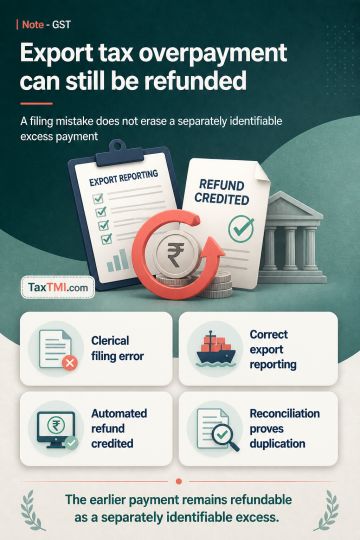
    Refund of Excess IGST Paid on Exports Following Clerical Error in FORM GSTR-3B
    Revocation of Cancellation of GST Registration for Non-Filing of Returns under Section 30 and Rule 2...
    Case Laws Income Tax
    TOLA, Section 149 and the Surviving-Time Test for Reassessment Proceedings
    Case Laws Customs
    Provisional Release of Unseized Imported Food Consignments under the Customs Act, 1962
    Case Laws Customs
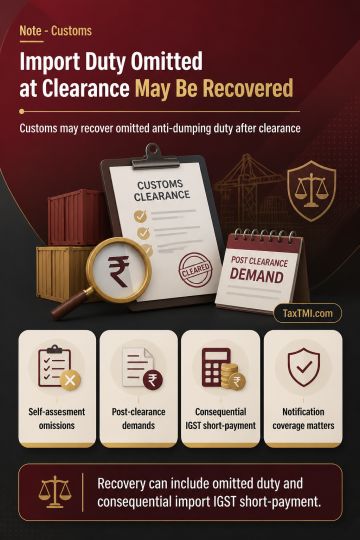
    Recovery of Unpaid Anti-Dumping Duty After Self-Assessment Under Section 28 of the Customs Act, 1962
    Project-Wise Anti-Profiteering Methodology in Real Estate under Section 171 of the Central Goods and...
    Case Laws Income Tax
    Retirement Leave Encashment Exemption under Section 10(10AA)(ii) and Retrospective Application of No...
    Transit-State Jurisdiction under GST: Limits on Detention and Penalty in External Inter-State Suppli...
    Post-Facto Shareholder Ratification of Diversion of Preferential Issue Proceeds under the PFUTP Regu...
    Case Laws Income Tax
    Section 195 Withholding on Payments to Non-Residents: Royalty, Fees for Technical Services and Busin...
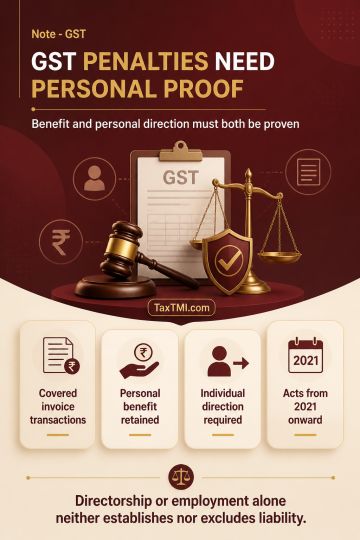
    Penalty: Scope of "Any Person" under Section 122(1A) of the Central Goods and Services Tax Act, 2017
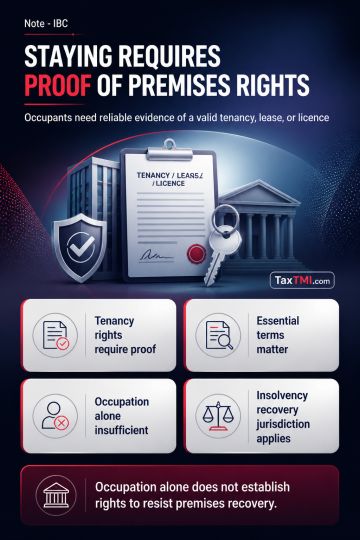
    Recovery of Corporate Debtor Premises and Proof of Tenancy, Lease or Licence Rights under the Insolv...
❮
❯
❯❯
Maximize Maximize Maximize
0 / 200
Expand Note
Add to Folder

No Folders have been created

+

Are you sure you want to delete "My most important" ?

NOTE:

Notes
Showing Results for :
Reset Filters
Results Found:
Show All Summaries Hide All Summaries
Case Laws Companies Law
Show AI Summary
Corporate veil-piercing permits forensic scrutiny in execution where promoter-controlled entities may dissipate shareholding despite judicial assurances.
Corporate veil-piercing in execution is an exceptional response where promoters allegedly use layered entities and securities transactions to deplete shareholding represented as security through judicial assurances. Separate personality remains the rule, and control or ownership alone does not suffice; there must be a nexus between control, misuse of the corporate form, and frustration of enforcement. A forensic audit reconstructs share movements, pledges, sales, financing, approvals, disclosures, and fund flows, distinguishing legitimate enforcement of pre-existing security from coordinated asset dissipation.
Case Laws GST
Show AI Summary
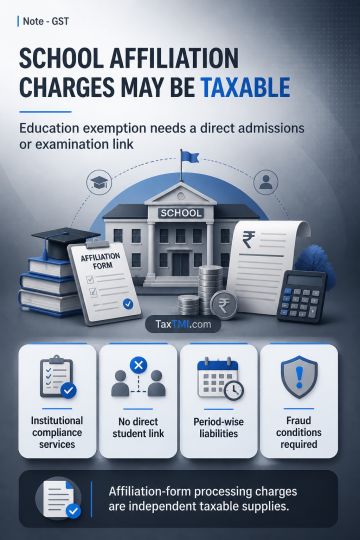
School affiliation services fall outside educational exemption without a direct nexus to admissions or examination conduct.
Consolidated show cause notices may combine financial years governed by Sections 73 and 74 where liabilities are segregated period-wise, each component independently meets limitation and notice requirements, the additional ingredients for fraud-based proceedings are satisfied, and no actual prejudice arises. School affiliation and affiliation-form processing charges are independent taxable supplies where they concern institutional eligibility and compliance, rather than directly and immediately relating to student admission or the conduct of examinations. A broad connection with education does not satisfy the educational-services exemption.
Case Laws GST
Show AI Summary
Fraudulent input tax credit requires proof of fictitious supplies, absent goods receipt, and fraud-linked self-assessment, not cancellation alone.
Input tax credit from allegedly non-existent suppliers depends on proof of genuine supply and actual receipt of goods or services, not merely invoices, accounting entries, or banking-channel payments. Section 155 places the burden of establishing ITC eligibility on the claimant. Section 74 requires more than ineligible credit: the wrongful availment must be linked to fraud, wilful misstatement, or suppression to evade tax. Retrospective supplier-registration cancellation is relevant evidence but is not conclusive. A fraud-based notice must disclose facts showing fictitious suppliers, absence of supply, and a basis for inferring the recipient's knowledge or participation.
Case Laws Money Laundering
Show AI Summary
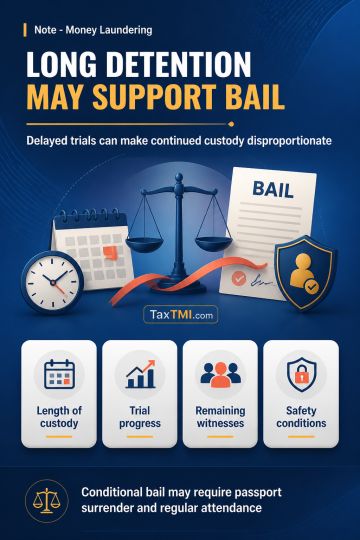
Prolonged pre-trial incarceration may justify conditional PMLA bail when delayed trials make continued detention constitutionally disproportionate.
Section 45 of the Prevention of Money-Laundering Act remains the stringent ordinary bail threshold, requiring prosecutorial opportunity and, on opposition, reasonable grounds to believe that the accused is not guilty and unlikely to offend while on bail. Article 21 nevertheless requires a separate, fact-sensitive inquiry where prolonged pre-trial detention and an unrealistic trial timetable make custody disproportionate. Relevant factors include custody length, trial progress, remaining witnesses, secured documentary evidence, source of delay, predicate-case status, and risks of absconding or witness interference. Conditions such as passport surrender, attendance, non-contact directions, and residence disclosure may safeguard the trial.
Case Laws Income Tax
Show AI Summary
Prospective operation of stamp-value taxation prevents retrospective application where property agreements and substantial payments predate the charging provision.
Section 56(2)(x)(b) applies to immovable property received for inadequate consideration only where its temporal and valuation conditions are satisfied. A stamp-value difference alone does not establish taxability. Where consideration was fixed and substantial payments or contractual performance occurred before the charging provision commenced, later conveyance or registration does not by itself attract the later charge. Agreement-date valuation is available only for covered transactions where consideration was fixed and paid, wholly or partly, through prescribed banking or electronic modes on or before the agreement date. The tax authority must identify the correct statutory basis and provide a meaningful opportunity to respond.
Case Laws GST
Show AI Summary
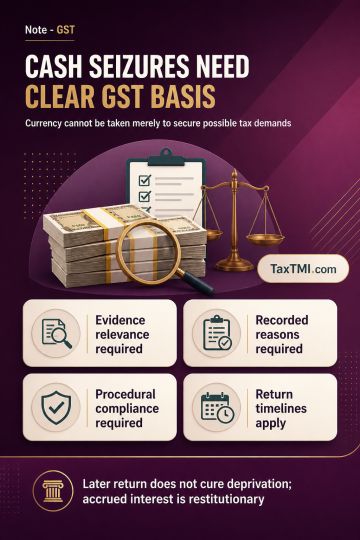
GST cash seizure limits require statutory relevance and restitutionary interest for unlawfully retained currency following searches.
GST seizure powers cannot be used to take cash as a general investigative measure or security for a possible tax demand. Currency is excluded from goods, and "things" is confined contextually to articles useful or relevant as evidence in GST proceedings. Valid seizure and retention require recorded statutory reasons, procedural compliance and observance of return timelines. Unauthorised retention engages property protections; later return does not cure the deprivation, and accrued interest is restitutionary rather than delayed-refund interest.
Case Laws Income Tax
Show AI Summary
Salary expense genuineness requires proof of actual services, business purpose, and fair testing of adverse third-party statements.
Under Section 37(1), salary expenditure is deductible only where it is actually incurred wholly and exclusively for business purposes and is supported by proof of genuine employment, services rendered, business nexus, and payment. Bank transfers and accounting entries alone are not conclusive. Where a third-party statement is central to an allegation of non-genuine salary, the taxpayer should receive disclosure and a meaningful opportunity to rebut it, including cross-examination where appropriate. A retracted and uncorroborated statement is vulnerable as the sole basis for disallowance.
Case Laws Income Tax
Show AI Summary
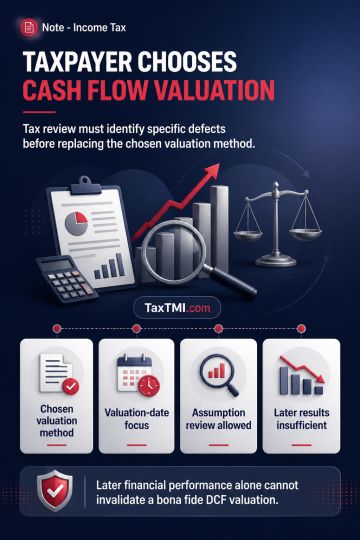
Discounted cash flow valuation remains taxpayer-selected under prescribed rules, while tax scrutiny must identify specific valuation-date defects.
The taxpayer may elect a prescribed DCF valuation for unquoted equity shares, and scrutiny of that method does not permit substitution with Net Asset Value merely because it produces a lower fair market value. The Assessing Officer may examine projections, discount rates, terminal assumptions, computations and source data, but rejection requires demonstrably wrong facts, material errors, a wholly erroneous basis or objectively unsupported assumptions. Subsequent financial performance cannot alone invalidate a bona fide DCF valuation; the relevant inquiry remains the reasonableness of valuation-date information.
Case Laws GST
Show AI Summary
Excess IGST on exports remains refundable when later correction triggers automated refund and reconciliation proves duplicate payment.
Refund of excess IGST paid on zero-rated exports may arise where turnover and tax are mistakenly entered under non-zero-rated supplies in FORM GSTR-3B while export invoices and shipping bills are correctly reported in FORM GSTR-1. If the exporter then pays the same IGST in the correct zero-rated field and the automated refund is credited against that later payment, the earlier payment remains a separately identifiable potential excess; its claim is not a repeat request for the same export-tax refund.
Case Laws GST
Show AI Summary
GST registration revocation requires timely application, return compliance, payment of dues, and a reasoned statutory decision.
GST registration revocation after cancellation for return default is a conditional, time-bound process. An application under Section 30 and Rule 23 must ordinarily be filed within ninety days, subject to prescribed extension, and cannot be made until pending returns are filed and tax, interest, penalty and late fee are paid. Portal non-acceptance may permit online or physical submission where technically unavailable, but does not condone delay or ensure revocation. The competent authority must assess statutory eligibility, sufficient grounds and compliance while following notice and hearing requirements before rejection.
Case Laws Income Tax
Show AI Summary
Reassessment limitation under TOLA requires final notices to issue within surviving time and satisfy statutory safeguards.
Reassessment limitation under TOLA is a jurisdictional restraint. Transitional notices issued between 1 April 2021 and 30 June 2021 are treated as Section 148A(b) show-cause notices, but only the surviving time remaining until 30 June 2021 is available for completing the reassessment process. Periods for supply of material and the assessee's response are excluded, but the Section 148A(d) decision, statutory approval and final Section 148 notice must issue within the remaining period. For Assessment Year 2015-16, post-1 April 2021 notices are treated as time-barred.
Case Laws Customs
Show AI Summary
Unseized food consignments cannot face indefinite detention without lawful seizure, valid sampling, and prompt assessment.
Provisional release of an unseized imported food consignment is not mechanically governed by Section 110A, which applies to goods seized under Section 110. Customs may examine, test, verify and reassess imports, but indefinite retention without a seizure memorandum or disclosed reasons connecting the goods with confiscation is not justified. Food sampling should follow the specialised food-safety process through an authorised officer. A valid food-safety report may support conditional clearance, while classification, duty liability, confiscation and adjudication remain open. Revenue may be protected through proportionate security.
Case Laws Customs
Show AI Summary
Anti-dumping duty recovery permits post-clearance demands and consequential import IGST where self-assessment omitted an applicable levy.
Unpaid anti-dumping duty omitted during self-assessment may be pursued through the customs recovery procedure without prior appellate modification of the self-assessment. The recovery framework applies to anti-dumping duty through statutory incorporation of provisions concerning assessment, non-levy, short-levy, interest and recovery. Where anti-dumping duty is chargeable, it forms part of the aggregate value used to compute IGST on imports, potentially creating a consequential IGST short-payment. Recovery requires accurate assessment of notification coverage, product, origin, rate, valuation, limitation and procedural safeguards.
Case Laws GST
Show AI Summary
Project-wise anti-profiteering requires actual input tax credit measurement and area-based allocation of benefits to real-estate purchasers.
Real-estate anti-profiteering under Section 171 requires project-level identification of additional input tax credit and allocation of the saving across total project area on a per-square-foot basis. Purchase value may quantify credit attributable to project expenditure, but turnover or collections cannot serve as the allocation basis. The comparison must use pre-GST credit actually availed rather than merely available credit. GST collected on consideration inflated by an undistributed benefit forms part of the amount not passed on and remains distinct from statutory interest.
Case Laws Income Tax
Show AI Summary
Retirement leave encashment exemption applies under the enhanced notified ceiling while preserving non-government employee classification and statutory conditions.
Section 10(10AA)(ii) governs retirement leave-encashment exemption for non-Government employees, subject to the ten-month earned-leave measure, average-salary computation, and the notified monetary ceiling. Notification No. 31/2023 specifies an enhanced ceiling of Rs. 25,00,000, is deemed effective from 1 April 2023, and certifies that retrospective effect causes no adverse effect. The enhanced ceiling is treated as a remedial rationalisation of an existing exemption and may govern pending earlier-period matters, while preserving the distinction between Government and non-Government employees.
Case Laws GST
Show AI Summary
Transit GST jurisdiction limits detention penalties for documented inter-State supplies lacking a local taxable nexus.
Transit-State jurisdiction under GST permits interception, document production, e-way bill verification and authorised physical inspection of goods moving through an intermediate State. It does not, in a pure transit movement, support detention-related penalty for an external inter-State supply where origin and destination lie outside the intercepting State, no tax is payable there, and there is no evidence of diversion, local supply, fictitious or mismatched documents, or mismatch of goods. Cross-empowerment is administrative and does not create an independent territorial taxable nexus.
Case Laws SEBI
Show AI Summary
Shareholder ratification cannot cure preferential-issue fund diversion when disclosed objectives are abandoned, triggering securities-market fraud and disclosure concerns.
Post-facto shareholder approval cannot retrospectively validate diversion of preferential-issue proceeds contrary to issue-specific objects disclosed to shareholders and the market. A special resolution authorises the issue but does not permit unrestricted use of proceeds. Periodic deviation reporting, audit-committee review and utilisation disclosures promote transparency; they do not enable diversion followed by later regularisation. Immediate diversion, inadequate commercial justification and missing documentation may indicate that disclosed objects were not genuinely intended to be performed. Later amendment of corporate objects or shareholder ratification cannot cure a completed securities-market disclosure breach.
Case Laws Income Tax
Show AI Summary
Cross-border software payments require copyright-right, technical-service, and permanent-establishment analysis before withholding obligations are determined under applicable treaties.
Section 195 requires withholding only from a remittance to a non-resident that includes income chargeable in India. For software, royalty depends on transfer of copyright rights, not merely the right to install, access, use, or distribute a copyrighted article under restrictive terms. Where a DTAA is more beneficial, its royalty and FTS definitions control; treaty FTS may require technology to be made available. Amounts that are neither royalty nor FTS require consideration as business profits, ordinarily taxable only where profits are attributable to a permanent establishment. Composite payments require component-wise allocation and analysis.
Case Laws GST
Show AI Summary
Personal GST penalty requires proof that the beneficiary retained benefit and directed a covered invoice or credit transaction.
Section 122(1A) may impose personal GST penalty on a registered or unregistered person only for a covered invoice or input tax credit transaction. Liability requires cumulative proof that the individual retained an identifiable personal benefit and that the transaction was conducted at that person's instance. Directorship, employment, registration, signature authority, or association with the taxable entity neither independently establishes nor excludes liability. Proceedings require transaction-specific and person-specific allegations and findings. The provision operates prospectively for underlying acts or transactions occurring on or after 01.01.2021.
Case Laws IBC
Show AI Summary
Proof of tenancy rights governs insolvency recovery of corporate-debtor premises from occupants lacking enforceable possessory interests.
Where premises form part of the corporate debtor's assets, Sections 18 and 25 of the Insolvency and Bankruptcy Code, 2016 require the resolution professional to take custody, control, preservation and protection measures. An occupant resisting recovery must prove a subsisting tenancy, leasehold interest or enforceable licence through reliable evidence of the parties' intended relationship and its essential terms. Permission to stock goods or conduct limited business activity, prolonged occupation, and business or utility records do not independently create rights in the premises. Section 60(5)(c) supports insolvency jurisdiction over asset-recovery measures connected with the insolvency estate.

TMI Notes

Back

All TMI Notes

Showing Results for :
Reset Filters
No Records Found

TMI Notes

Back

All TMI Notes

Money Laundering

Prolonged Pre-Trial Incarceration and Bail under Section 45 of the Prevention of Money-Laundering Act, 2002

25 October, 2026

Contents
Acts
Plus +
Summary
Note

Note

-

Bookmark

Print

Print

This is a neutral professional article. The judgment is analysed in the context of its factual background, issues framed, and conclusions reached by the Court.

2026 (9) TMI 558 - CALCUTTA HIGH COURT

At a Glance

Prolonged pre-trial incarceration in a money-laundering prosecution can justify bail on the constitutional protection of personal liberty and speedy trial under Article 21 of the Constitution of India, even where the accused does not satisfy the ordinary twin conditions in Section 45 of the Prevention of Money-Laundering Act, 2002. That conclusion is not automatic. The court must assess the period already spent in custody, the actual and likely progress of trial, the nature and security of the evidence, the source of delay, the risk of interference with witnesses, and the feasibility of conditions that preserve the fairness of the proceedings.

The operative decision granted bail to an accused who had remained in custody for more than a year. The court found that the statutory restriction in Section 45 had not been surmounted on the merits. Nevertheless, it treated the custody period, bail already granted in the predicate-offence case, the pending status of the predicate investigation, and the nature of certain material relied upon in the money-laundering case as circumstances warranting constitutional relief. The fact that the money-laundering trial had commenced and some witnesses had been examined did not prevent bail; it instead informed the strict conditions imposed to protect the trial.

The decision therefore marks an important distinction: Section 45 remains the governing statutory threshold for ordinary bail consideration, but it cannot be applied so mechanically that pre-trial detention becomes punitive where the constitutional right to liberty and a reasonably expeditious trial is materially engaged.

Background & Context

Money-laundering prosecutions operate within a stringent bail regime. The seriousness of allegations, the relationship between the scheduled offence and the alleged proceeds of crime, and apprehensions of absconding, witness intimidation or evidence tampering commonly weigh heavily against release. The statutory position does not, however, authorise detention as a substitute for punishment before adjudication of guilt.

In 2026 (9) TMI 558 - CALCUTTA HIGH COURT, the allegations were described as serious, including alleged impersonation and deception for obtaining substantial sums. On examining the investigative material, the court held that the accused had not overcome the restriction under Section 45. Yet the accused had remained in custody for more than a year, was on bail in the predicate-offence case, and the investigation in that predicate case remained pending.

The court also noted that the money-laundering investigation had dealt with certain original issues that did not necessarily concern the parking of tainted money and were not mentioned in the predicate-offence case. Their relevance was left for determination at trial, unless ultimately covered by the predicate case. This was not a final finding on the merits of the prosecution; it was a circumstance relevant to the continued necessity and proportionality of custody.

The trial had progressed beyond a purely preliminary stage, with some witnesses examined. The court accordingly balanced the liberty claim against the need to ensure the accused's presence and protect witnesses, granting bail subject to passport surrender, territorial restriction, disclosure of contact and residence particulars, non-contact with witnesses, regular trial attendance, and cancellation upon breach.

Key Issues / Provisions

Section 45: the statutory bail threshold

Section 45 of the Prevention of Money-Laundering Act, 2002 opens with a non obstante clause and provides that no person accused of an offence under the Act shall be released on bail or on bond unless: the Public Prosecutor has been given an opportunity to oppose the application; and, where the application is opposed, the court is satisfied that there are reasonable grounds for believing that the accused is "not guilty of such offence" and "is not likely to commit any offence while on bail".

These are generally described as the twin conditions. Section 45(2) makes the restriction additional to limitations under the Code of Criminal Procedure, 1973 or other law. The statutory text thus requires more than the ordinary assessment of flight risk, witness influence and evidence tampering. But the provision regulates ordinary statutory bail; it does not convert pre-trial custody into a sentence.

Article 21 and the right to a reasonably expeditious trial

Article 21 of the Constitution of India declares: "No person shall be deprived of his life or personal liberty except according to procedure established by law." The right to speedy trial is a recognised facet of this protection. Where the likely duration of prosecution makes continued detention oppressive, constitutional courts may protect liberty through bail notwithstanding statutory rigours, while ensuring that trial interests are protected by proportionate conditions.

Procedural provisions and detention benchmarks

Section 65 of the Prevention of Money-Laundering Act, 2002 applies the Code of Criminal Procedure, 1973 to arrest, search, seizure, investigation, prosecution and other proceedings under the Act, "in so far as they are not inconsistent with the provisions of this Act." This explains why general bail principles continue to have relevance, subject to Section 45.

Section 479 of the Bharatiya Nagarik Suraksha Sanhita, 2023 provides for release where detention reaches one-half of the maximum imprisonment for the offence, and one-third for a first-time offender, subject to its provisos and explanation. It also directs exclusion of detention caused by delay attributable to the accused. Section 479(2) states that, where investigation, inquiry or trial in more than one offence or multiple cases is pending, the person shall not be released on bail under that section. In the operative decision, the prosecution relied on the fact that the stated detention period had not been crossed. The court did not regard that fact as conclusive against constitutional bail on the facts before it.

Section 483 of the Bharatiya Nagarik Suraksha Sanhita, 2023 empowers the High Court or Court of Session to direct release of a person in custody on bail and to impose conditions necessary for the purposes specified in Section 480(3). Those purposes include securing attendance, preventing repetition of a similar offence, and preventing inducement, threat, promise or evidence tampering. Such conditions are central to reconciling personal liberty with the integrity of a PMLA trial.

Detailed Analysis

Section 45 and Article 21 operate in distinct but connected fields

The operative ruling does not dilute Section 45 or hold that a year of custody, by itself, neutralises the twin conditions. It first recorded that the accused could not meet the Section 45 restriction. Bail was nevertheless granted after a separate constitutional assessment of the duration of custody, the incomplete predicate investigation, the status of trial, and the possibility of safeguarding the process by conditions. The analysis is therefore fact-sensitive and cannot be reduced to a fixed temporal formula.

The court's approach is consistent with the proposition that a bail court may make a tentative assessment without conducting a mini-trial. The statutory assessment remains relevant, as do the conventional risks of absconding, reoffending, witness influence and obstruction. But when the prosecution is not realistically capable of concluding within a reasonable time, continued custody must be tested against Article 21 rather than justified only by the gravity of accusation.

Constitutional authorities on prolonged incarceration

In 2024 (9) TMI 1497 - Supreme Court, the court accepted that there was prima facie material for the money-laundering allegation, yet granted bail because multiple scheduled-offence trials, numerous accused and several hundred witnesses made a timely conclusion unrealistic. The decision is significant because it confirms that a prima facie case and the heightened threshold under Section 45 do not, by themselves, answer the separate Article 21 question. Stringent conditions were used to address apprehensions of witness influence and interference.

In 2024 (8) TMI 614 - Supreme Court, prolonged custody, non-commencement of trial, voluminous material and the absence of record support for attributing delay to the accused resulted in bail. The court held that delay and prolonged incarceration must be read into the exercise of discretion under Section 45 and general bail jurisdiction. Its relevance lies in the insistence that an accused cannot be denied relief merely because the case record is extensive, particularly where the documentary material is already secured.

In 2025 (2) TMI 904 - Supreme Court, the accused had spent over a year in custody, while only one of 225 prosecution witnesses had been examined. The court found no reasonable prospect of timely completion and treated further detention as an infringement of the speedy-trial guarantee. The ruling demonstrates that the custody period must be viewed with the remaining procedural workload, and not in isolation.

In 2024 (9) TMI 321 - SC Order, custody of about 22 months, multiple complaints, a large proposed witness base and the failure of earlier expectations of expeditious trial justified relaxation of Section 45. The court reiterated that detention cannot become punishment before conviction and paired release with passport, attendance and non-tampering conditions.

In 2024 (5) TMI 1523 - Supreme Court, the court treated the statutory undertrial-detention protection under Section 436A of the Code of Criminal Procedure, 1973 as applicable to a PMLA prosecution. Since the trial had not commenced and the relevant incarceration threshold was due to be reached, release was directed. The authority concerns a statutory entitlement rather than only discretionary constitutional bail, but it reinforces the anti-incarceration rationale.

In 2025 (3) TMI 272 - SC Order (LB), bail followed despite the twin conditions where the evidence was substantially documentary and already seized, about 50 witnesses remained, and the accused was on bail in the predicate case. The decision supports the practical proposition that the security of material evidence reduces the force of a generic tampering objection, though a court must still separately assess the risk of influencing witnesses.

In 2026 (3) TMI 1376 - SC Order, the prosecution complaint had been filed, the accused had remained in custody for over eight months and had previously appeared before the investigating agency. The court found no present necessity for further custody, holding that Section 45 cannot justify indefinite detention. This authority shows that the constitutional inquiry is not confined to exceptionally lengthy custody; post-complaint necessity and cooperation are also material.

In 2025 (12) TMI 372 - Supreme Court, the court granted bail where the record was documentary, numerous witnesses and extensive documents remained, proceedings were still at the document-supply stage, and early trial commencement was not imminent. The principle applied was that even a custody period of over seven months requires close constitutional scrutiny where the trial trajectory indicates substantial further delay.

Authorities identifying the limits of the constitutional exception

In 2023 (11) TMI 63 - Supreme Court, bail was refused after a tentative assessment of the material disclosed a prima facie case and the prosecution assured timely progress. The court nevertheless preserved liberty to renew the application if the trial became unduly protracted or circumstances changed. The decision confirms that prolonged incarceration is a contextual ground, not an automatic release rule.

In 2026 (1) TMI 1568 - KARNATAKA HIGH COURT, custody of 127 days was held insufficient to amount to long incarceration, despite recognition that Article 21 may in appropriate cases outweigh Section 45. Liberty was reserved to seek bail again if the trial failed to progress or custody became unduly prolonged. The decision illustrates the importance of demonstrating both meaningful custody and an adverse trial prognosis.

In 2023 (5) TMI 527 - Supreme Court, bail orders were set aside because the statutory rigour of Section 45 had not been applied and the completion of proceedings in the predicate case had been wrongly treated as dispositive of the Enforcement Directorate's separate inquiry. The decision remains an essential caution: a constitutional argument based on incarceration does not permit a court to ignore Section 45 or conflate predicate-offence proceedings with the money-laundering investigation.

Comparative applications in PMLA prosecutions

Authority Individual principle and relevance
2024 (11) TMI 60 - SC Order Bail was granted where continued custody was combined with absence of a subsisting scheduled offence when the PMLA complaint was filed. The case rests on its peculiar foundation but confirms that Article 21 assumes greater force when the legal basis of the PMLA prosecution itself is uncertain.
2024 (8) TMI 1411 - Supreme Court The court stressed that pre-trial incarceration must not become punishment, particularly where investigation is complete and early trial completion is unlikely. It also applied the statutory proviso for women, which is a distinct ground and should not be transposed to cases outside that proviso.
2024 (9) TMI 935 - CALCUTTA HIGH COURT Nearly two years of custody, a trial yet to begin, voluminous material and lack of delay attributable wholly to the accused supported conditional bail. The decision is particularly relevant to the use of strict passport, attendance and non-contact conditions.
2024 (10) TMI 1675 - CALCUTTA HIGH COURT Custody of about 15 months and the dim prospect of trial conclusion justified bail although the statutory detention benchmark had not yet been reached. It supports the proposition that an undertrial threshold is not a waiting period below which constitutional bail is unavailable.
2024 (10) TMI 1550 - DELHI HIGH COURT More than 24 months of custody, delay not attributable to the accused, lack of foreseeable trial conclusion and parity supported bail. The court also held that the statutory undertrial provision does not bar bail before its numerical threshold is attained.
2025 (2) TMI 1019 - DELHI HIGH COURT Over three years of custody, a trial yet to start, pending predicate proceedings and primarily documentary evidence resulted in bail. The decision treats the absence of a demonstrated flight risk or concrete tampering risk as relevant to conditional release.
2025 (1) TMI 1704 - PUNJAB AND HARYANA HIGH COURT Custody of about nine months, no progress beyond cognizance and the unlikelihood of early trial completion supported release. It illustrates that gravity and adverse conduct allegations remain relevant but may not alone justify punitive detention.
2025 (4) TMI 1747 - Supreme Court Where cognizance had not been taken, custody had reached about a year and early trial commencement was unrealistic, bail was granted with directions intended to remove the procedural impediment. The stage of cognizance is thus a relevant trial-delay indicator.
2025 (1) TMI 1447 - CHHATTISGARH HIGH COURT Bail was refused because the court found substantial prima facie material establishing a money trail and the Section 45 conditions remained unsatisfied. The decision demonstrates that a prolonged-incarceration argument must be supported by facts showing that detention has actually become excessive or constitutionally disproportionate.
2025 (2) TMI 1358 - RAJASTHAN HIGH COURT Bail was granted despite an adverse Section 45 assessment, having regard to Article 21 and parity with a similarly placed co-accused. The case confirms that parity is relevant, but only where the respective roles, evidence and circumstances are genuinely comparable.
2024 (8) TMI 650 - Supreme Court Although arising under another stringent special-law regime, the court held that statutory restrictions do not oust constitutional power where lengthy pre-trial custody and delayed trial infringe Article 21. Its general constitutional principle is applicable by analogy, not as a replacement for the PMLA-specific Section 45 inquiry.

Practical Implications

A bail application founded on prolonged incarceration should present a precise procedural chronology: arrest, filing of the prosecution complaint, cognizance, supply of documents, framing of charge, witnesses cited and examined, adjournments, and the realistic timetable for conclusion. The application should separately identify delay attributable to the prosecution, institutional circumstances or the defence. A constitutional plea is weakened where the record shows that the accused has caused substantial avoidable delay.

The applicant should address Section 45 directly. It is not sufficient to argue only that the complaint has been filed or that bail has been granted in the predicate case. The statutory twin conditions, the prosecution's right to oppose, and the ordinary bail risks must be met on their own terms, while the Article 21 submission must explain why continued detention has become disproportionate notwithstanding those considerations.

Where evidence is documentary and already seized, that fact should be demonstrated rather than merely asserted. Equally, a case involving vulnerable witnesses requires a workable protective proposal. Passport surrender, territorial restrictions, mandatory appearance, periodic reporting where appropriate, disclosure of mobile and residence details, non-contact directions, and an express cancellation clause are practical safeguards recognised across the authorities.

The pending status of the predicate case requires careful treatment. It may be relevant to the likely duration and structure of the proceedings, as it was in the operative decision. It does not, however, by itself prevent a PMLA prosecution or eliminate the need to apply Section 45, as the authority setting aside bail for failure to apply that provision makes clear.

Key Takeaways

  • Section 45 establishes the ordinary and stringent statutory framework: opportunity to the Public Prosecutor and, upon opposition, reasonable grounds to believe that the accused is not guilty and unlikely to commit an offence on bail.
  • Article 21 prevents the statutory regime from becoming a basis for indefinite or punitive undertrial detention where trial cannot reasonably conclude within a foreseeable period.
  • There is no universal custody period that entitles an accused to release. Duration must be evaluated with trial progress, remaining witnesses, volume of material, attribution of delay and the necessity of custody.
  • The fact that a trial has commenced does not foreclose bail. It may instead require conditions calibrated to protect witnesses and secure regular attendance.
  • Bail in the predicate offence, documentary evidence already in custody, absence of a demonstrated flight risk and a credible compliance proposal may strengthen the liberty analysis, but none is individually determinative.
  • A court granting constitutional bail must still engage with Section 45 and must not treat completion or progress of the predicate case as a substitute for the separate PMLA assessment.


Full Text:

2026 (9) TMI 558 - CALCUTTA HIGH COURT

Topics

Acts Income Tax