 TaxTMI
Login
 TaxTMI

Login
Loading...
Press 'Enter' to add multiple search terms. Rules for Better Search

Press 'Enter' after typing page number.
Press 'Enter' after typing page number.


No Folders have been created
Are you sure you want to delete "My most important" ?
NOTE:
Press 'Enter' after typing page number.








Press 'Enter' after typing page number.

All TMI Notes
Press 'Enter' after typing page number.
Press 'Enter' after typing page number.
All TMI Notes
 Get Daily Updates

Note

Bookmark

Share


This commentary provides doctrinal analysis and practical insights on the legal issue discussed below. The judgment is analysed in the context of its factual background, issues framed, and conclusions reached by the Court.
2026 (9) TMI 1764 - CESTAT CHENNAI (LB)
The classification of a ductless split air conditioner cannot be settled merely by identifying its indoor and outdoor units. Where the tariff separately specifies split air conditioners of two tons and above incorporating a refrigerating unit, capacity and refrigeration characteristics become material to the choice between that description and the general split-system entry.
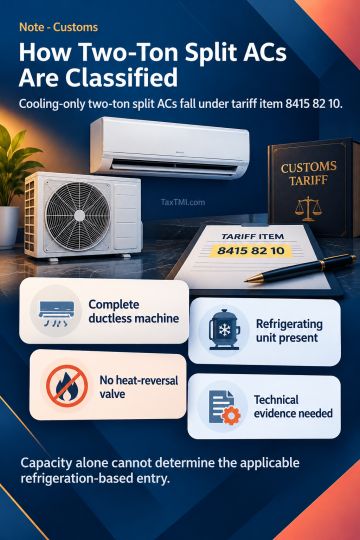
In 2026 (9) TMI 1764 - CESTAT CHENNAI (LB), the Larger Bench held that the two-ton, cooling-only ductless split air conditioners before it were classifiable under tariff item 8415 82 10, rather than 8415 10 10. Significantly, it rejected both competing earlier classifications: the general split-system classification and classification under the entry for machines not incorporating a refrigerating unit.
The decision therefore concerns more than the proposition that a specific entry prevails over a general one. It requires specificity to be established through the tariff hierarchy and the actual technical characteristics of the imported machine.
Heading 8415 covers "Air conditioning machines, comprising a motor-driven fan and elements for changing the temperature and humidity, including those machines in which the humidity cannot be separately regulated". The dispute arose within this common heading, not between different four-digit headings.
| Tariff reference | Relevant description | Classification significance |
|---|---|---|
| 8415 10 | Window or wall types, self-contained or "split-system" | Parent description relied upon by the appellant |
| 8415 10 10 | Split system | General split-system tariff item claimed by the appellant |
| 8415: Other branch | Other | Parent branch containing the refrigeration-based subdivisions |
| 8415 81 | Incorporating a refrigerating unit and a valve for reversal of the cooling or heat cycle (reversible heat pumps) | Requires the specified reversal feature |
| 8415 82 | Other, incorporating a refrigerating unit | Relevant refrigeration-based subheading |
| 8415 82 10 | Split air-conditioner two tons and above | Capacity-specific item selected by the Larger Bench |
| 8415 83 | Not incorporating a refrigerating unit | Inapplicable where incorporation is established |
| 8415 83 10 | Split air-conditioner two tons and above | Capacity description remains subject to the parent exclusion of a refrigerating unit |
The words "two tons and above" include a machine of exactly two-ton capacity. However, capacity does not operate independently: item 8415 82 10 requires incorporation of a refrigerating unit through its parent subheading, while item 8415 83 10 requires its absence.
Rule 1 of the General Rules for the Interpretation of the First Schedule provides that classification shall be determined "according to the terms of the headings and any relative Section or Chapter Notes". Section and chapter titles are provided for ease of reference only. The classification inquiry must therefore begin with operative descriptions and notes, rather than commercial labels alone.
Rule 3(a) applies where goods are prima facie classifiable under two or more headings and directs that "the heading which provides the most specific description shall be preferred to headings providing a more general description". Its qualification concerning headings referring only to parts of mixed goods, composite goods or retail sets prevents an automatic specificity preference in those situations.
Rule 3(c) permits selection of the heading occurring last in numerical order only "when goods cannot be classified by reference to (a) or (b)". Numerical sequence is thus a residual tie-breaker, not an independent reason for selecting a later tariff item.
Because both proposed classifications fall within heading 8415, Rule 6 is essential. Classification within a heading follows the terms of the subheadings, related notes and the preceding rules, applied mutatis mutandis, "on the understanding that only sub-headings at the same level are comparable". Rule 6 connects the general specificity principle to the internal structure of heading 8415.
The General Explanatory Notes to the First Schedule make a single-dash description a subdivision of the heading and a double-dash description a subdivision of the immediately preceding single-dash description. Triple-dash descriptions similarly remain subordinate to their relevant parent descriptions.
Accordingly, "Split air-conditioner two tons and above" cannot be read as a freestanding description wherever it appears. Under 8415 82 it inherits "incorporating a refrigerating unit"; under 8415 83 it inherits "Not incorporating a refrigerating unit". The Additional Notes reinforce the distinction between a four-digit heading, a six-digit subheading and an eight-digit tariff item.
The appellant argued that subheading 8415 10 covered a ductless system consisting of a condenser unit and an evaporator unit operating together, without prescribing a capacity limit. On that approach, conformity with the split-system description was sufficient to sustain item 8415 10 10.
The Larger Bench instead treated that item as covering non-specified split air conditioners and preferred the description expressly identifying machines of two tons and above incorporating a refrigerating unit. Ductless construction remained relevant to product identity, but did not displace the capacity-qualified description.
No. Identical capacity wording appears within different refrigeration-based branches. A machine cannot enter item 8415 83 10 solely because it is a two-ton split air conditioner when it incorporates the very refrigerating unit excluded by subheading 8415 83. Specificity must reflect the complete legally applicable description.
The interpretative difficulty lies in applying an eight-digit capacity distinction without disregarding the preceding tariff levels. Rule 6 and the dash notes require the relevant branches to be examined before the final item is selected. The Larger Bench's conclusion must therefore be understood as an interpretation of the connected tariff descriptions, not as permission to compare isolated eight-digit expressions while ignoring their parents.
The imported goods were undisputedly two-ton ductless split air conditioners comprising one indoor unit and one outdoor unit. Their technical write-up established cooling-only operation, incorporation of a refrigerating unit, and absence of a heat-reversal valve or heat-pump functionality.
These findings performed separate legal functions. Two-ton capacity satisfied the quantitative condition of item 8415 82 10. Incorporation of a refrigerating unit excluded subheading 8415 83. Absence of the reversal feature excluded subheading 8415 81. The selected classification consequently reflected both positive inclusion and reasoned exclusion.
The operative conclusion was that "the more specific entry covering 2-ton capacity split air conditioners incorporating a refrigerating unit, appearing under CTH 84158210, excludes the general entry for split air conditioners specified under CTH 84151010". Capacity alone was not the complete ratio; it operated with the machine's established refrigeration characteristics.
The Larger Bench also observed that a later entry is preferred where competing entries merit equal consideration. That observation must be read with Rule 3(c)'s express precondition: classification must first be incapable of resolution under Rules 3(a) and 3(b).
The principal reasoning here was affirmative specificity under item 8415 82 10. Its later numerical position should not be converted into a general presumption favouring higher tariff numbers. Nor does the presence of two physical units require recourse to essential-character analysis where the complete machine already satisfies an applicable description.
The Larger Bench recognised HSN Explanatory Notes as important interpretative guidance where the domestic tariff and HSN are aligned. Such guidance cannot dilute or override the fiscal statute. The express Indian tariff description therefore remains central to the capacity-based inquiry.
Common parlance similarly assists in understanding undefined or ambiguous commercial expressions; it cannot replace clear statutory conditions. Calling a product a "split system" does not answer whether it incorporates a refrigerating unit, possesses a reversal valve, or satisfies the specified capacity.
The Larger Bench held the earlier general split-system classification incorrect insofar as it placed two-ton split air conditioners under item 8415 10 10. It also held the earlier selection of item 8415 83 10 incorrect for the goods before it because they incorporated a refrigerating unit.
The reference was answered in favour of item 8415 82 10, and the matter was returned to the Division Bench for final decision. The classification ruling should not be described as the final disposal of the appeal or as determining every consequential assessment issue.
In 2020 (9) TMI 951 - CESTAT MUMBAI, the tribunal sustained item 8415 10 10 because the revenue authority had not established exclusion from the split-system description before moving to the proposed refrigeration-based classification. It emphasised hierarchical comparison, authenticated technical evidence and the department's burden to justify reclassification. Heating capability alone did not establish the necessary reversal arrangement. The Larger Bench displaced its classification proposition for two-ton split air conditioners; the need to prove the technical conditions of the proposed entry remains a distinct evidentiary requirement.
In 2016 (7) TMI 1123 - CESTAT CHENNAI, the tribunal preferred the capacity-specific description over the general split-system item, relying on technical character, common parlance and the principle that specific descriptions exclude general ones. However, it selected item 8415 83 10. The Larger Bench accepted neither that selection nor capacity as a substitute for the refrigeration condition. For goods incorporating a refrigerating unit, the earlier item selection is expressly incorrect. The decision also demonstrates the practical difficulty of relying on technical literature introduced only at the appellate stage.
In 2022 (5) TMI 1319 - CESTAT MUMBAI, the tribunal preferred item 8415 10 10 for specified ductless room air conditioners over a proposed reversible-heat-pump classification. It stressed comparison at corresponding tariff levels and rejected using eight-digit expansions to erase the six-digit split-system description. This presents the structural argument underlying the earlier general-entry approach. For goods matching the Larger Bench's two-ton, cooling-only factual findings, however, that reasoning cannot displace the specific reference ruling. The decision's separate distinction between complete systems presented together and components imported separately concerns an antecedent question, not competing classifications of an admitted complete machine.
In 2023 (6) TMI 319 - CESTAT CHENNAI, separately imported indoor and outdoor VRF components were classified as parts under item 8415 90 00. They were not presented as a complete factory-matched machine and required subsequent project-specific matching. Its relevance is limiting: before applying the two-ton machine classification, the goods presented for assessment must actually constitute the machine under consideration. The Larger Bench ruling does not establish that every separate indoor or outdoor unit is a complete split air conditioner.
In 2007 (12) TMI 8 - Supreme Court, assembly of condensing and cooling units with accessories and testing produced a complete, commercially new air conditioner. The court found it unnecessary to decide the applicability of Rule 2(a). Although the issue was manufacture, the decision helps distinguish component identity from complete-machine identity. It supplies no independent answer to the present competition between items 8415 10 10 and 8415 82 10.
In 2003 (3) TMI 97 - Supreme Court, a specific notification entry for "Parts and accessories of car air-conditioner including car air-conditioning kit" prevailed over a general description. The court also preserved the effect of an exclusion concerning the automotive gas compressor. Its doctrinal relevance is that specificity and exclusionary wording operate together. Correspondingly, the capacity-specific description here cannot be separated from its refrigerating-unit qualification.
In 2015 (7) TMI 96 - Supreme Court, the court clarified the treatment of separately supplied kits and compressors under Notification No. 166/86-CE. Rule 2(a) and Section Note 4 could not be imported to defeat the notification's explicit distinction between complete machines, kits and compressors. Separate and combined transactions required different treatment. The relevant principle is disciplined respect for the governing text: interpretative rules facilitate classification but cannot erase express distinctions. That notification-specific result does not determine the present tariff item.
In 2006 (9) TMI 519 - GUJARAT HIGH COURT, the specific composition entry for installation of air conditioners and A.C. coolers prevailed over the general entry for fabrication and installation of plant and machinery. Unsupported common-parlance distinctions did not exclude central air-conditioning installations from the specific description. The analogy supports meaningful preference for a directly applicable description, while remaining confined to the language of its own composition scheme.
In 2022 (11) TMI 1360 - RAJASTHAN HIGH COURT, deep freezers could not be brought within an air-conditioner-and-refrigerator entry contrary to an express notification exclusion. The revenue authority had not established coverage, and HSN reasoning could not defeat the exclusion. This illustrates the limit of the specificity maxim: an apparently specific entry must first legally cover the goods. Here, incorporation of a refrigerating unit similarly prevents resort to the expressly contrary 8415 83 branch.
In 2009 (1) TMI 9 - Supreme Court, the court rejected an exemption claim under Notification No. 30/88 where the manufacturer's operational manual described the goods as a heat-pump-type air conditioner and the expert evidence did not adequately address that material. The decision was expressly fact-specific. Its relevance is evidentiary: expert opinion must engage with the actual product literature. The claimant's burden to establish exemption eligibility must not be confused with the department's burden to justify a proposed tariff reclassification.
The classification record must establish more than a product name or declared tonnage. For the category decided by the Larger Bench, the material technical questions are:
A reasoned classification order should map those facts to the parent branch, subheading and tariff item. Merely reproducing "split system" is insufficient after the Larger Bench ruling for matching goods. Equally, merely reproducing "two tons and above" does not establish the appropriate refrigeration-based branch.
Manufacturer specifications, operating manuals and technical explanations are particularly important where refrigeration or reversal functionality is contested. The earlier evidentiary difficulties also show why technical material forming the basis of classification must be available for scrutiny at the appropriate stage.
The ruling does not justify automatic classification of reversible systems, separately presented VRF components, or machines with materially different technical characteristics under item 8415 82 10. Those distinctions must be addressed before extending its reasoning.
For the two-ton, ductless, cooling-only split air conditioners incorporating a refrigerating unit examined by the Larger Bench, item 8415 82 10 is the appropriate specific classification. Item 8415 10 10 does not prevail merely because the goods are split systems, while item 8415 83 10 is excluded by the presence of a refrigerating unit.
The controlling method is complete-description specificity: read the capacity condition with the parent refrigeration requirement, respect the tariff hierarchy, and establish the relevant technical facts. Neither an isolated commercial label nor numerical priority can substitute for that analysis.
Full Text:

