 TaxTMI
Login

Login
Loading...
Press 'Enter' to add multiple search terms. Rules for Better Search

Press 'Enter' after typing page number.
Press 'Enter' after typing page number.


No Folders have been created
Are you sure you want to delete "My most important" ?
NOTE:
Press 'Enter' after typing page number.





Press 'Enter' after typing page number.

All TMI Notes
Press 'Enter' after typing page number.
Press 'Enter' after typing page number.
All TMI Notes
 Get Daily Updates

Note

Bookmark

Share


Download

This is a neutral professional article. The judgment is analysed in the context of its factual background, issues framed, and conclusions reached by the Court.
2026 (9) TMI 1656 - MADRAS HIGH COURT
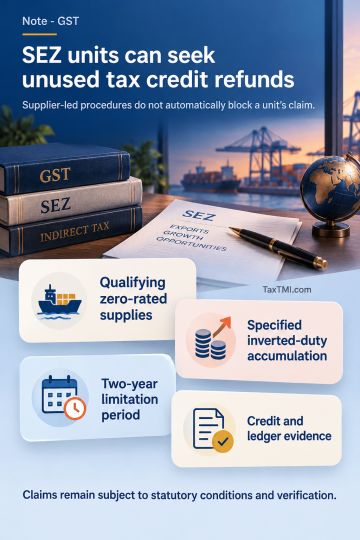
An SEZ unit is not excluded from claiming refund of unutilised input tax credit merely because Rule 89 prescribes a supplier-led procedure for refunds relating to supplies to SEZs. Section 54 of the Central Goods and Services Tax Act, 2017 and Rule 89 of the Central Goods and Services Tax Rules, 2017 must be read together without inserting an applicant-level restriction that their language does not contain.
In 2026 (9) TMI 1656 - MADRAS HIGH COURT, the court rejected the department's position that the GST legislation contains no enabling provision for an SEZ unit to seek refund of unutilised credit. It directed processing of the refund application within two months from receipt of a copy of the order. Recognition of the unit's eligibility to claim refund does not dispense with the substantive conditions, limitation requirements, verification and computation applicable to the claim.
The taxpayer, an SEZ unit, challenged the original and appellate orders concerning its refund claim. The departmental reasoning was categorical: Section 16 of the Integrated Goods and Services Tax Act, 2017, Section 54 of the CGST Act and Rule 89, read together, allegedly permitted only suppliers making supplies to SEZ units to claim refund. On that interpretation, the SEZ unit itself lacked statutory authority to apply.
The taxpayer relied on two earlier Madras rulings recognising an SEZ unit's entitlement to seek refund. The department stated that a writ appeal had been filed against the first ruling, but acknowledged that no interim order had been obtained. The court followed the reasoning of those decisions and allowed the writ petition.
The controversy requires a distinction between two transactions: supplies received by an SEZ unit, and zero-rated supplies made by that unit. A procedure regulating the supplier's refund on the first transaction cannot automatically exclude the unit's claim for accumulated credit under the statutory refund framework.
Section 54(1) of the CGST Act begins with "Any person claiming refund" and requires an application "before the expiry of two years from the relevant date", in the prescribed form and manner. This broad applicant description is important, but must operate with the provisions governing the particular refund category.
Section 54(3), subject to sub-section (10), permits "a registered person" to claim refund of unutilised input tax credit "at the end of any tax period". Its first proviso states that "no refund of unutilised input tax credit shall be allowed in cases other than":
Section 54(3) also prohibits refund where the supplier "avails of drawback in respect of central tax or claims refund of the integrated tax paid on such supplies". Accordingly, an SEZ unit's capacity to apply and the substantive admissibility of its credit are separate questions.
Section 54(4)(a) requires documentary evidence establishing that refund is due. Section 54(7) requires the refund order within sixty days from receipt of an application complete in all respects. Section 54(8)(b) provides for payment of refundable unutilised credit under sub-section (3) to the applicant rather than crediting it to the Consumer Welfare Fund.
Section 16(1) of the IGST Act defines "zero rated supply" to include exports and supplies "for authorised operations" to an SEZ developer or unit. Section 16(2) permits input tax credit for making zero-rated supplies, notwithstanding their exempt character, subject to Section 17(5) of the CGST Act.
Section 16(3) connects zero-rating with the refund framework: a registered person making zero-rated supplies without payment of integrated tax under bond or Letter of Undertaking is eligible to claim refund of unutilised credit "in accordance with" Section 54 and the rules, subject to prescribed conditions, safeguards and procedure. Section 16(4) separately provides for notified classes of persons or supplies using the tax-paid refund route.
Thus, exports by an SEZ unit may qualify independently as zero-rated supplies. The unit's status as recipient of inward supplies does not prevent it from also being a registered person making qualifying outward supplies.
Rule 89(1) of the CGST Rules, within its stated scope and exclusions, uses "Any person" and provides for electronic filing in FORM GST RFD-01 through the common portal. Its SEZ-specific proviso states that, "in respect of supplies to" an SEZ unit or developer, the application shall be filed by:
The interpretative question is whether this transaction-specific prescription excludes other applicants from Rule 89 altogether. The court answered that question in the negative.
Rule 89(2) requires the applicable supporting evidence. Clause (f) concerns a declaration that tax has not been collected from the SEZ unit or developer where refund relates to supplies made to it. Rule 89(3) requires a debit of the electronic credit ledger equal to the credit refund claimed. These requirements regulate the relevant claim; they do not establish a universal prohibition against SEZ applicants.
In 2026 (9) TMI 1656 - MADRAS HIGH COURT, the court addressed the department's conclusion that there was "no enabling provision for the SEZ unit to claim refund of un-utilized credit". It adopted the earlier interpretation of Section 54 and Rule 89 and found no reason to depart from it.
The holding removes the asserted disability attached to the applicant's SEZ status. The relief was a direction to process the application in accordance with the court's reasoning and the judgments followed. It was not an unconditional adjudication that every component of the amount claimed was refundable.
The absence of an interim order in the writ appeal against the earlier ruling was expressly recorded. The mere filing of that appeal did not cause the court to withhold application of the earlier reasoning. This procedural observation should not be converted into an assertion about the eventual outcome of that appeal.
The first earlier Madras ruling, whose relevant reasoning was reproduced, directly considered whether an SEZ unit could claim refund of unutilised credit. It rejected the contention that the references to suppliers in the SEZ proviso and Rule 89(2)(f) exhausted the classes of eligible applicants.
The court explained that a supplier to an SEZ is "only one kind of entity that may make an application under Rule 89". Mentioning that category does not, by itself, exclude other applicants. It also rejected the addition of "only" to the proviso: "No restrictions or amplifications of the Rule are permissible by interpretation."
Its significance is textual. The reasoning does not disregard the supplier-specific procedure; it prevents that procedure from being enlarged into an exclusion absent from the general application provision.
The second earlier Madras ruling reiterated the same position on SEZ refund eligibility. Its relevance lies in the continuity of interpretation: the operative ruling treated both earlier decisions as reasons to reject the department's categorical objection. It did not identify any departure from the combined reading of Section 54 and Rule 89.
In 2020 (9) TMI 294 - GUJARAT HIGH COURT, the issue concerned unutilised IGST credit distributed to an SEZ unit by an Input Service Distributor. The court recognised the unit's right to claim refund under Section 54 where no specific supplier could claim refund of the distributed credit.
The functional character of the ISD was central. Section 2(61) of the CGST Act, as considered in that decision, identifies an ISD as an office of the supplier distributing credit to units sharing the same permanent account number. Distribution of common credit is materially different from an identifiable supplier seeking refund on its own supply to an SEZ.
The supplier-led procedure therefore could not defeat the recipient unit's claim in that setting. The rejection order was quashed and processing directed within three months. The decision also establishes that administrative circulars cannot override an entitlement supported by the statute and rules.
In 2022 (2) TMI 947 - GUJARAT HIGH COURT, the SEZ unit's accumulated credit comprised ISD-distributed credit and tax charged on inward supplies used for exports. The credit remained unutilised in its electronic credit ledger.
The court applied the earlier ISD reasoning, rejected the denial of refund, and directed processing under Section 54 within three weeks. The decision is relevant because an asserted absence of circulars or processing guidelines did not displace the statutory basis for considering the claim. Nevertheless, its reasoning must be applied with regard to the demonstrated source and treatment of the accumulated credit.
In 2022 (4) TMI 1194 - MADRAS HIGH COURT, the taxpayer's head office had distributed common-service credit to its SEZ unit as an ISD. The court recognised the unit's exports as zero-rated supplies and treated Section 54 as complementary to the zero-rated refund entitlement under Section 16.
The supplier-specific proviso to Rule 89 was not a bar where the statutory conditions were satisfied. The court also distinguished the prohibition directed at drawback or refund of integrated tax from a general denial of the exporter's accumulated-credit claim. Since the disqualifying circumstance did not apply, the appellate rejection was set aside.
This reasoning supplies an important analytical link: the SEZ unit claims as a registered person with qualifying zero-rated outward supplies and unutilised credit, not merely because it is located in an SEZ.
In 2023 (3) TMI 56 - GUJARAT HIGH COURT, the court again rejected the contention that the supplier-led procedure barred the SEZ unit's refund of ISD-distributed credit. It simultaneously recognised the department's concern about duplicate refunds.
The rejection orders were quashed, with processing and grant of refund directed after verification and an undertaking or bond. The safeguard required repayment with interest if it transpired that the supplier had obtained refund, enabling departmental recovery. The exercise was to be completed within eight weeks.
The decision reconciles entitlement with revenue protection. Its undertaking requirement was a safeguard directed in that proceeding, not an applicant-level exclusion or a substitute for verifying the credit trail.
The order at 2024 (7) TMI 1809 - SC Order records disposal of the special leave petitions as not pressed because the tax effect fell below the threshold in the applicable departmental circular.
That disposal is relevant to the procedural history of the SEZ refund controversy. It is not a reasoned determination of Section 54 or Rule 89 on merits and should not be presented as an independent Supreme Court affirmation of every proposition in the underlying decisions.
In 2021 (9) TMI 626 - Supreme Court, the court examined inverted-duty refunds and held that the opening words of the first proviso to Section 54(3) impose substantive restrictions, not merely threshold qualifications. It upheld the challenged Rule 89(5) framework as it then operated and declined to rewrite it to enlarge refund entitlement.
The relevant principle here is that the broad expression "any unutilised input tax credit" cannot be detached from the statutory provisos. The decision did not determine SEZ applicant eligibility. It nevertheless prevents the SEZ rulings from being overstated: absence of an SEZ-specific exclusion does not eliminate the positive conditions for refund.
In 2022 (4) TMI 760 - MADRAS HIGH COURT, the court held that claiming drawback did not, by itself, defeat the exporter's refund claim. The relevant drawback rates represented the Customs component and were the same irrespective of availment of the input-tax facility.
For an SEZ refund claim involving drawback, the limited relevance is that the actual benefit claimed must be examined. Section 54(3) refers specifically to drawback "in respect of central tax"; every Customs drawback claim cannot automatically be treated as that disqualification. The decision does not dispense with verification of any overlapping benefit.
The application must distinguish the unit's own accumulated-credit claim from a supplier's refund on supplies made to it. Evidence of outward zero-rated supplies, the source of credit, ISD distribution where applicable, ledger balances and the computation must establish the actual statutory basis. SEZ status alone neither creates an unrestricted cash-refund entitlement nor justifies rejection.
Circular No. 48/22/2018-GST clarifies that the supplier's zero-rated benefit for supplies to an SEZ depends on receipt for authorised operations, endorsed by the specified officer. This requirement governs the relevant supply; it does not state that an SEZ unit can never seek refund of its own accumulated credit.
Circular No. 125/44/2019-GST provides for electronic filing and processing through FORM GST RFD-01. Its categories distinguish exports, supplies to SEZs, order-based refunds and "any other" grounds. These administrative categories must be matched to the actual claim rather than treated as an exhaustive substantive exclusion of SEZ applicants.
The circular links filing to generation of the Application Reference Number and provides for an acknowledgement or deficiency memo within fifteen days. Under its procedure, a deficiency memo cannot subsequently be issued once acknowledgement has been issued for that application.
The two-year period under Section 54(1) requires identification of the relevant date for the actual refund category. A favourable eligibility ruling does not, by itself, resolve that calculation. The statutory and rule versions applicable to the claim period also govern documentation and computation; later changes cannot simply be attributed to the reasoning of an earlier judgment.
Section 54(10) separately permits withholding or deduction in its specified circumstances involving return defaults or unpaid liabilities. Further, denial of cash refund and a finding that credit itself was wrongly availed are different determinations. The electronic-refund circular expressly distinguishes rejection for ineligible credit from rejection on other grounds. A categorical objection to SEZ applicant status should not be conflated with proof of wrongful credit availment.
The resulting position is one of eligibility subject to the statutory framework: an SEZ unit's claim must be examined on its legal and evidentiary merits, not rejected merely because the applicant is itself an SEZ unit.
Full Text:

