Loading...

⚠ ✕
❮ Top
☎ Help
☰
×

By creating an account you can:

Logo TaxTMI
Call Us / Help / Feedback✕

Contact Us At :

✉ E-mail: [email protected]

✆ To Call / Whatsapp, Check Contact Us

FAQs :

To know Frequently Asked Questions, Check FAQs

Most Asked Video Tutorials :

For more tutorials, Check Video Tutorials

Submit Feedback/Suggestion :

Email :
Please provide your email address so we can follow up on your feedback.
Category :
Description :
Min 15 characters 0/2000
Make Most of Text Search ✕
  1. Checkout this video tutorial: How to search effectively on TaxTMI.
  2. Put words in double quotes for exact word search, eg: "income tax"
  3. Avoid noise words such as : 'and, of, the, a'
  4. Sort by Relevance to get the most relevant document.
  5. Press Enter to add multiple terms/multiple phrases, and then click on Search to Search.
  6. Text Search
  7. The system will try to fetch results that contains ALL your words.
  8. Once you add keywords, you'll see a new 'Search In' filter that makes your results even more precise.
  9. Text Search
╳
Add to...
You have not created any category. Kindly create one to bookmark this item!
✕
Create New Category
Hide
Title :
Description :
❮❮ Hide
❮ Default View
Expand ❯❯
Close ✕
🔎 Filters / Advanced Search ❯
TEXT

Press 'Enter' to add multiple search terms. Rules for Better Search

Search In
Main Text + AI Text ❯
  • Main Text
  • Main Text + AI Text
  • AI Text
Law:
---- All Laws---- ❯
  • ---- All Laws----
  • Benami Property
  • Bill
  • Central Excise
  • Companies Law
  • Customs
  • DGFT
  • FEMA
  • GST
  • GST - States
  • IBC
  • Income Tax
  • Indian Laws
  • Money Laundering
  • SEBI
  • SEZ
  • Service Tax
  • VAT / Sales Tax
Types:
---- All Types ---- ❯
  • ---- All Types ----
  • Act Rules
  • Case Laws
  • Circulars
  • Manuals
  • News
  • Notifications
Sort By: ?
In Sort By 'Default', exact matches for text search are shown at the top, followed by the remaining results in their regular order.
Relevance Default Date
☰   Show Results ❯
    Case Laws Customs
    Clubbing of Contrived Split Consignments under Rule 2(a) and Valuation of a Dismantled Motorcycle
    GST on Corporate Guarantees: Substantive Liability, Deemed Valuation and Judicial Relief
    Case Laws Income Tax
    Employee Secondment under the India-USA DTAA: Employment Rights, Reimbursements and Included Service...
    Pre-deposit Under Section 112 and Independent Compliance with Tribunal Filing Fees
    Case Laws Income Tax
    TDS on Interest Paid by Co-operative Banks to Non-Member Co-operative Societies under Section 194A(3...
    Input Tax Credit and Supplier Non-Payment: Statutory Limits on Mechanical Reversal Under Section 16(...
    Case Laws Customs
    Appellate Jurisdiction over Goods Imported as Baggage under Sections 129A and 129DD of the Customs A...
    Monetary Limits for Departmental GST Appeals under Section 120 and Circular No. 207/1/2024-GST
    Alleged Re-use of E-Way Bills under Section 129: Evidentiary Burden in Detention Proceedings
    Turnover of Zero-Rated Supply Under Rule 89(4): Invoice Period and Subsequent Physical Export
    Case Laws Income Tax
    Reassessment Proceedings: Speaking Disposal of Objections Before Scrutiny Under Sections 143(2) and ...
    Suppression of Facts under Explanation 2 to Section 74 of the CGST Act in Cases of Ineligible Input ...
    Case Laws Customs
    Classification of Low-Ethoxylated Non-Ionic Fatty Alcohol Ethoxylates under Headings 3402 and 3824
    Case Laws Customs
    Seizure and Detention of Imported Cars under Sections 110, 110A and 124 of the Customs Act, 1962
    Case Laws Companies Law
    Lifting the Corporate Veil Where Promoter Shareholding Is Allegedly Dissipated Despite Judicial Assu...
    Consolidated Show Cause Notices under Sections 73 and 74 and Taxability of School Affiliation Servic...
    Fraudulent Input Tax Credit from Non-Existent Suppliers: Application of Sections 16, 74 and 155 of t...
    Case Laws Money Laundering
    Prolonged Pre-Trial Incarceration and Bail under Section 45 of the Prevention of Money-Laundering Ac...
    Case Laws Income Tax
    Prospective Operation of Section 56(2)(x)(b) in Stamp-Value Difference Cases Involving Immovable Pro...
    Seizure of Cash under Section 67 of the CGST Act and Interest on Illegal Retention
❮
❯
❯❯
Maximize Maximize Maximize
0 / 200
Expand Note
Add to Folder

No Folders have been created

+

Are you sure you want to delete "My most important" ?

NOTE:

Notes
Showing Results for :
Reset Filters
Results Found:
Show All Summaries Hide All Summaries
Case Laws Customs
Show AI Summary
Split motorcycle consignments require evidence of deliberate fragmentation for composite classification, with valuation assessed independently of classification.
Clubbing of split consignments for customs classification depends on proof that apparently separate imports form one deliberately fragmented transaction, not merely on the possibility of assembly. Rule 2(a) extends a tariff heading to an incomplete article possessing the essential character of the complete article and also covers a complete article presented disassembled. A change of tariff heading alone does not establish that the transaction value is inaccurate; substantive misdescription of the goods requires separate evidentiary consideration. Replacement value must follow the prescribed sequence of methods.
Case Laws GST
Show AI Summary
Corporate guarantee taxation depends on distinguishing taxable supply from valuation, particularly for unpaid support between related businesses.
GST on corporate guarantees requires separate consideration of whether a taxable supply exists and how that supply is valued. Section 7(1)(c) and Schedule I encompass qualifying supplies between related or distinct persons without consideration when made in the course or furtherance of business. Rule 28(2) deems the value of a guarantee furnished to a banking company or financial institution for a related recipient in India to be one per cent of the guaranteed amount per annum or actual consideration, whichever is higher. Where the recipient is eligible for full input tax credit, the proviso treats the value declared in the invoice as the value of the supply.
Case Laws Income Tax
Show AI Summary
Employee secondment taxation depends on employment rights, service consideration and demonstrable transfer of technical capability to host entities.
Local operational control and a stated suspension of foreign employment do not, by themselves, resolve whether underlying foreign employment rights survive. Under Article 12(4)(b) of the India-USA DTAA, technical or consultancy services must make technical knowledge, experience, skill, know-how or processes available, or involve development and transfer of a technical plan or design. Under the knowledge-transfer limb, the recipient must acquire a capability it can use independently; the mere application of expertise or presence of qualified personnel is insufficient. Recovery at actual cost and absence of markup do not, by themselves, establish that a foreign enterprise's receipt is non-taxable.
Case Laws GST
Show AI Summary
GST appellate pre-deposits may be satisfied by verified earlier payments after demand reduction, but filing fees remain independently payable.
When the first appellate authority substantially reduces the disputed tax demand, an earlier deposit may be sufficient to satisfy the Tribunal-stage requirement, subject to verification. Sufficiency depends on the reduced liability, the applicable appellate requirements and the amount actually deposited; a first appellate payment does not automatically eliminate the additional obligation. Tribunal filing fees under Section 112(7) operate independently of pre-deposit. Where a fee shortfall and earlier deposit require verification, proof of fee payment and verification of the deposit precede consideration of admission.
Case Laws Income Tax
Show AI Summary
Inter-co-operative society interest exemption preserves non-deduction by co-operative banks when depositors are co-operative societies under the statutory withholding framework.
Section 194A(3)(v) separately addresses interest paid by a co-operative bank to a member and interest paid by a co-operative society to another co-operative society. The exclusion of co-operative banks is confined to the member-payment limb; a co-operative bank remains a co-operative society for the inter-co-operative society limb. Paragraph 42.7 of Circular No. 19/2015 preserves non-deduction, including time-deposit interest, where the depositor is a co-operative society. Section 80P does not determine this withholding obligation.
Case Laws GST
Show AI Summary
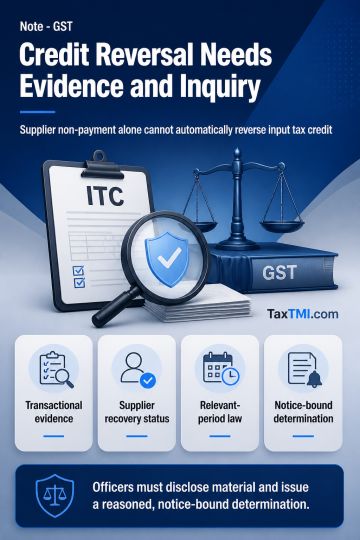
Input tax credit reversal requires evidence linking supplier non-payment to recipient ineligibility and a reasoned statutory inquiry.
Input tax credit under Section 16(2)(c) remains conditional on actual payment of tax to Government, but supplier non-payment or retrospective cancellation cannot by itself justify reversal. The recipient must establish eligibility through transactional evidence, while the proper officer must investigate the particular supply, disclose supplier-default and recovery material, apply the law applicable to the relevant period, and issue a reasoned, notice-bound determination. Supplier recovery status and protection against duplicate collection are material considerations.
Case Laws Customs
Show AI Summary
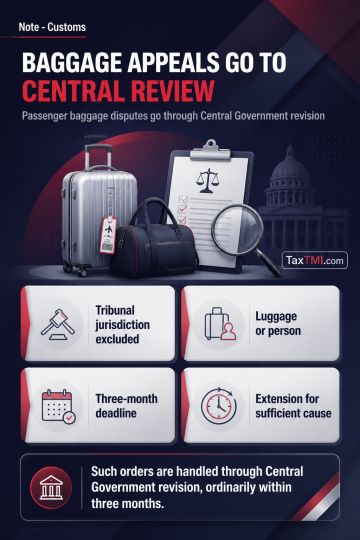
Baggage-related customs appeals proceed through statutory revision when the jurisdictional exclusion applies to passenger imports.
The first proviso to section 129A(1) excludes Appellate Tribunal jurisdiction over an order under section 128A relating to goods imported or exported as baggage. The decisive issue is the order's connection with baggage, not disputes concerning confiscation, declaration, duty, personal effects, concealment, concession, or penalty. Articles carried by an international passenger in luggage or on the person may constitute baggage. Section 129DD provides revision before the Central Government, ordinarily within three months, subject to a further period on sufficient cause.
Case Laws GST
Show AI Summary
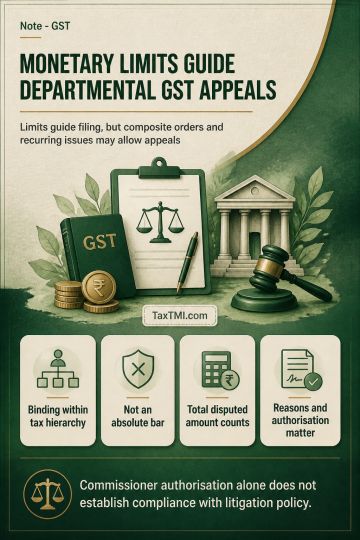
Departmental GST appeal monetary limits regulate officers, while composite orders and proven recurring issues may permit appeals.
Sections 120 and 168 of the Central Goods and Services Tax Act, 2017 make monetary-limit directions binding within the Central tax hierarchy, while they regulate the executive decision to file rather than create an inflexible jurisdictional bar before the Tribunal. In a composite order disposing of multiple appeals or demand notices, the relevant amount is the total disputed tax, interest, penalty or late fee, as applicable. The recurring or interpretative-issue exclusion requires a reasoned, case-specific basis, and Commissioner authorisation does not itself establish compliance with the litigation policy.
Case Laws GST
Show AI Summary
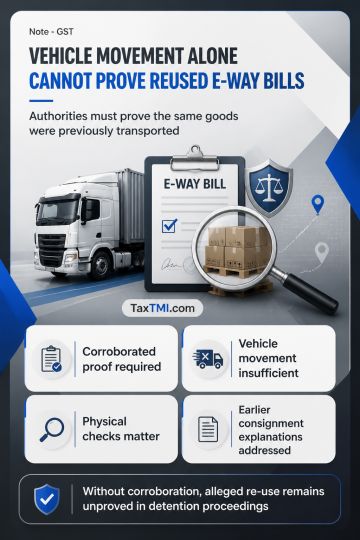
E-way bill re-use allegations require corroborated proof identifying the same goods; vehicle movement alone cannot establish contravention.
Alleged re-use of invoices and e-way bills requires the seizing authority to establish through positive, corroborated evidence that the intercepted goods are the same consignment previously transported under those documents. Toll data, vehicle movements and photographs may justify inquiry but do not alone prove prior delivery, identity of goods or re-use. Where invoices and e-way bills accompany the goods and physical verification shows no discrepancy, the authority must investigate and address any explanation of a different earlier consignment. Cases involving absent or expired transport documents remain factually distinct.
Case Laws GST
Show AI Summary
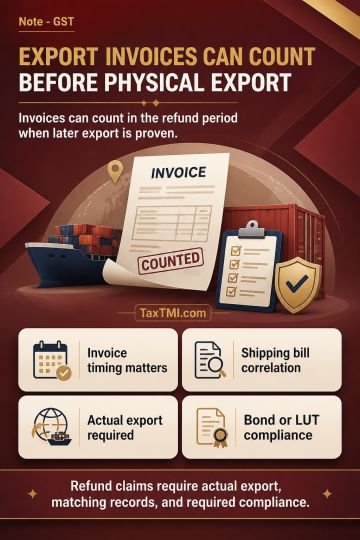
Zero-rated supply turnover includes export invoices from the refund period when actual export is subsequently established under bond or LUT.
Under Rule 89(4), invoice values for goods invoiced before or at removal for export under bond or Letter of Undertaking may be included in zero-rated turnover for the relevant refund period, although physical export occurs later. The invoice and removal determine period-wise attribution for the refund formula, while actual export remains essential to sustain the claim. Shipping bills, bills of export and related export records must correlate with the export invoices to establish that the goods were ultimately exported. Compliance with valuation, input tax credit eligibility and bond or Letter of Undertaking conditions remains necessary.
Case Laws Income Tax
Show AI Summary
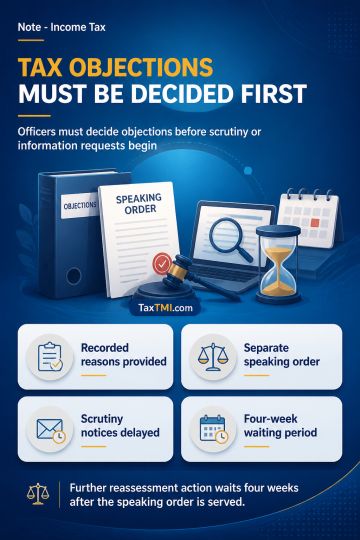
Reassessment objections require speaking disposal and a four-week pause before scrutiny or information requests can begin.
Under the pre-amendment Section 148 framework, reassessment jurisdiction must be resolved before merits-stage scrutiny begins. The Assessing Officer must furnish recorded reasons when requested, permit objections, and decide them through a separate speaking order. A Section 143(2) notice commences scrutiny, while a Section 142(1) notice is a substantive inquiry step; neither may issue before objections are decided. Following rejection, a four-week period from service of the speaking order must be allowed before further reassessment action, preserving an effective opportunity to challenge reopening.
Case Laws GST
Show AI Summary
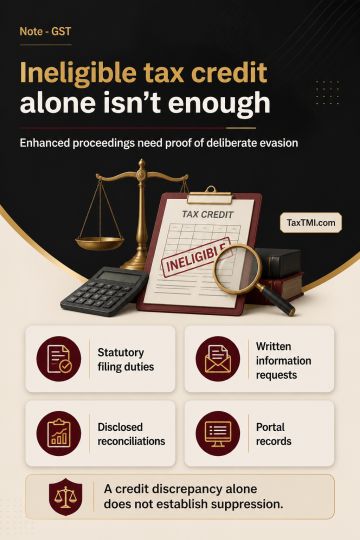
Suppression of facts requires proof of deliberate tax evasion; ineligible input tax credit alone cannot support enhanced proceedings.
Section 74 permits enhanced tax determination for wrongly availed or utilised input tax credit only where fraud, wilful misstatement, or suppression of facts to evade tax is established. Wrong or ineligible credit is distinct from substantive credit eligibility and cannot, without evidence of deliberate conduct and intent, amount to suppression. Under historical Explanation 2, suppression required either omitted information legally required in prescribed filings or failure to provide information sought in writing; both operate subject to the statutory evasion requirement. Disclosed reconciliations and portal records materially weaken a bare allegation of non-declaration.
Case Laws Customs
Show AI Summary
Organic surface-active agent classification requires water solubility and stability; phase-separating low-ethoxylated products fall outside Heading 3402.
Classification of low-ethoxylated non-ionic fatty alcohol ethoxylates under Heading 3402 requires satisfaction of the cumulative water test in Chapter Note 3. At the prescribed concentration, temperature, and standing period, the product must both remain a transparent or translucent liquid, or stable emulsion, without phase separation and reduce water surface tension to the stated threshold. Non-ionic character or surface activity alone is insufficient. Where a low-ethoxylated product separates into layers and fails the solubility and stability requirement, Heading 3824 may be considered after exclusion from Heading 3402.
Case Laws Customs
Show AI Summary
Lawful customs seizure requires recorded confiscation grounds, formal restraint where needed, and timely notice; detention cannot bypass safeguards.
Customs seizure of an imported car requires recorded reason to believe that it is liable to confiscation. A panchnama restraint cannot replace a lawful seizure order, an undertaking where seized goods remain in custody, or a served non-dealing order where seizure is impracticable. Section 110(2) requires prompt notice under Section 124, subject only to the prescribed extension mechanism. Prolonged effective detention cannot postpone those safeguards. Provisional release under Section 110A applies only to goods lawfully seized and cannot validate an earlier detention without statutory authority.
Case Laws Companies Law
Show AI Summary
Corporate veil-piercing permits forensic scrutiny in execution where promoter-controlled entities may dissipate shareholding despite judicial assurances.
Corporate veil-piercing in execution is an exceptional response where promoters allegedly use layered entities and securities transactions to deplete shareholding represented as security through judicial assurances. Separate personality remains the rule, and control or ownership alone does not suffice; there must be a nexus between control, misuse of the corporate form, and frustration of enforcement. A forensic audit reconstructs share movements, pledges, sales, financing, approvals, disclosures, and fund flows, distinguishing legitimate enforcement of pre-existing security from coordinated asset dissipation.
Case Laws GST
Show AI Summary
School affiliation services fall outside educational exemption without a direct nexus to admissions or examination conduct.
Consolidated show cause notices may combine financial years governed by Sections 73 and 74 where liabilities are segregated period-wise, each component independently meets limitation and notice requirements, the additional ingredients for fraud-based proceedings are satisfied, and no actual prejudice arises. School affiliation and affiliation-form processing charges are independent taxable supplies where they concern institutional eligibility and compliance, rather than directly and immediately relating to student admission or the conduct of examinations. A broad connection with education does not satisfy the educational-services exemption.
Case Laws GST
Show AI Summary
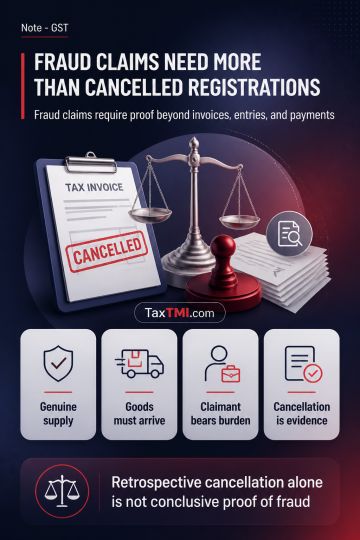
Fraudulent input tax credit requires proof of fictitious supplies, absent goods receipt, and fraud-linked self-assessment, not cancellation alone.
Input tax credit from allegedly non-existent suppliers depends on proof of genuine supply and actual receipt of goods or services, not merely invoices, accounting entries, or banking-channel payments. Section 155 places the burden of establishing ITC eligibility on the claimant. Section 74 requires more than ineligible credit: the wrongful availment must be linked to fraud, wilful misstatement, or suppression to evade tax. Retrospective supplier-registration cancellation is relevant evidence but is not conclusive. A fraud-based notice must disclose facts showing fictitious suppliers, absence of supply, and a basis for inferring the recipient's knowledge or participation.
Case Laws Money Laundering
Show AI Summary
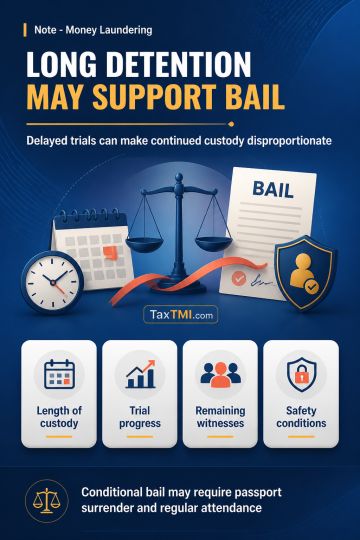
Prolonged pre-trial incarceration may justify conditional PMLA bail when delayed trials make continued detention constitutionally disproportionate.
Section 45 of the Prevention of Money-Laundering Act remains the stringent ordinary bail threshold, requiring prosecutorial opportunity and, on opposition, reasonable grounds to believe that the accused is not guilty and unlikely to offend while on bail. Article 21 nevertheless requires a separate, fact-sensitive inquiry where prolonged pre-trial detention and an unrealistic trial timetable make custody disproportionate. Relevant factors include custody length, trial progress, remaining witnesses, secured documentary evidence, source of delay, predicate-case status, and risks of absconding or witness interference. Conditions such as passport surrender, attendance, non-contact directions, and residence disclosure may safeguard the trial.
Case Laws Income Tax
Show AI Summary
Prospective operation of stamp-value taxation prevents retrospective application where property agreements and substantial payments predate the charging provision.
Section 56(2)(x)(b) applies to immovable property received for inadequate consideration only where its temporal and valuation conditions are satisfied. A stamp-value difference alone does not establish taxability. Where consideration was fixed and substantial payments or contractual performance occurred before the charging provision commenced, later conveyance or registration does not by itself attract the later charge. Agreement-date valuation is available only for covered transactions where consideration was fixed and paid, wholly or partly, through prescribed banking or electronic modes on or before the agreement date. The tax authority must identify the correct statutory basis and provide a meaningful opportunity to respond.
Case Laws GST
Show AI Summary
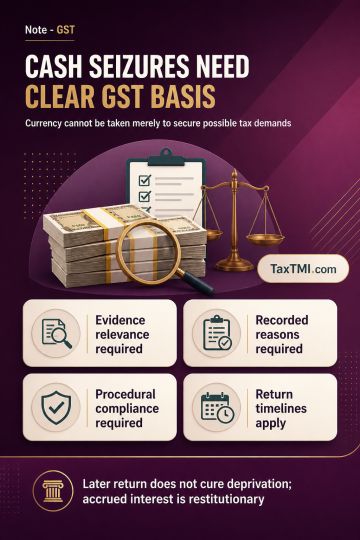
GST cash seizure limits require statutory relevance and restitutionary interest for unlawfully retained currency following searches.
GST seizure powers cannot be used to take cash as a general investigative measure or security for a possible tax demand. Currency is excluded from goods, and "things" is confined contextually to articles useful or relevant as evidence in GST proceedings. Valid seizure and retention require recorded statutory reasons, procedural compliance and observance of return timelines. Unauthorised retention engages property protections; later return does not cure the deprivation, and accrued interest is restitutionary rather than delayed-refund interest.

TMI Notes

Back

All TMI Notes

Showing Results for :
Reset Filters
No Records Found

TMI Notes

Back

All TMI Notes

Clubbing of Contrived Split Consignments under Rule 2(a) and Valuation of a Dismantled Motorcycle

2 November, 2026

Contents
Notifications
Acts
Rules & Regulations
Plus +
Summary
Note

Note

-

Bookmark

Print

Print

This commentary provides doctrinal analysis and practical insights on the legal issue discussed below. The judgment is analysed in the context of its factual background, issues framed, and conclusions reached by the Court.

2026 (10) TMI 580 - CESTAT CHENNAI

1. Introduction

Importation of a dismantled motorcycle raises two connected but distinct questions: whether apparently separate consignments constitute one complete article for tariff purposes, and whether the declared prices accurately represent the goods actually imported. Separate Bills of Entry, different ports and different named importers ordinarily matter. They are not, however, conclusive where objective evidence establishes a contrived division of one composite import.

In 2026 (10) TMI 580 - CESTAT CHENNAI, the tribunal upheld clubbing of an engine-and-chassis consignment with a complementary consignment containing the remaining motorcycle components. Classification under CTH 8711 50 00, rejection of declared value under Rule 10A and residual valuation under Rule 8 of the Customs Valuation Rules, 1988 were sustained. The significance lies in the distinction between identifying the true import transaction and artificially aggregating genuinely independent imports.

2. Legal & Statutory Context

Classification under the General Interpretative Rules

Rule 1 of the General Rules for Interpretation of the First Schedule to the Customs Tariff Act, 1975 requires classification according to "the terms of the headings and any relative Section or Chapter Notes". The remaining interpretative rules operate subject to those terms and notes.

Rule 2(a) contains two extensions of a heading:

"Any reference in a heading to an article shall be taken to include a reference to that article incomplete or unfinished, provided that, as presented, the incomplete or unfinished article has the essential character of the complete or finished article."

It further includes an article "complete or finished (or falling to be classified as complete or, finished by virtue of this rule), presented unassembled or disassembled".

The distinction matters. An incomplete article requires an essential-character inquiry. A complete article does not become mere parts simply because it is presented disassembled. Neither limb, however, independently authorises the aggregation of unrelated consignments.

The applicable valuation framework

The dispute falls within the historical framework of Section 14 of the Customs Act, 1962 and the Customs Valuation (Determination of Price of Imported Goods) Rules, 1988. The then-applicable Section 14(1) referred to "the price at which such or like goods are ordinarily sold, or offered for sale, for delivery at the time and place of importation" in international trade, subject to its commercial conditions. Section 14(1A) required the imported-goods price to be determined in accordance with the prescribed rules. The subsequently substituted wording of Section 14 must not be projected backwards onto these imports.

Rule 3 provides that, subject to Rules 9 and 10A, imported goods shall be valued at transaction value. If that method cannot determine value, valuation must proceed "sequentially through rules 5 to 8". Under Rule 4(1), transaction value is "the price actually paid or payable for the goods when sold for export to India", adjusted under Rule 9. Rule 4(2) governs acceptance subject to its specified conditions.

Rule 10A(1) operates where the proper officer has "reason to doubt the truth or accuracy" of the declared value. Further information, documents or evidence may be sought. If reasonable doubt remains after the response, or in its absence, the value is deemed incapable of determination under Rule 4(1). Under Rule 10A(2), an importer requesting it must receive written grounds for doubt and a reasonable opportunity of being heard before the final decision.

Rejection and replacement are separate statutory steps. The alternative methods remain controlled by their respective conditions:

Provision Operative requirement
Rule 5 and Rule 6 Transaction values of identical or similar goods sold for export to India and imported at or about the same time, with the prescribed commercial-level, quantity and other adjustments. Where multiple qualifying values exist, the lowest is used.
Rule 7 Deductive valuation based on sales in the greatest aggregate quantity to unrelated buyers, with prescribed deductions. Where qualifying contemporaneous sales are unavailable, the earliest qualifying sales after importation must occur before expiry of ninety days after importation.
Rule 7A Computed value comprising materials and processing costs, the prescribed profit and general expenses, and specified other expenses.
Rule 8 Only where preceding methods cannot determine value: "reasonable means consistent with the principles and general provisions" of the Rules and Section 14(1), using data available in India.

Rule 8 expressly excludes, among other bases, minimum customs values, export prices to countries other than India, and "arbitrary or fictitious values". Residual valuation is therefore a regulated method, not an unrestricted estimation power.

Previously registered vehicles

The Chapter 87 licensing note introduced through Notification No. 4 (RE-2001)/1997-2002 defines a second-hand or used vehicle to include one that "has been registered for use in any country according to the laws of that country, prior to importation into India". Prior sale, lease or loan is an alternative qualifying circumstance. Dismantling does not, by itself, remove a vehicle from that definition.

3. Interpretative Issues

The first issue is transactional: what was actually imported? The second is classificatory: how must that import be treated under Rule 2(a)? Maintaining this sequence prevents an allegation of intended assembly from substituting for proof that separate consignments were, in truth, one import.

The engine-and-chassis question must likewise be framed accurately. The tribunal did not establish that every motorcycle engine mounted on a chassis independently constitutes a complete motorcycle. It classified that consignment as part of an objectively established, complete, dismantled motorcycle. Its connection with the complementary consignment was decisive.

Valuation requires a further distinction. A different tariff heading does not necessarily demonstrate a false price: goods can be correctly described and genuinely priced despite a classification dispute. Here, however, the finding extended beyond classification to the identity of the goods-a previously registered motorcycle dismantled and declared as assorted spare parts.

Finally, physical examination, expert identification and statements recorded during investigation are different evidentiary sources. A defect affecting the use of statements does not automatically invalidate independently established facts about the goods.

4. Detailed Commentary & Analysis

The objective foundation for clubbing

The engine-and-chassis consignment was declared under CTH 8714 1900. The complementary body-parts consignment was declared under CTH 8714 9900. Examination revealed an engine mounted on a chassis with ancillary components in the former, and substantially all remaining motorcycle components in the latter.

The tribunal relied on a cumulative chain: importation within four days, a common overseas supplier, corresponding manufacturer's markings, complementary component content, examination by approved chartered engineers and a joint inspection confirming one complete motorcycle. A foreign registration plate found on the goods further supported their identity as a previously registered vehicle.

These circumstances did more than show that parts could eventually be assembled. They connected the consignments to one identified article. Neither temporal proximity nor a common supplier was treated as a sufficient universal test in isolation.

Reconciling presentation with anti-circumvention

The Supreme Court's dispersed-imports authority considered by the tribunal involved ninety-four lots over twenty-two months, sourced from different countries. It required classification of goods as presented and rejected reconstruction of a finished product from components not presented together. Its relevance is the protection it affords genuine, independent parts imports against artificial aggregation.

A different question arose in 2007 (9) TMI 275 - Supreme Court. Complementary footwear components were divided between ostensibly separate importers under coordinated arrangements involving common control, funding and manufacturing activity. The Supreme Court examined the composite transaction and held that the division was a fictitious arrangement to bypass the restriction under paragraph 156(A) of the EXIM Policy. Clubbing and classification as footwear in semi-knocked-down condition were upheld; residual valuation under Rule 8 was also accepted in that factual setting.

The motorcycle ruling reconciled the authorities by treating the anti-circumvention inquiry as anterior to classification. The presentation principle governs ordinary imports. Where evidence establishes that one import was deliberately split, classification proceeds upon the transaction's established reality rather than its documentary segmentation. This reasoning does not dispense with proof of contrivance.

The engine-and-chassis consignment

Once the two consignments were found to comprise one complete motorcycle, the engine-and-chassis consignment could not retain an independent spare-parts classification merely because it was separately invoiced and entered. Rule 2(a)'s treatment of disassembled articles supplied the classification consequence: CTH 8711 50 00 applied to the composite import.

The absence of proof of subsequent domestic assembly did not defeat that conclusion. Joint inspection had already established completeness. Nevertheless, the result does not determine the standalone tariff classification of an unrelated engine-and-chassis unit, nor establish Heading 8706 as a default alternative for motorcycle assemblies.

Rejection of value without reliance on admissions

The allegation that invoices had been solicited was not essential to the valuation result. The reasoning sustaining rejection put the investigative statements aside and relied on the established mismatch between declared spare parts and the dismantled, previously registered motorcycle actually imported.

That mismatch supplied an objective reason to doubt whether the declared values represented the actual article. The holding is therefore narrower than a proposition that every reclassification necessarily invalidates transaction value. Its foundation was substantive misdescription supported by examination, not merely disagreement over a tariff number.

Why residual valuation survived

The tribunal found no reliable, quantifiable contemporaneous data for identical or similar goods, and insufficient material for deductive or computed valuation. It therefore accepted recourse to Rule 8. The appraisals related to goods physically examined, while the joint inspection established the identity of the complete article being valued.

Separate appraisals of the two consignments were maintained even though they were classified as one composite motorcycle import. Technical valuation evidence and composite classification thus performed different functions. The replacement values and consequential differential duty and interest were sustained.

The Members agreed on that substantive outcome but differed over the evidentiary treatment of Section 108 statements under Section 138B. One excluded the statements as substantive proof; the other rejected mandatory fresh examination-in-chief as a universal prerequisite and regarded the statements as corroborative. The exclusionary reasoning cannot therefore be presented as a unanimous holding. Their common ground was that documentary, physical and expert evidence independently sustained the decisive findings.

5. Judicial / Administrative Perspective

Additional authorities on clubbing and presentation

The proximate-imports authority examined in the motorcycle appeal formulated two requirements: importation during a proximate period and sufficient components to constitute the complete article rather than mere parts. The tribunal found both satisfied. That test reinforces the need to connect timing with actual completeness; proximity alone cannot transform parts into a finished article.

The earlier Supreme Court spare-parts authority invoked by the appellant was distinguished because it concerned bona fide, unconnected imports without a finding of subterfuge or misdeclaration. Its continuing relevance is that lawful parts trading is not displaced merely because components are capable of combination.

The separate electronic-parts authority relied upon by the appellant was similarly distinguished on the absence of a contrived arrangement. It addresses genuinely independent parts imports, not documentary division of an identified complete article.

The classification-at-import authority cited by the appellant supported assessment in the goods' imported condition rather than according to subsequent processing or use. The tribunal accepted that principle but held that it did not answer the prior question whether the apparent separation itself was artificial.

The tricycle-parts authority discussed in the appeal involved omission of vital components and genuine commercial separateness between a manufacturer and trader. Both features mattered: incomplete component coverage and independent dealings distinguished that transaction from the complete, correlated motorcycle import.

The unexamined-consignments authority turned on the absence of inventory and examination capable of establishing what had actually been imported. Its relevance is evidentiary. In the motorcycle appeal, contemporaneous examination and written joint-inspection findings supplied precisely the missing foundation.

The Supreme Court anti-circumvention authority quoted in the appeal rejected an interpretation permitting importers to do indirectly what they were forbidden to do directly by separately importing components of a restricted article. It supports examination of substance, but does not eliminate the need to prove that the components represent that article.

The further Supreme Court authority discussed in the concurring reasons treated components divided into four consignments to circumvent licence restrictions as a fraudulent import arrangement. Its relevance is the same factual distinction: coordinated fragmentation, rather than ordinary procurement of separate components, justified composite treatment.

Essential character and the limits of chassis analogies

In 2003 (6) TMI 50 - CESTAT, NEW DELHI, the issue was whether component sets imported under individual Bills of Entry were engines or mere parts. Purchase orders, invoices and packing documents identified sets for specified engines. Rule 2(a) applied because each consignment, as presented, possessed the essential character of an engine, notwithstanding some local assembly requirements. Unlike the motorcycle dispute, aggregation across separate consignments was unnecessary. The decision illustrates ordinary application of Rule 2(a) after identification of the assessment unit.

In 2000 (10) TMI 488 - CEGAT, KOLKATA, drive-away chassis lacked the rear body and could not, as cleared, transport persons. The tribunal classified them under Heading 87.06 rather than as complete vehicles under Heading 87.03. Monocoque construction did not alter their chassis functions. The comparison cautions against equating a propulsion-capable structure with a complete vehicle; it does not decide the classification of motorcycle goods linked to a complementary consignment containing the missing components.

In 2020 (8) TMI 250 - AUTHORITY FOR ADVANCE RULING, WEST BENGAL, the issue concerned electrically operated three-wheelers supplied with or without battery packs. The authority regarded the battery as essential to the specified electrically operated vehicle description: supplies with batteries fell under HSN 8703, while those without fell under HSN 8706 as chassis fitted with engines. The ruling illustrates the importance of actual configuration and the governing description. Its GST context and different vehicle category prevent automatic transplantation to a motorcycle import.

In 1993 (7) TMI 315 - KARNATAKA HIGH COURT, an engine-and-wheels chassis without a body was held to be a chassis, not a completed motor vehicle, under the relevant sales-tax entries. Commercial understanding and the statutory distinction between chassis and vehicles controlled. Its relevance is conceptual, not determinative: a chassis can be commercially distinct from a vehicle, but that does not resolve a customs case where all components of one complete article were contemporaneously imported through a contrived split.

In 2012 (5) TMI 381 - CESTAT, MUMBAI, the issue was whether running gear formed part of chassis for the exclusion contemplated by Notification No. 4/97-C.E. The tribunal accepted that chassis includes the frame and running gear, including major mechanical components. This assists technical identification of a chassis assembly. It does not establish that the presence of such components either completes a motorcycle or fixes its customs tariff classification.

In 1986 (9) TMI 162 - CEGAT, NEW DELHI, semi-finished transmission components were classified under the motor-vehicle-parts entry of the tariff then applicable, rather than the competing mechanical heading. The relevant Section Notes controlled despite essential-character arguments. The enduring lesson is that Rule 2(a) cannot override express tariff architecture; the historical tariff numbers cannot simply be applied to the motorcycle consignment.

In 1996 (1) TMI 192 - CEGAT, NEW DELHI, the issue concerned bodies built on duty-paid chassis. The tribunal held that the specific body heading, 87.07, was not displaced by Chapter Note 3's manufacture deeming rule for specified vehicle headings. Its relevance is methodological: a deeming provision must remain within its textual scope. Neither a manufacture fiction nor an essential-character argument warrants ignoring a governing specific entry.

Valuation authorities and safeguards

In 2011 (10) TMI 4 - Supreme Court, the Supreme Court rejected enhancement based on higher market prices and inadequately comparable imports. A genuine contract price could not be displaced merely because prices rose before shipment. Rule 10A required material evidence, not suspicion, and the revenue bore the initial burden. The motorcycle ruling is distinguishable because physical evidence established a substantive mismatch in goods identity, rather than merely a price difference.

In 2003 (3) TMI 150 - CEGAT, CHENNAI, an alleged fabric misdescription arose from an incorrect reading of the declaration. Differences in quantity, quality and import period also defeated the proposed comparison. With no evidence rebutting the manufacturer's invoice, raw-material-cost valuation was rejected. The relevance is twofold: misdescription must first be established, and defective comparables cannot supply the missing valuation foundation. The motorcycle finding rested on actual component examination and correlation.

In 2023 (6) TMI 1090 - CESTAT MUMBAI, alleged cartelisation lacked evidentiary support, and international quotations were adopted without properly rejecting transaction value or explaining departure from earlier methods. The tribunal rejected that approach, including reliance on export prices to third countries. This authority limits the motorcycle ruling: established contrivance may justify scrutiny, but it cannot itself authorise an unreasoned jump to residual valuation or use of a prohibited benchmark.

In 2026 (3) TMI 1383 - CESTAT MUMBAI, the tribunal rejected steel-import revaluation founded on an engineer's opinion that did not establish misdescription or satisfy the valuation scheme. It also questioned the expert's relevant competence. That ruling arose under the 2007 Rules, unlike the motorcycle dispute. Its relevant principle is that an engineer's report is not a substitute for lawful rejection and sequential valuation. Technical expertise must supply usable evidence within an authorised method, not create the method itself.

In 2008 (9) TMI 64 - Supreme Court, findings on alleged misdescription and undervaluation were remitted because the tribunal had not adequately analysed the documentary and valuation evidence. The Supreme Court expressed no opinion on the merits. The authority therefore supports reasoned fact-finding, not any particular enhanced value. Motorcycle classification and valuation similarly require distinct findings connecting the evidence to each statutory conclusion.

The Supreme Court valuation authority separately considered in the motorcycle appeal cautioned against proving undervaluation through unsupported statements rather than evidence or comparable-import information. Its relevance lies in requiring an independent foundation. The motorcycle reasoning supplied that foundation through established nonconformity between the declared goods and the article actually imported.

6. Implications & Observations

The ruling's practical significance is concentrated in the quality of the factual record and the separation of statutory inquiries:

  • Clubbing requires a demonstrated composite transaction. Matching markings, complementary inventories and joint technical examination are materially stronger than a general allegation of coordinated imports.
  • The engine-and-chassis consignment must not be treated as a complete motorcycle merely by assertion. The reasoning must identify either an independently established essential character or, as here, its place within one complete disassembled import.
  • A foreign registration plate is corroborative physical evidence. Its significance arises with the other identification evidence; it should not be converted into a universal, conclusive presumption of previous registration.
  • A classification change and rejection of value require separate reasoning. The authority must explain why the declared price fails to represent the actual goods, rather than assume that a different heading necessarily establishes undervaluation.
  • Rule 10A safeguards and the sequential valuation requirement remain operative. Technical reports cannot cure an otherwise unlawful exit from transaction value.
  • Residual appraisals require scrutiny of expertise, identification of the goods, usable data and consistency with Rule 8's express limitations.
  • An objection to statements must be distinguished from an objection to physical or expert evidence. The Members' disagreement on statements did not unsettle their common classification and valuation conclusions.

Equally, the decision preserves the distinction between deliberate fragmentation and genuine parts imports. Separate commercial transactions do not become one import simply because their goods could be assembled into a vehicle.

7. Concluding Remarks

The governing proposition is evidence-dependent: a complete motorcycle cannot retain spare-parts treatment merely because a contrived arrangement divides it between consignments and named importers. Once the composite import is independently established, Rule 2(a) addresses its disassembled condition, including the engine-and-chassis consignment forming part of it.

Valuation remains a separate exercise. Established misdescription may justify rejection under Rule 10A, but replacement value must follow the prescribed sequence and rest on reasonable, legally permissible material. The ruling recognises substance over artificial segmentation without creating an unrestricted power either to club imports or to enhance their value.


Full Text:

2026 (10) TMI 580 - CESTAT CHENNAI

Topics

Acts Income Tax