 TaxTMI
Login
 TaxTMI

Login
Loading...
Press 'Enter' to add multiple search terms. Rules for Better Search

Press 'Enter' after typing page number.
Press 'Enter' after typing page number.


No Folders have been created
Are you sure you want to delete "My most important" ?
NOTE:
Press 'Enter' after typing page number.







Press 'Enter' after typing page number.

All TMI Notes
Press 'Enter' after typing page number.
All TMI Notes

Note

Bookmark

Share


This is a neutral professional article. The judgment is analysed in the context of its factual background, issues framed, and conclusions reached by the Court.
2026 (8) TMI 1499 - GUJARAT HIGH COURT
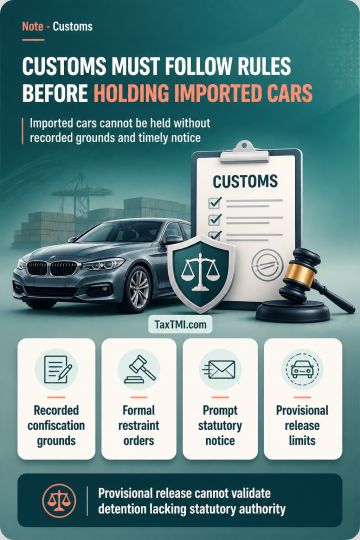
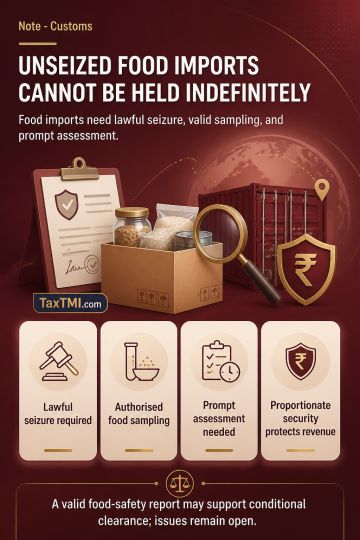
The power to seize imported goods under Section 110 of the Customs Act, 1962 arises only where the proper officer has "reason to believe" that the goods are liable to confiscation.
A panchnama recording that an owner must not remove, part with, or deal with a car is not, by itself, a substitute for the statutory seizure order or for the written restraining order contemplated by the provisos to Section 110(1).
Where physical seizure is impracticable, the statutory alternatives require a recorded and communicated order. The officer must also address the particular statutory condition that makes physical custody or seizure impracticable.
Section 110(2) ordinarily requires return of goods if notice under Section 124(a) is not issued within six months of seizure. The period may be extended only once, for a further period not exceeding six months, by the specified senior authority for recorded reasons and with prior intimation to the affected person.
The ruling in 2026 (8) TMI 1499 - GUJARAT HIGH COURT holds that the department cannot retain an imported car under the label of detention for an extended period and later issue a seizure memo so as to avoid the statutory discipline governing seizure and notice.
Provisional release under Section 110A is a distinct, discretionary mechanism available only in respect of goods seized under Section 110. It does not validate an antecedent detention that is without statutory authority.
Seizure under customs law is a coercive statutory measure. It interferes with an importer's possession and ability to use or deal with imported goods, while preserving the department's ability to pursue confiscation proceedings. The statutory scheme consequently requires both a jurisdictional basis and a defined procedural path.
The central issue in 2026 (8) TMI 1499 - GUJARAT HIGH COURT was whether an imported car, already cleared after assessment, could be kept under a panchnama restraint for more than a year, followed by a formal seizure memo and a notice proposing confiscation. The taxpayer had been directed not to deal with or part with the car during enquiry. A formal seizure memo under Section 110(1) and a notice under Section 124 were issued only subsequently.
The court treated the prolonged restraint as an actual detention. It held that the Customs Act does not permit the investigating authority to hold goods indefinitely in the guise of detention, without employing the statutory safeguards that govern seizure or a restraint order where seizure is impracticable. The court therefore directed release of the car and held the later provisional-release conditions to be unlawful on the facts before it.
The decision is significant because a car is ordinarily retained through a restriction on its use or transfer rather than through immediate removal to a customs warehouse. That practical feature does not dilute the statutory requirements. The nature of the goods may explain why physical removal is impracticable; it does not dispense with a lawful order, recorded satisfaction, or the temporal safeguards built into Section 110.
Section 110 of the Customs Act, 1962 authorises seizure only where "the proper officer has reason to believe that any goods are liable to confiscation under this Act". Thus, the belief must concern statutory liability to confiscation; a general desire to enquire, verify documents, or keep goods available does not by itself answer the statutory test.
The first proviso applies where it is not practicable "to remove, transport, store or take physical possession of the seized goods". In that event, custody may be left with the owner, beneficial owner, person holding out as importer, or the person from whose custody the goods were seized, but this is conditional upon execution of an undertaking that the goods will not be removed, parted with, or otherwise dealt with without prior permission.
The second proviso addresses the separate situation where it is not practicable to seize the goods. The proper officer may then serve an order upon the relevant person directing that the goods shall not be removed, parted with, or otherwise dealt with except with prior permission. The distinction matters: the first proviso contemplates seized goods left in custody under an undertaking, whereas the second contemplates a served order when seizure itself is impracticable.
Section 110(2) provides that where goods are seized under Section 110(1) and no notice under Section 124(a) is given within six months of seizure, "the goods shall be returned to the person from whose possession they were seized." The first proviso permits the Principal Commissioner or Commissioner, for reasons recorded in writing, to extend the period by no more than a further six months and to inform that person before the original period expires.
Section 124 supplies the procedural content of the required notice. No confiscation order or penalty can be made unless the owner or affected person is given a written notice, with the prescribed prior approval, informing that person of the grounds on which confiscation or penalty is proposed; a reasonable time to make a written representation; and a reasonable opportunity of being heard.
The supplied text of Section 110(2) also contains a second proviso stating that, where an order of provisional release has been passed under Section 110A, "the specified period of six months shall not apply." This statutory qualification must be read when examining the consequence of a valid provisional-release order. In the case under discussion, however, the court found the provisional-release order itself unlawful on the facts and did not allow a later release order to cure the preceding prolonged detention.
Section 110A of the Customs Act, 1962 provides that goods, documents or things "seized under section 110" may, pending the adjudicating authority's order, be released to the owner upon a bond in the proper form and such security and conditions as the adjudicating authority may require. The provision presupposes a seizure under Section 110. It is not an independent source of power to regularise a mere detention or to require security for goods that were not lawfully seized.
Instruction No. 01/2017-Customs directly addresses the recurring practice of holding up goods only under a panchnama. It states that a panchnama is a statement by panch witnesses and cannot be treated as an order passed by the proper officer under Section 110. The instruction requires that, whenever goods are seized, the proper officer must, in addition to the panchnama, pass an appropriate seizure memo or order "clearly mentioning the reasons to believe that the goods are liable for confiscation."
For cases where seizure is impracticable, the instruction reiterates the need for a served order restraining removal, parting with, or dealing in the goods, and directs that investigation be fast-tracked to determine whether goods should be seized or released. It further states that its prescribed timelines must be strictly followed notwithstanding provisional release. The instruction reinforces procedural discipline, though its operation remains subject to the statutory text of Section 110(2), including its provisos.
The court in 2026 (8) TMI 1499 - GUJARAT HIGH COURT treated the restraint recorded in the panchnama as actual detention because the taxpayer was deprived of the practical ability to deal with the imported car. There was neither an undertaking under the first proviso to Section 110(1) nor a served written order under the second proviso explaining why seizure was impracticable. The subsequent formal seizure memo, issued after the prolonged restraint, could not enable the department to reap the benefit of its earlier inaction.
The court held that the officer must satisfy a two-fold obligation before resorting to statutory control over the goods: first, explicitly record reasons that the goods are liable to confiscation; and second, record clear satisfaction as to the particular impracticability contemplated by the relevant proviso. A panchnama cannot independently satisfy these ingredients. On that reasoning, time was held to run from the actual detention rather than from the department's belated seizure memo.
2016 (7) TMI 1164 - DELHI HIGH COURT separately analysed the distinction between detention and seizure. It held that a panchnama stating that goods should not be removed or dealt with was not a statutory restraint order under the proviso to Section 110(1). A valid seizure requires the proper officer to record, before seizure, reasons to believe that the goods are liable to confiscation. The decision treated continued detention without a lawful seizure order as without authority of law. This reasoning was expressly applied in the principal ruling to an imported car.
2011 (2) TMI 417 - CALCUTTA HIGH COURT likewise held that goods cannot be detained indefinitely without a formal Section 110 order. It recognised the authority's power to investigate and, where justified, to detain or seize, but made clear that the statutory limitation in Section 110(2) cannot be circumvented by retaining goods without a specific order. The decision also explains that a notice purporting to extend the Section 110(2) period cannot operate without an antecedent valid seizure or detention order under Section 110.
The Supreme Court formulation reproduced in the principal ruling states that, once a car is seized under Section 110(1), absence of a Section 124(a) notice within six months requires return of the car. The period may be extended by no more than six further months only by the Principal Commissioner or Commissioner, for recorded reasons and with intimation to the person concerned before expiry of the original period. If no notice is issued even within the permissible extended period, release follows.
2024 (2) TMI 686 - DELHI HIGH COURT applied a comparable approach where detention receipts had been issued but the statutory show-cause notice was not issued in time. It held that the Customs Act does not recognise detention as a means of escaping the consequences of seizure. On the facts, the detention receipts were treated in substance as seizure, and release followed under Section 110(2), without prejudice to other action permissible in law.
2020 (12) TMI 329 - BOMBAY HIGH COURT independently held that imported goods cannot be withheld indefinitely without seizure. It emphasised that Section 110(2), read with Section 124(a), fixes the statutory framework within which the confiscation process must proceed and that detention cannot be used to evade those temporal consequences. Release of goods, however, does not foreclose lawful investigation or proceedings that remain otherwise available.
2020 (1) TMI 113 - PATNA HIGH COURT explains that "reason to believe" must be founded on objective material and reasonable grounds, rather than suspicion, assertion, or general trade practice. Reasons must be evident from the seizure record and the material before the officer; later explanations cannot be used to supplement a deficient public order. This is an important protection where post-clearance action against an imported car is based on valuation, description, origin, or alleged import irregularities.
2024 (8) TMI 1161 - PATNA HIGH COURT illustrates the corresponding qualification. It held that a separately narrated expression of "reasons to believe" is not invariably indispensable if the seizure memo itself identifies the statutory provisions alleged to have been violated and the relevant circumstances disclose the basis of action. Whether the statutory recital is sufficient will depend on the contents of the seizure memo and the factual record. This does not dispense with the requirement of objective grounds; it concerns the adequacy of their communication in the seizure record.
2007 (12) TMI 173 - HIGH COURT MADRAS reached a different result on its facts. It held that initial detention following interception did not amount to seizure, because formal seizure occurred later and the notice was issued within six months from that formal seizure. The distinction drawn was between temporary custody for enquiry and deprivation of possession through a procedurally completed seizure.
The principal ruling does not erase that distinction. Rather, it holds that the distinction cannot be invoked where the department has effectively immobilised goods for a prolonged period through a panchnama restraint, without a lawful order under either proviso to Section 110(1), and thereafter attempts to commence the statutory clock by issuing a late seizure memo. The character, content, duration, and legal basis of the restraint are therefore decisive.
Circular No. 35/2017-Customs states that provisional release may normally be considered upon the owner's request, subject to a bond for full or estimated value and security covering duty or differential duty, potential fine, and potential penalty. It also identifies categories in which provisional release was stated not to be allowed, including prohibited goods, goods lacking statutory compliance, goods specified or notified under Section 123, and cases where recorded reasons show that release is not in public interest.
In the principal ruling, the court recorded that paragraph 2 of this circular, to the extent it curtailed adjudicatory discretion, had been set aside by the Delhi High Court. It strongly deprecated reliance on that paragraph to impose the conditions for provisional release of the car. The ruling underscores that security conditions under Section 110A must follow a lawful seizure and a legally sustainable exercise of adjudicatory discretion; they cannot be mechanically imposed by treating administrative guidance as conclusive.
For importers and owners of vehicles, a panchnama, detention memo, seizure memo, undertaking, and any order under the provisos to Section 110(1) should be examined as separate instruments. Their legal effect cannot be assumed merely from the label used by the department.
The record should disclose: the officer's reasons to believe; the alleged confiscation basis; the date and manner of seizure or restraint; why physical seizure was impracticable, if that is asserted; and whether the owner was served with the statutory order or required to execute an undertaking.
The six-month period under Section 110(2), the date of a Section 124(a) notice, and the validity of any extension must be tracked carefully. An extension requires recorded reasons, must not exceed six months, and must be communicated before the original period expires.
A request for provisional release should identify the statutory foundation under Section 110A, address the stated revenue risk, and challenge conditions that lack a case-specific basis. A provisional-release request does not concede the validity of the seizure or foreclose a challenge to unlawful detention.
For the department, the safer course is to make a prompt, reasoned decision: issue a valid seizure order with recorded reasons, serve a lawful restraint order where seizure is impracticable, or release the car. Prolonged informal restraint creates a serious risk that the detention itself will be treated as triggering the statutory protections.
The statutory safeguards against seizure of an imported car are substantive and procedural. Section 110 requires a proper officer's recorded "reason to believe" that the car is liable to confiscation. Where physical seizure cannot practicably occur, the provisos prescribe specific alternatives: custody on an undertaking after seizure, or a served non-dealing order where seizure is impracticable.
Section 110(2) and Section 124 connect possession-based coercive action to prompt commencement of confiscation proceedings. The ordinary consequence of failure to issue the prescribed notice within time is return of the seized goods, subject to the statutory extension mechanism and the expressly stated qualification concerning a valid Section 110A provisional-release order.
The principal ruling establishes that the department cannot keep a car under an unstructured restraint for a substantial period and then use a delayed seizure memo to reset the statutory framework. The legality of the measure depends on its real effect, the recorded statutory basis, compliance with the prescribed form of control, and observance of the safeguards governing notice, release, and provisional release.
Full Text:

