 TaxTMI
Login
 TaxTMI

Login
Loading...
Press 'Enter' to add multiple search terms. Rules for Better Search

Press 'Enter' after typing page number.
Press 'Enter' after typing page number.


No Folders have been created
Are you sure you want to delete "My most important" ?
NOTE:
Press 'Enter' after typing page number.




Press 'Enter' after typing page number.

All TMI Notes
Press 'Enter' after typing page number.
All TMI Notes

Note

Bookmark

Share


This is a neutral professional article. The judgment is analysed in the context of its factual background, issues framed, and conclusions reached by the Court.
2026 (8) TMI 1363 - GSTAT THIRUVANANTHAPURAM
Input tax credit is available only subject to the eligibility conditions and restrictions under Section 16 of the Central Goods and Services Tax Act, 2017. Section 16(1) permits a registered person, subject to prescribed conditions and restrictions, to take credit of input tax charged on supplies used or intended to be used in the course or furtherance of business. Section 16(2) imposes further conditions, including possession of the prescribed tax document, receipt of goods or services, payment of tax to the Government, and furnishing of the return.
The fact that credit may ultimately be found ineligible under Section 16, or may require restriction or reversal under Section 17 of the Central Goods and Services Tax Act, 2017, does not by itself answer the separate question whether the enhanced consequences under Section 74 can be invoked. Section 17 restricts credit to the business or taxable-supply attribution where inputs or input services have mixed use, and Section 17(5) identifies specified blocked credits. Eligibility is thus a substantive ITC issue; fraud, wilful misstatement and suppression concern the statutory basis for a Section 74 proceeding.
In 2026 (8) TMI 1363 - GSTAT THIRUVANANTHAPURAM, the controversy arose from an audit-based allegation of excess ITC. The notice treated the taking of allegedly ineligible self-assessed credit, referred to as being under Section 42(1), as suppression of facts and invoked Section 74. The adjudicating authority found that the relevant reconciliation had already been disclosed through annual-return filings and that the notice did not establish fraud, wilful misstatement, or suppression. The appellate authority reversed that conclusion by relying, among other matters, on an alleged non-response to audit communications. The Tribunal set aside the appellate order.
The decision is significant because it separates an allegation of erroneous or ineligible ITC from the distinct and more exacting statutory ingredients necessary to invoke Section 74. It also addresses the evidentiary importance of disclosures in returns, statements and reconciliations, and the limits imposed by the show cause notice on subsequent adjudication and appellate review.
Section 74 of the Central Goods and Services Tax Act, 2017 applies to determination of tax pertaining to periods up to Financial Year 2023-24. The material part of Section 74(1) provides that where it appears to the proper officer that tax has not been paid, short paid or erroneously refunded, or ITC has been wrongly availed or utilised, "by reason of fraud, or any wilful-misstatement or suppression of facts to evade tax", the officer shall issue a notice requiring the noticee to show cause against payment of the specified amount, interest under Section 50, and penalty equivalent to the tax specified in the notice.
The provision carries a distinct procedural and penal framework. Section 74(2) requires notice to be issued at least six months before the deadline for the order. Under Section 74(10), the order must be issued within five years from the due date for furnishing the annual return for the relevant financial year, or within five years from the date of an erroneous refund. Section 74(5), Section 74(8) and Section 74(11) prescribe payment-based closure mechanisms with penalties of fifteen per cent before notice, twenty-five per cent within thirty days of notice, and fifty per cent within thirty days of communication of the order, respectively.
Accordingly, the statutory words connecting wrongful ITC with "fraud", "wilful-misstatement" or "suppression of facts to evade tax" are not surplusage. They define the foundation on which the Section 74 route, its extended determination period and its enhanced penalty structure may be adopted.
For the period in which Explanation 2 was in force, it stated that "suppression" meant "non-declaration of facts or information which a taxable person is required to declare in the return, statement, report or any other document furnished under this Act or the rules made thereunder, or failure to furnish any information on being asked for, in writing, by the proper officer." The supplied statutory text records that Explanation 2 has since been omitted. The decision under discussion applies the definition as it operated for the proceedings concerned.
The two limbs of the historical definition require precision. The first turns on an identifiable fact or information that the taxable person was legally required to declare in a prescribed return, statement, report or other document. The second turns on a written requisition by the proper officer and a failure to furnish the information so sought. In either event, the definition operates within Section 74(1), whose text requires fraud, wilful misstatement or suppression "to evade tax".
Section 42 of the Central Goods and Services Tax Act, 2017 now stands omitted. Its erstwhile Section 42(1) provided for matching of details of every inward supply furnished by the recipient with corresponding outward-supply details furnished by the supplier, import IGST data, and duplicate ITC claims. The mere reference to Section 42(1) in an ITC dispute cannot, by itself, create a presumption that an erroneous claim was knowingly made or that facts were suppressed. The statutory requirements of Section 74 remain independently required.
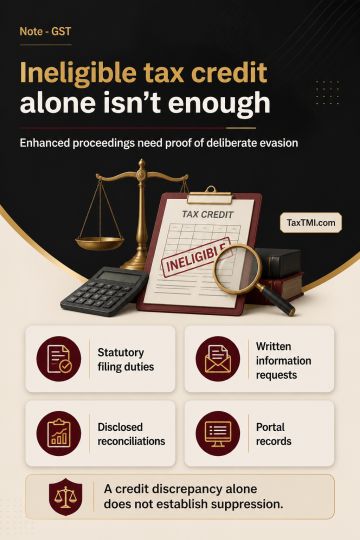
The central holding in 2026 (8) TMI 1363 - GSTAT THIRUVANANTHAPURAM is carefully qualified but clear: in the absence of other contrary evidence, mere taking of ineligible self-assessed ITC in the electronic credit ledger does not amount to suppression within Section 74(1). The Tribunal found that the show cause notice was founded on bare propositions that excess or ineligible credit itself amounted to suppression and that it was availed with mala fide intent. It contained no material establishing that the taxpayer knew the credit was ineligible and nevertheless took it in a contumacious act.
The Tribunal treated the burden as resting on the department to allege and establish the relevant statutory ingredients with evidence. Every transgression of Section 16(2) or the erstwhile Section 42(1) cannot be elevated into Section 74 action. There must be clear and categorical material that the transgression resulted from fraud, wilful misstatement, or suppression of facts with intent to evade tax. The Tribunal also noted the applicable departmental instruction placed before it: Section 74(1) cannot be invoked merely because GST was not paid, and material evidence of fraud, wilful misstatement or suppression to evade tax must both exist and form part of the show cause notice.
The Tribunal gave substantial weight to the factual finding that invoice-wise reconciliation concerning the alleged ITC difference had been uploaded with annual-return and GSTR-9C filings and was available on the common portal. Where the reconciliation is part of the statutory record, an allegation that the taxpayer failed to declare the very information must identify what required disclosure was absent and why the filed material did not meet that requirement. The appellate authority had not displaced the finding that the reconciliation was already disclosed.
This approach is consistent with 2013 (3) TMI 44 - CESTAT KOLKATA. There, disclosure of the quantum of credit in periodic returns, coupled with the absence of a prescribed requirement to furnish service-wise particulars in those returns, was held insufficient to establish suppression. The department could call for particulars and scrutinise the declaration; failure to include information not required by the return did not, without a positive act and intent to evade, justify the extended period.
Likewise, 2016 (9) TMI 89 - CESTAT CHENNAI distinguished the merits of credit eligibility from limitation. Although the credit was held ineligible, the extended period was rejected because the availment was reflected in returns and there was no demonstration of deliberate suppression or mala fide intent. The authority confirms that ineligibility of credit and suppression are legally distinct conclusions.
In 2019 (5) TMI 129 - CESTAT CHENNAI, the extended period was similarly held unavailable where credit availment had been disclosed in returns and the taxpayer had made an advance intimation of its intended credit position. The case illustrates that disclosure and the absence of material showing intent may independently defeat an allegation of suppression, even if the department disputes entitlement to credit.
The decision in 2026 (8) TMI 1363 - GSTAT THIRUVANANTHAPURAM also rejects the proposition that a mere failure to reply to an audit enquiry or final audit report necessarily constitutes suppression. First, the Tribunal held that this allegation was not part of the show cause notice. Secondly, the appellate order did not identify the information sought, the time at which it was sought, or the statutory provision under which it was sought. Thirdly, the statutory records and reconciliation were already available on the portal. On those facts, a non-response could not, without more, establish suppression.
2023 (8) TMI 995 - CESTAT NEW DELHI reinforces the proposition that a self-assessment regime does not itself convert an ordinary omission, interpretative disagreement or audit detection into wilful suppression. The authority emphasised that suppression must be deliberate and intentional, and that shortcomings in scrutiny do not relieve the department of its obligation to establish the mens rea necessary for extended limitation.
2017 (10) TMI 786 - CESTAT BANGALORE also held that regular return filing and departmental awareness during audit negated suppression with intent. Its relevance lies in the distinction between a demand arising after audit and proof that the taxpayer intentionally concealed material facts. Audit detection alone is not proof of the latter.
The principle is not that return disclosure invariably immunises a taxpayer from Section 74 or extended-period action. 2021 (8) TMI 127 - CESTAT NEW DELHI represents a materially different factual conclusion. The Tribunal found that the taxpayer had not disclosed the impugned credit until the departmental audit raised the issue, reversed the credit only after the query, and admitted that the credit was wrongly taken. On that factual foundation, the conduct was treated as suppression with intent to evade duty, and the extended period and penalty were sustained.
This authority demonstrates the evidentiary distinction. A finding of suppression cannot be based solely on the legal conclusion that credit was ineligible. But it may be sustained where the record establishes non-disclosure of material facts, post-detection reversal or admission, and facts from which deliberate concealment and intent can properly be inferred.
In 2026 (8) TMI 1363 - GSTAT THIRUVANANTHAPURAM, the Tribunal found that the appellate order impermissibly adopted a new foundation: alleged failure to supply information during audit. As the show cause notice had rested on the alleged act of taking ineligible ITC, the taxpayer was not put to notice of a separate case based on written requisitions and audit non-compliance. The appellate authority could not cure the evidentiary and pleading deficiencies of the notice by introducing a new basis for Section 74.
2015 (2) TMI 1297 - CESTAT MUMBAI is also relevant on the consequences of an interpretative credit dispute. Credit on the disputed items was held inadmissible on merits, but extended-period demands were set aside because periodic returns and audits did not show fraud, collusion, wilful misstatement or suppression with intent. Thus, even an adverse decision on ITC eligibility does not eliminate the requirement to prove the special statutory ingredients for the extended route.
2025 (4) TMI 565 - CESTAT BANGALORE similarly held that transactions recorded in returns and books, and subjected to audit, did not support invocation of the extended period in the absence of misstatement or wilful suppression with intent. The authority confirms that regular documentation and disclosure are probative on the issue of intent, although their effect will necessarily depend on the complete factual record.
Full Text:

