 TaxTMI
Login
 TaxTMI

Login
Loading...
Press 'Enter' to add multiple search terms. Rules for Better Search

Press 'Enter' after typing page number.
Press 'Enter' after typing page number.


No Folders have been created
Are you sure you want to delete "My most important" ?
NOTE:
Press 'Enter' after typing page number.









Press 'Enter' after typing page number.

All TMI Notes
Press 'Enter' after typing page number.
Press 'Enter' after typing page number.
All TMI Notes

Note

Bookmark

Share


This is a neutral professional article. The judgment is analysed in the context of its factual background, issues framed, and conclusions reached by the Court.
2026 (10) TMI 404 - CESTAT HYDERABAD
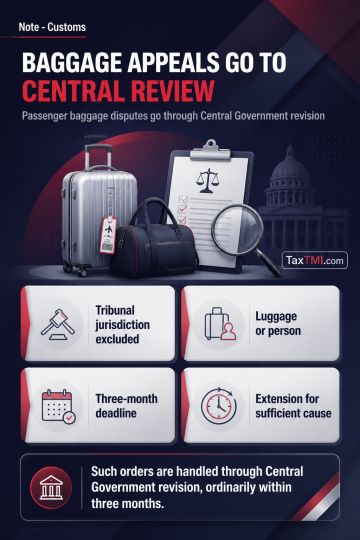
The first proviso to Section 129A of the Customs Act, 1962 creates a forum-specific bar: no appeal lies to the Appellate Tribunal, and the Tribunal has no jurisdiction to decide an appeal, against an order of the Commissioner (Appeals) under section 128A where that order relates to goods imported or exported as baggage. The statutory alternative is revision by the Central Government under Section 129DD of the Customs Act, 1962.
In 2026 (10) TMI 404, the Tribunal applied this exclusion to gold chains brought into India by an arriving international passenger. The fact that the articles were recovered from the passenger's person, the dispute involved alleged non-declaration, or the proceedings concerned confiscation and penalty did not alter the jurisdictional character of the matter. Those issues went to merits; they did not determine the appellate forum.
The decisive enquiry is whether the impugned order under section 128A truly relates to goods imported or exported as baggage. If it does, the Tribunal cannot entertain the appeal. However, the supplied authorities also demonstrate that the bar is not attracted merely because an article was physically found in luggage or on a traveller. Currency, proceedings founded on an independent export prohibition, and goods found in circumstances disconnected from an international baggage import may raise a distinct jurisdictional question.
Customs adjudication may culminate in confiscation, redemption consequences, duty demand or penalty. The ordinary appellate route from an order of the Commissioner (Appeals) is regulated by section 129A. That route is expressly curtailed for the defined class of matters stated in the first proviso to section 129A(1), including orders relating to goods imported or exported as baggage.
The statutory distinction is important because jurisdiction cannot be conferred by the nature of the merits urged. A plea that goods were personal effects, were not liable to duty, were not required to be declared, were improperly confiscated, or were entitled to redemption concerns the correctness of the underlying customs action. It does not, by itself, displace an exclusion that depends on the subject matter of the order and the mode in which the goods entered or left India.
The decision in 2026 (10) TMI 404 arose from an order of the Commissioner (Appeals) concerning confiscation of gold chains carried by an arriving passenger. The Tribunal sustained the preliminary jurisdictional objection, held that the goods were imported as baggage, and directed return of the appeal papers to enable recourse to the revisional remedy. It did not decide the merits of confiscation or penalty.
Section 2 of the Customs Act, 1962 supplies the relevant statutory concepts. Section 2(3) states that baggage includes unaccompanied baggage but does not include motor vehicles. Section 2(22) treats both baggage and currency and negotiable instruments as separate inclusions within the wider definition of goods. This separate enumeration assumes significance where the disputed subject matter is currency rather than baggage.
Section 2(23) defines import as bringing into India from a place outside India. Section 2(25) defines imported goods as goods brought into India from a place outside India, excluding goods that have been cleared for home consumption. Read together, these provisions support the characterisation of articles brought by an international passenger and not cleared for home consumption as imported goods; whether they are baggage for the forum provision remains dependent on the character of the transaction and order.
Section 129A(1) permits an appeal to the Appellate Tribunal against, among other orders, an order passed by the Commissioner (Appeals) under section 128A. The first proviso then provides that no appeal shall lie to the Appellate Tribunal and the Appellate Tribunal shall not have jurisdiction to decide any appeal in respect of an order under clause (b), where the order relates to any goods imported or exported as baggage.
The drafting is prohibitory as well as jurisdictional. It does not merely regulate the manner in which an appeal should be filed. Once the proviso is attracted, the Tribunal is precluded from deciding the appeal. The proviso also covers short-landed goods and drawback matters, but those categories do not govern a passenger-baggage dispute.
Section 129DD(1) provides that the Central Government may, on the application of a person aggrieved by an order under section 128A which is of the nature referred to in the first proviso to section 129A(1), annul or modify that order. Thus, section 129DD operates as the corresponding statutory remedy for a baggage-related order excluded from the Tribunal's appellate jurisdiction.
Under section 129DD(2), the revision application must be made within three months from communication of the impugned order. The Central Government may permit presentation within a further period of three months if sufficient cause prevented timely filing. Section 129DD(3) prescribes a fee of two hundred rupees where the duty, interest, fine or penalty does not exceed one lakh rupees, and one thousand rupees where it exceeds that amount.
In 2026 (10) TMI 404, the Tribunal held that gold chains brought by an international passenger remained goods imported as baggage for purposes of the first proviso to section 129A(1). Recovery from a trouser pocket rather than checked-in baggage did not alter that conclusion. Equally, questions of personal use, concealment, invoice, declaration and intention to evade duty were characterised as merits issues which could not change the prescribed appellate forum. The appeal papers were returned for pursuit of revision under section 129DD.
2022 (10) TMI 100 is central to the treatment of jewellery worn on the person. It held that the applicable Baggage Rules, 2016 expressly extend the baggage regime to articles carried on the person, including jewellery. The statutory fiction had to receive full effect. Consequently, an appeal concerning such jewellery fell within the section 129A(1) exclusion, and the revisional remedy was preserved without adjudicating confiscation merits.
2026 (8) TMI 533 similarly treated the nature of the goods and the order as the jurisdictional determinants. It held that disputes about interception, declaration, passenger eligibility, confiscation and penalty cannot overcome the express exclusion once the case concerns gold chains brought as passenger baggage. The Tribunal returned the papers without expressing a view on merits.
In 2026 (1) TMI 439, a plea that a gold chain was a bona fide personal effect and did not require declaration was held insufficient to establish Tribunal jurisdiction. Whether the article was a personal effect or a dutiable gold import, the Tribunal regarded it as part of the passenger's baggage. The dispute therefore remained within the section 129A(1) proviso.
2025 (6) TMI 1190 applied the same result to orders made under the baggage provisions. It construed the proviso literally and held that the appeal had to be pursued before the appropriate Revisional Authority. The decision also left any issue concerning computation of limitation following pursuit before the wrong forum for consideration by that authority.
2023 (8) TMI 64 held that dutiable gold concealed on an arriving passenger remained baggage notwithstanding denial of any baggage-rule concession. Ineligibility for a duty concession was distinguished from the intrinsic character of the goods as baggage. The consequence was absence of Tribunal jurisdiction and availability of revision.
2023 (7) TMI 1191 separately held that gold jewellery and bars detected on a passenger before customs clearance constituted baggage imported into India. It reasoned that exclusion from a baggage allowance does not convert baggage into non-baggage for section 129A purposes. The appeal was therefore held not maintainable before the Tribunal.
In 2024 (12) TMI 176, the Tribunal applied the proviso to a baggage-related seizure and returned the appeal for presentation before the proper forum. This demonstrates that return of the papers, rather than an examination of merits, may be the appropriate procedural outcome where lack of jurisdiction is identified.
2022 (1) TMI 521 dealt with goods found in a baggage search. It held that the express wording of the proviso removes the Tribunal's jurisdiction and identified section 129DD revision as the alternative statutory remedy.
2016 (8) TMI 393 treated baggage classification and the revisionary remedy as determinative of maintainability. The decision emphasised that the presence of confiscation issues, restrictions and the importer's burden in relation to the goods did not authorise the Tribunal to decide a baggage appeal.
2025 (10) TMI 1081 treated seizure and confiscation of gold recovered from a passenger and luggage after international travel as a baggage case. It declined to examine merits after holding that an appeal from the Commissioner (Appeals) could not lie to the Tribunal.
2023 (4) TMI 1486 reached the same jurisdictional conclusion for a dispute concerning export of foreign currency as baggage. It held that the proper statutory route was before the Revisional Authority and granted liberty to pursue that remedy.
In 2010 (8) TMI 815, the Tribunal declined jurisdiction even though the appeal had been heard and the jurisdictional point had not initially been raised. The ruling reflects the settled procedural proposition that a statutory want of subject-matter jurisdiction cannot be cured by the parties' omission.
2011 (11) TMI 630 upheld the view that the proviso unequivocally removes Tribunal jurisdiction over baggage-related orders. It also found no legal infirmity in the Tribunal acting on the jurisdictional bar at the stage at which it was noticed.
1992 (4) TMI 140 held, by majority, that even goods ultimately treated as commercial rather than bona fide baggage did not cease to be goods imported as baggage for the forum provision. The manner in which the goods were presented and imported was material; later treatment for confiscation did not displace the statutory exclusion.
2018 (8) TMI 1530 held that gold chains worn on the person were baggage rather than personal effects under the applicable regulatory scheme, because jewellery was excluded from the stated personal-effects category. This supported the conclusion that the Tribunal lacked jurisdiction.
2012 (9) TMI 824 held that gold in passenger baggage within the customs area and not cleared for home consumption continued to be imported goods. The assertion that non-declared goods were smuggled rather than baggage did not permit the appeal to bypass the section 129A proviso.
2024 (12) TMI 1156 adopted a narrower approach and held that a dispute substantially concerning assessment and its consequences remained within Tribunal jurisdiction. It rejected the preliminary objection and entertained the appeal. In 2026 (10) TMI 404, that approach was treated as distinguishable because it adopted a restrictive construction of baggage in the assessment and confiscation context. The latter decision applied the express statutory exclusion to the passenger-import facts before it.
2002 (12) TMI 390 distinguished currency from baggage. Since section 2(22) separately enumerates baggage and currency within goods, and the proceedings were founded on attempted export and misdeclaration, the Tribunal held that the baggage exclusion did not apply. 2010 (12) TMI 1335 affirmed the same distinction: currency notes do not become baggage merely because they are found in baggage. These authorities show that physical location is not always conclusive; the legal character of the subject matter and proceedings remains critical.
2023 (10) TMI 324 held that proceedings based on attempted export contrary to prohibition, rather than on a baggage-rule or baggage-declaration contravention, did not fall within the limited section 129A exclusion. The Tribunal could therefore exercise jurisdiction. The authority illustrates that an order must genuinely relate to baggage, and cannot be excluded solely because the goods were associated with a traveller.
2025 (4) TMI 463 drew a further factual distinction between an international arrival and goods recovered from persons arriving on domestic legs of travel. It held that the baggage presumption did not automatically extend to the domestic-arrival cases, whereas jewellery found on an international passenger remained baggage under the applicable rules. The department's burden to establish the factual basis for treating goods as baggage was thereby preserved in the domestic setting.
The first proviso to section 129A(1) is an express exclusion of Tribunal jurisdiction over an order of the Commissioner (Appeals) relating to goods imported or exported as baggage. Section 129DD is the corresponding statutory mechanism for revision before the Central Government.
For international passenger imports, goods carried in checked-in baggage, hand baggage or on the person may fall within the baggage category. Their alleged concealment, non-declaration, dutiability or ineligibility for concession does not ordinarily change the forum analysis.
The characterisation must nevertheless be legally and factually exact. The distinct statutory treatment of currency, an order founded on non-baggage export prohibition, and circumstances lacking a demonstrated international baggage nexus may keep the Tribunal's appellate jurisdiction available. The jurisdictional question must therefore be resolved from the statutory language, the impugned order and the actual nature of the customs proceedings.
Full Text:

