Loading...

⚠ ✕
❮ Top
☎ Help
☰
×

By creating an account you can:

Logo TaxTMI
Call Us / Help / Feedback✕

Contact Us At :

✉ E-mail: [email protected]

✆ To Call / Whatsapp, Check Contact Us

FAQs :

To know Frequently Asked Questions, Check FAQs

Most Asked Video Tutorials :

For more tutorials, Check Video Tutorials

Submit Feedback/Suggestion :

Email :
Please provide your email address so we can follow up on your feedback.
Category :
Description :
Min 15 characters 0/2000
Make Most of Text Search ✕
  1. Checkout this video tutorial: How to search effectively on TaxTMI.
  2. Put words in double quotes for exact word search, eg: "income tax"
  3. Avoid noise words such as : 'and, of, the, a'
  4. Sort by Relevance to get the most relevant document.
  5. Press Enter to add multiple terms/multiple phrases, and then click on Search to Search.
  6. Text Search
  7. The system will try to fetch results that contains ALL your words.
  8. Once you add keywords, you'll see a new 'Search In' filter that makes your results even more precise.
  9. Text Search
╳
Add to...
You have not created any category. Kindly create one to bookmark this item!
✕
Create New Category
Hide
Title :
Description :
❮❮ Hide
❮ Default View
Expand ❯❯
Close ✕
🔎 Filters / Advanced Search ❯
TEXT

Press 'Enter' to add multiple search terms. Rules for Better Search

Search In
Main Text + AI Text ❯
  • Main Text
  • Main Text + AI Text
  • AI Text
Law:
---- All Laws---- ❯
  • ---- All Laws----
  • Benami Property
  • Bill
  • Central Excise
  • Companies Law
  • Customs
  • DGFT
  • FEMA
  • GST
  • GST - States
  • IBC
  • Income Tax
  • Indian Laws
  • Money Laundering
  • SEBI
  • SEZ
  • Service Tax
  • VAT / Sales Tax
Types:
---- All Types ---- ❯
  • ---- All Types ----
  • Act Rules
  • Case Laws
  • Circulars
  • Manuals
  • News
  • Notifications
Sort By: ?
In Sort By 'Default', exact matches for text search are shown at the top, followed by the remaining results in their regular order.
Relevance Default Date
☰   Show Results ❯
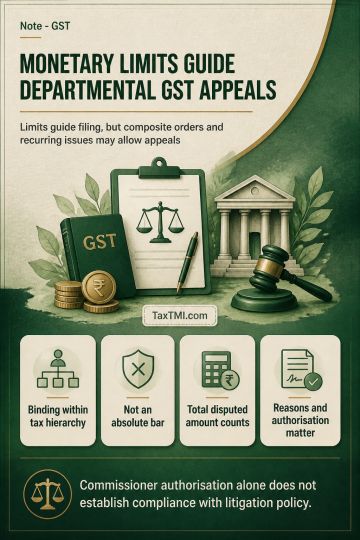
    Monetary Limits for Departmental GST Appeals under Section 120 and Circular No. 207/1/2024-GST
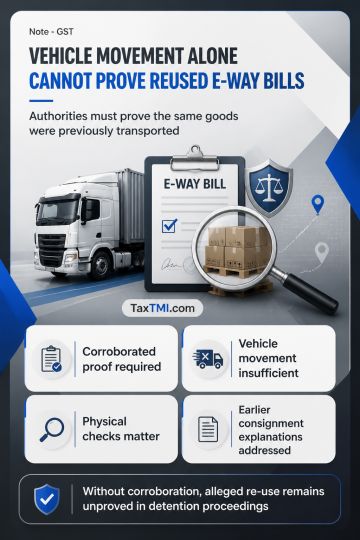
    Alleged Re-use of E-Way Bills under Section 129: Evidentiary Burden in Detention Proceedings
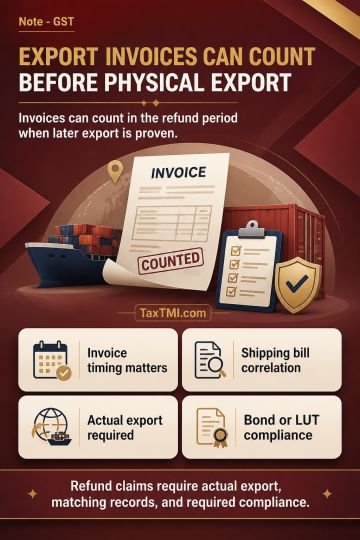
    Turnover of Zero-Rated Supply Under Rule 89(4): Invoice Period and Subsequent Physical Export
    Case Laws Income Tax
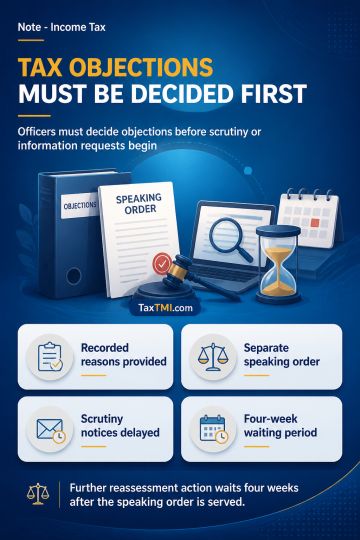
    Reassessment Proceedings: Speaking Disposal of Objections Before Scrutiny Under Sections 143(2) and ...
    Suppression of Facts under Explanation 2 to Section 74 of the CGST Act in Cases of Ineligible Input ...
    Case Laws Customs
    Classification of Low-Ethoxylated Non-Ionic Fatty Alcohol Ethoxylates under Headings 3402 and 3824
    Case Laws Customs
    Seizure and Detention of Imported Cars under Sections 110, 110A and 124 of the Customs Act, 1962
    Case Laws Companies Law
    Lifting the Corporate Veil Where Promoter Shareholding Is Allegedly Dissipated Despite Judicial Assu...
    Consolidated Show Cause Notices under Sections 73 and 74 and Taxability of School Affiliation Servic...
    Fraudulent Input Tax Credit from Non-Existent Suppliers: Application of Sections 16, 74 and 155 of t...
    Case Laws Money Laundering
    Prolonged Pre-Trial Incarceration and Bail under Section 45 of the Prevention of Money-Laundering Ac...
    Case Laws Income Tax
    Prospective Operation of Section 56(2)(x)(b) in Stamp-Value Difference Cases Involving Immovable Pro...
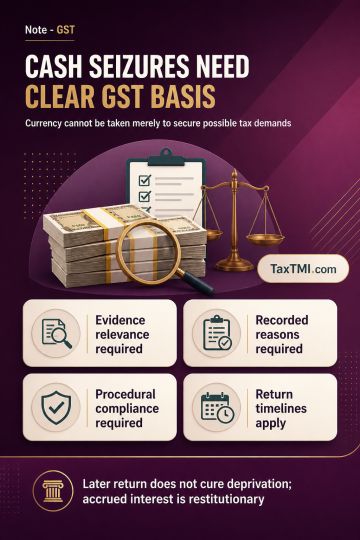
    Seizure of Cash under Section 67 of the CGST Act and Interest on Illegal Retention
    Case Laws Income Tax
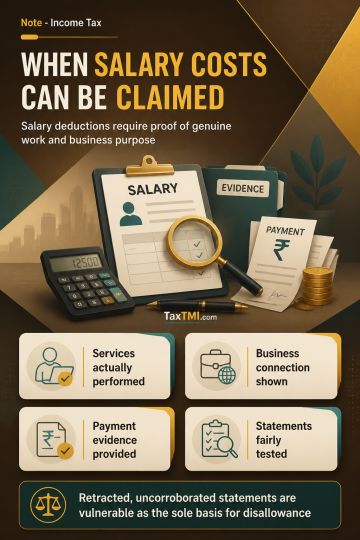
    Disallowance of Salary Expenditure for Allegedly Non-Genuine Services under Section 37
    Case Laws Income Tax
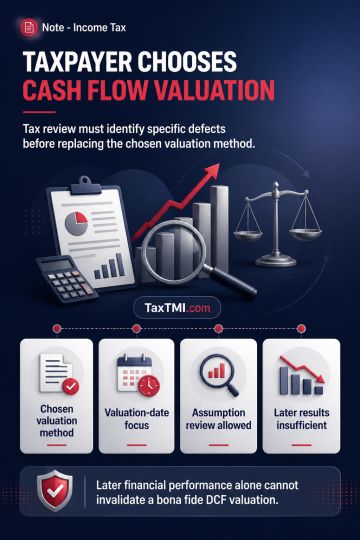
    Fair Market Value of Unquoted Equity Shares Under Section 56(2)(viib) and Rule 11UA
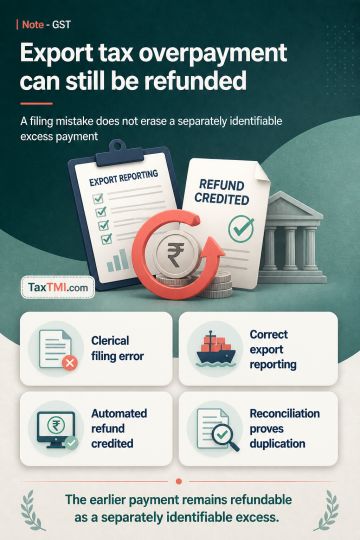
    Refund of Excess IGST Paid on Exports Following Clerical Error in FORM GSTR-3B
    Revocation of Cancellation of GST Registration for Non-Filing of Returns under Section 30 and Rule 2...
    Case Laws Income Tax
    TOLA, Section 149 and the Surviving-Time Test for Reassessment Proceedings
    Case Laws Customs
    Provisional Release of Unseized Imported Food Consignments under the Customs Act, 1962
    Case Laws Customs
    Recovery of Unpaid Anti-Dumping Duty After Self-Assessment Under Section 28 of the Customs Act, 1962
❮
❯
❯❯
Maximize Maximize Maximize
0 / 200
Expand Note
Add to Folder

No Folders have been created

+

Are you sure you want to delete "My most important" ?

NOTE:

Notes
Showing Results for :
Reset Filters
Results Found:
Show All Summaries Hide All Summaries
Case Laws GST
Show AI Summary
Departmental GST appeal monetary limits regulate officers, while composite orders and proven recurring issues may permit appeals.
Sections 120 and 168 of the Central Goods and Services Tax Act, 2017 make monetary-limit directions binding within the Central tax hierarchy, while they regulate the executive decision to file rather than create an inflexible jurisdictional bar before the Tribunal. In a composite order disposing of multiple appeals or demand notices, the relevant amount is the total disputed tax, interest, penalty or late fee, as applicable. The recurring or interpretative-issue exclusion requires a reasoned, case-specific basis, and Commissioner authorisation does not itself establish compliance with the litigation policy.
Case Laws GST
Show AI Summary
E-way bill re-use allegations require corroborated proof identifying the same goods; vehicle movement alone cannot establish contravention.
Alleged re-use of invoices and e-way bills requires the seizing authority to establish through positive, corroborated evidence that the intercepted goods are the same consignment previously transported under those documents. Toll data, vehicle movements and photographs may justify inquiry but do not alone prove prior delivery, identity of goods or re-use. Where invoices and e-way bills accompany the goods and physical verification shows no discrepancy, the authority must investigate and address any explanation of a different earlier consignment. Cases involving absent or expired transport documents remain factually distinct.
Case Laws GST
Show AI Summary
Zero-rated supply turnover includes export invoices from the refund period when actual export is subsequently established under bond or LUT.
Under Rule 89(4), invoice values for goods invoiced before or at removal for export under bond or Letter of Undertaking may be included in zero-rated turnover for the relevant refund period, although physical export occurs later. The invoice and removal determine period-wise attribution for the refund formula, while actual export remains essential to sustain the claim. Shipping bills, bills of export and related export records must correlate with the export invoices to establish that the goods were ultimately exported. Compliance with valuation, input tax credit eligibility and bond or Letter of Undertaking conditions remains necessary.
Case Laws Income Tax
Show AI Summary
Reassessment objections require speaking disposal and a four-week pause before scrutiny or information requests can begin.
Under the pre-amendment Section 148 framework, reassessment jurisdiction must be resolved before merits-stage scrutiny begins. The Assessing Officer must furnish recorded reasons when requested, permit objections, and decide them through a separate speaking order. A Section 143(2) notice commences scrutiny, while a Section 142(1) notice is a substantive inquiry step; neither may issue before objections are decided. Following rejection, a four-week period from service of the speaking order must be allowed before further reassessment action, preserving an effective opportunity to challenge reopening.
Case Laws GST
Show AI Summary
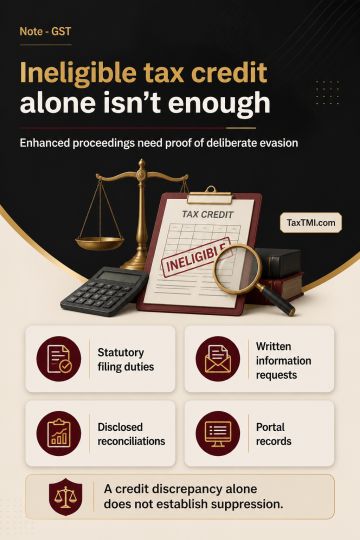
Suppression of facts requires proof of deliberate tax evasion; ineligible input tax credit alone cannot support enhanced proceedings.
Section 74 permits enhanced tax determination for wrongly availed or utilised input tax credit only where fraud, wilful misstatement, or suppression of facts to evade tax is established. Wrong or ineligible credit is distinct from substantive credit eligibility and cannot, without evidence of deliberate conduct and intent, amount to suppression. Under historical Explanation 2, suppression required either omitted information legally required in prescribed filings or failure to provide information sought in writing; both operate subject to the statutory evasion requirement. Disclosed reconciliations and portal records materially weaken a bare allegation of non-declaration.
Case Laws Customs
Show AI Summary
Organic surface-active agent classification requires water solubility and stability; phase-separating low-ethoxylated products fall outside Heading 3402.
Classification of low-ethoxylated non-ionic fatty alcohol ethoxylates under Heading 3402 requires satisfaction of the cumulative water test in Chapter Note 3. At the prescribed concentration, temperature, and standing period, the product must both remain a transparent or translucent liquid, or stable emulsion, without phase separation and reduce water surface tension to the stated threshold. Non-ionic character or surface activity alone is insufficient. Where a low-ethoxylated product separates into layers and fails the solubility and stability requirement, Heading 3824 may be considered after exclusion from Heading 3402.
Case Laws Customs
Show AI Summary
Lawful customs seizure requires recorded confiscation grounds, formal restraint where needed, and timely notice; detention cannot bypass safeguards.
Customs seizure of an imported car requires recorded reason to believe that it is liable to confiscation. A panchnama restraint cannot replace a lawful seizure order, an undertaking where seized goods remain in custody, or a served non-dealing order where seizure is impracticable. Section 110(2) requires prompt notice under Section 124, subject only to the prescribed extension mechanism. Prolonged effective detention cannot postpone those safeguards. Provisional release under Section 110A applies only to goods lawfully seized and cannot validate an earlier detention without statutory authority.
Case Laws Companies Law
Show AI Summary
Corporate veil-piercing permits forensic scrutiny in execution where promoter-controlled entities may dissipate shareholding despite judicial assurances.
Corporate veil-piercing in execution is an exceptional response where promoters allegedly use layered entities and securities transactions to deplete shareholding represented as security through judicial assurances. Separate personality remains the rule, and control or ownership alone does not suffice; there must be a nexus between control, misuse of the corporate form, and frustration of enforcement. A forensic audit reconstructs share movements, pledges, sales, financing, approvals, disclosures, and fund flows, distinguishing legitimate enforcement of pre-existing security from coordinated asset dissipation.
Case Laws GST
Show AI Summary
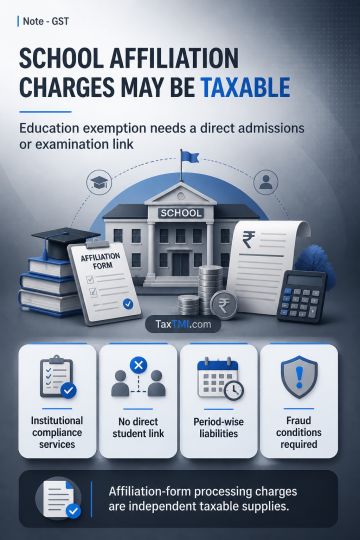
School affiliation services fall outside educational exemption without a direct nexus to admissions or examination conduct.
Consolidated show cause notices may combine financial years governed by Sections 73 and 74 where liabilities are segregated period-wise, each component independently meets limitation and notice requirements, the additional ingredients for fraud-based proceedings are satisfied, and no actual prejudice arises. School affiliation and affiliation-form processing charges are independent taxable supplies where they concern institutional eligibility and compliance, rather than directly and immediately relating to student admission or the conduct of examinations. A broad connection with education does not satisfy the educational-services exemption.
Case Laws GST
Show AI Summary
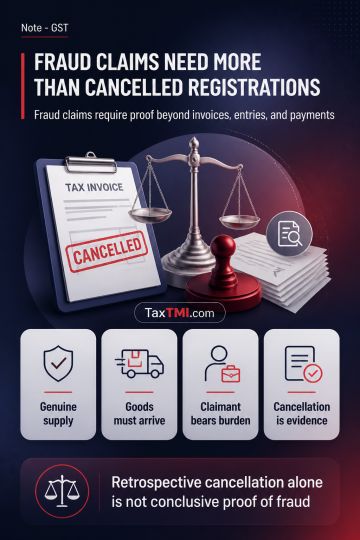
Fraudulent input tax credit requires proof of fictitious supplies, absent goods receipt, and fraud-linked self-assessment, not cancellation alone.
Input tax credit from allegedly non-existent suppliers depends on proof of genuine supply and actual receipt of goods or services, not merely invoices, accounting entries, or banking-channel payments. Section 155 places the burden of establishing ITC eligibility on the claimant. Section 74 requires more than ineligible credit: the wrongful availment must be linked to fraud, wilful misstatement, or suppression to evade tax. Retrospective supplier-registration cancellation is relevant evidence but is not conclusive. A fraud-based notice must disclose facts showing fictitious suppliers, absence of supply, and a basis for inferring the recipient's knowledge or participation.
Case Laws Money Laundering
Show AI Summary
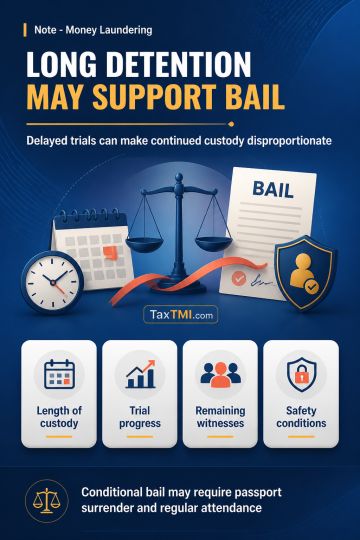
Prolonged pre-trial incarceration may justify conditional PMLA bail when delayed trials make continued detention constitutionally disproportionate.
Section 45 of the Prevention of Money-Laundering Act remains the stringent ordinary bail threshold, requiring prosecutorial opportunity and, on opposition, reasonable grounds to believe that the accused is not guilty and unlikely to offend while on bail. Article 21 nevertheless requires a separate, fact-sensitive inquiry where prolonged pre-trial detention and an unrealistic trial timetable make custody disproportionate. Relevant factors include custody length, trial progress, remaining witnesses, secured documentary evidence, source of delay, predicate-case status, and risks of absconding or witness interference. Conditions such as passport surrender, attendance, non-contact directions, and residence disclosure may safeguard the trial.
Case Laws Income Tax
Show AI Summary
Prospective operation of stamp-value taxation prevents retrospective application where property agreements and substantial payments predate the charging provision.
Section 56(2)(x)(b) applies to immovable property received for inadequate consideration only where its temporal and valuation conditions are satisfied. A stamp-value difference alone does not establish taxability. Where consideration was fixed and substantial payments or contractual performance occurred before the charging provision commenced, later conveyance or registration does not by itself attract the later charge. Agreement-date valuation is available only for covered transactions where consideration was fixed and paid, wholly or partly, through prescribed banking or electronic modes on or before the agreement date. The tax authority must identify the correct statutory basis and provide a meaningful opportunity to respond.
Case Laws GST
Show AI Summary
GST cash seizure limits require statutory relevance and restitutionary interest for unlawfully retained currency following searches.
GST seizure powers cannot be used to take cash as a general investigative measure or security for a possible tax demand. Currency is excluded from goods, and "things" is confined contextually to articles useful or relevant as evidence in GST proceedings. Valid seizure and retention require recorded statutory reasons, procedural compliance and observance of return timelines. Unauthorised retention engages property protections; later return does not cure the deprivation, and accrued interest is restitutionary rather than delayed-refund interest.
Case Laws Income Tax
Show AI Summary
Salary expense genuineness requires proof of actual services, business purpose, and fair testing of adverse third-party statements.
Under Section 37(1), salary expenditure is deductible only where it is actually incurred wholly and exclusively for business purposes and is supported by proof of genuine employment, services rendered, business nexus, and payment. Bank transfers and accounting entries alone are not conclusive. Where a third-party statement is central to an allegation of non-genuine salary, the taxpayer should receive disclosure and a meaningful opportunity to rebut it, including cross-examination where appropriate. A retracted and uncorroborated statement is vulnerable as the sole basis for disallowance.
Case Laws Income Tax
Show AI Summary
Discounted cash flow valuation remains taxpayer-selected under prescribed rules, while tax scrutiny must identify specific valuation-date defects.
The taxpayer may elect a prescribed DCF valuation for unquoted equity shares, and scrutiny of that method does not permit substitution with Net Asset Value merely because it produces a lower fair market value. The Assessing Officer may examine projections, discount rates, terminal assumptions, computations and source data, but rejection requires demonstrably wrong facts, material errors, a wholly erroneous basis or objectively unsupported assumptions. Subsequent financial performance cannot alone invalidate a bona fide DCF valuation; the relevant inquiry remains the reasonableness of valuation-date information.
Case Laws GST
Show AI Summary
Excess IGST on exports remains refundable when later correction triggers automated refund and reconciliation proves duplicate payment.
Refund of excess IGST paid on zero-rated exports may arise where turnover and tax are mistakenly entered under non-zero-rated supplies in FORM GSTR-3B while export invoices and shipping bills are correctly reported in FORM GSTR-1. If the exporter then pays the same IGST in the correct zero-rated field and the automated refund is credited against that later payment, the earlier payment remains a separately identifiable potential excess; its claim is not a repeat request for the same export-tax refund.
Case Laws GST
Show AI Summary
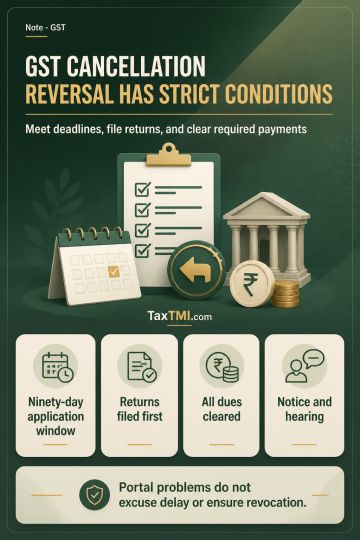
GST registration revocation requires timely application, return compliance, payment of dues, and a reasoned statutory decision.
GST registration revocation after cancellation for return default is a conditional, time-bound process. An application under Section 30 and Rule 23 must ordinarily be filed within ninety days, subject to prescribed extension, and cannot be made until pending returns are filed and tax, interest, penalty and late fee are paid. Portal non-acceptance may permit online or physical submission where technically unavailable, but does not condone delay or ensure revocation. The competent authority must assess statutory eligibility, sufficient grounds and compliance while following notice and hearing requirements before rejection.
Case Laws Income Tax
Show AI Summary
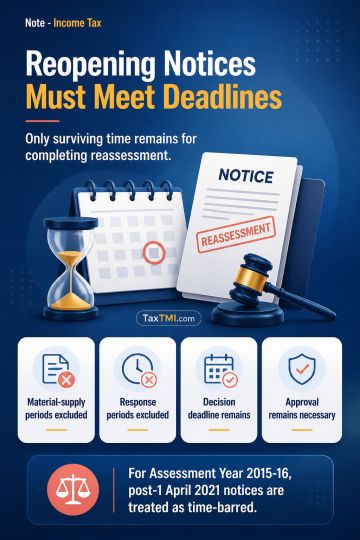
Reassessment limitation under TOLA requires final notices to issue within surviving time and satisfy statutory safeguards.
Reassessment limitation under TOLA is a jurisdictional restraint. Transitional notices issued between 1 April 2021 and 30 June 2021 are treated as Section 148A(b) show-cause notices, but only the surviving time remaining until 30 June 2021 is available for completing the reassessment process. Periods for supply of material and the assessee's response are excluded, but the Section 148A(d) decision, statutory approval and final Section 148 notice must issue within the remaining period. For Assessment Year 2015-16, post-1 April 2021 notices are treated as time-barred.
Case Laws Customs
Show AI Summary
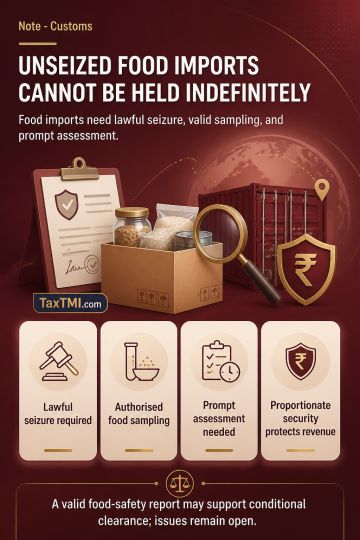
Unseized food consignments cannot face indefinite detention without lawful seizure, valid sampling, and prompt assessment.
Provisional release of an unseized imported food consignment is not mechanically governed by Section 110A, which applies to goods seized under Section 110. Customs may examine, test, verify and reassess imports, but indefinite retention without a seizure memorandum or disclosed reasons connecting the goods with confiscation is not justified. Food sampling should follow the specialised food-safety process through an authorised officer. A valid food-safety report may support conditional clearance, while classification, duty liability, confiscation and adjudication remain open. Revenue may be protected through proportionate security.
Case Laws Customs
Show AI Summary
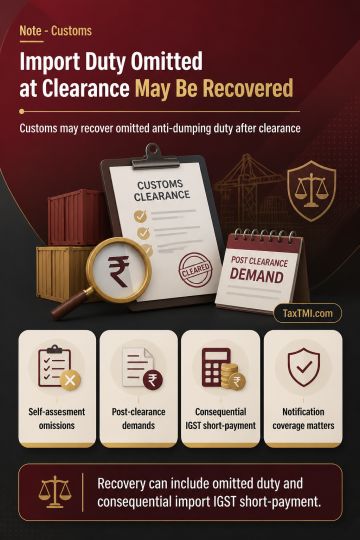
Anti-dumping duty recovery permits post-clearance demands and consequential import IGST where self-assessment omitted an applicable levy.
Unpaid anti-dumping duty omitted during self-assessment may be pursued through the customs recovery procedure without prior appellate modification of the self-assessment. The recovery framework applies to anti-dumping duty through statutory incorporation of provisions concerning assessment, non-levy, short-levy, interest and recovery. Where anti-dumping duty is chargeable, it forms part of the aggregate value used to compute IGST on imports, potentially creating a consequential IGST short-payment. Recovery requires accurate assessment of notification coverage, product, origin, rate, valuation, limitation and procedural safeguards.

TMI Notes

Back

All TMI Notes

Showing Results for :
Reset Filters
No Records Found

TMI Notes

Back

All TMI Notes

Monetary Limits for Departmental GST Appeals under Section 120 and Circular No. 207/1/2024-GST

29 October, 2026

Contents
Circulars
Acts
Plus +
Summary
Note

Note

-

Bookmark

Print

Print

This commentary provides doctrinal analysis and practical insights on the legal issue discussed below. The judgment is analysed in the context of its factual background, issues framed, and conclusions reached by the Court.

2026 (8) TMI 1116 - GSTAT KOLKATA

Introduction

The monetary-limit regime for departmental GST appeals is not merely an internal convenience measure. It is a statutory litigation-control mechanism that directs the Central tax administration to deploy appellate remedies selectively, while preserving the Department's ability to contest questions of wider legal or revenue consequence. The operative framework is contained in Section 120 of the Central Goods and Services Tax Act, 2017, read with Section 168 of the Central Goods and Services Tax Act, 2017 and Circular No. 207/1/2024-GST.

The central question is twofold: whether the monetary limits in the Circular bind departmental officers, and whether a Tribunal must dismiss an appeal simply because the amount in dispute is below the stated threshold. The distinction is material. The Circular controls the Department's decision to institute litigation; its effect upon the adjudicatory jurisdiction of the appellate forum must be understood from the text of Section 120 and the terms of the Circular itself.

2026 (8) TMI 1116 - GSTAT KOLKATA addresses this issue in the context of three departmental appeals arising out of a common appellate order. It holds that the Board's directions are legally binding on Central tax officers, but do not bind the Tribunal in the same manner. It also recognises that the monetary computation rule for composite orders and the exclusions for recurring or interpretative issues can sustain departmental recourse despite an objection based on the threshold.

Legal & Statutory Context

Statutory authority to regulate departmental appeals

Section 120(1) of the Central Goods and Services Tax Act, 2017 authorises the Board, on the recommendations of the Council, to issue "orders or instructions or directions fixing such monetary limits, as it may deem fit" for regulating the filing of an appeal or application by a Central tax officer. The provision is directed to the executive decision whether an appeal should be filed; it does not create a substantive right in favour of a taxpayer to insist that every low-value departmental appeal be adjudicated only by dismissal.

Section 120 also preserves the non-precedential character of a decision not to appeal on account of the monetary policy. Under sub-section (2), non-filing in one matter does not preclude an appeal in another matter involving the same or similar issues. Sub-section (3) prevents a party from alleging departmental acquiescence merely because no appeal was filed. Sub-section (4) requires the Tribunal or court to "have regard to the circumstances" in which an appeal was not filed pursuant to the Board's directions. These provisions demonstrate that the policy aims to control litigation volume without conceding the legal issue involved.

Binding administrative directions under Section 168

Section 168(1) of the Central Goods and Services Tax Act, 2017 provides that the Board may issue orders, instructions or directions for uniformity in implementation of the Act and that "all such officers and all other persons employed in the implementation of this Act shall observe and follow" them. Read with Section 120(1), this language gives the monetary-limit policy binding force within the departmental hierarchy. An officer cannot disregard the policy on a personal assessment that an adverse order deserves challenge.

Appellate setting

Section 112 of the Central Goods and Services Tax Act, 2017 provides the statutory route to the Appellate Tribunal. Under Section 112(3), the Commissioner may direct a subordinate officer to apply to the Tribunal for determination of points arising from an appellate or revisional order. That authorisation mechanism operates alongside, and not in substitution of, Section 120. Accordingly, a departmental authorisation to appeal must still conform to the Board's monetary-limit directions, unless a stated exclusion applies.

Circular No. 207/1/2024-GST

Circular No. 207/1/2024-GST, issued under Sections 120 and 168, fixes the following thresholds below which Central tax officers shall not file an appeal or application, subject to the exclusions in paragraph 4:

Appellate forum Monetary limit
GSTAT Rs. 20,00,000
High Court Rs. 1,00,00,000
Supreme Court Rs. 2,00,00,000

The relevant measure of the amount in dispute depends upon the character of the controversy. Paragraph 3 requires consideration of disputed tax where tax is in issue, disputed interest where interest alone is in issue, disputed penalty where penalty alone is in issue, and the aggregate of interest, penalty and late fee where no tax is in dispute. Crucially, paragraph 3(viii) provides that, in a composite order disposing of more than one appeal or demand notice, the monetary limit applies to the total amount of tax, interest, penalty or late fee, as applicable, and not to the amount involved in each individual appeal or demand notice.

Paragraph 4 excludes specified matters from the monetary ceilings. These include constitutional or ultra vires issues and matters relating to valuation, classification, refund, place of supply, or "any other issue" which is recurring in nature and/or involves interpretation of the Act, Rules, notifications, circulars, orders or instructions. Paragraph 5 adds an independent discipline: crossing the numerical threshold does not itself justify an appeal. The officer must decide on the merits while keeping in view the objective of reducing unnecessary litigation and providing certainty to taxpayers.

Interpretative Issues

Does the Circular bind the Department, the Tribunal, or both?

The statutory language establishes a clear departmental obligation. Sections 120 and 168 require Central tax officers to act consistently with the Board's directions. The more difficult question is institutional: whether a non-compliant appeal is jurisdictionally barred before the Tribunal. Section 120(4) does not state that the Tribunal shall dismiss every appeal falling below the threshold; it requires the Tribunal to have regard to the circumstances in which an appeal was not filed. This textual choice supports the distinction between a binding executive instruction and a fetter upon adjudicatory jurisdiction.

How is the threshold calculated in a composite order?

Paragraph 3(viii) directly addresses composite orders. Where a common order disposes of several appeals or demand notices, the relevant figure is the total disputed amount, not the amount severally attributable to each component. A taxpayer cannot isolate each demand merely because separate appeals have been filed against a common order. At the same time, the Department must demonstrate that the order is genuinely composite and accurately aggregate only those components which paragraph 3 permits it to aggregate.

How wide is the recurring or interpretative-issue exclusion?

The phrase "recurring in nature and/or involves interpretation" cannot be treated as a formula that nullifies the monetary policy whenever a statutory provision requires construction. Such an approach would make the threshold largely illusory. The exclusion requires a reasoned identification of a recurring issue or a question of statutory interpretation warranting consideration on merits. The Department should record why the issue has wider operational relevance and why the appeal falls within paragraph 4(iv), rather than rely on a bare assertion of interpretative importance.

Detailed Commentary & Analysis

In 2026 (8) TMI 1116 - GSTAT KOLKATA, the taxpayer contested the departmental appeals on the basis that the amount involved in each appeal was below the GSTAT threshold. The Tribunal rejected that objection. The appeals arose from a common order and, applying paragraph 3(viii), the aggregate amount was treated as exceeding the prescribed monetary limit. The Tribunal also accepted the Department's submission that the dispute involved interpretation of statutory and rule provisions and was of a recurring character, thereby attracting the paragraph 4(iv) exclusion.

The decision is significant for three reasons. First, it gives operative weight to the composite-order rule, preventing a fragmented calculation of tax effect where the Circular expressly requires aggregation. Secondly, it treats the exclusions as substantive exceptions, rather than mere departmental rhetoric. Thirdly, it distinguishes the obligation of departmental officers from the role of the Tribunal: the Circular is binding on officers, whereas for the Tribunal it is relevant and persuasive in assessing the objection to the appeal.

The Tribunal's approach must nevertheless be read with paragraph 5 of the Circular. Even if the aggregated amount exceeds the threshold, or an exclusion is potentially available, a departmental appeal is not automatic. The reviewing authority must apply its mind to the merits, the litigation-reduction objective, and the need for certainty. A recorded decision which separately addresses threshold, method of calculation, exclusion and merits would best give effect to the statutory scheme.

The decision also illustrates why monetary-limit objections should be dealt with at the threshold. The taxpayer should identify the correct category under paragraph 3, challenge an unjustified aggregation, and require the Department to state the paragraph 4 exclusion relied upon. The Department, in turn, should plead the specific exclusion in its appeal or supporting record and place sufficient material to show that the exclusion is not being invoked mechanically.

Judicial / Administrative Perspective

Governing GST analysis

2026 (8) TMI 1116 - GSTAT KOLKATA holds that Sections 120 and 168 make the Circular binding upon Central tax officers but not upon the Tribunal as an adjudicatory body. On the facts, the aggregate-value principle applicable to a common order and the recurring/interpretative-issue exclusion defeated the taxpayer's monetary-limit objection. The appeal was therefore entertained, although the Tribunal separately found the fraud or suppression basis of the demand unsustainable and directed determination in accordance with the applicable statutory consequence. That latter aspect does not dilute the ruling on the Circular's application.

Authorities on departmental obligation

2012 (8) TMI 865 - GUJARAT HIGH COURT treated a departmental monetary-limit circular as binding on the Department and dismissed an appeal where the disputed amount was below the prescribed threshold. The substantive tax questions were left open. The authority supports the proposition that an officer cannot pursue a low-value appeal contrary to a subsisting departmental instruction.

2001 (11) TMI 238 - Bombay High Court similarly treated the Board's monetary-limit instruction as a binding litigation policy and declined to entertain the Revenue's appeal. Its doctrinal relevance lies in recognising that a statutory appellate remedy available to the Revenue can be regulated by a valid Board policy governing when that remedy should be invoked.

2014 (9) TMI 342 - GUJARAT HIGH COURT applied a monetary instruction which was in force when the appeals came up for consideration, notwithstanding that the appeals had been filed earlier. The court dismissed the matters without examining merits. This demonstrates the strong judicial preference for enforcing litigation-reduction policy where no exception is established.

1996 (5) TMI 90 - HIGH COURT OF JUDICATURE FOR RAJASTHAN concerned prosecution rather than an appellate remedy, but its reasoning is relevant to the binding quality of Board directions. It held that subordinate officers must follow departmental guidelines issued under statutory authority and treated continuation of action contrary to a monetary guideline as an abuse of process. The decision reinforces the proposition that such directions are not optional within the departmental hierarchy.

Authorities on exceptions and proof

2007 (9) TMI 272 - MADHYA PRADESH HIGH COURT recognised that monetary instructions can contain exceptions for important or recurring legal questions. However, the Department must place material before the appellate forum to establish that the case falls within the exception. It does not permit a general assertion of importance to displace the threshold.

2007 (11) TMI 124 - ANDHRA PRADESH HIGH COURT emphasised that an exception to a monetary-limit instruction must be specifically pleaded and supported by evidence. A routine appeal filed without material showing applicability of the exception was not protected. This approach has direct practical value under paragraph 4 of Circular No. 207/1/2024-GST.

2008 (8) TMI 94 - MADRAS HIGH COURT held that a Board circular may regulate the Department's practice of filing appeals and rejected the contention that the statutory appeal provision makes the monetary policy ineffective. The authority further confirms that an appeal below the limit can proceed only if a stated exception is actually attracted.

Tribunal decisions under analogous and GST frameworks

2024 (5) TMI 1404 - CESTAT CHANDIGARH dismissed departmental appeals under a customs monetary-limit instruction after finding that the relevant exceptions had not been established. Although it arose under a different enactment, it is persuasive for the proposition that litigation-control instructions must be implemented according to their express exclusions rather than by a broad assertion of legal importance.

2026 (10) TMI 1367 - GSTAT GHAZIABAD held that, in a penalty-only dispute, the disputed penalty is the relevant measure for the threshold. It also held that statutory authorisation to file an appeal does not by itself prove an exception to the monetary-limit policy. The Revenue was required to plead and establish the particular exception relied upon.

2026 (10) TMI 1140 - GSTAT GHAZIABAD adopted the same approach in another penalty-only appeal. It treated maintainability under the litigation policy as an anterior issue and held that bare approval or authorisation by the Commissioner was insufficient without material demonstrating a recognised exception.

2026 (10) TMI 292 - GSTAT SURAT gave a narrow construction to the recurring/interpretative-issue exclusion. It held that the mere fact that a dispute requires interpretation does not automatically displace the threshold; there must be a genuine recurring or wider revenue implication. This is an important caution in applying paragraph 4(iv).

2026 (9) TMI 722 - GSTAT ERNAKULAM applied the Circular's category-specific computation rule in an interest-only dispute. As the disputed interest alone fell below the GSTAT limit and no exclusion was shown, the appeal was dismissed. The decision confirms that tax, interest, penalty and late fee cannot be combined indiscriminately contrary to paragraph 3.

Related approach to revised policies

2024 (10) TMI 431 - RAJASTHAN HIGH COURT considered the applicability of revised monetary thresholds and exceptions to pending income-tax appeals. It illustrates that the temporal reach of a litigation policy depends on its own language; monetary limits and exceptions must be applied as the governing circular expressly provides.

2024 (12) TMI 717 - BOMBAY HIGH COURT likewise distinguished between revised monetary limits and newly introduced exceptions, treating the latter according to their stated prospective operation. Though arising under the income-tax framework, it underscores a general interpretative discipline: an exception cannot be given a temporal or substantive reach beyond the terms of the governing Board instruction.

Implications & Observations

  • For every proposed departmental appeal, the file should identify the applicable paragraph 3 category: tax, interest only, penalty only, late fee only, or the specified aggregate where no tax is disputed.

  • Where a common order covers multiple demands or appeals, the Department should expressly record the basis for aggregation under paragraph 3(viii), including the total amount relevant to the appeal.

  • Where the monetary limit is not met, the appeal should identify the precise paragraph 4 exclusion. A generic statement that an issue involves interpretation is vulnerable in light of the requirement of genuine recurring or wider significance.

  • Commissioner's authorisation under Section 112(3) should not be equated with compliance with Circular No. 207/1/2024-GST. The two requirements are distinct: one authorises the application, while the other regulates whether it should be filed.

  • For taxpayers, a preliminary objection should address both the arithmetic and the exception. The objection should specify why the matter is not composite, why the Department's calculation is inconsistent with paragraph 3, or why the alleged exception is unsupported by a recorded and case-specific basis.

  • There are differing applications in the supplied GST Tribunal decisions. Some decisions dismiss low-value appeals where no exception is proved, while the governing decision holds that the Circular does not bind the Tribunal in the same manner as it binds departmental officers and accepts the composite-order and interpretative-issue grounds on its facts. The result therefore turns on the Circular's text, the pleaded exclusion, and the record supporting it.

Concluding Remarks

The monetary limits under Circular No. 207/1/2024-GST are binding directions to Central tax officers issued under the combined authority of Section 120 and Section 168 of the Central Goods and Services Tax Act, 2017. They are designed to regulate departmental litigation, not to concede legal questions or create an inflexible jurisdictional bar in every low-value appeal.

Under 2026 (8) TMI 1116 - GSTAT KOLKATA, the Tribunal may consider the Circular as relevant and persuasive but is not bound by it in the manner departmental officers are bound. A composite order must be tested on the aggregate-value rule in paragraph 3(viii), and an appeal concerning a recurring or interpretative issue may fall within paragraph 4(iv). Nonetheless, the Department carries the practical burden of demonstrating the factual and legal basis for aggregation and for the asserted exclusion. This disciplined approach best reconciles the statutory right to appeal, uniform administration, and the Circular's explicit objective of reducing unnecessary Government litigation.


Full Text:

2026 (8) TMI 1116 - GSTAT KOLKATA

Topics

Acts Income Tax