 TaxTMI
Login
 TaxTMI

Login
Loading...
Press 'Enter' to add multiple search terms. Rules for Better Search

Press 'Enter' after typing page number.
Press 'Enter' after typing page number.


No Folders have been created
Are you sure you want to delete "My most important" ?
NOTE:
Press 'Enter' after typing page number.

Press 'Enter' after typing page number.

All TMI Notes
Press 'Enter' after typing page number.
Press 'Enter' after typing page number.
All TMI Notes

Note

Bookmark

Share


This is a neutral professional article. The judgment is analysed in the context of its factual background, issues framed, and conclusions reached by the Court.
2026 (9) TMI 1491 - GSTAT LUCKNOW
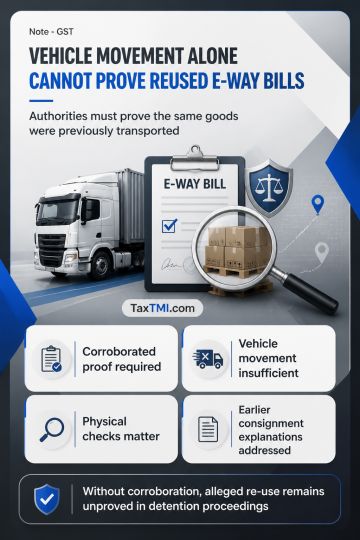
The central question in 2026 (9) TMI 1491 - GSTAT LUCKNOW was whether toll-plaza movement data and photographs, when read with a later movement of the same vehicle under the same invoices and e-way bills, were sufficient to establish re-use of those documents and an attempted evasion of tax.
The taxpayer's goods were intercepted while being carried under invoices and e-way bills. The department relied on toll-plaza records and photographs to infer that the same vehicle had made an earlier outward journey carrying the same goods, returned empty, and later again transported goods under the same invoices and e-way bills. On that basis, it treated the later movement as a re-transportation of goods already moved and imposed tax and penalty under Section 129.
The taxpayer's case was that the earlier journey concerned a different consignment. It relied on a driver's explanation and documents relating to an earlier movement of cotton cuttings. It also contended that the physical verification disclosed no discrepancy in the description, quantity, value or ownership of the intercepted goods and that the invoices and e-way bills were valid.
The Tribunal allowed the appeal and set aside the appellate order. Its decisive reasoning was evidentiary: the allegation that the goods had been re-transported rested principally on an inference from the vehicle's prior location and photographs. There was no independent, cogent proof that the very goods covered by the disputed invoices and e-way bills had completed an earlier journey or had been delivered. The Tribunal further noted that the taxpayer's explanation regarding a different earlier consignment had not been verified by the revenue authority.
The result was not founded simply on the existence of valid transport documents. Rather, it followed from the failure to establish the factual premise necessary for treating those documents as having been used earlier for the same goods. Any amount deposited in consequence of the detention and penalty proceedings was directed to be refunded in accordance with law.
Section 68 of the Central Goods and Services Tax Act, 2017 permits the Government to require the person in charge of a conveyance to carry prescribed documents and devices. Under Section 68(3), where a conveyance is intercepted, the proper officer may require production of those documents and devices for verification, and the person in charge must produce them and permit inspection of the goods.
Section 129 of the Central Goods and Services Tax Act, 2017 employs the operative condition that goods are transported or stored in transit "in contravention of the provisions of this Act or the rules made thereunder." Thus, detention or seizure must be anchored in an identifiable contravention. Section 129(3), in the text reproduced here, requires the proper officer to issue a notice within seven days of detention or seizure, specifying the penalty payable, and thereafter pass an order within seven days from service of that notice. Section 129(4) prohibits determination of penalty without an opportunity of being heard.
The exact statutory version applied to the disputed movement is not reproduced in the decision. The evidentiary reasoning of the Tribunal nevertheless remains directed to the foundational question whether a contravention, namely re-use of the transport documents for the same goods, had been established.
Rule 138 of the Central Goods and Services Tax Rules, 2017 requires a registered person causing movement of goods of consignment value exceeding the stated threshold to furnish prescribed information in Part A of FORM GST EWB-01 "before commencement of such movement." For movement by road, Rule 138(2) requires furnishing Part B, while Explanation 2 to Rule 138(3) states that an e-way bill is not valid for road movement unless Part B information has been furnished, subject to the stated exceptions.
Rule 138A complements Rule 138. The person in charge of the conveyance must carry the invoice, bill of supply or delivery challan, as applicable, and a physical or electronic copy or number of the e-way bill. The statutory scheme therefore treats the invoice and e-way bill as material tools of verification; it does not dispense with an inquiry into whether the documents actually correspond to the goods and movement in question.
Rule 138B authorises interception to verify the e-way bill and permits physical verification by the authorised proper officer. Its proviso permits physical verification by another officer only upon specific information of tax evasion and necessary approval. Under Rule 138C, a summary inspection report must be recorded in Part A of FORM GST EWB-03 within twenty-four hours, with the final report ordinarily recorded in Part B within three days. These requirements reinforce that inspection must produce a documented factual basis for further coercive action.
Circular No. 41/15/2018-GST similarly contemplates verification before detention. Where no prima facie discrepancy is found, the conveyance is to be allowed to proceed. Where inspection is undertaken, the process contemplates a statement in FORM GST MOV-01, an inspection order in FORM GST MOV-02, a physical-verification report in FORM GST MOV-04, and release in FORM GST MOV-05 if no discrepancy is found. Detention under Section 129 is contemplated through FORM GST MOV-06 and notice in FORM GST MOV-07; objections require a speaking order in FORM GST MOV-09.
The Tribunal distinguished suspicion arising from vehicle movement from proof of re-use of an e-way bill. Repeated movement of a vehicle, even with a visually similar load, does not by itself prove that the same consignment was first transported, delivered, returned and then carried again under the same documents. The evidentiary gap becomes material where the taxpayer offers a competing explanation that the earlier movement concerned different goods.
In the facts examined, the departmental case was built upon toll timings, movement records and photographs. The Tribunal accepted that this material was relevant, but found it insufficient to establish that the disputed goods had already completed an earlier journey. It also found that the revenue authority had not verified the taxpayer's explanation that the earlier journey involved cotton cuttings under different documentation. The appellate conclusion that intention to evade tax was "automatically proved" by the asserted re-transportation was therefore unsustainable, because the asserted re-transportation itself had not been proved.
The practical distinction is important. Toll data may prove that a vehicle passed a particular point at a particular time. A photograph may indicate the presence of a load. Neither item automatically proves the identity of a particular taxable consignment, prior delivery to the named recipient, or re-use of a particular invoice and e-way bill. Those additional propositions require corroboration.
2023 (9) TMI 267 - ALLAHABAD HIGH COURT directly addresses alleged re-use of an e-way bill. It holds that, where re-use is alleged, the initial burden lies upon the seizing authority to lead positive evidence that the goods had been transported earlier using the same e-way bill. The existence of an e-way bill does not by itself permit a presumption of an earlier transaction. The authority must undertake or rely upon corroborative inquiry or material; a bare conclusion in the seizure order cannot sustain tax and penalty.
This authority closely supports the Tribunal's approach. Both decisions reject the substitution of assertion for proof in a re-use allegation. The Tribunal's reasoning adds an important factual dimension: where the taxpayer provides an alternate account of the vehicle's prior movement, the authority must test that account through appropriate verification rather than treat the unexplored explanation as proof of evasion.
2019 (11) TMI 473 - KERALA HIGH COURT concerned a different route taken by a vehicle carrying goods under a valid e-way bill. It held that detention cannot be automatic merely because the driver chose an alternate route to the declared destination. A presumption may arise only where the vehicle is found on a road stretch or travelling in a direction inconsistent with reaching the stated destination. The authority is relevant because it insists that vehicle-location facts must be read in their actual commercial and geographical context.
Applied to a re-use allegation, this reasoning means that toll movement data is not self-explanatory. The officer must establish why the route, direction, timing and loading pattern reasonably point to an unlawful movement of the particular consignment, rather than another lawful journey by the same vehicle.
2024 (8) TMI 772 - ALLAHABAD HIGH COURT held that where an e-way bill was produced after detention but before the seizure order, and no discrepancy in that document was identified, the documentary defect stood cured on the facts. The authority also noted that the department could verify the transaction through other available investigatory measures. Its relevance here lies in the proposition that a presumption of evasion should not survive unexamined where subsequently available material supports the claimed transaction and no discrepancy is demonstrated.
Conversely, 2024 (2) TMI 1128 - ALLAHABAD HIGH COURT illustrates the boundary of this principle. There, neither invoice nor e-way bill accompanied the goods at interception. The Court held that the absence of both documents was not merely technical, raised a presumption of intent to evade tax, and shifted the evidentiary burden to the owner or transporter. Later production of documents did not by itself remove liability where that presumption remained unrebutted.
The two authorities show why the Tribunal's decision should not be understood as a general immunity from Section 129. In the present case, the goods were accompanied by invoices and e-way bills, and no discrepancy in description, quantity, value or ownership was established. The controversy was not an admitted absence of documents at interception; it was the department's affirmative allegation that validly produced documents had been re-used. That allegation required proof.
Circular No. 64/38/2018-GST draws a statutory-administrative distinction between no valid e-way bill and specified minor errors where an invoice and e-way bill do accompany the goods. It states that Section 129 proceedings may not be initiated for stated errors, including an error in one or two digits or characters of the vehicle number; the prescribed response in those situations is the specified token penalty under Section 125.
2024 (7) TMI 370 - GUJARAT HIGH COURT applied that distinction where the invoice and e-way bill otherwise corresponded to the goods and a vehicle-number mismatch resulted from a bona fide replacement vehicle. It held that Section 129 detention was not justified on those facts. Although a vehicle-number mismatch is not the same as alleged re-use, the decision confirms the need to differentiate a genuine contravention from a circumstance that is compatible with a documented, bona fide movement.
2024 (2) TMI 189 - Supreme Court concerned movement after expiry of an e-way bill. The Court accepted that there was no live e-way bill and that a fresh bill ought to have been generated if transportation did not occur within the original validity period. The tax demand was upheld, while the penalty was reduced on the particular facts through an order expressly stated not to be a precedent. This outcome is materially different from an unproved allegation of re-use, but it demonstrates that a clear and admitted documentary non-compliance may attract consequences even where the goods belong to the taxpayer.
The supplied authorities therefore reveal a fact-sensitive framework. A valid document does not foreclose inquiry. Equally, a suspicion born from vehicle data, route variation or document appearance cannot replace proof of the precise contravention alleged. The Tribunal's ruling rests on the latter proposition.
For revenue authorities, a sustainable re-use case should establish more than a sequence of vehicle movements. The material should identify the earlier consignment, connect it to the disputed invoice and e-way bill, and show why the intercepted goods are the same goods already transported. Independent verification from the alleged purchaser, consignor, transporter, loading or unloading records, or other contemporaneous material may be significant. If the taxpayer claims a different prior consignment, the claim should be investigated and the outcome recorded in the order.
For taxpayers and transporters, the immediate response to interception should preserve the evidentiary trail. This includes invoices, e-way bills, consignment notes, loading records, delivery acknowledgements, toll records, driver statements, records of other consignments carried by the same vehicle, and material explaining timing or route. An explanation resting only on a driver's assertion may be vulnerable; contemporaneous, independent documents make the explanation capable of verification.
Procedurally, objections to a notice under Section 129 should address each alleged link in the departmental inference: identity of goods, timing, prior delivery, route, vehicle loading, and document linkage. The objection should also require a reasoned response to the taxpayer's evidence. Under Rule 142 of the Central Goods and Services Tax Rules, 2017, a summary of a notice under Section 129 is to be served electronically in FORM GST DRC-01, and a summary of the order is to be uploaded in FORM GST DRC-07. These electronic steps operate alongside the inspection and detention record contemplated by the MOV forms.
Failure to respond at the earliest stage carries practical risk, particularly because an officer may decide on available material. Yet, as this decision demonstrates, an ex parte or inadequately contested proceeding does not dispense with the revenue authority's obligation to establish the factual basis of an allegation of re-use before tax and penalty are confirmed.
Full Text:

