 TaxTMI






 25 Nov 2026

Abbreviations used:
ITA 1961 or ITA 61 or 61 Act - The income-tax Act, 1961
ITA 2025 or ITA 25 or 25 Act - The income-tax Act, 2025
ITR 1962 or 62 Rules - Income Tax Rules 1962
ITR 2026 Or Rules 2026- Income-tax rules 2026
AY and PY - assessment / previous year in ITA 1961
TY - Tax year in ITA 2025
Provisions are analysed in tabular manner. Extra words and phrases found in one of enactment but not in another are highlighted/ catch worded by italicising them:
| From ITA 2025 | From ITA 1961 placed in matching position | Remarks |
| Part C
| Part E
| Similar. |
| 378. Revision of other orders. | Revision of other orders. | Similar. |
| (1) The Competent Authority may, for any order, other than an order to which section 377 applies, passed by an authority subordinate to him, either of his own motion or on an application by the assessee for revision,--
| 264. (1) In the case of any order other than an order to which section 263 applies passed by an authority subordinate to him, the 9[Principal 10[Chief Commissioner or Chief Commissioner or Principal] Commissioner or] Commissioner may, either of his own motion or on an application by the assessee for revision, | Similar except for changes in style, sections, definition designations, and different places of putting provision within section. |
| (a) call for the record of any proceeding under this Act in which any such order has been passed;
| call for the record of any proceeding under this Act
in which any such order has been passed
| Similar except for changes in style
|
| (b) make such inquiry or cause such inquiry to be made; and
| and may make such inquiry or cause such inquiry to be made subject to the provisions of this Act, | Similar except for changes in style
|
| (c) subject to the provisions of this Act, pass such order thereon, not being an order prejudicial to the assessee, as he thinks fit.
| may pass such order thereon, not being an order prejudicial to the assessee, as he thinks fit. | Similar except for changes in style except that Word 'may' is not found in ITA 2025 |
| (2) The Competent Authority shall not of his own motion revise any order under this section if the order has been made more than one year previously.
| (2) The 9A[Principal 10A[Chief Commissioner or Chief Commissioner or Principal] Commissioner or] Commissioner shall not of his own motion revise any order under this section if the order has been made more than one year previously. | Similar except for changes in style, and definition
|
| (3) An application for revision under this section shall be made by the assessee, within one year from the date on which the order in question was communicated to him or the date on which he otherwise came to know of it, whichever is earlier. | (3) In the case of an application for revision under this section by the assessee, the application must be made within one year from the date on which the order in question was communicated to him or the date on which he otherwise came to know of it, whichever is earlier : | Similar except for changes in style
|
| (4) The Competent Authority may, if he is satisfied that the assessee was prevented by sufficient cause from making the application within the period as provided in sub-section (3), admit an application made after the expiry of the period specified in that sub-section. | Provided that the 9B[Principal 10B[Chief Commissioner or Chief Commissioner or Principal] Commissioner or] Commissioner may, if he is satisfied that the assessee was prevented by sufficient cause from making the application within that period, admit an application made after the expiry of that period. | Similar except for changes in style, authorities,
|
| (5) The Competent Authority shall not revise any order under this section in the following cases:-
| (4) The 9C[Principal 10C[Chief Commissioner or Chief Commissioner or Principal] Commissioner or] Commissioner shall not revise any order under this section in the following cases- | Similar except for changes in style About designations and definition.
|
| (a) where an appeal against the order lies to the Joint Commissioner (Appeals) or the Commissioner (Appeals) or to the Appellate Tribunal, but has not been made and the time within which such appeal may be made has not expired;
| (a) where an appeal against the order lies to the 1[Deputy Commissioner (Appeals)] 2[or to 11[the Joint Commissioner (Appeals) or the Commissioner (Appeals)]] or to the Appellate Tribunal but has not been made and the time within which such appeal may be made has not expired, or, in the case of an appeal 3[to 11A[the Joint Commissioner (Appeals) or the Commissioner (Appeals)] or] to the Appellate Tribunal, the assessee has not waived his right of appeal; or | Similar except for changes in style About designations and definition.
|
| (b) where the appeal lies to the Joint Commissioner (Appeals) or the Commissioner (Appeals) or to the Appellate Tribunal, the assessee has not waived his right of appeal; or | (b) where the order is pending on an appeal before the 4[Deputy Commissioner (Appeals)]; or | Similar except for changes in style About designations and definition.
|
| (c) where the order has been made the subject of an appeal to the Joint Commissioner (Appeals) or the Commissioner (Appeals) or to the Appellate Tribunal. | (c) where the order has been made the subject of an appeal 5[to 11B[the Joint Commissioner (Appeals) or the Commissioner (Appeals)] or] to the Appellate Tribunal. | Similar except for changes in style About designations and definition.
|
| (6) Every application by an assessee for revision under this section shall be accompanied by a fee of Rs. 500.
| (5) Every application by an assessee for revision under this section shall be accompanied by a fee of 6[five hundred] rupees. | Same. |
| (7) On every application by an assessee for revision under this section, an order shall be passed within one year from the end of the financial year in which such application is made. | 7[(6) On every application by an assessee for revision under this sub-section, made on or after the 1st day of October, 1998, an order shall be passed within one year from the end of the financial year in which such application is made by the assessee for revision. | Similar except for changes in style
|
| (8) In computing the period of limitation under sub-section (7), the following period shall be excluded:-
| Explanation.-In computing the period of limitation for the purposes of this sub-section, the time taken in giving an opportunity to the assessee to be re-heard under the proviso to section 129 and 12[the period commencing on the date on which stay on any proceeding under this section was granted by an order or injunction of any court and ending on the date on which certified copy of the order vacating the stay was received by the jurisdictional Principal Commissioner or Commissioner] shall be excluded. | Similar except for changes in style, sections, placing of provisions in sub-clauses in ITA25.
|
| (a) the time taken in giving an opportunity to the assessee to be reheard under section 244(2); and |
| In ITA61 mentioned in Explanation given earlier. |
| (b) the period commencing on the date on which stay on any proceeding under this section has been granted by an order or injunction of any court and ending on the date on which certified copy of the order or injunction vacating the stay is received by the jurisdictional Principal Commissioner or Commissioner.
|
| In ITA61 mentioned in Explanation given earlier. |
| (9) If after the exclusion of the period provided in sub-section (8), the time limit for completion as provided in sub-section (7) is less than sixty days, such remaining period shall be extended to sixty days and such period of limitation shall be deemed to have been extended accordingly.
|
|
|
| (10) Irrespective of anything contained in sub-section | (7) Notwithstanding anything contained in sub-section (6), |
|
| (7), an order in revision under that sub-section may be passed at any time in consequence of or to give effect to any finding or direction contained in an order of the Appellate Tribunal, the High Court or the Supreme Court.
| an order in revision under sub-section (6) may be passed at any time in consequence of or to give effect to any finding or direction contained in an order of the Appellate Tribunal, the High Court or the Supreme Court.] |
|
|
|
|
|
| (11) For the purposes of this section,--
|
|
|
| (a) "Competent Authority" means the Principal Chief Commissioner or Chief Commissioner or Principal Commissioner or Commissioner;
|
|
|
| (b) an order by the Competent Authority declining to interfere shall, not be deemed to be an order prejudicial to the assessee.
| Explanation 1.-An order by the Principal Chief Commissioner or Chief Commissioner or Principal Commissioner or Commissioner declining to interfere shall, for the purposes of this section, be deemed not to be an order prejudicial to the assessee. |
|
|
| Explanation 2.-For the purposes of this section, the 8[Deputy Commissioner (Appeals)] shall be deemed to be an authority subordinate to the 9E[Principal 10E[Chief Commissioner or Chief Commissioner or Principal] Commissioner or] Commissioner. | Changes due to change in style of presenting provisions. |
New and old provisions both are intended to have same effect. However, some changes in style and wording can make a difference in interpretation.
The intentions, scope, procedural aspects in both enactments are similar and to the same effect, therefore, settled rulings under ITA 61 will govern new provisions of ITA25. However, due to changes in style and certain commonly revised phrases used in new enactment, scope of litigation is likely to enlarge because tax authorities are likely to say old and new provisions are not similar and some changes can be highlighted to litigate.
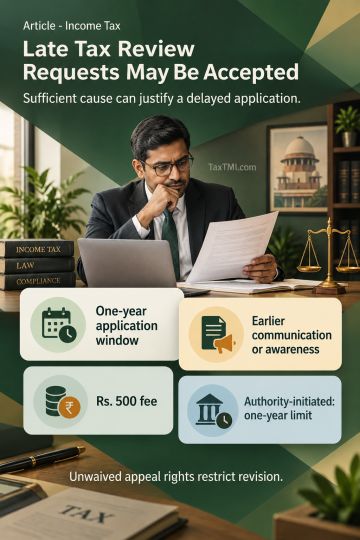
Section 378 of the Income-tax Act, 2025 is in lieu of Section 264 of the Income-tax Act, 1961 effective April 1, 2026, both are taxpayer-friendly revision framework under which an assessee can seek relief, and period for application is longer then for filing of first appeal.
Although the provision authorises the revisionary authority to issue orders which can be in favour of assessee by removing error in order of lower authority, however, exercise of such authority is rarely exercised and assessee has to approach by making an application for revision.