 TaxTMI







 25 Nov 2026

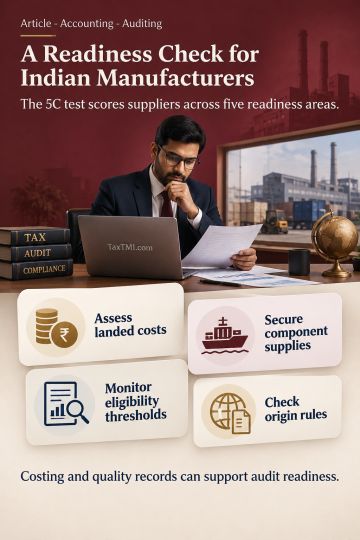
Global companies want a second source beyond China. Whether that source turns out to be an Indian client depends far more on execution than on headlines.
A manufacturing client returns from a sourcing fair excited: a European buyer wants a second supplier outside China and has asked for a quotation. A month later the buyer's audit questionnaire arrives - 140 questions on costing, quality records, ESG data, labour compliance, power backup and financial strength.
The opportunity was real. Whether the client could capture it depended on documents, data and systems most of which sat with the finance team. That's where practitioners come in.
One picture of the shift
In the twelve months to March 2025, Apple's suppliers reportedly assembled about US$22 billion worth of iPhones in India - roughly one in five made worldwide. Ten years earlier the figure was close to nil.
Speeches didn't cause that. A few large contract manufacturers built plants, the government offered production-linked incentives, and Apple concluded after Chinese pandemic lockdowns disrupted supply that relying on one country was too risky.
Yet many of the components inside those phones still came from China.
That is China Plus One in a single frame: genuine movement, genuine opportunity and genuine limits.
What the phrase means
"China Plus One" means keeping production in China while building at least one alternative elsewhere. Japanese companies began using the idea amid rising tensions with China around 2010-2012, and it went global after:
- The US-China trade war from 2018.
- Pandemic lockdowns and port closures from 2020.
- Growing geopolitical risk and export controls.
India, Vietnam, Mexico, Indonesia, Thailand, Malaysia and others all compete to be the "plus one."
For Indian clients the question is blunt: a once-in-a-generation opening, or a story that sounds better than it is?
Lesson from history: the long way round Africa
In the fifteenth century Asian spices reached Europe mainly through routes controlled by Middle Eastern and Venetian traders. European buyers depended on one dominant channel and paid accordingly.
In 1498 Vasco da Gama reached Calicut by sailing around Africa. Building the new route cost years, ships and lives - but once built, it reshaped trade for centuries.
Diversification isn't a wish. It's a slow, costly construction project, and the rewards go to whoever actually builds the route.
The case for real opportunity
- Electronics: India is now a major smartphone exporter, led by iPhones and Samsung devices, and mobile phones rank among its top export items.
- Policy: Production Linked Incentive schemes launched from 2020 span 14 sectors, including electronics, pharmaceuticals, auto components, solar modules and textiles.
- Domestic demand: a large home market lets manufacturers serve local customers and export from one base.
- Trade agreements: FTAs with the UAE, Australia, EFTA, the UK, Oman and New Zealand, plus the concluded India-EU agreement, widen access.
- Talent: a deep pool of engineers and technicians and expanding global capability centres.
The case for real limits
- China's scale: China accounts for roughly 30% of global manufacturing value added on World Bank and UN data; India's share is in low single digits.
- Component ecosystems: much "plus one" output is final assembly using imported parts, so value addition and margins stay thin.
- Logistics and power: improving, but still uneven by state and sector.
- Approvals: land, labour, environmental and customs processes can be slow.
- Rivals: Vietnam, Mexico and others are also winning orders - Vietnam remains a major base for Samsung smartphones.
Buyers don't pick a country. They pick a supplier who delivers quality, cost and reliability - on time, every time.
In a nutshell
Essence: China Plus One is real, but it rewards ready suppliers in competitive countries, not countries that are merely "not China."
The uncomfortable reality
Plenty of Indian businesses talk about China Plus One without changing anything, expecting buyers to arrive because of geopolitics.
In reality global buyers send long audits, insist on certifications, test samples for months and benchmark prices against Vietnam, Mexico and China itself. Many Indian suppliers lose out not because of policy but because of inconsistent quality, missed deliveries, weak documentation and slow communication.
The opportunity is national; readiness is company by company.
The 5C Readiness Test
Score the business from 1 to 5 on each before chasing a global order.
1. Cost
Is the landed cost - logistics, duties and inventory included - competitive with China, Vietnam and other options, and is it known precisely?
2. Components
Are critical inputs secure? If they come from China, what happens in a disruption, and which could be localised?
3. Capability
Are the engineering, quality systems and scale adequate, and could the plant pass an audit on process control and testing?
4. Compliance
Are labour, safety, environmental, ESG and traceability requirements met and documented well enough for audits and forced-labour checks?
5. Continuity
Can delivery stay consistent - power backup, logistics, financial strength and management depth - and will the business still be standing in five years?
A score below 3 on any C is likely to cost the order.
For practitioners: making clients audit-ready
- Produce a defensible product costing. Buyers increasingly ask for cost breakdowns; standard costing reconciled to the books builds credibility in negotiations.
- Prepare financial-strength evidence - audited accounts, bank references, credit ratings and order-book summaries - before the buyer asks.
- Advise on PLI and incentive accounting. Recognise incentives only when conditions are met with reasonable assurance, and track eligibility thresholds so claims aren't lost.
- Model capex and working capital. Additional capacity, tooling and inventory for a global contract need a funded plan, not just optimism.
- Build the ESG and compliance file - energy, safety, labour and statutory compliance records - since these now sit alongside price in supplier evaluations.
Illustration
Take an illustrative Pune auto-components maker with Rs. 150 crore revenue, approached by a European car-parts company seeking a non-Chinese second source.
The 5C score:
- Cost: 4 - competitive on labour and overheads; logistics dearer.
- Components: 2 - key castings imported from China.
- Capability: 3 - good machining; weak quality documentation.
- Compliance: 2 - no ESG data; incomplete safety records.
- Continuity: 3 - single plant, limited backup power.
Over the next 12 months it:
- Partners with a domestic foundry to localise castings.
- Implements IATF 16949 quality management with digital inspection records.
- Builds an ESG data set and a safety register.
- Adds backup power and a second logistics partner.
Result: a trial order, followed by a three-year contract worth Rs. 60 crore a year. The buyer said China Plus One opened the door; the 5C work is what got the company through it.
Trends that will shape the next decade
- Component localisation - pressure to move beyond assembly into components, where margins and resilience are greater.
- Traceability - forced-labour, carbon and origin checks will make documentation as important as price.
- Regional blocs - trade agreements will increasingly decide which "plus one" wins which market.
Suppliers investing now in quality systems, data and component depth are the ones global buyers will stay with after the headlines fade.
How to measure readiness
- 5C scores rise each year, with none below 3.
- The share of components sourced domestically grows.
- Audit pass rates with global buyers improve.
- Export revenue from new global customers increases.
Immediate actions by role
- Owner: score the business on the 5C test with the leadership team.
- Quality head: list the certifications target buyers require.
- Purchasing head: identify components sourced from a single country and look for alternatives.
- Sales head: commit to one international sourcing fair or buyer meet this year.
The objection we hear most - and our response
The objection: "China is too large and too efficient. India can't match it on cost or scale, so China Plus One is mostly hype."
The answer: India doesn't need to replace China to benefit. Even a small slice of global supply chains moving creates very large opportunities for individual companies. Buyers aren't trying to leave China entirely; they want an alternative that works. In sectors where India has scale, skills, policy support and domestic demand - electronics assembly, pharmaceuticals, auto components, specialty chemicals, engineering goods - the shift is already visible. The real question is whether a particular client can become someone's dependable second source.
Practitioners' FAQ
"Which sectors stand to gain most?"
Electronics, pharmaceuticals, auto components, engineering goods, specialty chemicals, textiles and solar equipment have drawn strong interest, but results depend on each company's capability.
"Do PLI schemes help small suppliers?"
They mostly target larger manufacturers, but their growth pulls in component makers and service providers.
"Should imports from China stop?"
Not necessarily. Diversify critical inputs and understand the risks; abrupt switching can raise costs and hurt quality.
"How can global buyers be reached?"
Through trade fairs, export promotion councils, sourcing platforms, global capability centres and by supplying companies that already export.
Position as at October 2026: India's PLI schemes continue across 14 sectors, and electronics exports remain a fast-growing category. New trade agreements with the UK (in force July 2026), Oman and New Zealand, and the concluded India-EU agreement, expand market access, while the US applies an additional 10% tariff on most Indian goods under Section 301 since July 2026. Check sector-specific schemes and rules of origin before planning capacity.
Pitfalls
- Expecting orders simply because "buyers are leaving China."
- Underestimating audit, certification and documentation demands.
- Concealing dependence on Chinese components from buyers.
- Building capacity ahead of confirmed orders.
- Competing on price alone.
Terms explained
- China Plus One - retaining production in China while developing at least one alternative.
- PLI scheme - India's incentives tied to increased domestic manufacturing.
- Value addition - the share of a product's value created in a given country.
- Supplier audit - a buyer's inspection of quality, compliance and capacity.
- IATF 16949 - the global automotive quality-management standard.
- Friend-shoring - relocating supply chains to politically friendly countries.
Misconceptions clarified
- "Geopolitics will bring buyers to India." Buyers go to ready suppliers.
- "Assembly is enough." Lasting advantage comes from components and quality systems.
- "Incentives guarantee profitability." PLI rewards incremental output; the underlying business still has to be competitive.
Action checklist
5C scores reviewed annually
Single-country critical components identified
Certification roadmap in place
Landed cost benchmarked against Vietnam and China
Discussion points for the team
1. Where would a global buyer's audit find us weakest?
2. Which component would halt production if imports stopped?
3. Which existing customer could introduce us to its global sourcing team?
Half-hour action exercise
Score the client on the 5C test, then put one question to an existing export customer: "What would make you buy more from us instead of from China or Vietnam?"
The answer is the next twelve-month plan.
Summary for busy professionals
- China Plus One is real - India now assembles about one in five iPhones - but bounded by China's scale and component depth.
- India brings policy support, a large market, FTAs and talent, alongside gaps in components, logistics and regulation.
- Buyers choose ready suppliers, not countries.
- Score cost, components, capability, compliance and continuity.
- Build quality systems, localise components, document compliance and fund growth properly to win long contracts.
The route is open. Only suppliers who build their ships will sail it.
References
- Bloomberg reporting on Apple iPhone assembly in India (April 2025).
- Ministry of Commerce and Industry and Invest India - Production Linked Incentive schemes. investindia.gov.in
- World Bank, World Development Indicators - Manufacturing, value added (current US$). data.worldbank.org
- UNIDO, International Yearbook of Industrial Statistics. unido.org
- Sanjay Subrahmanyam, The Career and Legend of Vasco da Gama (Cambridge University Press, 1997).