 TaxTMI







 25 Nov 2026

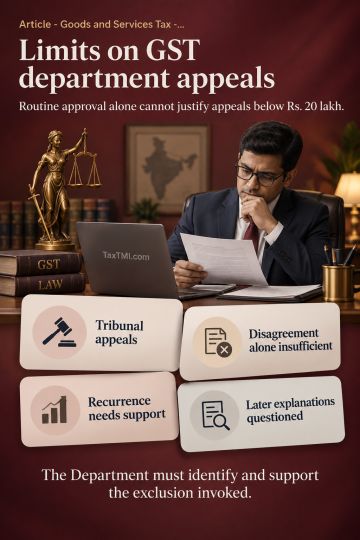
1. The issue
Circular No. 207/1/2024-GST dated 26.06.2024 fixes Rs. 20,00,000 as the monetary limit below which the Department shall not file appeals before the GST Appellate Tribunal (GSTAT), subject to the exclusions in para 4. Yet departmental appeals involving amounts well below Rs. 20 lakh are being filed in a mechanical manner, without strictly following the circular.
Three patterns are emerging before GSTAT. First, the Commissioner's authorization makes no mention of any exclusion under para 4. Second, the Department argues at the hearing that the issue involves interpretation of law and is recurring in nature, falling under para 4(iv)(e). Third, where the authorization is silent, it argues that the reasoning for the exclusion is recorded in the backup papers on which the authorization was approved.
2. Legal framework
Section 112(3) of the CGST Act empowers the Commissioner to examine the record of an order of the Appellate Authority "for the purpose of satisfying himself as to the legality or propriety of the said order" and, by order, direct a subordinate officer to apply to the Tribunal "for determination of such points arising out of the said order as may be specified by the Commissioner in his order".
Section 120(1) empowers the Board, on the Council's recommendations, to fix monetary limits "for the purposes of regulating the filing of appeal or application". Sub-sections (2) to (4) protect the Revenue: non-filing does not preclude appeals in other cases on the same issue and no party can contend that the officer has acquiesced in the decision.
Section 168(1) provides that, once the Board issues instructions, "all such officers and all other persons employed in the implementation of this Act shall observe and follow such orders, instructions or directions."
Circular No. 207/1/2024-GST, issued under Section 120 read with Section 168, fixes limits of Rs. 20 lakh (GSTAT) Rs. 1 crore (High Court) and Rs. 2 crore (Supreme Court). Under para 3, where tax is disputed only the aggregate disputed tax is counted; where only penalty, interest or late fee is disputed, that amount is counted.
Para 4 provides that the limits "shall be applicable in all cases" except where: (i) a provision of the Acts is held ultra vires the Constitution; (ii) Rules are held ultra vires the parent Act; (iii) a notification, circular or instruction is held ultra vires; (iv) the matter relates to valuation, classification, refunds, place of supply or "any other issue, which is recurring in nature and/or involves interpretation of the provisions of the Act /the Rules/ notification/circular/order/instruction etc"; (v) strictures or costs have been imposed against the Department; or (vi) "in the opinion of the Board", it is necessary to contest the case in the interest of justice or revenue.
Para 6 adds that cases not appealed under these instructions "shall not have any precedent value".
3. GSTAT: authorization alone does not establish an exclusion
Benches of GSTAT have consistently dismissed below-limit departmental appeals at the threshold where no exclusion was pleaded and established, leaving the merits open.
The Ghaziabad cases are appeals by the UP State Tax Department, decided under Section 120 of the UPGST Act and the State's Circular No. 2425008 dated 05.07.2024 (continued by Circular No. 252/2026-27). As reproduced by the Tribunal, its exceptions track para 4 of Circular No. 207, with the residual exception resting on the Commissioner's opinion. The Surat and Ernakulam decisions apply Circular No. 207 directly.
Burden on the Revenue. In Elegant Engineers (para 7), the Bench held that "An exception cannot be assumed merely because the Department wishes to file an appeal." In Devendra Singh (para 6), it required the Revenue to disclose which exception is invoked, the facts supporting it, its legal basis and, where residual discretion is relied on, "the order or recorded opinion demonstrating that the statutory discretion was actually exercised in the particular case." The Department "cannot be permitted to leave these matters to inference."
Permission is not compliance. In Elegant Engineers (para 8), the Bench held: "Permission to file an appeal and compliance with the conditions governing it are separate matters. Authorization alone does not establish an exception to the monetary limit." Otherwise, "every appeal below the limit could proceed on routine authorization, defeating the policy." Its finding in para 16(i) reads:
"... The Revenue has failed to establish any recognized exception. There is no material showing that the Commissioner specifically exercised the residual power on reasons relating to this case to bring the appeal within an exception. Merely stating that the Commissioner approved or authorized the appeal does not satisfy the statutory requirements and the binding litigation policy. This appeal therefore cannot be admitted for a decision on merits."
The same finding appears in the other Ghaziabad decisions listed above. Relying on RANADEY MICRONUTRIENTS Versus COLLECTOR OF CENTRAL EXCISE - 1996 (9) TMI 124 - Supreme Court, the Bench added that the Department "cannot rely on a statutory system for controlling litigation when convenient and ignore it simply because an order has gone against it" (para 10). In Surya Business Combines, GSTAT Ernakulam likewise found the appeal "not covered under any of the exclusion clauses" and dismissed it (paras 7 to 9).
4. "Interpretation of law" and "Recurring Nature"
Rutu Chemicals (GSTAT Surat)
The Department challenged deletion of a Rs. 22,155/- penalty, the Appellate Authority having granted relief under Section 128A. The only ground on the exclusions was that, although the penalty was below the threshold, "the order is considered contrary to law" (para 9).
Referring to Section 168, the Bench held that below the limit "the appeal should be filed only in the cases covered by the six prescribed exclusions" (para 8) and that "mere disagreement with the order passed by the Appellate Authority would not bring a case within the exclusions of the circular" (para 10).
The AR then argued para 4(iv)(e), a plea the Bench noted "does not appear in the grounds of appeal" (para 11). Rejecting it, the Bench held that the clause cannot be read so widely as to make the circular "virtually ineffective and purposeless" (para 11.2) and that the appeal did not show the specific question was recurring or arose in several cases (para 11.3). It added: "The fact that resolution of the issue requires interpretation of law is not enough to override the policy. Most disputes reaching this Tribunal would involve the interpretation of some provisions" (para 11.4). In paras 11.5 and 11.6 it held:
"... Prudence has to be exercised while invoking the phrase "any other issue". Where, similar to the issues such as valuation, classification etc., "any other issue" also has a wider implication and a substantial impact on revenue, pursuing the litigation further could be justified. Otherwise, the department has no compulsion to litigate every case disregarding its impact on revenue. ... A safeguard is already built into Section 120 itself ....
11.6. On the facts of the case, we do not find that the question posed by the department has any genuine recurring or cascading implication."
Usha Gupta (Supreme Court)
In Assistant Commissioner of Revenue v. Usha Gupta, [2025] 179 taxmann.com 200 (SC), involving a penalty of about Rs. 13 lakh, the Revenue contended that the case may fall under para 4(iv). The Court held (paras 5 and 6):
"5. ... We do not find that the impugned order would fall in any of the specific categories mentioned in Clause (iv) of Paragraph 4 of the Circular as the direction relates to re-computation of penalty in respect of a specific transaction and does not directly involve refund or interpretation of any provision of the Act/ Rules/ Notification, etc. Moreover, the issue is not of a recurring nature.
6. Consequently, we decline to entertain the appeal. ..."
Narbada Industries (J&K and Ladakh High Court)
In Commissioner of CGST and Central Excise v. Narbada Industries, [2022] 139 taxmann.com 136, arising under the Central Excise Act and the CBIC circular dated 22.08.2019, the Court held the circular binding (paras 26 to 28). It noted that no material showed special permission from the Government to file the appeals ignoring the circular (para 29), that no substantial question of law was involved (para 30), and held the appeals "not maintainable" (para 31).
Typical below-limit appeals, such as those against deletion of transit penalties or on whether admitted tax was paid, are often fact-specific. On the reasoning in Rutu Chemicals and Usha Gupta, labelling such a dispute as one of "interpretation" (say, of Section 75(12)) or as "recurring" does not bring it within the exclusion.
5. Reasons in the "backup papers"
Section 112(3) requires the Commissioner to act "by order", specifying the points "in his order". Where that order is silent on any exclusion, a plea under para 4 raised later, whether in a reply, at the hearing or by pointing to the backup file, is a ground not found in the order.
In MOHINDER SINGH GILL & ANR. Versus THE CHIIEF ELECTION COMMISSIONER, NEW DELHI & ORS. - 1977 (12) TMI 138 - Supreme Court, the Constitution Bench held (para 8):
"... when a statutory functionary makes an order based on certain grounds, its validity must be judged by the reasons so mentioned and cannot be supplemented by fresh reasons in the shape of affidavit or otherwise. Otherwise, an order bad in the beginning may, by the time it comes to Court on account of a challenge, get validated by additional grounds later brought out."
The Court relied on COMMISSIONER OF POLICE, BOMBAY Versus GORDHANDAS BHANJI. - 1951 (11) TMI 17 - Supreme Court, para 9:
"... public orders, publicly made, in exercise of a statutory authority cannot be construed in the light of explanations subsequently given by the officer making the order of what he meant, or of what was in his mind, or what he intended to do. ... [They] must be construed objectively with reference to the language used in the order itself."
On this basis, the taxpayer can argue that an authorization silent on the exclusion must be judged by its own language and cannot be supplemented by later reasons or backup papers. The GSTAT decisions speak of the "record" and "recorded opinion" and the Department may rely on that wording; the answer lies in Section 112(3) and Mohinder Singh Gill.
6. Conclusion
The decisions discussed lead to five points for taxpayers facing below-limit departmental appeals:
1. Raise maintainability at the threshold; GSTAT decides it before the merits (Elegant Engineers, para 14).
2. Check whether the authorization identifies an exclusion and its reasons; mere approval is not enough (Elegant Engineers, para 16(i)).
3. Resist the "interpretation" and "recurring" plea where the dispute is fact-specific (Rutu Chemicals, paras 10 and 11.4; Usha Gupta, para 5).
4. Resist reliance on backup papers (Mohinder Singh Gill, para 8; Gordhandas Bhanji, para 9).
As GSTAT Surat observed, the department "has no compulsion to litigate every case disregarding its impact on revenue". Strict adherence to the circular at the authorization stage would avoid appeals that end in dismissal at the threshold.