 TaxTMI







 25 Nov 2026

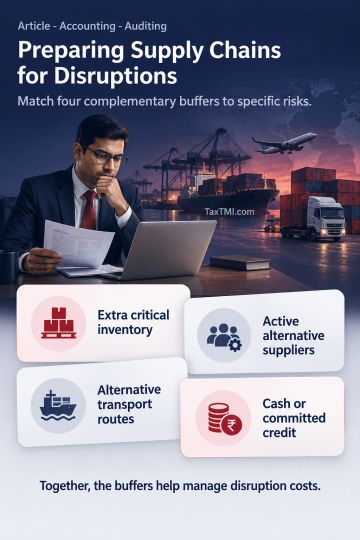
For forty years businesses cut inventory to cut cost. A pandemic, a stranded ship and a war zone revealed what that efficiency was concealing - and finance teams are now asked to decide how much resilience is worth.
Finance teams are trained to see inventory as trapped cash. Every month the working-capital dashboard rewards a lower days-in-stock figure, and every budget review asks procurement to trim it further.
Then a supplier stops shipping for three weeks and the plant sits idle. The inventory "saved" was worth a fraction of the sales lost. The real finance question isn't how low stock can go, but where a small buffer prevents a large loss.
One ship, one canal, one week
On 23 March 2021 the Ever Given, a 400-metre container ship, ran aground in the Suez Canal during a sandstorm and blocked it for six days.
Hundreds of vessels queued at either end. Lloyd's List estimated that roughly US$9.6 billion of goods passed through the canal on a typical day. European factories waited for parts, retailers waited for stock and container rates, already inflated by the pandemic, climbed again.
Businesses had optimised for the normal day. The shocks of the 2020s exposed the price of having no plan for the abnormal one.
The brilliance - and the trap - of just-in-time
In the decades after the Second World War, Toyota developed a production system in which parts arrived exactly when required, in exactly the quantity required. Stock was waste, and problems were exposed and fixed rather than buried under inventory.
Just-in-time, or lean, transformed manufacturing worldwide, freeing cash, cutting waste and improving quality.
As it spread, though, many companies copied the low inventory without the deep supplier relationships, visibility and discipline behind it. They optimised for cost alone - single suppliers, distant sources, minimal stock.
It worked superbly as long as nothing went wrong.
Lesson from history: seven good years
In Genesis, Joseph reads Pharaoh's dream of seven fat cows and seven lean ones as seven years of plenty followed by seven of famine, and advises storing grain in the good years. When famine arrives, Egypt has food and neighbours come to buy.
Read as history or parable, the message is the same: buffers built in good times are strength in bad times. Joseph didn't predict the exact year; he simply prepared for one.
A decade of disruption
- 2011 - Japan's To hoku earthquake and tsunami disrupted automotive and electronics supply chains.
- 2020-2022 - pandemic lockdowns closed factories and ports; container rates soared.
- 2021 - the Ever Given blocked Suez; a chip shortage halted car lines.
- 2022 - war in Ukraine disrupted energy, grain, fertiliser and metals.
- From late 2023 - attacks in the Red Sea pushed many ships around Africa, adding roughly 10 to 14 days to Asia-Europe voyages.
- 2025-2026 - abrupt tariff changes and export controls upended sourcing decisions.
Each was called "unprecedented." Together they formed a pattern.
Disruption is no longer a rare event. It's a recurring cost of doing business.
In a nutshell
Essence: supply shocks are now frequent enough that resilience, not just cost, must be designed into how a business buys, stores and moves goods.
Toyota's second lesson
After 2011 Toyota found it took weeks to work out which of its suppliers' suppliers were affected. It built a detailed multi-tier supplier database and asked key suppliers to hold more stock of critical parts, especially semiconductors.
When the chip shortage struck in 2021, Toyota was widely reported to have coped better than many rivals in the early months.
The inventor of just-in-time had learned to add just-in-case - selectively, where it mattered most.
The uncomfortable reality
Many businesses still treat inventory and backup suppliers purely as cost. Finance pushes stock down, procurement picks the cheapest single source and nobody models what happens if that source stops.
When disruption arrives, they lose sales worth far more than the inventory they saved - and customers move to more reliable suppliers.
The cheapest supply chain on paper is often the most expensive in practice.
The Four Buffers
Resilience doesn't mean piling up stock everywhere. It means placing the right buffer in the right place.
Buffer 1 - Stock
Carry extra inventory only for critical items - long lead times, single sources or high impact if missing. Classify by impact and replaceability, not just by value.
Buffer 2 - Source
Qualify a second supplier for critical inputs, ideally in another region, and keep it active with a share of volume so the relationship works when needed.
Buffer 3 - Route
Know alternative routes and logistics partners - other ports, carriers, modes and warehouses - and pre-negotiate where possible.
Buffer 4 - Cash
Hold a liquidity reserve - cash or committed credit - to fund emergency freight, higher prices or extra stock when shocks hit.
For practitioners: putting numbers on resilience
- Quantify the cost of a stockout. Estimate contribution lost per day of stoppage for each critical input; it is the benchmark against which buffer costs are judged.
- Compute carrying cost properly. Include financing, storage, insurance, obsolescence and handling, so buffers are neither under- nor over-priced.
- Segment inventory by criticality, not only ABC by value; a low-value part with a single source can be the most dangerous line on the list.
- Reflect buffers in working-capital plans and bank limits, and explain to lenders why days-in-stock rose for selected items.
- Review valuation and write-downs. Strategic stock must still be tested for obsolescence and net realisable value at each reporting date.
Illustration
Take an illustrative Rs. 500 crore Indian appliance maker that imports compressors from one East Asian supplier and keeps two weeks' stock.
In early 2024 Red Sea disruptions and higher freight delay shipments and production halts for nine days, costing about Rs. 22 crore in lost sales.
Applying the buffers:
- Stock - six weeks of compressors and other critical parts; normal levels for everything else.
- Source - a second compressor supplier in another country qualified for 30% of volume.
- Route - a second freight forwarder and an alternative port added.
- Cash - a committed working-capital line arranged for emergencies.
Extra annual cost: roughly Rs. 4 crore in carrying and dual-sourcing costs.
When the next disruption comes - a supplier factory shutdown - production doesn't stop. Rs. 4 crore of insurance protected Rs. 22 crore of sales.
Building resilience step by step
1. Identify critical items - the inputs whose absence would stop production or sales.
2. Map the tiers - who supplies the suppliers of those items.
3. Score the risk - single source, single country, long lead time, financial weakness.
4. Choose the buffer - stock, source, route or cash - according to risk and cost.
5. Watch the signals - supplier health, geopolitics, freight rates and weather.
6. Rehearse - run a "what if this supplier stops for 30 days?" exercise every year.
7. Rebalance - adjust buffers as risks and costs change.
The next ten years
Climate events, geopolitical tension and trade rules are likely to keep disruption frequent, while digital tools - supplier risk monitoring, real-time shipment tracking and AI demand planning - make buffers smarter and cheaper. The winners won't hold the most inventory; they'll know exactly where a small buffer prevents a big loss.
Immediate actions by role
- Owner: name the five inputs whose loss would stop the business fastest.
- Procurement head: qualify a second supplier for at least one this quarter.
- Logistics head: agree alternative routes and freight partners in writing.
- CFO: secure a committed credit line for emergency purchases.
Indicators of success
- Production or sales lost to supply disruption decline.
- Fewer critical items depend on a single supplier.
- Recovery time after disruption shortens.
- Inventory rises only for critical items, not across the board.
The objection we hear most - and our response
The objection: "Extra stock and backup suppliers tie up cash and raise cost. Our competitors run lean and so must we."
The answer: Resilience should be targeted, not general. Most items can stay lean; a handful of critical inputs deserve buffers, and their cost is usually a fraction of the sales and customers lost in one disruption. When rivals run dry, the resilient supplier picks up their customers. Lean is a tool, not a creed - use it where it fits.
Practitioners' FAQ
"How much safety stock is enough?"
It depends on lead time, demand variability, supply risk and the cost of a shortage. Begin with critical items and model scenarios rather than applying one rule.
"Is nearshoring the answer?"
Sometimes. Nearer suppliers cut transit risk but may cost more; combine geography with supplier quality and diversification.
"How can sub-tier suppliers be identified?"
Ask key suppliers to disclose sub-tier sources for critical parts and write that into contracts and audits.
"Does this matter for small businesses?"
Yes - they have less bargaining power in shortages and less cash to absorb shocks.
Position as at October 2026: Red Sea security risks continue to affect some Asia-Europe shipping decisions, and tariff and export-control changes remain a source of disruption. Review your critical-item list, alternative routes and liquidity lines at least twice a year.
Pitfalls
- Cutting stock across the board without classifying criticality.
- Single-sourcing critical inputs from one region.
- Qualifying backup suppliers on paper but never ordering from them.
- Ignoring sub-tier suppliers.
- Operating with no liquidity reserve.
Terms explained
- Just-in-time - receiving inputs only as needed, keeping stock low.
- Just-in-case - holding buffers against disruption.
- Safety stock - extra inventory to cover delays or demand spikes.
- Lead time - the gap between ordering and receiving goods.
- Sub-tier supplier - a supplier's own supplier.
- Dual sourcing - using two suppliers for the same input.
Misconceptions clarified
- "Resilience means more stock everywhere." Targeted buffers on critical items cost far less.
- "A backup supplier on paper is enough." Only an active relationship works in a crisis.
- "Lower inventory always means better working capital." Not if a stockout destroys sales and customers.
Action checklist
Critical items identified and classified
Active second supplier for each critical input
Alternative routes agreed with forwarders
Committed emergency credit line in place
Disruption rehearsal held each year
Discussion points for the team
1. Which supplier failure would halt production within a week?
2. Have we ever actually ordered from our backup supplier?
3. How would we ship if our usual route closed tomorrow?
Half-hour action exercise
List the five inputs that would stop the business fastest. For each, note number of suppliers, countries of origin, weeks of stock and lead time.
Any input with one supplier, one country and less stock than its lead time is the first resilience project.
Summary for busy professionals
- The 2020s brought repeated shocks - pandemic, Ever Given, chip shortages, war, Red Sea attacks and tariff swings.
- Just-in-time works, but copying low inventory without resilience creates fragility.
- Toyota added selective buffers after 2011 and handled the chip shortage better than many.
- Place stock, source, route and cash buffers only where they matter most - and cost them against the price of a stockout.
- Map critical items and sub-tier suppliers, score the risk and rehearse disruptions.
Efficiency wins the ordinary day. Resilience wins the year.
References
- Lloyd's List, reporting on the value of Suez Canal traffic during the Ever Given blockage (March 2021).
- Taiichi Ohno, Toyota Production System: Beyond Large-Scale Production (Productivity Press, 1988).
- Reuters reporting on Toyota's post-2011 supplier database and semiconductor stockpiling (March 2021).
- UNCTAD, Review of Maritime Transport (2024). unctad.org
- McKinsey Global Institute, Risk, Resilience, and Rebalancing in Global Value Chains (August 2020).