 TaxTMI







 25 Nov 2026

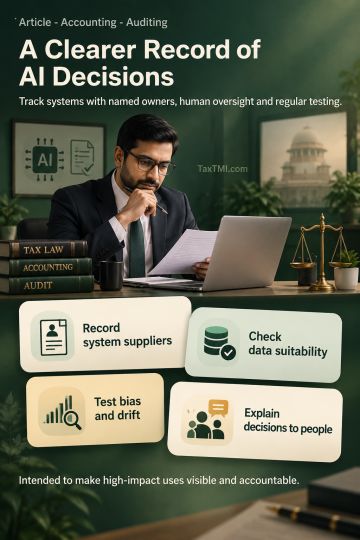
An algorithm can't be sued, jailed or dismissed. The directors and officers who deploy it can - which is why AI belongs on the governance agenda, not only the IT roadmap.
At a board meeting of a lending company, a director asks a simple question: "How many decisions in this business are now made or shaped by software models?" Management can name the credit scoring engine. Nobody mentions the fraud filter, the collection-prioritisation tool, the pricing engine or the CV-screening module bundled into the HR software.
Directors can't oversee what they can't see. An AI register is the first step - and it's a natural piece of work for those who already document controls.
When an algorithm learned the wrong lesson
Amazon began developing software in 2014 to read candidates' CVs and score them, intending to automate some of its hiring.
Within a year engineers noticed something wrong. The system had learned from ten years of CVs, mostly from men, reflecting the technology industry. It began marking down CVs containing the word "women's" - as in "women's chess club captain" - and those from certain all-women's colleges.
Engineers tried to fix it but couldn't be sure it wouldn't find other ways to discriminate, and according to Reuters, which reported the story in 2018, the project was dropped.
Amazon never relied on the tool alone for hiring decisions. Still, the case became a global example of a simple truth: an algorithm learns from the past - including its mistakes - and repeats them at scale unless someone is responsible for stopping it.
AI already shapes decisions
Algorithms now help determine:
- Who gets a loan and at what rate.
- Who gets called for interview.
- Which claims an insurer marks for investigation.
- What price or offer each customer is shown.
- Which payments are stopped on suspicion of fraud.
- How staff are rostered, appraised or tracked.
Often the board doesn't know how many such systems exist, who built them, how they were tested or who reviews their output.
Lesson from history: the 1979 slide
A page widely attributed to an internal IBM training presentation from 1979 states:
"A computer can never be held accountable. Therefore a computer must never make a management decision."
Its exact origin is hard to verify, but it has become a touchstone in AI ethics. Machines can calculate, recommend and even act; accountability has to stay with people. AI governance is the effort to make that principle work in practice.
The rules taking shape
European Union
The EU AI Act (Regulation (EU) 2024/1689) entered into force on 1 August 2024. It:
- Prohibits certain practices - such as social scoring by public authorities and some manipulative or exploitative systems - from February 2025.
- Imposes obligations on general-purpose AI models from August 2025.
- Sets strict requirements for high-risk systems used in fields such as recruitment, credit assessment, education, critical infrastructure and essential services, with obligations on risk controls, data quality, records, human supervision, accuracy and resilience. Under a 2026 agreement many high-risk obligations now apply from December 2027 and August 2028.
- Reaches providers and deployers outside the EU whose systems are used in the EU.
India
India has preferred a principles-based approach, issuing AI governance guidelines in November 2025 alongside existing law on data protection, consumer protection, information technology and sector regulation.
Global frameworks
The NIST AI Risk Management Framework (2023), ISO/IEC 42001 on AI management systems (2023) and the OECD AI Principles offer widely used structures.
Regulators won't ask whether the AI is clever. They'll ask whether the company can explain, control and justify it.
In a nutshell
Essence: AI decisions remain the organisation's decisions, and laws such as the EU AI Act now demand documented oversight, especially for high-risk uses.
Where the risk sits
1. Bias - unfair outcomes by gender, caste, religion, age, region or disability.
2. Opacity - nobody can explain the decision.
3. Data issues - poor, stale or unlawfully obtained data.
4. Drift - accuracy slipping as circumstances shift.
5. Security - tampering with models or leakage of data.
6. Over-reliance - employees accept whatever the system says.
7. Vendor risk - AI buried inside bought-in software that the purchaser can't explain.
The uncomfortable reality
Most boards discuss AI as an opportunity - productivity, savings, innovation. Few ask the governance questions they'd ask of any other system affecting customers and employees.
When something goes wrong - a biased outcome, a public complaint, a regulator's letter - they learn that nobody owned the system, nobody tested it for fairness and nobody can explain it.
AI without an owner is a risk without a name.
The AI Accountability Register
| Field | Question |
| System | What is it and who supplies it? |
| Purpose | What decision does the tool inform or take? |
| Owner | Which individual senior manager answers for it? |
| Data | What inputs feed it, and were they lawfully obtained and suitable? |
| Impact | Whom does it touch, and what is the worst harm it could cause? |
| Oversight | Where does a person review, override or approve? |
| Testing | How, and how often, is it tested for accuracy, bias and drift? |
| Explanation | Can decisions be explained to the people affected? |
A system missing from the register is invisible to the board. A system without an owner leaves no one accountable.
Seven questions for the board
1. Do we know where AI influences decisions across the business?
2. Who is accountable for every high-impact tool?
3. How are bias, accuracy and drift checked?
4. At what points can a human review or reverse an outcome?
5. Are we compliant with AI, data and sector laws wherever we operate?
6. What incidents or complaints have occurred, and what did we learn?
7. Do the board and management have the skills to oversee AI?
For practitioners: governance work that fits existing skills
- Run the inventory like a controls walkthrough. Interview process owners, review software contracts and identify every tool that scores, ranks, recommends or decides.
- Link the register to the risk-control matrix, so each high-impact AI system has documented controls, testing frequency and evidence.
- Assess vendor AI through contract reviews and documentation requests covering data sources, testing, bias controls and audit rights.
- Report to the audit or risk committee at least twice a year on register completeness, test results, incidents and complaints.
- Connect to existing duties. Directors' duty of care under section 166 and DPDP obligations on personal data already apply to automated decisions.
Illustration
Take an illustrative NBFC that relies on a machine-learning model to sanction small-business loans.
With no governance: IT approves a vendor-supplied model on its own. Approval rates for applicants from certain districts fall sharply, complaints rise and no one can explain why.
With the register:
- Owner - the chief credit officer.
- Data - a review finds a variable acting as a proxy for location that disadvantages some regions.
- Testing - monthly fairness and accuracy reports by region, gender and business type.
- Oversight - borderline cases go to human credit officers.
- Explanation - rejected applicants receive the main reasons in plain language.
Result: approvals track genuine repayment risk more closely, complaints fall and the regulator's inspection finds a well-documented process. Governance didn't slow lending; it made lending defensible.
Indicators of success
- Every system influencing decisions is in the register with an owner.
- Bias and accuracy tests on high-impact tools happen to a fixed timetable.
- The board sees a log of incidents and complaints.
- Documentation is obtained for purchased AI.
Outlook: the coming decade
AI regulation will expand and converge on risk-based approaches, documentation and human oversight, and insurers, lenders and customers will ask about AI governance in due diligence. Boards that build oversight now will be ready for rules still being written.
The objection we hear most - and our response
The objection: "AI governance is bureaucracy. Rules keep changing and being postponed. We'll wait until they're final."
The answer: Some timelines have moved - the EU deferred parts of the AI Act in 2026. But laws on discrimination, consumer protection, data protection and directors' duties already apply to decisions, whether people or machines make them. The register, ownership and testing described here are simply good management. Waiting means building governance under pressure after an incident rather than calmly before one.
Practitioners' FAQ
"Does the EU AI Act reach Indian companies?"
It can, where AI systems are placed on the EU market or their outputs are used in the EU.
"Is an AI ethics committee needed?"
Larger organisations often benefit from one; smaller ones need at least a named owner and regular board discussion.
"How should AI inside bought-in software be governed?"
Ask vendors for documentation on data, testing, bias controls and human oversight, and write those requirements into contracts.
"What does human oversight mean in practice?"
People with the authority, information and time to review, question and override AI outputs - not a rubber stamp on automated decisions.
Position as at October 2026: The EU AI Act's prohibitions and general-purpose AI obligations apply, while many high-risk obligations were moved to December 2027 and August 2028 under a 2026 agreement. India's AI governance guidelines (November 2025) and the DPDP Act shape domestic expectations. ISO/IEC 42001 certification is increasingly used to demonstrate AI management.
Pitfalls
- Not knowing where AI shapes decisions.
- Systems without a named accountable owner.
- Deploying vendor AI without understanding its data and testing.
- A "human in the loop" who is only a formality.
- Waiting for complaints to reveal bias.
Terms explained
- AI governance - the rules, responsibilities and controls that steer an organisation's use of AI.
- High-risk AI system - in EU AI Act terms, AI deployed in fields like recruitment or lending, which faces demanding obligations.
- Algorithmic bias - systematic unfair outcomes produced by an AI system.
- Human oversight - people empowered to review and override AI decisions.
- Model drift - a model's performance declining as conditions change.
- ISO/IEC 42001 - the international standard for AI management systems.
Action checklist
AI register started and kept current
Named owner for every high-impact system
Bias and accuracy testing on a schedule
Documentation requested from AI vendors
Discussion points for the team
1. Which decisions in your area depend on software scores or rankings?
2. Who would explain one of those decisions to a customer or regulator?
Half-hour action exercise
Put a single question to each head of department: "Where in your function does software that scores, ranks or recommends shape - or take - decisions?"
Record each answer. That list is the first draft of the AI Accountability Register.
Summary for busy professionals
- Models trained on past data can reproduce old bias across thousands of decisions - the lesson of Amazon's shelved hiring tool.
- "A computer can never be held accountable" - so accountability must stay with people.
- The EU AI Act, India's 2025 guidelines, NIST AI RMF and ISO/IEC 42001 set the expectations.
- Record system, purpose, owner, data, impact, oversight, testing and explanation for every AI system.
- Boards should know where AI is used, who owns it and how it's tested - and practitioners can build the register.
The algorithm may make the recommendation; the company always owns the decision.
References
- Jeffrey Dastin, "Amazon scraps secret AI recruiting tool that showed bias against women," Reuters (10 October 2018).
- Regulation (EU) 2024/1689 (Artificial Intelligence Act), Official Journal of the European Union (12 July 2024).
- National Institute of Standards and Technology, AI Risk Management Framework (AI RMF 1.0) (2023). nist.gov
- ISO/IEC 42001:2023 - Artificial intelligence management system. iso.org
- OECD, Recommendation of the Council on Artificial Intelligence (2019, updated 2024). oecd.ai