 TaxTMI







 24 Nov 2026

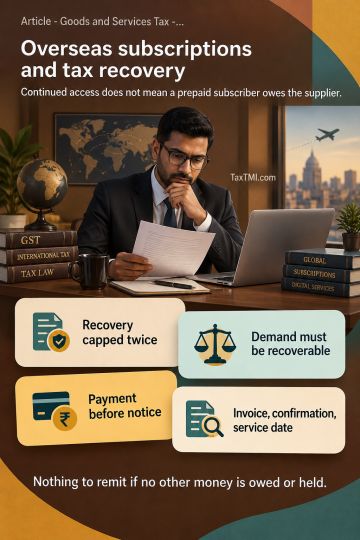
While reading R. Rajasree's Malayalam novel (Aathreyakam), I paused over the young Niramithran's arrival in a place far removed from the familiar world of kings and warriors. He goes there seeking refuge. The episode left me thinking about how far authority can reach. That question returned in an unlikely setting when I considered the IGST on a prepaid subscription to an overseas legal database.
Take an unregistered advocate in Kerala who pays for a year's access before the provider activates the account. The invoice is fully paid and the proceeds settle abroad. The supplier has no office or representative in India and has appointed nobody here to pay IGST on its behalf. Months later, after the supplier's IGST demand has become recoverable, a notice reaches the advocate, who is still using the database. Can the department collect the supplier's tax from the subscriber? For a notice under Section 79(1)(c) of the CGST Act, the answer depends on whether the advocate still owes or holds any money for the supplier.
Who owes the IGST
An overseas subscription to an online legal database is an online information and database access or retrieval service, known as OIDAR. Section 13(12) of the IGST Act places the supply where the recipient is located. Section 14(1) makes the overseas supplier liable on a direct supply to a non-taxable online recipient in India. Since 1 October 2023, the definition in Section 2(16) covers unregistered recipients in India even if they use the service for business or professional purposes. The advocate's use of the database for legal research therefore falls within the provision on the facts assumed here. For a recipient with ordinary GST registration, liability on the import generally falls on the recipient under reverse charge.
Section 14(2) requires the overseas supplier to obtain a single registration under the simplified scheme. A representative in India, where one exists, must register and pay on the supplier's behalf. If the supplier has neither a physical presence nor a representative in India, it must appoint a person here to pay the tax. The supplier's failure to make that appointment leaves the statutory liability in place and can make domestic collection harder.
What the recovery notice can reach
Section 20 of the IGST Act applies the CGST demand and recovery provisions to integrated tax. Once the demand is recoverable, Section 79(1)(c) permits the proper officer to require a third party to pay the Government out of money due or becoming due to the defaulter, or money held or subsequently held for the defaulter. The amount recoverable from that third party is limited by the amount owed or held and the amount recoverable from the defaulter.
In this example, the supplier still owes the advocate access to the database. The advocate's payment obligation ended when the fee was paid in full. Section 79(1)(c)(vii) expressly lets a notice recipient prove that payment was made before service. The invoice, payment confirmation and the date of service matter. If the advocate can establish full payment before service and has no other money due to or held for the supplier, there is nothing to remit under the notice for that subscription.[4]
The customer's payment and the merchant's settlement can occur at different times. If an intermediary within Indian jurisdiction still owes a settlement amount to the supplier or holds funds on its behalf, the department may be able to reach those funds. The settlement records and contracts show who owes or holds the money. An Indian-issued card, by itself, does not establish that the card issuer owes the overseas supplier anything.
A renewal can bring a fresh instalment or fee within reach if the subscriber incurs a contractual obligation to pay. The notice itself cannot require the subscriber to renew. Where the proceeds have already settled abroad and there are no domestic assets, receivables or funds within reach, a recoverable demand may yield little through domestic recovery measures.
A question for the GST Council
The payment trail is the practical starting point. Where a domestic intermediary still has settlements to make to an identified defaulter, the existing recovery power may suffice. Where payments settle entirely offshore, the GST Council could examine whether targeted transaction reporting would identify defaulting suppliers early enough to improve compliance. A requirement for payment intermediaries to collect IGST at checkout would need an express statutory basis and safeguards against double collection.
The question that stayed with me after reading Aathreyakam comes down, here, to the payment records. Section 14 identifies the person liable for the tax. Recovery under Section 79(1)(c) depends on finding money owed to or held for that person. When the notice reaches the advocate, the year's subscription is still running. The fee has already been paid and settled abroad.