 TaxTMI







 24 Nov 2026

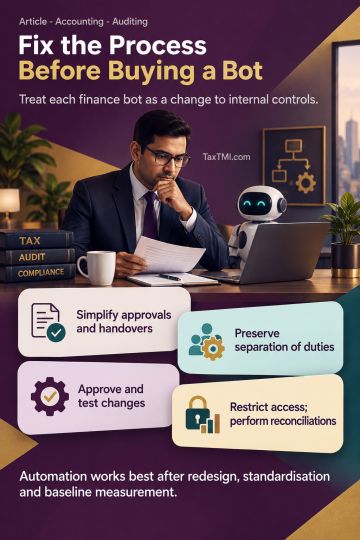
Bots, RPA and AI amplify whatever they're handed. Feed them a messy accounts-payable or order-to-cash process and they'll produce a bigger mess - faster and harder to see.
An RPA vendor's proposal to a client promises to "process 6,000 invoices a month with zero human effort." The demo is impressive: the bot opens emails, keys data, routes approvals and posts entries.
The internal auditor reading the proposal notices something else. The bot faithfully reproduces three layers of approval nobody needs, matches invoices to purchase orders that are raised after the invoice, and posts to four different coding structures across four plants. It will automate the dysfunction, not remove it.
Tesla's admission
On 13 April 2018 Elon Musk tweeted: "Yes, excessive automation at Tesla was a mistake. To be precise, my mistake. Humans are underrated."
Tesla had planned a heavily automated line for the Model 3. Output fell far behind target - what Musk called "production hell" - and some automation proved too complex or unreliable. Parts of it, including a complex conveyor system, were removed and people were added back.
Tesla later became one of the highest-volume electric carmakers. The 2018 lesson remains: automation doesn't fix a process that hasn't been mastered; it magnifies whatever is already there.
The rush to automate
Almost anything can now be automated:
- RPA copying data between systems.
- AI tools reading documents and answering queries.
- Workflow software routing approvals.
- Robots and machines on the shop floor.
- AI agents acting on the company's behalf.
Vendors promise savings, speed and accuracy, and leaders want quick wins - so companies automate what they already do, exactly as they already do it.
Lesson from history: "Don't automate, obliterate"
In 1990 MIT professor Michael Hammer published "Reengineering Work: Don't Automate, Obliterate" in the Harvard Business Review.
He described companies that had spent heavily on computers for little gain because they used technology to speed up old, inefficient processes rather than redesigning them. One example was Ford's accounts-payable department, which redesigned its process to pay on receipt of goods and needed far fewer people as a result.
A line often attributed to Bill Gates says the same: automation applied to an efficient operation magnifies the efficiency; applied to an inefficient one, it magnifies the inefficiency.
What goes wrong
1. Unnecessary steps automated - the bot diligently performs work that shouldn't exist.
2. Inconsistent processes automated - every branch does it differently, so exceptions break the bot.
3. Bad data automated - wrong inputs, processed faster and spread further.
4. Unclear rules automated - judgement calls coded as rigid rules.
5. Problems hidden - errors once visible to staff now buried in systems.
6. Fragility - a changed website, form or screen stops the bot.
Done by hand, a broken process produces a few errors a day. Automated, it can produce thousands an hour.
In a nutshell
Essence: automation multiplies what it's given, so simplify, standardise and clean the process first - then automate.
The uncomfortable reality
Automation projects are often chosen for visibility - a demo, a launch, an announcement - rather than readiness.
When results disappoint, the technology gets the blame, though the real cause is usually a process nobody had questioned in years.
Many companies don't need more technology. They need fewer, simpler steps - and then technology.
The Four-Gate Automation Test
Gate 1 - Necessary
Does each step add value for the customer, the law or the business? Remove what doesn't.
Gate 2 - Simple
Can approvals, handovers, forms and systems be reduced? Simplify before automating.
Gate 3 - Standard
Is the process the same everywhere, with clear rules and defined exceptions? Standardise variants.
Gate 4 - Measured
Are today's volume, time, cost and error rate known? Without a baseline the benefit can't be proved. Measure first.
Only processes that pass all four gates are ready.
For practitioners: controls and audit considerations
- Treat every bot as a change to internal controls. Update process narratives and the risk-control matrix, and confirm segregation of duties survives automation.
- Insist on change management. Bot logic, credentials and rule changes should follow the same approval and testing discipline as ERP changes.
- Secure bot credentials. Service accounts used by bots need least-privilege access and periodic review, since they often carry broad rights.
- Reconcile bot output. Build control totals and exception reports so finance can confirm what the bot processed against source volumes.
- Clean master data first. Vendor, customer and item masters with duplicates or stale records will be reproduced at scale.
Illustration
Take an illustrative Rs. 800 crore company processing 6,000 supplier invoices a month that plans to buy RPA bots for entry and approval.
The four gates reveal:
- Necessary - three managers approve every invoice, even small ones, and one approval adds no checks.
- Simple - invoices arrive by email, post, WhatsApp and courier, and 40% are matched manually because POs are raised after invoices.
- Standard - each of four plants uses different coding.
- Measured - nobody knows the current error rate or cost per invoice.
Fixes before automation:
- One approval below Rs. 1 lakh; two above.
- A single invoice inbox or supplier portal.
- A "no PO, no pay" rule for most purchases.
- One coding structure across plants.
- A baseline: 9 days per invoice and a 4.5% error rate.
Then automation: AI-assisted invoice capture and automatic three-way matching.
Result: processing time drops to two days and errors fall below 1%. The vendor's original proposal would have automated the old process at greater cost for less benefit.
Automating well
1. Map the process end to end, including exceptions and workarounds.
2. Remove, simplify and standardise.
3. Fix data at source - clean customer, supplier and item masters.
4. Start small - one process, one unit, measured results.
5. Keep people for exceptions and judgement.
6. Monitor and maintain - every automation needs an owner, controls and updates.
7. Measure benefits honestly against the baseline.
Indicators of success
- Cycle time falls sharply.
- Error rates fall, not just processing time.
- Exceptions handled by people shrink as a share of volume.
- Cost per transaction falls after including software, maintenance and support.
- Bot failures caused by system changes are rare and quickly fixed.
Outlook: the coming decade
AI agents will cope with more variation than rigid bots, tempting businesses to automate messy processes without fixing them - the same mistake on a larger scale. Organisations that first make processes simple, standard and measurable will gain most from AI. Process discipline will become a competitive advantage.
Immediate actions by role
- COO: run the five processes proposed for automation through the four gates.
- Process owners: map one process end to end, workarounds included.
- CFO: require a baseline of time, cost and errors before approving any automation.
- IT head: require a named business owner for every bot.
Illustration from a smaller enterprise
Take an illustrative logistics company that buys software to send customers automatic delivery updates. The updates draw on the dispatch system, but dispatch staff often update records hours late, so customers receive wrong messages and complaints double.
The company fixes the process first - drivers update status on a mobile app at each stop and dispatch records are checked hourly. Then the same software works as promised. The technology was never the problem; the process was.
The objection we hear most - and our response
The objection: "Redesign takes months. Automation tools are quick. Let's automate now and improve later."
The answer: "Later" rarely arrives once bots are live; they become part of the problem, built around old steps and hard to change. Fixing a process often takes weeks, not months, and frequently delivers much of the benefit before any technology is bought. Automation then becomes faster, cheaper and more reliable. Speed that multiplies errors isn't speed - it's acceleration in the wrong direction.
Practitioners' FAQ
"Is RPA a bad idea?"
No. It suits stable, rules-based tasks between systems that can't easily be integrated. It's risky as a substitute for fixing processes or systems.
"What should be automated first?"
High-volume, rules-based, stable processes with clean data and measurable outcomes - once they pass the four gates.
"Will AI make redesign unnecessary?"
No. AI tolerates more variation, but it still learns from and acts on the organisation's processes and data. A confusing process confuses AI too.
"Who should own automation?"
The business process owner, supported by IT - not IT alone.
Position as at October 2026: AI-assisted automation and AI agents are expanding rapidly into finance, operations and customer service. Auditors and regulators increasingly expect automated processes to have documented controls, change management and monitoring. Treat every automation as a change to internal controls.
Pitfalls
- Automating processes nobody has mapped.
- Measuring success by the number of bots deployed.
- Keeping unnecessary approvals in automated workflows.
- Ignoring data quality.
- Leaving automations without owners or maintenance.
Terms explained
- RPA - software bots that replicate human clicks and keystrokes across systems.
- Process mapping - documenting every step, including exceptions.
- Baseline - time, cost and error measurements before a change.
- Exception - a case that falls outside the standard rules.
- Cycle time - total time from start to finish.
- Reengineering - redesigning a process from first principles instead of speeding up old steps.
Misconceptions clarified
- "Automation always saves money." Only when the process is right first.
- "We'll clean up the process later." Once automated, broken steps become harder to change.
- "Bots don't need controls." They need access reviews, change management and output reconciliation like any system.
Action checklist
End-to-end process map, workarounds included
Steps with no value removed
Variants harmonised across units
Baseline of time, cost and errors captured
Named business owner for each automation
Monitoring, maintenance and control plan agreed
Discussion points for the team
1. Which step would nobody miss if it vanished?
2. How many versions of this process exist across our teams?
3. Do we know today's error rate before automating?
Half-hour action exercise
Take one process the client plans to automate and write every step on paper. For each, ask: "What would happen if we stopped doing this?"
Strike out every step where the honest answer is "nothing." Those should be removed, not automated.
Summary for busy professionals
- Tesla's 2018 experience showed that over-automating an unmastered process slows production.
- Hammer's 1990 advice - "don't automate, obliterate" - still holds: redesign first.
- Automation amplifies unnecessary steps, inconsistent rules and bad data.
- Pass every process through necessary, simple, standard and measured.
- Treat bots as control changes - with access reviews, change management and reconciled output.
Make it right first; make it fast second.
References
- Elon Musk, post on Twitter (13 April 2018); CBS News interview on Tesla Model 3 production (April 2018).
- Michael Hammer, "Reengineering Work: Don't Automate, Obliterate," Harvard Business Review (July-August 1990).
- Michael Hammer and James Champy, Reengineering the Corporation (HarperBusiness, 1993).
- Taiichi Ohno, Toyota Production System: Beyond Large-Scale Production (Productivity Press, 1988).