 TaxTMI







 24 Nov 2026

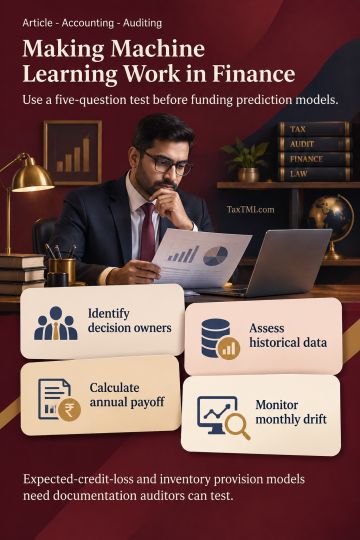
Machine learning isn't magic. It is prediction from data, and a prediction is worth paying for only when it changes a decision the business actually makes.
A client's management presents an "AI roadmap" with a data lake, a team of data scientists and twelve models in the pipeline. The CFO asks the practitioner reviewing the budget a fair question: "How will we know any of this pays back?"
The answer starts not with algorithms but with decisions. Which decisions does the business make hundreds of times a month, what is a better outcome worth in rupees, and who will act on the prediction? Without those answers, the roadmap is a cost centre.
Two companies, two opposite mistakes
In 2006 Netflix offered US$1 million to anyone who could improve its recommendation predictions by 10%. Thousands of teams competed, and in 2009 a combined team called BellKor's Pragmatic Chaos won.
Netflix later explained that it didn't put the full winning solution into production: the extra accuracy didn't justify the engineering effort, and the business was shifting from DVDs to streaming, which changed what needed predicting.
Twelve years later Zillow made the opposite error. Its "Zillow Offers" business used algorithms to value homes and buy them directly. In November 2021 Zillow said it would shut the business, with losses of more than half a billion dollars and about a quarter of staff to go; its chief executive said the company couldn't forecast future prices accurately enough.
One firm passed on a better prediction because it wouldn't change the business enough. The other staked the business on predictions that weren't good enough.
What machine learning actually is
Without the jargon: machine learning is software that learns patterns from past data to make predictions about new cases.
- Which customers are likely to stop buying?
- How much of each product will sell next month?
- Is this transaction probably fraud?
- Will this borrower repay?
- When is this machine likely to fail?
Instead of a person writing every rule, the system finds patterns across thousands or millions of examples.
Lesson from history: Halley's life table
In 1693 the astronomer Edmond Halley, of comet fame, studied birth and death records from Breslau and built one of the first reliable life tables, estimating the probability that a person of a given age would live another year.
He showed it could price annuities, which governments were then selling at rates that ignored age.
Halley turned data into prediction and prediction into better financial decisions. Machine learning does the same at vastly greater scale.
Where prediction pays
Machine learning adds most value when:
1. The decision recurs - thousands of times a day or month.
2. Good data exists - historical examples of the outcome.
3. Better prediction changes the action - what is stocked, approved, priced or prioritised.
4. Improvement is measurable - fewer stockouts, lower fraud, higher retention.
5. Errors are tolerable or controllable - mistakes can be caught or reversed.
Typical high-value uses:
- Demand forecasting for inventory and production.
- Fraud detection in payments and claims.
- Credit risk in lending decisions.
- Churn prediction to target retention offers.
- Predictive maintenance before machines fail.
- Dynamic pricing to match demand.
- Lead scoring to focus sales effort.
A prediction that doesn't change a decision is merely an interesting number.
In a nutshell
Essence: machine learning creates value when frequent, measurable decisions get better because of better predictions - not because a model is sophisticated.
Where it fails
- Rare or unprecedented events - models learn from the past and struggle when the world shifts, as Zillow discovered.
- Poor data - incomplete, biased or inconsistent records yield poor predictions.
- Undefined decisions - nobody knows what will be done differently.
- No feedback loop - predictions are never checked against outcomes.
- Over-confidence - treating probabilities as certainties.
The uncomfortable reality
Many companies launch ML projects because competitors have, or because they "have lots of data." They hire data scientists, build models and present impressive accuracy figures.
Then nothing changes on the ground. Sales ignores the lead scores, the warehouse ignores the forecast and the model gathers dust.
The problem is rarely the algorithm. It's starting with technology instead of the decision.
The Five-Question Prediction Test
1. Decision - Which specific decision will the prediction improve, and who makes it?
2. Data - Is there enough reliable historical data on the outcome?
3. Payoff - What is a 10% better prediction worth in rupees a year?
4. Error cost - What happens when it's wrong, and how will that be caught?
5. Action - How will the prediction reach whoever acts, and will they use it?
Without answers to all five, it's a data-science experiment, not a business project.
For practitioners: evaluating and controlling ML in client businesses
- Build the business case in rupees. Value the improvement - fewer stockouts, lower credit losses, reduced fraud - against build, run and maintenance costs.
- Check data lineage. Confirm training data comes from reliable, reconciled sources rather than spreadsheets nobody controls.
- Require a baseline and a holdout comparison so performance is judged against current practice, not in isolation.
- Monitor drift and outcomes monthly and document model changes, particularly where predictions feed provisioning, credit or pricing.
- Consider accounting and disclosure effects. Models used in expected-credit-loss estimates or inventory provisions are part of management's estimates and need documentation auditors can test.
Illustration
Take an illustrative Rs. 600 crore grocery and household-goods distributor with 8,000 product lines, frequent stockouts of fast movers and piles of slow movers.
The five questions:
- Decision - weekly reorder quantities for each product and warehouse.
- Data - three years of daily sales, promotions, seasons and supplier lead times.
- Payoff - each 1% cut in stockouts adds about Rs. 2 crore in sales, and each day of excess stock costs about Rs. 40 lakh a year in working capital.
- Error cost - wrong forecasts mean stockouts or excess, controlled by buyer review of large orders.
- Action - forecasts feed directly into purchase orders, with buyers approving exceptions.
After a year: stockouts down 30%, inventory down eight days, and buyers spending time negotiating with suppliers instead of calculating orders. The model worked because the decision, data and action were defined first.
Getting started
1. Pick one high-frequency decision with clear value.
2. Check data quality before modelling.
3. Start simple - basic statistics sometimes beat complex models.
4. Pilot against current practice and measure.
5. Embed predictions in workflows, not just dashboards.
6. Monitor performance, since models drift.
7. Keep people in charge of high-stakes and unusual decisions.
Indicators of success
- Decision outcomes improve against a baseline.
- Model accuracy is tracked monthly and doesn't drift unnoticed.
- Decision-makers actually use the predictions.
- Value delivered in rupees exceeds the cost of building and running the model.
Outlook: the coming decade
Machine learning will be embedded in nearly every business application, often unlabelled. The edge will come less from building models and more from clean data, clear decisions and the discipline to act on predictions - and to recognise when not to trust them.
Immediate actions by role
- CEO: name the one recurring decision most worth improving.
- CFO: estimate the rupee value of a 10% better prediction for it.
- Data or IT team: assess the quality of the data behind it.
- Decision owner: agree how predictions will reach the people who act.
The objection we hear most - and our response
The objection: "We're not a tech company. We lack data scientists and data. Machine learning is for big firms."
The answer: Many ML capabilities now come built into accounting, CRM, inventory and payment software - the client may already be paying for them. Mid-sized businesses often hold years of sales, inventory and customer data. The key isn't a large team; it's choosing one valuable decision and using available tools or partners. Start with the decision, not the data science.
Practitioners' FAQ
"How does machine learning differ from AI?"
It's a major branch of AI focused on learning patterns from data; generative AI such as chatbots is built with machine-learning techniques.
"How much data is needed?"
It depends. Some useful models need a few thousand examples, others millions; quality and relevance matter more than volume.
"How can we tell a model works?"
Test it on unseen data, compare it with current methods and track real-world results after launch.
"Can models be biased?"
Yes - they learn from historical data that may carry bias. Test outcomes across groups, especially in lending, hiring and pricing.
Position as at October 2026: Machine-learning features are now embedded in most major ERP, CRM, banking and e-commerce platforms. High-impact uses such as credit scoring and hiring face growing regulatory scrutiny under laws such as the EU AI Act and data-protection rules. Document models used in significant decisions.
Pitfalls
- Beginning with "we need AI" rather than a decision.
- Judging success by model accuracy rather than business results.
- Ignoring data quality.
- Deploying without drift monitoring.
- Trusting predictions blindly in unusual conditions.
Terms explained
- Machine learning - software that learns from data to make predictions.
- Training data - historical examples used to build a model.
- Model drift - falling accuracy as conditions change.
- Feedback loop - comparing predictions with outcomes to improve the model.
- Overfitting - a model that memorises past data and fails on new cases.
Action checklist
Decision defined before any modelling begins
Rupee value of improvement estimated
Data quality and lineage checked
Predictions built into the workflow
Accuracy and drift reviewed monthly
People retain control of high-stakes cases
Discussion points for the team
1. Which decision do we make hundreds of times a month on gut feel?
2. Do we have three years of clean data on its outcomes?
3. Who would act on a better prediction - and would they trust it?
Half-hour action exercise
List three decisions the client makes hundreds or thousands of times a year - reorders, credit limits, discounts, follow-ups - and ask of each: "If the outcome could be predicted 10% better, what would that be worth?"
The highest figure is the first ML candidate.
Summary for busy professionals
- Machine learning is prediction from past data, valuable only when it improves a decision.
- Netflix didn't deploy its full prize-winning model; Zillow lost heavily on predictions that weren't good enough.
- It works best for frequent, measurable decisions with good data and controllable errors.
- Ask about decision, data, payoff, error cost and action before funding a project.
- Start simple, embed predictions in workflows, monitor drift, document models used in estimates and keep people in charge of high stakes.
Don't ask what machine learning can do. Ask which decision the business wants to make better.
References
- Netflix Technology Blog, "Netflix Recommendations: Beyond the 5 stars (Part 1)" (April 2012).
- Zillow Group, shareholder letter and announcement on winding down Zillow Offers (2 November 2021). investors.zillowgroup.com
- Edmond Halley, "An Estimate of the Degrees of the Mortality of Mankind," Philosophical Transactions of the Royal Society 17 (1693).
- Ajay Agrawal, Joshua Gans and Avi Goldfarb, Prediction Machines: The Simple Economics of Artificial Intelligence (Harvard Business Review Press, 2018; updated 2022).