 TaxTMI





 12 Nov 2026

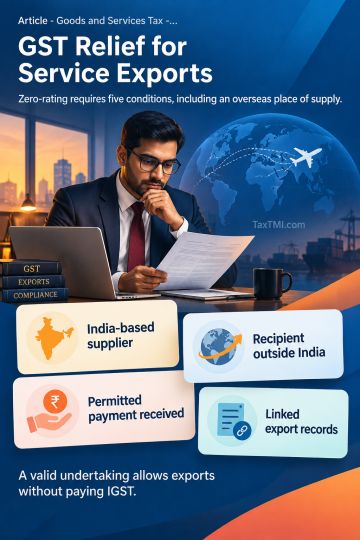
The overseas client is satisfied and the funds have landed. If the documents aren't in order, the GST, FEMA and income-tax questions may be only beginning.
A new client walks in with three years of foreign earnings and a simple request: "Can you file my returns? It's all export, so there's no GST."
Then the practitioner opens the file. Receipts came through two platforms and a personal savings account. Invoices were made in a spreadsheet with no GSTIN, no LUT reference and no place-of-supply analysis. Remittance advices were never downloaded. One of the "foreign clients" turns out to be an Indian company's overseas office paying on behalf of its Mumbai parent.
The work may genuinely have been exported. The proof, in most cases, has to be rebuilt.
From a few software houses to a services superpower
In the 1990s a small number of Indian firms began writing code for American and European clients from offices in Bengaluru, Pune and Chennai. Three decades on, India ranks among the largest services exporters in the world, with RBI data showing annual services exports in the hundreds of billions of US dollars.
The growth is no longer confined to large IT firms. Freelance designers, developers, consultants, agencies, trainers and startups now bill clients across the globe - and many of them run that business with almost no paperwork.
The questions that come later
Typically they arrive two or three years after the work:
- Why was no GST charged on these receipts?
- Where is the evidence of foreign exchange inflow?
- Why were some proceeds realised late?
- Why does GST turnover differ from income-tax turnover?
Each question is answerable - but only with documents that should have been collected at the time.
Lesson from history: papers that travel with value
Medieval and early modern merchants built an entire system of documents - bills of exchange, bills of lading, letters of credit - so that goods and money crossing borders could be trusted by parties who never met. Trade finance still works that way: documents move alongside value, and value without documents is exposed.
A service export has no ship and no container to inspect. That makes its documents more important, not less.
The five GST conditions for an export
Under the IGST Act, a supply of services is generally an export only when every condition is satisfied:
1. The supplier is located in India.
2. The recipient is located outside India.
3. The place of supply is outside India.
4. Consideration is received in convertible foreign exchange, or in Indian rupees where the RBI permits.
5. Supplier and recipient are not merely establishments of the same person, such as a branch and its head office.
Meet all five and the supply is zero-rated. Miss one and it may be taxed like a domestic supply.
Place of supply: the most common blind spot
For many services, place of supply follows the recipient's location. But special rules apply to some categories - services on goods physically made available in India, services connected with immovable property, events and others - and these can place the supply in India even when the client is overseas.
Intermediary services - arranging or facilitating supplies between two other parties - have been a long-running battleground, because their place of supply has generally been the supplier's location, making them taxable in India.
The practitioner's first step: identify which section 13 rule governs the client's specific service before treating it as an export.
The Five Export Proofs
Every export file should contain five proofs:
1. Who - a written contract or engagement letter identifying a client outside India.
2. What - a compliant export invoice describing the service, with mandatory particulars and, where relevant, the LUT reference.
3. Where - support for a place of supply outside India for that category of service.
4. Money - inward remittance through authorised channels with the right purpose code, plus bank evidence such as a FIRA/FIRC and, where used, e-BRC.
5. Match - reconciliation of invoices, bank receipts, GST returns and the income-tax return.
In a nutshell
Essence: an export isn't what the client did but what the client can prove - who, what, where, money and match.
LUT or IGST-and-refund
There are two main routes to zero-rating:
- Under a Letter of Undertaking - exporting without paying IGST. Most small exporters choose this. The LUT is filed online and generally renewed each financial year.
- On payment of IGST, followed by a refund claim.
Exporting with neither a valid LUT nor payment of IGST can lead to a demand for tax and interest.
The FEMA side
Export receipts are also governed by FEMA and RBI directions:
- Realisation and repatriation within the period the RBI prescribes; delays may need the bank's approval.
- Authorised channels with correct purpose codes.
- Documentation - inward remittance advices and certificates.
- Payment platforms and aggregators used in a way that generates proper inward remittance records.
Income tax considerations
- Resident taxpayers are taxed in India on export income regardless of where the client sits.
- Foreign clients may withhold tax locally; credit in India depends on the treaty, documentation and current rules.
- Clients abroad may request a tax residency certificate to apply treaty rates.
- GST and income-tax turnover should reconcile.
For practitioners: an export compliance pack
- Onboarding checklist for every new foreign client: contract, recipient location evidence, place-of-supply note and currency of payment.
- LUT calendar - file before the first export invoice of each financial year and record the ARN on every invoice.
- Monthly remittance download from banks and platforms, matched invoice by invoice.
- Receivables ageing against RBI timelines, with early bank contact where realisation will be late.
- Quarterly reconciliation of GSTR-1 export entries, bank receipts and books, so the annual return and ITR agree.
Illustration
A freelance designer in Guwahati earns about Rs. 30 lakh a year from clients in the US and UK through a payment platform.
Without the Five Proofs: no registration review, no LUT, receipts into a personal account, invoices missing mandatory details and no remittance certificates. A later enquiry questions the nature and source of the funds, and GST treatment is uncertain.
With the Five Proofs: registration checked against thresholds, an LUT filed each year, proper export invoices, receipts into a business account with purpose codes, remittance advices downloaded monthly and a quarterly reconciliation. Same clients, same income - and a clean, defensible export business.
The uncomfortable reality
Many small exporters assume nobody will check because they are small. Yet banks report inward remittances, GST and income-tax data are increasingly matched, and platforms report transactions.
Small exporters aren't invisible. They're just checked later, when the documents are harder to find.
Indicators of success
- Invoices meet every GST and foreign exchange requirement.
- Remittance evidence exists for each receipt.
- Contracts, purpose codes and bank certificates are filed payment by payment.
- Zero-rating and refunds are processed without dispute.
- Proceeds are realised within the permitted period.
Outlook: the coming decade
India's services exports keep diversifying - from software and design to consulting and global capability centres - while digital banking makes cross-border receipts faster. Documentation will remain what separates protected export income from questioned income.
Immediate actions by role
- Client owner: list every foreign client and the route by which each pays.
- Accountant: confirm each receipt has a supporting bank document.
- Sales: use written contracts with currency and payment-term clauses.
- Practitioner: review GST treatment of exports and refund eligibility.
Misconceptions clarified
- "Money from abroad is automatically export income." Only if the contract, currency, channel and place-of-supply conditions are all met.
- "GST has nothing to do with exporters." Zero-rating and refunds depend on correct invoicing and filing.
- "The platform takes care of the paperwork." It helps, but the exporter remains responsible for the records.
The objection we hear most - and our response
The objection: "I'm a one-person freelancer. GST registration, LUTs and purpose codes are too much for me. Clients pay on time; that should be enough."
The answer: The system is more complicated than it needs to be, but the core routine takes about an hour a month: invoice properly, receive into a business account, download remittance documents and reconcile each quarter. Once set up, it runs on habit. It also protects more than compliance - banks, landlords, visa offices and investors all ask for proof of income. Good documentation is how a freelancer becomes a business.
Practitioners' FAQ
"Is GST registration needed if turnover is small?"
Exports count towards aggregate turnover, and registration rules for inter-state and export supplies need careful checking. Registration can also enable refunds of input tax credit. Advice should be specific to the client.
"Are receipts through PayPal or similar platforms valid export proceeds?"
They can be, if they come through authorised channels with proper records. Download and retain every remittance document.
"What if a client pays late?"
Track overseas receivables against RBI timelines and approach the bank early if realisation will be delayed.
Position as at October 2026: Export of services is defined in section 2(6) of the IGST Act, with place-of-supply rules in section 13; LUTs are filed on the GST portal for each financial year; and FEMA rules on export of goods and services, purpose codes and realisation timelines are set by the RBI and may be revised. Changes to intermediary rules have been discussed in recent years - verify current provisions with your adviser.
Pitfalls
- Routing export receipts into personal accounts or informal channels.
- Charging no GST without a valid LUT.
- Treating every service to a foreign client as an export.
- Letting overseas receivables run past permitted periods.
- Ignoring purpose codes and bank documentation.
- Reporting different turnover in different returns.
Terms explained
- Export of services - a service supplied to a recipient outside India, paid for in permitted foreign exchange, satisfying the GST conditions.
- FIRA/FIRC and e-BRC - bank documents evidencing receipt of foreign payment.
- Purpose code - the code that identifies why a foreign payment was made.
- Zero-rated supply - an export that bears no GST, with related input credit usable or refundable.
Half-hour action exercise
Take the client's three largest foreign customers from last year and test each against the Five Export Proofs:
| Proof | Client 1 | Client 2 | Client 3 |
| Who - contract |
|
|
|
| What - export invoice |
|
|
|
| Where - place of supply |
|
|
|
| Money - remittance document |
|
|
|
| Match - reconciled |
|
|
|
Fill every gap this month, while documents are still easy to obtain.
Summary for busy professionals
- India's services exports have grown enormously, and smaller exporters need the same discipline as large ones.
- Under GST a service is an export only if all five conditions hold, including place of supply outside India and payment in convertible foreign exchange (or permitted INR).
- Build every file around the Five Export Proofs: who, what, where, money and match.
- Export under a valid LUT or pay IGST and claim a refund; follow FEMA rules on channels and realisation.
- Documentation turns freelance earnings into a defensible, bankable business.
Each dollar earned should arrive with a document that shows where it came from and why.
References
- Integrated Goods and Services Tax Act, 2017, sections 2(6) and 13. cbic-gst.gov.in
- Reserve Bank of India - Master Direction on Export of Goods and Services; Handbook of Statistics on the Indian Economy (services exports). rbi.org.in
- Directorate General of Foreign Trade - electronic Bank Realisation Certificate system. dgft.gov.in
- Nasscom - industry reports on India's technology services exports. nasscom.in