 TaxTMI





 12 Nov 2026

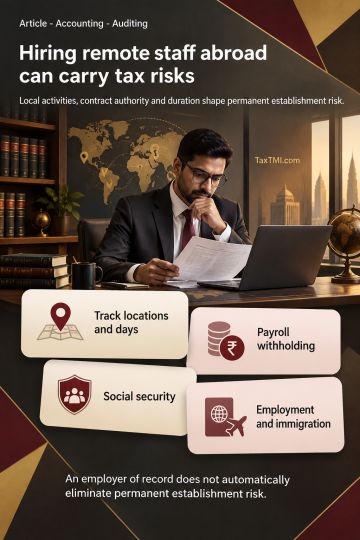
Hiring talent anywhere has never been easier. The tax, payroll, social security and labour-law consequences haven't gone away - they have simply become harder to spot.
A founder messages their CA on a Friday evening: "Our best developer wants to work from Portugal for a year. Any issue?"
It sounds like an HR question. In practice it can raise corporate tax, payroll withholding, social security, labour law, immigration and FEMA questions all at once. The answer depends less on where the person sits than on what they do there and for how long.
How the pandemic changed the question
When borders shut in March 2020, millions of people found themselves working from countries where their employers had no office, registration or payroll.
Advisers everywhere asked whether all those companies had suddenly created taxable presences abroad. In April 2020 the OECD published guidance indicating that temporary, exceptional remote working forced by the pandemic should not generally create a permanent establishment, and it refreshed that guidance in January 2021.
The emergency has passed. Cross-border remote working has stayed. The question the OECD answered for a crisis is now an everyday business decision.
Four ordinary decisions, four potential exposures
- A Bengaluru software company recruits an outstanding developer based in Lisbon.
- A Delhi consultancy lets a senior manager spend six months working from Dubai.
- A US startup appoints a sales head in Mumbai to "open the India market," with no Indian entity.
- An employee asks to spend the winter working overseas, and the line manager agrees.
Each feels routine, because remote tools make geography seem irrelevant. Tax authorities don't see it that way.
Lesson from history: presence brings obligation
The idea that a foreign trader should pay tax where it maintains a fixed base of business is very old. Modern treaties - built on models from the League of Nations, the OECD and the UN - formalised it in the twentieth century as the permanent establishment concept.
The logic is intuitive: if a business operates through a real presence in a country, that country may tax the profits from that presence. Remote work just makes it far easier to create one without realising.
How a PE can arise
Depending on the treaty and domestic law, a permanent establishment may result from:
- A fixed place of business - an office, branch, factory or other place through which business is carried on. A home office regularly used for the company's work can, in some circumstances, be argued to qualify.
- A dependent agent - someone who habitually concludes contracts, or plays the principal role leading to them, on the company's behalf.
- A service PE - under certain treaties, rendering services through employees in the country beyond a specified number of days.
- Construction or installation projects lasting longer than prescribed periods.
Once a PE exists, the foreign company may need to register, file and pay tax locally on the profits attributable to it.
Remote tools have erased borders for talent. Tax law hasn't erased them at all.
The Remote Risk Map
Not every arrangement is dangerous. Two questions place any case in one of four zones:
1. What does the person actually do? Internal, back-office or development work for the home market carries less risk; selling, negotiating and closing contracts with local customers carries more.
2. For how long, and how regularly? A short temporary stay is lower risk; an open-ended or recurring arrangement is higher.
|
| Short or temporary | Long or permanent |
| Internal / back-office role | Low risk - monitor days | Medium - check payroll, social security, residency |
| Customer-facing / contract authority | Medium - limit authority | High - structure properly before it starts |
In a nutshell
Essence: the most hazardous case is a long-term, customer-facing person who can commit the company in the country where they live.
It isn't only corporate tax
A PE is one piece. Employing someone abroad can also bring:
- Payroll withholding - many countries require employers, foreign ones included, to withhold tax on pay for work done locally.
- Social security - contributions may fall due where the work is performed. Bilateral agreements sometimes allow staff to remain in the home scheme for a period, backed by a certificate of coverage.
- Employment law - local rules on minimum pay, hours, leave, termination and benefits can override the contract.
- Personal tax residence - the employee may become resident locally, changing their own tax position.
- Immigration - working on a tourist visa is frequently unlawful; some countries offer digital-nomad visas with their own conditions.
- Indirect tax and transfer pricing - once a PE or local entity exists, intercompany charges and indirect taxes follow.
The contractor label won't always hold
Many companies try to sidestep all of this by calling overseas workers "independent contractors." That works for genuinely independent professionals. But if the person works full time, exclusively, under the company's direction and using its systems, many countries will treat the relationship as employment - with back taxes, contributions and penalties.
For practitioners: what to put in place for clients
- Build a cross-border worker register listing each person's country, role, start date, day count and authority to sign.
- Review offer letters and contracts so that authority to negotiate or conclude contracts abroad is expressly limited where no local structure exists.
- Check the Indian side. Payments to non-residents may need withholding analysis and Form 15CA/15CB compliance; overseas remittances fall under FEMA.
- Obtain certificates early. Tax residency certificates and social security certificates of coverage are far easier to secure before a posting begins.
- Re-test annually. A developer who starts attending customer meetings has moved into a different zone of the map.
Illustration
A Pune SaaS startup engages a "country manager" in Germany as a contractor. She works full time, uses a company email signature reading "Head of DACH," negotiates prices with German customers and signs order forms.
- PE exposure: high - she may be a dependent agent who habitually concludes contracts.
- Employment exposure: high - the role looks like employment.
- Payroll and social security: likely payable in Germany.
Safer options: an employer of record while numbers are small, restricting her authority so that contracts are approved and signed in India, or a German subsidiary once the market justifies it - each with local advice.
The uncomfortable reality
Many founders see international hiring purely as recruitment. It is equally a tax, legal and compliance decision.
The cheapest way to hire abroad is to understand the obligations before the offer letter goes out - not after a notice arrives.
Managing the exposure
1. Adopt a remote-work policy covering who may work from another country, for how long, in which roles and with whose approval.
2. Track locations and day counts, since many thresholds turn on days.
3. Limit authority for remote staff in sensitive roles; no contract-concluding power abroad without a proper structure.
4. Pick the right model for long-term hires:
- Employer of record - a local provider employs the person and runs payroll and compliance. Useful for small numbers, though it does not automatically remove PE risk.
- Subsidiary or branch - where presence is strategic and long term.
- Genuine contractor arrangement - only where the relationship really is independent.
5. Use treaty and social security protections - certificates of residence and coverage where available.
6. Review regularly, because roles and locations change.
Indicators of success
- Every overseas worker is recorded with location, role and authority.
- Tax and social security advice is taken before anyone relocates.
- Contracts spell out what remote workers may and may not do, especially regarding signing.
- Payroll and filings are compliant in each relevant country.
- No unexpected registrations or PE claims emerge.
Outlook: the coming decade
Global hiring, digital-nomad visas and employer-of-record services will keep growing, while tax and social security agencies share more data on workers and payments. As visibility rises, so will the cost of getting remote work wrong. Clients who plan before people move will gain global talent without global tax surprises.
Immediate actions by role
- HR: list every employee or contractor working from outside India.
- CFO: assess tax and social security exposure country by country.
- Line managers: make sure overseas staff don't negotiate or sign on the company's behalf without advice.
- Legal and tax advisers: review contracts for cross-border workers.
The objection we hear most - and our response
The objection: "No tax authority will notice a single remote employee abroad. Big companies do it all the time."
The answer: Sometimes they don't - until a payroll audit, a visa application, a customer dispute, an employee claim or an investor's due diligence surfaces it. Data sharing between tax and social security agencies is growing. And the bigger risk is often not the tax office but the employee's statutory rights or an acquirer's findings. "They won't notice" isn't a compliance strategy; it's a bet placed with the company's balance sheet.
Practitioners' FAQ
"Can someone work from abroad for a few weeks?"
Short, occasional stays in internal roles are usually low risk, but check that country's rules on day counts, payroll and immigration.
"Does an employer of record remove all exposure?"
No. It handles employment compliance, but PE exposure depends on what the person does - particularly contract authority.
"What about Indian companies paying people overseas?"
FEMA rules on remittances and withholding on payments to non-residents may apply. Take advice before the arrangement starts.
Position as at October 2026: The OECD's 2021 guidance on treaties and remote work, the 2017 updates to Article 5 of the OECD Model on dependent agents, and the multilateral instrument (MLI) shape PE rules in many treaties, including several of India's. India's Income-tax Act, 2025 (from 1 April 2026) and FEMA govern Indian-side obligations. Day-count thresholds and treaty terms vary - check the specific treaty.
Pitfalls
- Approving "work from anywhere" requests without checking the country and the role.
- Giving remote sales staff authority to sign contracts abroad.
- Calling full-time workers contractors to avoid obligations.
- Assuming an employer of record solves everything.
- Overlooking the worker's immigration status.
Terms explained
- Permanent establishment - a fixed base or dependent agent through which a foreign company can become taxable in another country.
- Employer of record - a provider that legally employs staff in a country on behalf of another company.
- Social security agreement - a treaty preventing double contributions for people working across borders.
Half-hour action exercise
List everyone who works for the client from outside India, employees and contractors alike.
Place each on the Remote Risk Map by role (internal or customer-facing) and duration (temporary or long term). Anyone in the high-risk box needs a structural decision this quarter.
Summary for busy professionals
- Remote employees and agents abroad can create a permanent establishment; the pandemic-era relief no longer applies.
- On the Remote Risk Map, long-term customer-facing roles carry the greatest exposure.
- Payroll withholding, social security, local labour law, personal residence and immigration add further obligations.
- Treating employees as contractors creates back liabilities.
- A remote-work policy, location tracking, limited authority and the right structure - EOR, subsidiary or genuine contractor - keep the risk manageable.
Global talent is an opportunity. An unplanned global presence is a liability.
References
- OECD, OECD Secretariat Analysis of Tax Treaties and the Impact of the COVID-19 Crisis (April 2020) and Updated Guidance on Tax Treaties and the Impact of the COVID-19 Pandemic (January 2021). oecd.org
- OECD, Model Tax Convention on Income and on Capital (2017), Article 5 and Commentary.
- United Nations, Model Double Taxation Convention between Developed and Developing Countries (2021).
- Ministry of Labour and Employment, India - Social Security Agreements. labour.gov.in