 TaxTMI





 12 Nov 2026

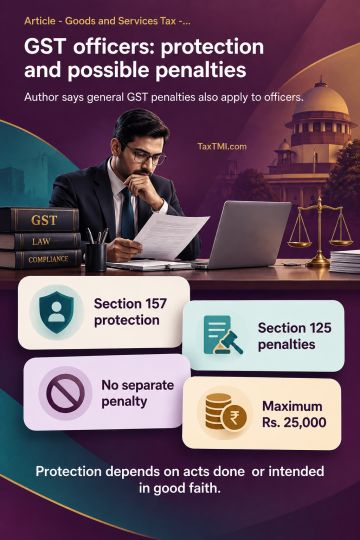
In my considered view, the law is applicable to each and every citizen of India with no exceptions. This being so, several officers often violate the provisions of GST law such as section 75(4), 75 (7) etc. I had come across at least 100 such violations by even senior officers at the level of Additional Commissioner (Appeals) through various writs before the respective jurisdictional high courts all over India. The counsel for the petitioners are never concerned on these as their entire focus is on disposal of the writ by way of allowing the same. No client insists on imposition of cost on erring tax official or passing strictures on the concerned officer despite the fact that for the wrong doing of that officer, the taxpayer has already suffered. In my considered view, a legal dispute is a battle and before start, the taxpayer must be aware of the strength and weakness on taxpayer side as well as the strength and weakness on the department side. The officers are of the strong view that all their actions get protected under section 157 of the CGST Act.
This is an attempt to create awareness amongst all the taxpayers residing all over India that though the law gives some protection to the GST officers, it is not a blanket protection. To be more specific, the protection applies if and only if whatever is done or intended to be done happens to be in good faith under this act or the rules made thereunder. This is clear from the language of the section itself. Hence, hereafter, any officer when he violates any section or rule, we have to examine as to whether that action was with good faith. Now comes the next question on applicability of section 125 of the CGST Act on the tax officials. This section categorically applies to all Indian citizens and not restricted only to taxpayers. The section reads as "Any person, who contravenes any of the provisions of this Act or any rules made thereunder for which no penalty is separately provided for in this Act, shall be liable to a penalty which may extend to twenty five thousand rupees".
Let us deviate from core issue for a short while. There are two aspects . The first aspect is that section applies to any person as the legislature has used only these two words and not any taxpayer. Thus the legislative intention is that any person, including the tax officer must abide by all sections and rules, as otherwise Section 125 is applicable. The second aspect is the quantum which is only up to a maximum of 25,000 as the language reads as may extend to twenty five thousand. 100's of representations were sent to Honourable Union Finance Minister, including one by me through taxtmi.com in https://www.taxtmi.com/article/detailed?id=16539 on 30/05/2026 which readers may like to see. This representations have been taken very seriously and the GST Council on 08/10/2026 in their meeting approved the proposal to reduce maximum penalty from 25,000 to 10,000 which may take effect from 01/04/2027 or a little later.
Let us move further on our core issue of applicability or otherwise of the section 125 on all the tax officers who incorrectly apply a legal provision. I am handling one case of my client where three officers, one at deputy commissioner level in OIO and one at additional commissioner level in OIA and one joint commissioner who has entertained our rectification application against OIA and granted major relief but failed to notice the violation of section 73(9), though the same is apparent on record. As we all are kindly aware, a penalty under section 73 is only up to an amount of equivalent to ten per cent of tax determined or ten thousand rupees, whichever is higher, due from such person. My case is live before the GSTAT and as the matter is sub judice, I am not revealing any identity or actual figures but make an attempt to create an awareness, as it is absolutely possible that there could be other taxpayers who is also affected like me.
The total ITC that was required to be reversed was 50 lakhs. My client has already reversed 40 lakhs as per his workings even one year before the date of audit. The Assistant Commissioner has also recorded in the show cause notice this fact and mentioned that why 50 lakhs should not be confirmed and why 40 lakhs should not be appropriated against the above fifty lakhs. The Assistant Commissioner, who is well aware that the penalty is only up to 1,00,000 on the amount of 10,00,000 being considered by him as due for reversal, has unfortunately did not quantify the penalty but mentioned as to why applicable penalty under section 73(9) should not be confirmed.
The deputy commissioner, while passing the OIO has held that 50 lakhs must be reversed and 40 lakhs already reversed is appropriated but levied a penalty of 5,00,000 being an amount calculated at 10% on 50,00,000 in gross violation of Section 73(9).
Conclusion: There are only two possibilities on proposing this penalty incorrectly. One is with due awareness with intentional ulterior motives or unintentional as he was not fully aware of the exact requirements of section 73(9). I put the question to all as to whether both are not equally dangerous?. When an error is committed by a honest taxpayer unintentionally due to inadvertent error, the same is treated as violation. The second aspect is the applicability of section 125 on the erring tax officials as the officer has also violated section 73((9) which is beyond all reasonable doubts on earth is not with good intention.