 TaxTMI





 12 Nov 2026

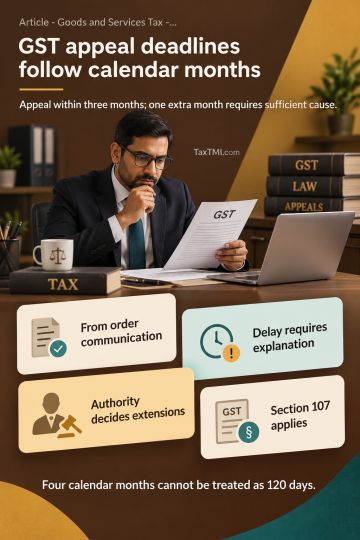
The Right to Appeal Must Be Exercised Within the Limitation Period Prescribed by Law
The right to challenge an adjudication order before an appellate authority is an important statutory safeguard under the Goods and Services Tax law. However, the legislature requires that this right be exercised within the prescribed period. Section 107 of the Central Goods and Services Tax Act, 2017, provides a specific limitation period for filing an appeal before the First Appellate Authority and permits condonation of delay for a further limited period upon showing sufficient cause. Since the Appellate Authority cannot ordinarily entertain an appeal beyond the maximum permissible period, correctly computing limitation has considerable legal significance.
A recurring difficulty arises when statutory periods expressed in months are mechanically converted into a fixed number of days. Although such a calculation may appear convenient, it can yield an incorrect result because calendar months do not contain an equal number of days. A period of four calendar months may comprise 120, 121, 122 or 123 days, depending on the months involved. Consequently, treating four months as invariably equivalent to 120 days may deprive an appellant of the period expressly permitted by the statute.
The Bombay High Court addressed this important question in United India Insurance Company Ltd. Versus Union of India and Ors. - 2026 (11) TMI 486 - BOMBAY HIGH COURT. The Court held that the limitation period prescribed under Sections 107(1) and 107(4) of the CGST Act must be computed in calendar months and cannot be mechanically confined to 120 days. The judgment is particularly significant because the Appellate Authority rejected the taxpayer's appeal as delayed by two days, even though it was filed on the corresponding date four months after the communication of the adjudication order. The decision provides valuable guidance on the correct interpretation of statutory limitation provisions.
An Incorrect Calculation of 120 Days Led to Rejection of the GST Appeal
United India Insurance Company Ltd., the petitioner, was aggrieved by an adjudication order passed under the GST law. The order was communicated to the petitioner on 11.08.2025, and the petitioner filed an appeal before the Appellate Authority on 11.12.2025. Thus, the appeal was presented on the corresponding date, four calendar months after the communication of the adjudication order.
The Appellate Authority adopted a different method of calculating limitation. It treated the ordinary period of three months prescribed under Section 107(1), together with the further period of one month contemplated under Section 107(4), as an aggregate period of 120 days. On this basis, the authority concluded that the appeal had been filed two days beyond the permissible period and rejected it by order dated 07.05.2026.
Aggrieved by the rejection, the petitioner approached the Bombay High Court under Article 226 of the Constitution of India. The petitioner challenged the Appellate Authority's computation and contended that the statute expressly prescribed limitation in months rather than days. The Respondent-State opposed the writ petition and supported the impugned appellate order.
The controversy before the High Court was therefore confined to the proper interpretation and computation of the limitation period under Section 107. The merits of the underlying GST dispute were not examined.
Ordinary Limitation and Condonation of Delay Are Governed by Separate Statutory Conditions
Section 107 of the CGST Act, 2017 sets out the statutory framework for appeals against decisions or orders passed by adjudicating authorities. To understand the present judgment, Sections 107(1), 107(2), 107(3) and 107(4) merit particular attention, as they prescribe the limitation periods applicable to appeals filed by aggrieved persons and applications initiated pursuant to departmental directions.
Section 107(1) provides that any person aggrieved by a decision or order passed by an adjudicating authority may file an appeal before the prescribed Appellate Authority within three months from the date of communication of the decision or order. The term communicated is important because the limitation period is linked to the communication of the order rather than merely to the date appearing on the order. Therefore, where an adjudication order is passed on one date but communicated later, the statutory limitation period is calculated with reference to the date of communication.
Section 107(2) deals with departmental proceedings. It empowers the Commissioner to examine the record of an adjudication proceeding and direct a subordinate officer to apply to the Appellate Authority within six months from the date of communication of the decision or order. Section 107(3) further provides that such an application shall be dealt with as if it were an appeal. Thus, the legislature has prescribed different ordinary limitation periods for appeals by aggrieved persons and departmental applications.
Section 107(4) authorises the Appellate Authority to permit an appeal to be presented within a further period of one month, where it is satisfied that the appellant was prevented by sufficient cause from filing within the prescribed period of three months or six months, as applicable. This provision does not automatically extend the ordinary limitation period. It confers a limited discretionary power upon the Appellate Authority, which must be exercised after considering the explanation furnished for the delay.
The statutory position is summarised as follows:
| Nature of appeal | Ordinary limitation | Further condonable period | Maximum statutory period |
| Appeal by an aggrieved person under Section 107(1) | 3 months | 1 month | 4 calendar months |
| Departmental application under Sections 107(2) and 107(3) | 6 months | 1 month | 7 calendar months |
The above periods are expressed in calendar months, not in a fixed number of days. The additional month is available only if the Appellate Authority is satisfied that sufficient cause existed for the delay. This distinction must be maintained when applying the principle laid down by the Bombay High Court..
The Statutory Expression Month Must Be Understood as a Calendar Month
Section 3(35) of the General Clauses Act, 1897, also supports interpreting the expression month as a calendar month, as it defines a month as reckoned according to the British calendar. In ordinary legal computation, this expression refers to a calendar month rather than a fixed period of 30 days. The definition becomes relevant where legislation prescribes a period in months without providing a different method of calculation.
Section 9 of the General Clauses Act, 1897 also contains principles governing the commencement and termination of statutory periods. Its application depends on the language and context of the relevant enactment. These principles underscore the need to calculate statutory time limits in accordance with the words actually employed by the legislature. Where a period is prescribed in months, the corresponding calendar date ordinarily assumes significance, subject to applicable statutory rules and judicial principles governing computation.
For example, where an order is communicated on 15.01.2026, the corresponding date after three calendar months is 15.04.2026, and after four calendar months is 15.05.2026. It would be incorrect to determine the permissible period merely by adding 90 or 120 days without examining the statutory language. Similarly, where the relevant period includes February, the difference between calendar months and fixed day counts may become even more pronounced.
It is important to clarify that the Bombay High Court's judgment did not separately undertake an elaborate interpretation of Sections 3(35) and 9 of the General Clauses Act. The reference to these provisions provides additional statutory context for understanding the principle recognised by the Court. The judgment itself rests upon the clear distinction between the expressions months and days appearing in Section 107.
Practical Illustrations Explain the Difference Between Calendar Months and Fixed Days
The judgment's practical importance becomes clearer when the limitation period is calculated for different dates of communication. The following illustrations assume that the ordinary rules of calendar-month computation apply and that no separate statutory exclusion, extension or special circumstance affects the relevant period. They distinguish between the ordinary limitation period and the additional period during which delay may be condoned.
Illustration 1 - Communication of an Order on 11.08.2025
An adjudication order is communicated to a registered person on 11.08.2025. The ordinary three-month period under Section 107(1) extends to 11.11.2025. Where sufficient cause for delay is established, the Appellate Authority may permit filing during the further one-month period extending to 11.12.2025.
| Particulars | Relevant date |
| Communication of order | 11.08.2025 |
| Completion of ordinary three-month period | 11.11.2025 |
| Completion of further one-month period | 11.12.2025 |
| Total elapsed days over four calendar months | 122 days |
Thus, an appeal filed on 11.12.2025 falls within the outer statutory period for condonation. It cannot be rejected merely because 122 elapsed days have passed since communication of the order. This illustration represents the actual controversy considered by the Bombay High Court.
Illustration 2 - Communication of an Order on 15.01.2026
An adjudication order is communicated on 15.01.2026. The ordinary three-month limitation period extends to 15.04.2026, while the further condonable period extends to 15.05.2026.
| Particulars | Relevant date |
| Communication of order | 15.01.2026 |
| Completion of ordinary three-month period | 15.04.2026 |
| Completion of further one-month period | 15.05.2026 |
| Total elapsed days over four calendar months | 120 days |
In this illustration, four calendar months happen to comprise 120 elapsed days. However, this numerical coincidence does not establish that four months must always be treated as 120 days. The statutory unit of measurement remains calendar months.
Illustration 3 - Communication of an Order on 10.11.2026
An adjudication order is communicated on 10.11.2026. The ordinary limitation period extends to 10.02.2027, while the further condonable period extends to 10.03.2027.
| Particulars | Relevant date |
| Communication of order | 10.11.2026 |
| Completion of ordinary three-month period | 10.02.2027 |
| Completion of further one-month period | 10.03.2027 |
| Total elapsed days over four calendar months | 120 days |
This illustration demonstrates that February may form part of the relevant period without necessarily producing a total below 120 days. The result depends upon all the calendar months included in the computation, rather than upon the length of any single month.
Illustration 4 - Communication of an Order on 10.01.2028 in a Leap Year
An adjudication order is communicated on 10.01.2028. Since 2028 is a leap year, February contains 29 days. The ordinary three-month period extends to 10.04.2028, while the further condonable period extends to 10.05.2028.
| Particulars | Relevant date |
| Communication of order | 10.01.2028 |
| Completion of ordinary three-month period | 10.04.2028 |
| Completion of further one-month period | 10.05.2028 |
| Total elapsed days over four calendar months | 121 days |
Even though February has an extra day in a leap year, the statutory period remains four calendar months. An appeal filed on 10.05.2028 would therefore fall within the outer condonable period, subject to satisfaction of the conditions prescribed under Section 107(4).
These illustrations establish that the correct approach is to identify the relevant calendar dates rather than to assume an aggregate of 120 days. They also demonstrate that the number of elapsed days may vary without altering the statutory period expressed in months.
Four Calendar Months Cannot Be Mechanically Restricted to 120 Days When the Statute Prescribes Limitation in Months
In the present case, the Appellate Authority proceeded on the assumption that the three-month ordinary limitation period and the further one-month condonable period together constituted an inflexible 120-day period. Consequently, the authority treated the petitioner's appeal filed on 11.12.2025 as delayed by two days and rejected it without examining the substantive controversy.
The error arose because the authority replaced the statutory expression 'months' with a fixed number of days. Section 107(1) expressly prescribes three months, while Section 107(4) permits a further period of one month. Neither provision states that the ordinary limitation period is 90 days or that the additional condonable period is 30 days. The authority therefore adopted a method of calculation that was not supported by the statutory language.
The Division Bench comprising Justice M.S. Karnik and Justice Sandesh D. Patil recognised this distinction and held that the statutory limitation period must be computed in calendar months. The Court specifically observed that Section 107(4) does not prescribe a further period of 30 days or an aggregate period of 120 days. The combined ordinary and condonable periods cannot therefore be mechanically treated as an inflexible aggregate of 120 days.
This reasoning preserves the legislative choice of terminology. If Parliament had intended the limitation period to be 90 days followed by another 30 days, it could have expressly adopted those expressions. Instead, it prescribed three months and a further one month. The Appellate Authority was consequently required to apply those periods according to their statutory meaning. An interpretation that substitutes days for months cannot be sustained where it results in an erroneous rejection of an appeal.
Filing Within the Additional One Month Does Not Automatically Entitle an Appellant to Condonation
An important distinction must be maintained between an appeal filed within the ordinary limitation period and one filed during the additional period contemplated under Section 107(4). An appeal filed within the ordinary three-month period under Section 107(1) does not require condonation of delay. However, where the appeal is filed after the expiry of that period but within the further one month, the appellant must establish sufficient cause for not filing within the ordinary period.
The expression "may" in Section 107(4) indicates that the Appellate Authority exercises statutory discretion, subject to satisfaction regarding sufficient cause. Therefore, the additional one-month period cannot be regarded as an unconditional extension available to every appellant. The authority must examine the explanation furnished for the delay and determine whether the circumstances justify condonation.
The Bombay High Court's judgment must be understood in this context. The Court held that the petitioner's appeal fell within the limitation framework prescribed under Section 107 and could not be rejected by mechanically applying a 120-day calculation. The judgment does not establish that every appeal filed within four calendar months must automatically be admitted without consideration of the statutory requirements governing condonation. This distinction is particularly relevant for professionals advising taxpayers on appellate remedies.
An Appeal Cannot Be Rejected as Time Barred on the Basis of an Incorrect Limitation Calculation
The rejection of an appeal on limitation grounds has serious consequences, as it prevents examination of the underlying adjudication order on merits. Where the rejection rests on an incorrect interpretation of the statutory limitation period, the appellant is deprived of the opportunity to pursue the remedy provided by law. Consequently, the determination of limitation must rest on the correct statutory method, not an administrative assumption about the number of days in a month.
Having found the Appellate Authority's computation legally unsustainable, the Bombay High Court allowed the writ petition. It quashed and set aside the appellate rejection order dated 07.05.2026 and directed the Appellate Authority to hear the petitioner's appeal on merits and in accordance with law. The relief was confined to correcting the erroneous rejection of the appeal on the ground of limitation.
The High Court did not examine the merits of the underlying GST demand or determine whether the adjudication order was otherwise legally sustainable. Those questions remained for consideration by the Appellate Authority. The judgment therefore reinforces the principle that an appeal falling within the statutory limitation framework cannot be rejected merely because the authority has adopted an incorrect method of computing the permissible period.
Correct Communication Dates and Calendar Month Computation Are Essential for Valid Appeals
The decision provides useful guidance for taxpayers and professionals responsible for preparing and filing GST appeals. The first requirement is to establish the correct date of communication of the adjudication order. The date appearing on the order and the date of its communication may differ, and the latter ordinarily determines the commencement of limitation under Section 107(1). Proper records of communication, including relevant electronic records, should therefore be preserved.
The second requirement is to calculate the limitation period in calendar months rather than mechanically applying 90 days and 30 days. Where an appeal is filed after the ordinary three-month period, a proper application explaining the delay and establishing sufficient cause should accompany the appeal. Professionals should also ensure compliance with the prescribed appellate procedure, including the requirements relating to admitted dues and statutory pre-deposit under Section 107(6).
The judgment may also assist taxpayers whose appeals have been rejected solely because the Appellate Authority incorrectly treated four calendar months as 120 days. However, the appropriate remedy in an individual case will depend upon the facts, the date of communication, the date of filing, the reasons recorded in the rejection order and the procedural remedies available under law. The decision should not be understood as permitting appeals beyond the maximum statutory period or dispensing with other mandatory conditions governing appellate proceedings.
***