 TaxTMI





 12 Nov 2026

When several people owe one debt, the law can let the creditor collect all of it from any of them. That rule runs from the dinner table to the GST notice.
Five friends go out to dinner. The bill comes to Rs. 10,000/-. You had one coffee.
Four of them leave early, each promising to settle up later. The waiter brings you the bill. You explain that your share is Rs. 150/-. He replies that the restaurant does not care who ate what; everyone at the table owes all of it, and you are the one still sitting there.
Restaurants may not face it every day, but the law faces it too often.
The rule is called joint and several liability. Each person who shares a debt owes all of it, and the creditor chooses whom to ask. You may then pursue your friends for their shares, but if one has vanished, that is your loss, not the restaurant's.
The rule sits quietly inside home loans, guarantees, and business partnerships. It is also written into India's GST law, where it can reach people who believed they were safely out of the picture. In July this year, the Punjab and Haryana High Court dismissed the petition of a man pursued for Rs. 37.84 Lakh of GST owed by a firm he said he had left four years earlier.[1]
One timely intimation would probably have spared him.
Three ways to owe the same money
Suppose three people owe Rs. 3 Lakh between them and one of them disappears. The label on the debt decides who carries the missing Rs. 1 Lakh.
| Kind of Liability | What the creditors may do | Who carries the missing Rs. 1 Lakh |
| Several | Claim of Rs. 1 Lakh from each person, and no more | The creditor |
| Joint | Claim of Rs. 3 Lakh from the Group, as one debt | The debtors who remain |
| Joint and Several | Claim the full Rs. 3 lakh from any one of them, or from all | The debtors who remain |
The creditor cannot collect/ recover twice.
In fact, the Indian law settled the matter early, about a century and a half ago. Section 43 of the Indian Contract Act, 1872 (the ICA) lets the holder of a joint promise compel any one of the promisors to perform all of it, unless they have expressly agreed otherwise. As the 13th Law Commission succinctly put it: "Unlike English Law, the Indian Law makes a general liability joint and several, in the absence of an agreement to the contrary". The ICA's own illustration makes the point clear.
A, B and C owe Rs. 3,000/-. C has nothing and A is compelled to pay the whole. A may recover Rs. 15,00/- from B.
Those left standing share the loss, and the creditor bears none of it. Whoever pays more than a fair share may recover the excess from the others, a right known as contribution as per Section 43 ibid.
Why the law is unforgiving
Every legal system must answer one question: when one of the several people who owe the same money cannot pay, who absorbs the loss? Joint and Several liability tends to provide the answer: not the creditor. The creditor collects in full from whoever can pay, and the risk of the defaulting debtor falls on those who stood alongside.
You may have signed up already
Most adults meet this rule without noticing it. Whenever you sign with someone else, or for someone else, you may be promising to pay the whole debt and not just your share. Common examples include home loans, guarantees, and partnerships. Joint home loans are usually written so that each co-borrower answers for the entire loan. If one stops paying, the bank may look to the other for the full instalment. Similarly, a guarantor is not strictly a co-debtor, but the effect is close. Under Section 128 of the ICA, a guarantor's liability is "co-extensive" with the borrower's. In Bank of Bihar v. Damodar Prasad (1968) [2], the Supreme Court said that the guarantor's liability "was immediate" and "was not deferred until the creditor exhausted his remedies against the principal debtor".
Section 25 of the Partnership Act, 1932 makes every partner liable "jointly with all other partners and also severally" for all the firm's acts done while he is a partner. Your partner's bad bargain is your bad bargain. The partners' joint and several liability frightened businesses into a new invention: the LLP. The LLP concept began in America in the 1980s and was adopted in India with the LLP Act, 2008. Section 28 says that a partner is not personally liable for the LLP's obligations "solely by reason of being a partner."
We will come to GST's take on LLPs a little later in the article.
GST names the cases: who else must pay
GST begins simply. The tax is payable by the "taxable person", usually the registered business, and it stays there unless the Act itself moves it. Chapter XVI of the CGST Act, 2017, Sections 85 to 94, is where it moves. It names who else can be made to pay, and on what terms. The main entries are tabulated below:
A Business owes GST
| Partner, firm or LLP (Sec. 90) | Private Company director (Sec. 89 and 88 (3)) | Buyer of the Business (Sec.85, lessees too) | Agent for its goods (Sec. 86) | Heir of the owner (Section 86) | Anyone else (Spouse, friend, employee) |
| Liable with the firm, in full. No exit based on conduct. (No exit based on conduct) | Liable if the company cannot pay. (Exit: Prove no gross neglect, malfeasance, or breach of duty on your part) | Liable for dues up to the transfer (Alongside the seller, wholly or to the extent of the transfer) | Liable with the principal (Services are outside the Section) | Depends on the business (Continued: Liable for the dues. Stopped: Only out of the estate.) | No Liability for the tax. (Any penalty needs its own basis, such as retaining the benefit, u/s 122 (1A) |
Some Surprises in the Fine Print
Your partnership deed does not bind the tax department.
Section 90 opens with the non-obstante clause "Notwithstanding any contract to the contrary and any other law for the time being in force". This section will prevail over any other mutual agreement between the partners. For example, a clause saying that one partner alone will look after GST may be enforceable between the partners, but it will not impact a GST demand which is valid jointly and severally. To that extent, even a contrary possibility contemplated u/s 43 may not provide a remedy.
Recently, in June 2026, the Madras High Court declined to interfere with the attachment, or freezing, of a former partner's bank account for the firm's dues of 2019-2020. The partner had resigned in June 2020.
Leaving a firm is not enough. Intimate.
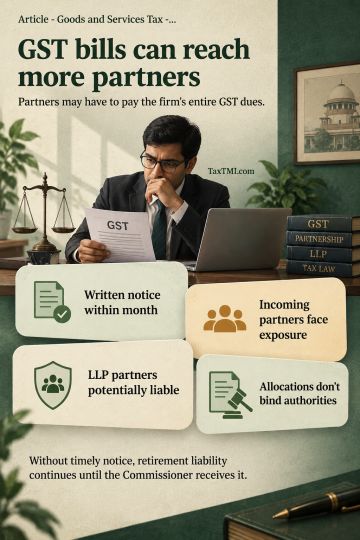
When a partner retires, the partner or the firm must intimate the GST Commissioner in writing, lest his liability continues till the Department receives this intimation. In Harvinder Singh v. State of Punjab, the Punjab and Haryana High Court, the partner had claimed he retired in April 2021, but the details reached the GST portal only in February 2025; in the meantime, the firm defaulted in April 2022, a year after his claimed retirement. Recovery proceedings followed against his property. He argued that informing the authorities was the firm's job, and that he had given up his portal login. The High Court dismissed his petition on the strength of Section 90.
A simple notice in the month after he left would, in the words of the Section, have confined his dues to the retirement.
Joining can cost too.
Ordinary partnership law protects the newcomer. Under Section 31 (2) of the Partnership Act, an incoming partner "does not thereby become liable" for what the firm did before he joined.
Section 94 seems to depart from that. Under Section 94 (2), when a firm's constitution changes, its partners, "as it existed before and as it exists after" the change, are jointly and severally liable for the earlier period. A new partner may therefore inherit a legacy liability. This provision becomes a landmine, as it starkly contrasts with the general perception of partnership firms u/s 31(2) of the Partnership Act.
An LLP is a "firm" here.
As discussed supra, Section 28 of the LLP Act includes an Explanation to Section 94 stating that, for this chapter, an LLP "shall also be considered as a firm". Section 90 then reaches each partner and overrides "any other law". Through this provision, the business form invented to limit this liability is brought back into the GST fold. Directors of a private company at least have a possible exit; Section 90 gives the partners none.
Where the reach ends
The list under the GST also has a boundary. A role that the Act does not name creates no liability for the tax, and a named role comes with conditions. Courts have enforced both points. Here are some situations;
Family is not a role. Being a spouse, son, or parent does not by itself put anyone on the list. Even an heir is reached, as Section 93 provides. An heir who carries on the business is liable for the dues. If the business is not continued, he will pay only out of the estate, and "to the extent to which the estate is capable of meeting the charge".
Recently, in April 2026, the Bombay High Court quashed the attachment of a son's bank account over about Rs. 4.15 crore said to be owed by his late father[3]. The two shared a trade name, but the son had his own registration and place of business, and his liability had never been determined. The court left the tax department free to proceed under Section 93 properly.
- A common director does not join two companies. In Ramms India v. Deputy Commissioner[4], one company's bank account had been reached for another company's dues. The Karnataka High Court held that a shared director was no ground for lifting the corporate veil, and set the recovery aside.
- A director's liability is not automatic. Section 89 applies only to private companies, and it covers only dues that cannot be recovered from the company. The director must then show that the failure was not due to gross neglect, misfeasance or breach of duty on his part. Further, the Madras High Court has confirmed that the director must have the chance to do so, and the Court quashed the recovery notice on his bank account and sent the matter back for a fresh order [5].
Before you Sign
" Give a pledge and trouble is at hand" is the third maxim inscribed at the temple of Apollo at Delphi, beside the more famous "Know thyself" and "nothing in excess". The maxim may offer counsel for modern commerce, for it runs on guarantees, partnerships, and joint loans. That is why due diligence must come before the signature. Once you have signed, the creditor chooses whom to pursue. The following are a few flags.
- Read the words. If a document says "jointly and severally", assume you are signing for the whole amount.
- Retiring from a firm? Give the Department written notice within one month, and keep proof.
- Joining a firm or buying a business? Examine its GST history first: returns, notices and unpaid demands. An indemnity is worth having, but it binds the seller, not the tax department.
- Choosing an LLP? Do not assume that "limited" covers GST.
The Restaurant in the introduction is not a villain. It is owed Rs. 10,000/-, and the law says it should suffer for your friends' manners. The tax department stands in much the same place: revenue is due, and the statute tells him whom he may ask.
When all is said and done, the most important rule is one that no statute contains: at dinner as in business, you alone decide who you sit down with.
[1] Harvinder Singh Versus State of Punjab and others. - 2025 (7) TMI 1615 - PUNJAB AND HARYANA HIGH COURT
[2] Bank Of Bihar Ltd Versus Damodar Prasad & Anr. - 1968 (8) TMI 195 - Supreme Court
[3] Navin Vishwanathan Prop. of M/s. Oriental Facility Versus State of Maharashtra and Ors. - 2026 (4) TMI 1060 - BOMBAY HIGH COURT
[4] M/s. Ramms India Private Limited Versus The Deputy Commissioner of Commercial Taxes Bengaluru, The Manager Canara Bank Karnataka, M/s. Xylem Resource Management Private Limited Karnataka. - 2026 (1) TMI 149 - KARNATAKA HIGH COURT
[5] Khalid Buhari, S/o. Abdul Kadar Versus Assistant Commissioner of CGST and C. Ex., Chennai, The Branch Manager, HDFC Bank, Chennai - 2026 (2) TMI 1203 - MADRAS HIGH COURT