 TaxTMI





 12 Nov 2026

A Pending Challenge Does Not Establish an Exception to the Monetary Limit
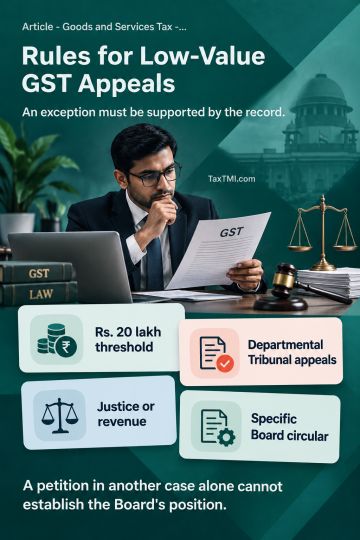
A departmental appeal below the prescribed monetary limit cannot proceed merely because the Department seeks to keep the legal issue alive. The applicable litigation policy must permit the appeal. If the Department relies on an exception, it must establish the basis for that exception. A Supreme Court petition in another case may show that a judgment remains under challenge, but it does not necessarily establish the Board's direction to pursue other low-value cases.
The GST Appellate Tribunal, Thane Bench, examined this distinction in ASISH KUMAR PATI Versus LINDE INDIA LIMITED - 2026 (11) TMI 416 - GSTAT THANE. The Bench comprised Shri Ramesh Nair, Member (Judicial), and Shri Prallhad S. Paranjape, Member (Technical). The Department's appeal, numbered APL/2/THN/2026, involved Rs. 3,37,176, substantially below the Rs. 20 lakh monetary limit applicable to departmental appeals before GSTAT.
The Department argued that its appeal should be heard because it had challenged a Bombay High Court judgment on the same issue before the Supreme Court. However, that pending challenge did not, by itself, establish that the Board's opinion required under the exception relied upon.
Since the Department failed to establish the claimed exception, the appeal was dismissed. The decision addressed whether the Department could pursue this low-value appeal; it did not decide who was right on the underlying tax issue.
The Monetary-Limit Objection Required Examination Before the Merits
The Department sought to bring the appeal within paragraph 4(vi) of CBIC Circular No.207/1/2024-GST dated 26.06.2024. Its authorised representative submitted that it had filed a petition with the Supreme Court against the Bombay High Court's decision in the Godrej & Boyce Mfg. Co. Ltd. Versus Union of India and Ors. - 2021 (11) TMI 157 - BOMBAY HIGH COURT. According to the Department, the issue in that proceeding was identical to the issue arising in the appeal against Linde India Limited.
No representative appeared for the respondent. Nevertheless, the absence of opposition did not dispense with the need to examine the Department's compliance with its litigation policy. The Tribunal heard the departmental representative and considered the record before deciding whether the appeal could proceed. The result did not depend on an elaborate taxpayer submission; it followed from the applicable circular and the material available.
The short order does not describe the transactions underlying the disputed amount or reproduce the substantive findings the Department challenged. Those details should not be inferred merely because Godrej & Boyce was cited. The record clearly establishes that the amount was below the limit and that the Department relied on another Supreme Court proceeding to invoke the Board-opinion exception.
Monetary Limits Have a Statutory Foundation
Section 120(1) of the CGST Act, 2017 empowers the Board, on the GST Council's recommendations, to prescribe monetary limits for appeals or applications by Central tax officers. The statutory framework recognises that not every adverse order needs to lead to further litigation. The amount involved and the applicable policy help determine whether to pursue an appeal.
CBIC Circular No. 207/1/2024-GST dated 26.06.2024 implements that framework. It prescribes a Rs.20 lakh threshold before the GSTAT, subject to stated exclusions. Its purpose includes reducing unnecessary litigation and using judicial resources more effectively. The monetary limit must therefore be read together with the exceptions, rather than either being ignored.
This structure serves a practical purpose. A substantial legal question may arise in a relatively small demand, whereas a greater demand may present no worthwhile ground for further challenge. The policy accommodates such differences through its conditions and exclusions. Its effectiveness depends on identifying which provision actually permits the proposed appeal, rather than treating the Department's disagreement with the result as sufficient.
A Board-Opinion Exception Requires an Identifiable Board Position
Paragraph 4(vi) applies to a case or class of cases that, in the Board's opinion, requires contest in the interests of justice or revenue. The key criterion is the identity of the decision-maker. The exception refers to the Board's opinion, not merely the preference of the officer handling the case or the existence of litigation elsewhere.
The Thane Bench held that filing an appeal or petition before the Supreme Court in another case could not be treated as a uniform Board opinion. It stated that the Board needed to issue a specific circular communicating its view on the issue and guiding field formations to contest the matter before higher forums. The Department's reliance on the pending petition did not satisfy that requirement.
The distinction is between a particular litigation step and a communicated policy position. An appeal in one case establishes that the Department has challenged that decision. It does not, on its own, show whether other cases are covered by a general direction or how that direction operates despite the monetary limit. The exception required the Board's position to be established; it could not be inferred solely from the pending petition.
An Identical Issue Must Still Fit the Particular Exception Invoked
The Department emphasised that the issue before the Supreme Court was identical, which explained why it considered the other case relevant. It did not, however, answer the question posed by paragraph 4(vi): whether the Board had formed and communicated the opinion required to pursue the present low-value appeal. Similarity of issues and satisfaction of an exception are connected but separate matters.
A simple illustration clarifies the distinction. Suppose the Department challenges a High Court judgment involving a substantial amount and later wishes to appeal against another order involving only Rs.4 lakh. Showing that both cases raise the same legal question may explain the Department's concern. It does not, by itself, establish the Board-opinion exception under which the smaller appeal is sought to be pursued.
The circular also contains other exclusions, including one concerning recurring or interpretative issues. The Thane order did not independently decide whether every possible exclusion could apply. It dealt with the particular ground advanced under paragraph 4(vi). The decision should therefore not be expanded into a proposition that a low-value appeal can never proceed when a similar issue is pending elsewhere. Its narrower point is that the invoked exception must actually be established.
Filing a Petition Does Not Suspend the Judgment Under Challenge
The Tribunal further noted that the appeal record disclosed no Supreme Court stay of the judgment challenged in the separate proceeding. This observation was material because the Department relied on that challenge. A petition seeking the Supreme Court's review of a judgment is distinct from an order suspending the judgment's operation. The former is a litigant's procedural step; the latter requires judicial action.
Consequently, the High Court judgment could not be treated as suspended merely because the Department had challenged it. This does not prejudge the outcome of the Supreme Court proceeding. It recognises that a judgment retains its legal effect unless a competent court alters, stays, or otherwise deals with it. The observation in the Thane order concerns the record available when that appeal was decided.
The two deficiencies should nevertheless remain distinct. The absence of a demonstrated Board direction concerned the monetary-limit exception. The absence of a stay concerned the effect of the pending challenge on the High Court judgment. A stay in another proceeding would require examination according to its terms; it would not automatically establish the separate Board-opinion requirement. Nor should the order be read as imposing a stay requirement upon every exception in the circular.
The Earlier Credit Dispute and Permission to Pursue This Appeal Were Separate Questions
The Department referred to Godrej & Boyce Mfg. Co. Ltd. Versus Union of India and Ors. - 2021 (11) TMI 157 - BOMBAY HIGH COURT. The company had carried forward approximately Rs.3.83 crore into GST through Form GST TRAN-1. This included Education Cess, Secondary and Higher Education Cess, and a personal ledger account balance under the earlier excise system. The Department issued a notice proposing to reject and recover these amounts, relying on amendments and explanations to Section 140 of the CGST Act, 2017.
The Bombay High Court found that the Department had not shown that the amendments supporting its interpretation had taken effect. It also held that Explanation 3 to Section 140 of the CGST Act, 2017 could not support the notice under Section 140(1) of the CGST Act, 2017 in the manner proposed. The notice therefore rested on an incorrect legal foundation and was set aside. However, the Department remained free to issue a fresh notice on a legally sustainable basis. The judgment did not unconditionally approve every disputed credit.
In the Linde India Limited appeal, the Department relied on its Supreme Court challenge to that judgment to justify pursuing an appeal involving only Rs.3,37,176, despite the monetary limit. The question was therefore different: did the pending challenge establish the Board's opinion required under the exception invoked? The Thane Bench answered that question against the Department. It did not reconsider whether the credit disputed in Godrej & Boyce was admissible. Challenging that judgment showed that the Department continued to contest it; it did not, by itself, establish a Board direction permitting other low-value appeals.
The Applicable Circular Determines Whose Opinion Matters
A useful comparison arises in Commissioner State Tax U.P (Through-Amit Kumar Singh, Assistant Commissioner) Versus Govindam Flavours, Keshav Nagar, Kanpur - 2026 (11) TMI 112 - GSTAT AGRA. That case involved Uttar Pradesh State Tax Circular No. 2425008 dated 05.07.2024, whose residual exception referred to the Commissioner's opinion. The Agra Bench rejected the monetary-limit objection and examined the departmental appeal on merits.
The Agra order expressly stated that an opinion of the Commissioner under that exception could not be challenged and did not require stated grounds or reasons. The Thane order, by contrast, required a specific Board circular and declined to infer a uniform Board opinion from litigation in another case. These observations should be reported as they stand rather than combined into an inaccurate statement that every authority adopted the same approach.
The practical starting point is therefore the applicable circular, the designated decision-maker and the material relied upon to invoke the exception. A State Commissioner's exception cannot simply be substituted for a Board-level exception under the Central circular. Equally, differences in the identity of the authority do not justify overlooking the distinct reasoning expressed in the two orders. Each decision must be understood within its own record and policy framework.
A Monetary-Limit Dismissal Does Not Decide Substantive Taxability
The departmental appeal against Linde India Limited was dismissed on the monetary-limit ground. The Tribunal neither adjudicated the underlying tax question, nor directed a fresh determination of that question, nor awarded a separate refund. The decision therefore provides authority on the claimed litigation-policy exception, rather than a merits ruling on the substantive dispute.
The wider statutory framework preserves this distinction. Sections 120(2) to 120(4) of the CGST Act, 2017 protect the Department's position where an appeal is not filed under the monetary-limit instructions. Such non-filing does not necessarily amount to acceptance of the legal issue or prevent contest in another eligible case. The relevant circumstances must be recognised when the earlier outcome is relied upon.
Accordingly, neither side should overstate the dismissal. The Department lost the present appeal because it failed to establish the exception it invoked. The taxpayer could rely on that procedural outcome, but it did not thereby obtain a fresh Tribunal declaration settling the underlying issue in every other case. Closing one low-value appeal and resolving the general legal controversy are different outcomes.
The Exception Must Be Established Before the Merits Are Argued
For the Department, a low-value appeal requires a clear explanation of the relied-upon exclusion and the material supporting it. Where the exception depends on the Board's opinion, the relevant direction must be identified and linked to the issue in the appeal. A reference to a pending Supreme Court case should clearly explain its relevance and any operative order.
For taxpayers, the monetary-limit objection should likewise address the correct circular and exception. An amount below the threshold is an important starting point, but the policy's exclusions must also be considered. The objection is strongest when it precisely identifies what the Department has failed to establish, rather than assuming that every low-value appeal is prohibited.
The principle emerging from Linde India Limited is clear: a Supreme Court petition in another case does not, by itself, establish the exception needed to pursue a departmental appeal below the monetary limit. The authority to continue litigation must come from the applicable framework and the record supporting its use.
***