 TaxTMI
Login

Login
Loading...
Press 'Enter' to add multiple search terms. Rules for Better Search

Press 'Enter' after typing page number.
Press 'Enter' after typing page number.


No Folders have been created
Are you sure you want to delete "My most important" ?
NOTE:
Press 'Enter' after typing page number.






Press 'Enter' after typing page number.

All TMI Notes
Press 'Enter' after typing page number.
Press 'Enter' after typing page number.
All TMI Notes

Note

Bookmark

Share


Download

This is a neutral professional article. The judgment is analysed in the context of its factual background, issues framed, and conclusions reached by the Court.
2026 (10) TMI 75 - GSTAT VARANASI
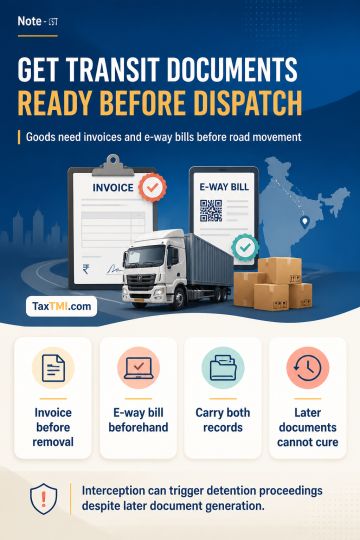
The e-way bill framework combines pre-movement reporting with in-transit verification. It is designed to ensure that taxable goods moving by road are traceable through a contemporaneous tax invoice and transport documentation. The statutory sequence is therefore significant: the invoice is to be issued before or at the time of removal, the e-way bill is ordinarily to be generated before movement commences, and the prescribed records must be available when the conveyance is intercepted.
In 2026 (10) TMI 75 - GSTAT VARANASI, the tribunal considered an interception where taxable goods were being transported without the invoice or e-way bill. The documents were generated after interception and produced before the penalty order. The taxpayer contended that the goods matched the subsequently produced documents, that the transaction was genuine, and that there was no intent to evade tax.
The tribunal rejected the challenge to detention and penalty. It held that the statutory breach was complete once the conveyance left with the consignment without the mandated documents. On the facts found, a later-generated invoice and e-way bill could not cure the original non-compliance. The tribunal also treated the taxpayer's explanation and conduct as insufficient to establish that the lapse was merely procedural.
The decision places the timing requirement at the centre of transit compliance. It does not treat the later availability of documents as equivalent to documentary compliance at the point when goods were actually placed in movement.
Section 31 requires a registered person supplying taxable goods to issue a tax invoice, where the supply involves movement, "before or at the time of removal of goods for supply to the recipient." The invoice must state the description, quantity and value of goods, tax charged and prescribed particulars. The detailed invoice particulars are set out in Rule 46, including supplier and recipient details, serial number, date, description, quantity, taxable value, tax rate and tax amount.
Rule 138(1) provides that every registered person causing movement of goods of consignment value exceeding fifty thousand rupees, whether in relation to supply, otherwise than supply, or due to inward supply from an unregistered person, "shall, before commencement of such movement," furnish the Part A information in FORM GST EWB-01 electronically on the common portal. The phrase "before commencement" fixes the relevant temporal point. It does not contemplate that a later generation will ordinarily regularise an already commenced undocumented movement.
For transportation by road by the consignor or consignee, Rule 138(2) requires generation of the e-way bill after furnishing Part B details. Rule 138(3) correspondingly requires the transporter to generate the bill where the goods are handed to a transporter and the bill has not otherwise been generated. Rule 138 further states that an e-way bill is not valid for road movement unless Part B has been furnished, subject to the specified exceptions.
Rule 138A(1) states that the person in charge of a conveyance "shall carry" both: "(a) the invoice or bill of supply or delivery challan, as the case may be; and (b) a copy of the e-way bill in physical form or the e-way bill number in electronic form" or the prescribed RFID-mapped equivalent. The use of "and" means that the invoice-side document and e-way bill-side document are not interchangeable alternatives.
Section 68 complements this obligation. The person in charge of a conveyance carrying a prescribed consignment must carry the prescribed documents and devices; where intercepted, that person is liable to produce them and allow inspection of the goods.
Rule 138B authorises interception of a conveyance to verify the e-way bill in physical or electronic form for inter-State and intra-State movements. Physical verification is to be carried out by the authorised proper officer, though specific information of tax evasion may permit verification by another officer after necessary approval. Under Rule 138C, the summary inspection report must be recorded online within twenty-four hours, and the final report within three days, subject to the stated extension mechanism.
Section 129(1) applies where goods are transported or stored in transit "in contravention of the provisions of this Act or the rules made thereunder." The goods, conveyance and relevant documents are liable to detention or seizure. Where the owner comes forward, release is upon payment of penalty equal to two hundred per cent of the tax payable; where the owner does not come forward, the applicable penalty is fifty per cent of the value of goods or two hundred per cent of tax payable, whichever is higher. Release may also be secured by prescribed security.
Section 129(3) requires notice within seven days of detention or seizure, specifying the penalty, followed by an order within seven days from service of notice. Section 129(4) requires an opportunity of hearing. Section 129(5) deems the proceedings under the notice concluded on payment of the amount under Section 129(1). If payment is not made within fifteen days from receipt of the order, Section 129(6) permits sale or other disposal to recover the penalty, subject to the stated provisions concerning conveyance and perishable or hazardous goods.
Rule 142 also requires an electronic summary of a notice under Section 129 in FORM GST DRC-01 and an electronic summary of the order in FORM GST DRC-07. The interception procedure in Circular No. 41/15/2018-GST contemplates, among other steps, recording the statement in FORM GST MOV-01, an inspection order in FORM GST MOV-02 where documents are not produced or inspection is intended, detention in FORM GST MOV-06, and a notice specifying the proposed liability in FORM GST MOV-07. Where no discrepancy is found, the procedure contemplates release in FORM GST MOV-05.
In 2026 (10) TMI 75 - GSTAT VARANASI, the tribunal read Section 31, Rule 138 and Rule 138A as one compliance chain. A tax invoice must exist before or at removal; the e-way bill must be generated before movement; and the person in charge must carry the invoice and e-way bill during transit. The tribunal characterised Rule 138A as imposing twin and mandatory requirements, rather than a choice between invoice and e-way bill.
The central question was whether documents created after interception, but produced before the Section 129(3) order, could validate the earlier movement. The tribunal answered it in the negative. It reasoned that the e-way bill mechanism is intended to enable contemporaneous tracking and verification of movement. If documents could be generated after detection and yet validate an undocumented journey, the statutory objective would be defeated. On the factual findings, the taxpayer's explanation was not accepted as a credible basis to rebut the inference arising from complete absence of the prescribed records at interception.
The operative lesson is not that later documents are irrelevant for every purpose. They may form part of a reply and may bear upon genuineness, proportionality or intent. But where the documents themselves came into existence only after interception, they cannot establish that the statutory pre-movement conditions had been met.
In 2024 (2) TMI 1128 - ALLAHABAD HIGH COURT, the court held that absence of both invoice and e-way bill at interception is not merely a technical lapse. It may raise a rebuttable presumption of intent to evade tax, shifting the evidentiary burden to the owner or transporter. Subsequent production of documents did not absolve the taxpayer because the documents had not accompanied the goods at the relevant time and the presumption remained unrebutted.
In 2024 (3) TMI 219 - ALLAHABAD HIGH COURT, the court similarly held that later furnishing of invoice and e-way bill cannot, by itself, establish absence of intent to evade tax. A taxpayer must furnish reasonable grounds explaining why the records were unavailable during movement. The decision is particularly aligned with the governing determination because it distinguishes a substantiated explanation from a bare post-detection attempt at compliance.
In 2025 (4) TMI 810 - ALLAHABAD HIGH COURT, the court addressed an incomplete e-way bill where Part B was generated only after interception. It held that, after the relevant rule position considered by the court, a complete e-way bill had to accompany the goods. The absence of Part B and inconsistencies in transit particulars supported the conclusion that subsequent completion did not neutralise the contravention.
In 2024 (1) TMI 1150 - ALLAHABAD HIGH COURT, relief was granted because the tax invoices accompanying the goods contained relevant particulars, including vehicle details, and the delayed e-way bill arose from technical difficulties and local transport barriers. There was no discrepancy in the accompanying documents and no established intent to evade tax. This authority illustrates that a delayed e-way bill may be treated differently where contemporaneous invoice evidence was available and the lapse was found to be technical rather than an undocumented movement.
In 2023 (10) TMI 218 - ALLAHABAD HIGH COURT, the goods were accompanied by invoice, consignment note and an e-way bill that had been cancelled by the purchaser without the taxpayer's knowledge. The court held that the absence of a finding of intent to evade tax was decisive on those facts and indicated that a collateral breach may require consideration under a different penalty provision rather than detention proceedings. It does not concern post-interception creation of all prescribed documents.
In 2025 (5) TMI 770 - ALLAHABAD HIGH COURT, the court set aside a penalty imposed solely for non-filling of Part B because the order recorded no attempt to evade tax. The authority is confined to an incomplete e-way bill and an order lacking any finding on evasion; it does not equate a partially completed documentation trail with total absence of invoice and e-way bill at the time of interception.
In 2022 (4) TMI 241 - MADRAS HIGH COURT, detention was accepted as justified where the e-way bill contained an incorrect business-location declaration, but penalty was quashed because the consignor and consignee were the same entity and subsequent registration amendment demonstrated absence of ulterior motive. This was a technical inaccuracy in existing documentation, not a case where the statutory records were generated only after interception.
In 2024 (2) TMI 189 - Supreme Court, the court accepted that no live e-way bill existed on interception and that a fresh bill should have been generated. The tax demand was retained, while the penalty was reduced in exercise of equitable discretion owing to the nature of the capital-goods movement and the earlier, though expired, e-way bill. The order was expressly stated not to be a precedent.
In 2022 (7) TMI 603 - CALCUTTA HIGH COURT, a short e-way bill expiry, the nature of the goods, and a bona fide explanation led to relief because no deliberate evasion was found. The decision was confined to its peculiar facts.
In 2022 (5) TMI 1075 - CALCUTTA HIGH COURT, the documentary record indicated that another valid e-way bill covered the movement. The court therefore found no deliberate or wilful attempt to evade tax. Its reasoning turns on the availability of an operative documentary basis at the time of movement.
In 2022 (4) TMI 1542 - CALCUTTA HIGH COURT, the court considered an e-way bill that had expired shortly after arrival in the destination area. The statutory latitude for extension, the consignee's communication and absence of material questioning bona fides rendered the penalty disproportionate on the peculiar facts.
In 2022 (8) TMI 814 - MADHYA PRADESH HIGH COURT, an expiry shortly before interception, unaccompanied by evidence of evasion, fraud or negligence, was insufficient to sustain the penalty. The court also invoked proportionality in relation to the short, bona fide delay.
These authorities address expiry or extension of an e-way bill that had already been generated. They are analytically distinct from an initial movement in which no invoice or e-way bill existed or was available when interception occurred.
In 2019 (11) TMI 711 - GUJARAT HIGH COURT, the invoice and e-way bill required by Rule 138A were produced at interception. Detention based on extraneous transport-receipt objections was quashed. The court also emphasised that procedural instructions issued under Section 168 bind field officers and that an order cannot be supported later by fresh grounds in an affidavit. The decision reinforces the converse proposition: where the prescribed invoice and e-way bill are produced and reveal no prima facie discrepancy, the conveyance should ordinarily be permitted to proceed.
In 2025 (12) TMI 941 - GUJARAT HIGH COURT, the court distinguished the Section 129 detention regime from the more severe confiscation route under Section 130. It held that a reasoned opinion of intent to evade tax must rest on concrete, serious material; minor discrepancies cannot support confiscation. In the transit context, the decision recognises the procedural time limits under Rule 138C and requires that the nature and gravity of the breach govern whether matters remain under Section 129 or warrant confiscation proceedings.
The supplied authorities reflect fact-sensitive judicial approaches to detention penalties. Some decisions stress that an intention to evade tax must be established or meaningfully considered, especially where invoices existed, an e-way bill had earlier been generated, there was a short validity lapse, or the defect was demonstrably technical. Other decisions recognise a rebuttable presumption when goods move without the statutory documents at all.
On the governing decision, the decisive feature is complete non-availability of invoice and e-way bill at interception, followed by their creation after interception. The tribunal treated this as a substantive breach of the pre-movement framework and found that the factual explanation did not rebut the inference arising from the breach. Accordingly, post-interception generation is not a substitute for pre-movement compliance.
Full Text:

