Loading...

⚠ ✕
❮ Top
☎ Help
☰
×

By creating an account you can:

Logo TaxTMI
Call Us / Help / Feedback✕

Contact Us At :

✉ E-mail: [email protected]

✆ To Call / Whatsapp, Check Contact Us

FAQs :

To know Frequently Asked Questions, Check FAQs

Most Asked Video Tutorials :

For more tutorials, Check Video Tutorials

Submit Feedback/Suggestion :

Email :
Please provide your email address so we can follow up on your feedback.
Category :
Description :
Min 15 characters 0/2000
Make Most of Text Search ✕
  1. Checkout this video tutorial: How to search effectively on TaxTMI.
  2. Put words in double quotes for exact word search, eg: "income tax"
  3. Avoid noise words such as : 'and, of, the, a'
  4. Sort by Relevance to get the most relevant document.
  5. Press Enter to add multiple terms/multiple phrases, and then click on Search to Search.
  6. Text Search
  7. The system will try to fetch results that contains ALL your words.
  8. Once you add keywords, you'll see a new 'Search In' filter that makes your results even more precise.
  9. Text Search
╳
Add to...
You have not created any category. Kindly create one to bookmark this item!
✕
Create New Category
Hide
Title :
Description :
❮❮ Hide
❮ Default View
Expand ❯❯
Close ✕
🔎 Filters / Advanced Search ❯
TEXT

Press 'Enter' to add multiple search terms. Rules for Better Search

Search In
Main Text + AI Text ❯
  • Main Text
  • Main Text + AI Text
  • AI Text
Law:
---- All Laws---- ❯
  • ---- All Laws----
  • Benami Property
  • Bill
  • Central Excise
  • Companies Law
  • Customs
  • DGFT
  • FEMA
  • GST
  • GST - States
  • IBC
  • Income Tax
  • Indian Laws
  • Money Laundering
  • SEBI
  • SEZ
  • Service Tax
  • VAT / Sales Tax
Types:
---- All Types ---- ❯
  • ---- All Types ----
  • Act Rules
  • Case Laws
  • Circulars
  • Manuals
  • News
  • Notifications
Sort By: ?
In Sort By 'Default', exact matches for text search are shown at the top, followed by the remaining results in their regular order.
Relevance Default Date
☰   Show Results ❯
    Refund of Unutilised Input Tax Credit by SEZ Units under Section 54 and Rule 89
    Case Laws Customs
    Private Bonded Warehouse Licence: Penalty-Based Disqualification under Regulation 3(2)(c)
    Refund of Accumulated Compensation Cess on Zero-Rated Supplies under Section 54 and Rule 89
    Penalty for Wrongful Availment of Input Tax Credit: The Distinction Between Sections 73 and 74
    Input Tax Credit on Resort Construction After Retrospective Substitution in Section 17(5)(d): Except...
    Shareholder Locus Standi under Section 61 in Challenges to Resolution-Plan Approval
    GSTR-2A Mismatch, Supplier Certification (of tax payment) and the Burden of Proving Input Tax Credit...
    Concessional GST on Works Contracts for Co-operative Spinning Mills: Government Entity Status and Pr...
    Case Laws Customs
    Abetment and Knowing Use of False Import Documents under Sections 112(a) and 114AA
    Subcontracted Services on Own Account and the Intermediary Exclusion under Section 2(13)
    Case Laws Customs
    Classification of Two-Ton Ductless Split Air Conditioners under Tariff Item 8415 82 10
    Case Laws Income Tax
    Transfer Pricing of Pre-Conversion Interest on Compulsorily Convertible Debentures
    Case Laws Customs
    Clubbing of Contrived Split Consignments under Rule 2(a) and Valuation of a Dismantled Motorcycle
    GST on Corporate Guarantees: Substantive Liability, Deemed Valuation and Judicial Relief
    Case Laws Income Tax
    Employee Secondment under the India-USA DTAA: Employment Rights, Reimbursements and Included Service...
    Pre-deposit Under Section 112 and Independent Compliance with Tribunal Filing Fees
    Case Laws Income Tax
    TDS on Interest Paid by Co-operative Banks to Non-Member Co-operative Societies under Section 194A(3...
    Input Tax Credit and Supplier Non-Payment: Statutory Limits on Mechanical Reversal Under Section 16(...
    Case Laws Customs
    Appellate Jurisdiction over Goods Imported as Baggage under Sections 129A and 129DD of the Customs A...
    Monetary Limits for Departmental GST Appeals under Section 120 and Circular No. 207/1/2024-GST
❮
❯
❯❯
Maximize Maximize Maximize
0 / 200
Expand Note
Add to Folder

No Folders have been created

+

Are you sure you want to delete "My most important" ?

NOTE:

Notes
Showing Results for :
Reset Filters
Results Found:
Show All Summaries Hide All Summaries
Case Laws GST
Show AI Summary
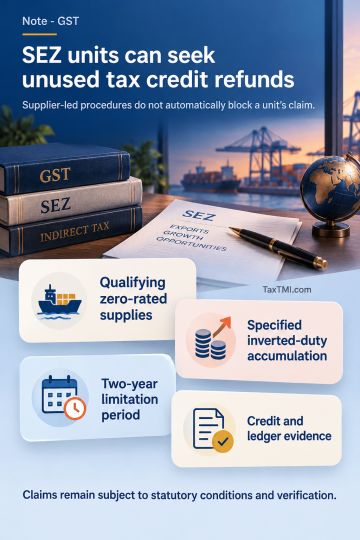
SEZ refund eligibility extends to unutilised input tax credit despite supplier-specific procedures, subject to statutory conditions and verification.
SEZ units are not categorically excluded from claiming refunds of unutilised input tax credit merely because Rule 89 prescribes a supplier-led procedure for supplies to SEZs. That procedure governs the supplier's claim for the relevant inward supply; it does not exclude a unit's own claim under the statutory refund framework. Section 54 of the CGST Act permits registered persons to claim refunds of unutilised credit subject to substantive conditions, including those governing zero-rated supplies made without payment of tax and specified inverted-duty accumulation. Refund applications must identify the applicable statutory basis, relevant date and two-year limitation period, and support the claim with evidence of qualifying supplies, credit sources, ledger balances and computation.
Case Laws Customs
Show AI Summary
Warehouse licensing disqualification requires more than a prior customs monetary penalty and depends on offence-based eligibility criteria.
Penalisation for an offence under Regulation 3(2)(c) is not established merely by the existence of a customs monetary penalty. The legal basis and character of the earlier proceedings must be examined against the distinction between adjudicatory penalties and the offences-and-prosecutions framework. The absence of conviction alone does not resolve every disqualification ground. Antecedent verification follows a centralised process, while a favourable eligibility assessment must be followed by the insurance, undertaking, indemnity and warehouse-keeper requirements under Regulation 4.
Case Laws GST
Show AI Summary
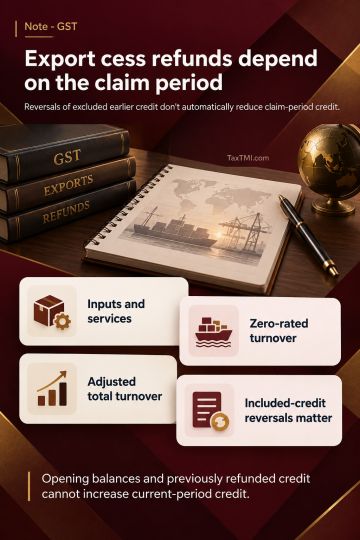
Compensation cess refunds on exports depend on period-specific credit attribution, not automatic deductions for unrelated earlier-period reversals.
Under Rule 89(4), the refund formula applies Net ITC to zero-rated turnover and adjusted total turnover. Period-specific Net ITC depends on credit availed on inputs and input services during the period for which the claim is filed. A reversal reported during that period does not automatically reduce Net ITC if it relates to residual earlier-period credit excluded from the current computation. Reversals affecting credit included in the computation remain relevant, and opening balances or previously refunded credit cannot be added to current-period Net ITC.
Case Laws GST
Show AI Summary
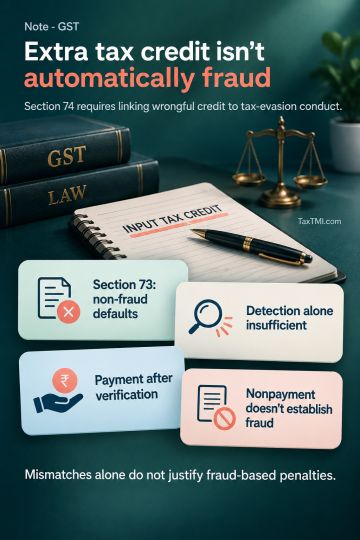
Input tax credit mismatches alone do not justify fraud-based penalties, even when excess credit is paid after verification.
Section 74 requires a factual connection between the wrongful credit and fraud, wilful misstatement or suppression of facts to evade tax; a mismatch or eligibility failure alone does not establish that connection. Section 73 covers defaults without those elements. Departmental detection, an admission of excess credit and payment after verification do not by themselves establish why the excess arose or prove the conduct necessary for Section 74. Failure to pay the pre-notice penalty cannot itself establish the fraud-related basis for Section 74.
Case Laws GST
Show AI Summary
Resort construction credit depends on immovability, own-account use, and the statutory distinction between buildings and plant and machinery.
Input tax credit on resort construction is subject to the blocked-credit restriction for goods and services received to construct immovable property on a taxable person's own account, including property used in the course or furtherance of business. The general business-use entitlement under section 16 does not displace this restriction in section 17(5)(d). The Finance Act, 2025 retrospectively substituted plant and machinery for "plant or machinery" from 1 July 2017, with the relevant provision commencing on 1 October 2025. The defined expression covers apparatus, equipment and machinery fixed to the earth by foundation or structural support and used for making outward supplies, including those foundations and supports. It excludes land, buildings and other civil structures, telecommunication towers and pipelines laid outside factory premises.
Case Laws IBC
Show AI Summary
Shareholder standing in insolvency appeals depends on legal capacity, not merely allegations of fraudulent changes to creditor-approved plans.
Individual shareholder standing to appeal against approval of a resolution plan is distinct from the legality of the plan itself. Under Section 61(1) of the Insolvency and Bankruptcy Code, 2016, an appellant must qualify as a person aggrieved. The applicable judicial interpretation restricts an appeal pursued exclusively in an individual shareholder capacity, even where equity interests are affected. Section 61(3) separately specifies permissible grounds of challenge: a plan's contravention of law and material irregularity in the resolution professional's exercise of powers are distinct grounds. Pleading either ground does not itself establish standing.
Case Laws GST
Show AI Summary
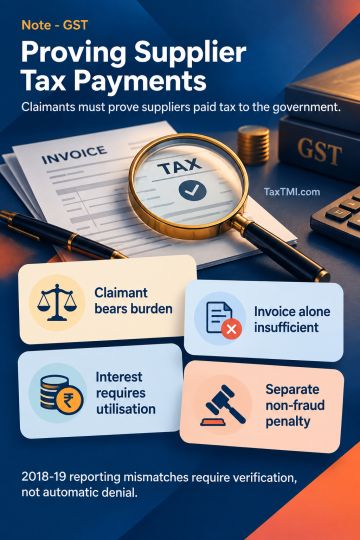
Input tax credit requires proof of supplier tax payment; reporting mismatches call for verification rather than automatic denial.
Supplier payment of tax to the Government is a condition of input tax credit eligibility under section 16(2)(c), and the claimant bears the burden of proving eligibility under section 155. Payment of the invoice and tax to the supplier, receipt of the supply and possession of an invoice do not themselves establish the supplier's remittance. For 2018-19, a GSTR-2A mismatch calls for verification and does not alone prove ineligibility. Interest under section 50(3) requires credit to have been both wrongly availed and utilised; its calculation follows Rule 88B(3). Non-fraud penalty operates under a separate statutory trigger and is not automatically excluded by the absence of fraud or utilisation.
Case Laws GST
Show AI Summary
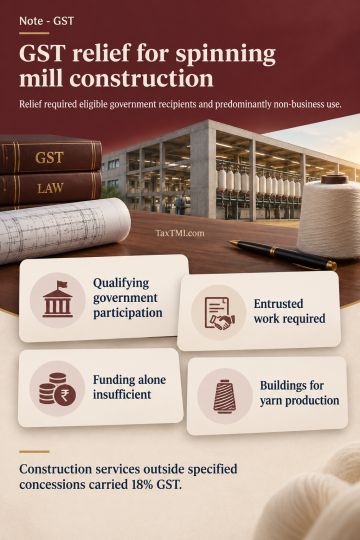
Non-business construction concessions for spinning mills require eligible recipient status and predominantly non-industrial use of the constructed buildings.
For the disputed period, the works-contract concession required both an eligible governmental recipient and structures predominantly meant for use other than commerce, industry, business or profession. Government Entity status required evidence of the recipient's constitution and qualifying governmental participation, while procurement had to relate to entrusted work. Project funding, tender approval and supervision did not by themselves establish governmental constitution or control. The spinning-mill factory buildings and allied works were intended for yarn production and related commercial activities. The residual construction-services entry carried aggregate GST of 18% for services outside the specified concessional entries.
Case Laws Customs
Show AI Summary
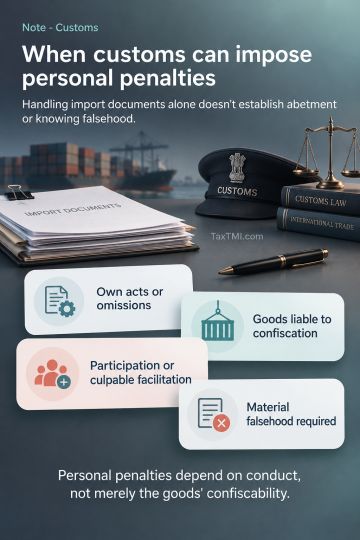
Import document handling alone does not establish customs abetment or knowing use of materially false declarations.
Personal customs penalties depend on the person's own conduct, not merely on the confiscability of imported goods. Under Section 112(a) of the Customs Act, 1962, liability may arise from a person's own act or omission rendering goods liable to confiscation or from abetment of such conduct. The direct limb can operate on a strict-liability basis where a person's own act or omission renders goods confiscable; an allegation of abetment instead requires evidence of participation or culpable facilitation. Section 114AA requires knowing or intentional making, signing or use, or causing the making, signing or use, of a declaration, statement or document that is materially false or incorrect in customs business.
Case Laws GST
Show AI Summary
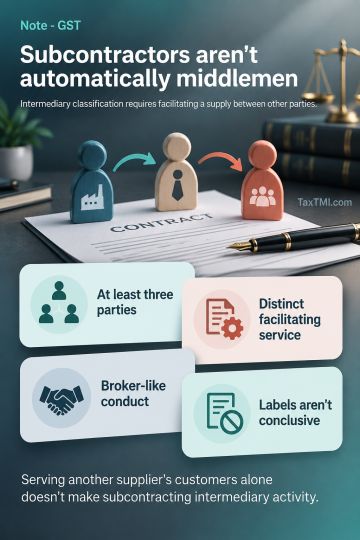
Subcontracted services performed on own account are not intermediary services merely because they support overseas recruitment and customer-facing activities.
Intermediary classification under Section 2(13) of the IGST Act distinguishes arranging or facilitating supplies between other persons from supplying services on one's own account. The intermediary framework requires at least three parties, a main supply and a distinct ancillary facilitating supply, with conduct resembling that of a broker or agent. Subcontracting the whole or part of a service is not intermediary activity merely because performance supports another supplier's business or involves its customers. Neither a bilateral agreement, contractual label nor remuneration method is conclusive.
Case Laws Customs
Show AI Summary
Split air conditioner classification requires capacity and refrigeration features to be assessed against the applicable tariff hierarchy.
Classification of ductless split air conditioners depends on the complete tariff description and the machine's technical characteristics. A complete, cooling-only, two-ton split air conditioner incorporating a refrigerating unit and lacking a heat-reversal valve falls within tariff item 8415 82 10 rather than the general split-system item 8415 10 10. Item 8415 82 10 inherits its parent subheading's refrigerating-unit requirement, while item 8415 83 10 requires the absence of such a unit. Capacity alone does not establish the applicable refrigeration-based entry. Technical evidence should establish whether the goods are a complete machine and identify their capacity and operating features.
Case Laws Income Tax
Show AI Summary
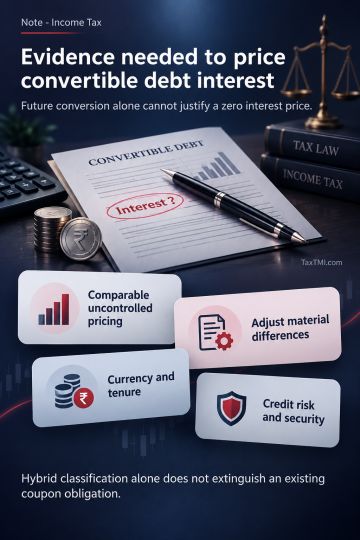
Convertible debenture interest requires evidence-based pricing before conversion; future equity conversion alone cannot establish a nil arm's length price.
Pre-conversion interest on compulsorily convertible debentures (CCDs) issued to a non-resident associated enterprise requires arm's length pricing. Compulsory future conversion and hybrid classification do not, by themselves, establish a nil price or extinguish an existing coupon obligation. Rule 10AB's Other Method requires a price charged, paid or expected in comparable uncontrolled circumstances, with reasonably accurate adjustments for material differences under Rule 10B. Currency, benchmark date, tenure, credit risk, security, non-redemption and conversion benefits affect comparability; a conventional bank lending rate is not automatically comparable to a long-tenor CCD.
Case Laws Customs
Show AI Summary
Split motorcycle consignments require evidence of deliberate fragmentation for composite classification, with valuation assessed independently of classification.
Clubbing of split consignments for customs classification depends on proof that apparently separate imports form one deliberately fragmented transaction, not merely on the possibility of assembly. Rule 2(a) extends a tariff heading to an incomplete article possessing the essential character of the complete article and also covers a complete article presented disassembled. A change of tariff heading alone does not establish that the transaction value is inaccurate; substantive misdescription of the goods requires separate evidentiary consideration. Replacement value must follow the prescribed sequence of methods.
Case Laws GST
Show AI Summary
Corporate guarantee taxation depends on distinguishing taxable supply from valuation, particularly for unpaid support between related businesses.
GST on corporate guarantees requires separate consideration of whether a taxable supply exists and how that supply is valued. Section 7(1)(c) and Schedule I encompass qualifying supplies between related or distinct persons without consideration when made in the course or furtherance of business. Rule 28(2) deems the value of a guarantee furnished to a banking company or financial institution for a related recipient in India to be one per cent of the guaranteed amount per annum or actual consideration, whichever is higher. Where the recipient is eligible for full input tax credit, the proviso treats the value declared in the invoice as the value of the supply.
Case Laws Income Tax
Show AI Summary
Employee secondment taxation depends on employment rights, service consideration and demonstrable transfer of technical capability to host entities.
Local operational control and a stated suspension of foreign employment do not, by themselves, resolve whether underlying foreign employment rights survive. Under Article 12(4)(b) of the India-USA DTAA, technical or consultancy services must make technical knowledge, experience, skill, know-how or processes available, or involve development and transfer of a technical plan or design. Under the knowledge-transfer limb, the recipient must acquire a capability it can use independently; the mere application of expertise or presence of qualified personnel is insufficient. Recovery at actual cost and absence of markup do not, by themselves, establish that a foreign enterprise's receipt is non-taxable.
Case Laws GST
Show AI Summary
GST appellate pre-deposits may be satisfied by verified earlier payments after demand reduction, but filing fees remain independently payable.
When the first appellate authority substantially reduces the disputed tax demand, an earlier deposit may be sufficient to satisfy the Tribunal-stage requirement, subject to verification. Sufficiency depends on the reduced liability, the applicable appellate requirements and the amount actually deposited; a first appellate payment does not automatically eliminate the additional obligation. Tribunal filing fees under Section 112(7) operate independently of pre-deposit. Where a fee shortfall and earlier deposit require verification, proof of fee payment and verification of the deposit precede consideration of admission.
Case Laws Income Tax
Show AI Summary
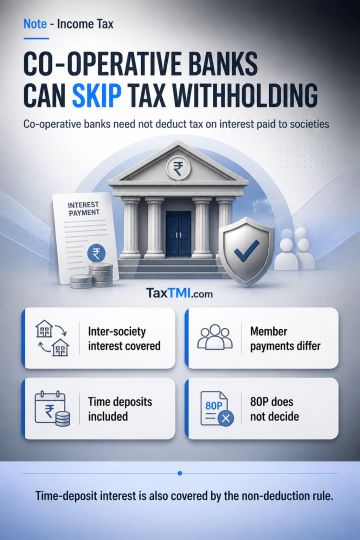
Inter-co-operative society interest exemption preserves non-deduction by co-operative banks when depositors are co-operative societies under the statutory withholding framework.
Section 194A(3)(v) separately addresses interest paid by a co-operative bank to a member and interest paid by a co-operative society to another co-operative society. The exclusion of co-operative banks is confined to the member-payment limb; a co-operative bank remains a co-operative society for the inter-co-operative society limb. Paragraph 42.7 of Circular No. 19/2015 preserves non-deduction, including time-deposit interest, where the depositor is a co-operative society. Section 80P does not determine this withholding obligation.
Case Laws GST
Show AI Summary
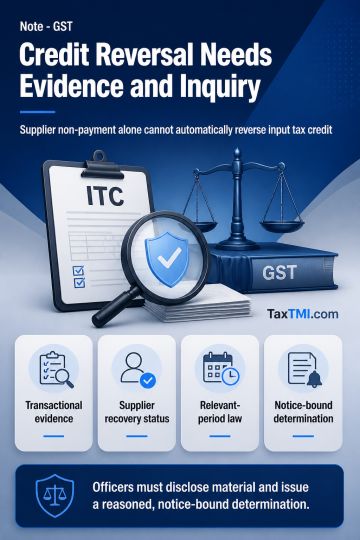
Input tax credit reversal requires evidence linking supplier non-payment to recipient ineligibility and a reasoned statutory inquiry.
Input tax credit under Section 16(2)(c) remains conditional on actual payment of tax to Government, but supplier non-payment or retrospective cancellation cannot by itself justify reversal. The recipient must establish eligibility through transactional evidence, while the proper officer must investigate the particular supply, disclose supplier-default and recovery material, apply the law applicable to the relevant period, and issue a reasoned, notice-bound determination. Supplier recovery status and protection against duplicate collection are material considerations.
Case Laws Customs
Show AI Summary
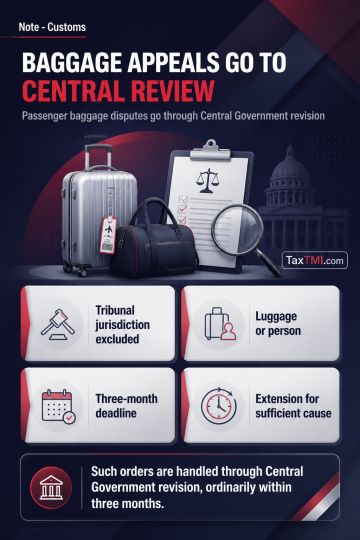
Baggage-related customs appeals proceed through statutory revision when the jurisdictional exclusion applies to passenger imports.
The first proviso to section 129A(1) excludes Appellate Tribunal jurisdiction over an order under section 128A relating to goods imported or exported as baggage. The decisive issue is the order's connection with baggage, not disputes concerning confiscation, declaration, duty, personal effects, concealment, concession, or penalty. Articles carried by an international passenger in luggage or on the person may constitute baggage. Section 129DD provides revision before the Central Government, ordinarily within three months, subject to a further period on sufficient cause.
Case Laws GST
Show AI Summary
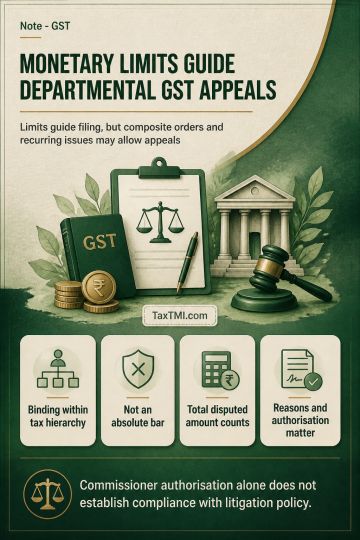
Departmental GST appeal monetary limits regulate officers, while composite orders and proven recurring issues may permit appeals.
Sections 120 and 168 of the Central Goods and Services Tax Act, 2017 make monetary-limit directions binding within the Central tax hierarchy, while they regulate the executive decision to file rather than create an inflexible jurisdictional bar before the Tribunal. In a composite order disposing of multiple appeals or demand notices, the relevant amount is the total disputed tax, interest, penalty or late fee, as applicable. The recurring or interpretative-issue exclusion requires a reasoned, case-specific basis, and Commissioner authorisation does not itself establish compliance with the litigation policy.

TMI Notes

Back

All TMI Notes

Showing Results for :
Reset Filters
No Records Found

TMI Notes

Arm's Length Price Determination u/s 92C: Comparability Analysis: Economic Relevance of Turnover and Related-Party Transactions

5 October, 2026

Contents
Acts
Rules & Regulations
Plus +
Summary
Note

Note

-

Bookmark

(New) -

Download

Print

Print

This is a neutral professional article. The judgment is analysed in the context of its factual background, issues framed, and conclusions reached by the Court.

2026 (9) TMI 711 - KARNATAKA HIGH COURT

At a Glance

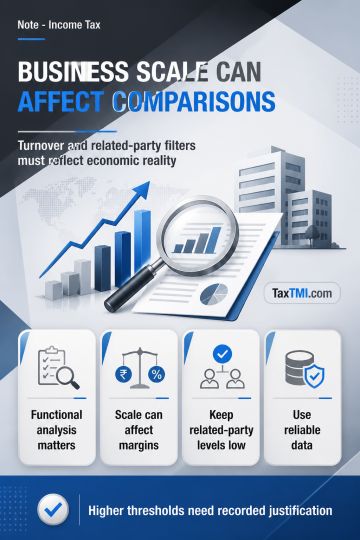
  • Turnover and related-party transactions (RPTs) are not statutory thresholds in themselves; they are comparability filters whose legitimacy depends on the statutory comparability exercise under Chapter X.
  • Under Rule 10B of the Income-tax Rules, 1962, comparability must be judged with reference to functions, assets, risks, contractual terms and market conditions. The rule also permits exclusion where material differences affect price, cost or profit and cannot be eliminated through reasonably accurate adjustments.
  • An upper turnover filter of Rs. 200 crores was held to be rational on the facts considered. Larger enterprises may possess brand value, bargaining strength, valuable intangibles and economies of scale that can affect profitability and comparability.
  • An RPT filter of 15% is ordinarily preferable where a sufficient pool of reliable comparables meeting that threshold is available. A higher threshold of 20% or 25% may be adopted only upon a specific finding that sufficient lower-RPT comparables are unavailable.
  • Selection of comparables and application of filters remain data-driven factual exercises. However, appellate scrutiny under section 260A remains available where the exercise disregards the Act or Rules, or where the findings are shown to be perverse.

Background & Context

Transfer-pricing analysis seeks to determine whether the price or margin arising from a controlled transaction is consistent with the arm's length standard. Section 92 of the Income-tax Act, 1961 provides that "any income arising from an international transaction shall be computed having regard to the arm's length price." The provision also requires allowances for expense or interest arising from an international transaction to be determined on that basis.

The mechanism is set out in Section 92C. Section 92C(1) requires the arm's length price to be determined by the "most appropriate method", having regard to the nature and class of transaction, associated persons, functions performed and other prescribed factors. The recognised methods include the comparable uncontrolled price method, resale price method, cost plus method, profit split method and transactional net margin method.

Where the transactional net margin method is adopted, Rule 10B(1)(e) requires comparison of the tested party's net profit margin with the net profit margin realised by an unrelated enterprise in a comparable uncontrolled transaction, with adjustments for differences that could materially affect the net margin. The exercise is therefore not confined to a mathematical comparison of margins. It requires a defensible selection of enterprises whose economic circumstances provide a reliable benchmark.

The central question is whether turnover disparity and the extent of related-party dealings of a potential comparable can materially affect its profit margin. The Court answered both questions through the statutory framework of comparability, rather than by treating either filter as an inflexible rule.

Key Issues / Provisions

Issue Statutory and rule-based anchor Operative consequence
Selection of the most appropriate method Section 92C and Rule 10C The method must be best suited to the transaction and provide the most reliable measure of the arm's length price.
Turnover filter Rule 10B(2)(b) and Rule 10B(2)(d) Assets employed, risks assumed and market conditions, including market size, may make substantial size differences relevant to comparability.
RPT filter Rule 10B(2) and Rule 10B(3) The filter seeks to reduce the influence of controlled dealings on a comparable's profitability and preserve an uncontrolled benchmark.
Associated-enterprise framework Section 92A Associated enterprises include enterprises participating directly or indirectly in the management, control or capital of the other enterprise, subject also to the statutory deeming tests.
Re-determination by the Revenue Section 92C(3) The arm's length price may be re-determined only where one or more specified statutory conditions exist, followed by the prescribed opportunity to show cause.

Rule 10C(1) states that the most appropriate method is the method "best suited to the facts and circumstances" of the particular transaction and which provides "the most reliable measure" of the arm's length price. Under Rule 10C(2), the choice requires consideration of the nature of the transaction, functional analysis, availability and reliability of data, degree of comparability, availability of reliable adjustments, and reliability of assumptions.

More specifically, Rule 10B(2) requires comparison by reference to: the characteristics of the property or services; "the functions performed, taking into account assets employed ... and the risks assumed"; contractual allocation of responsibilities, risks and benefits; and market conditions, including geographical location and "size of the markets". Rule 10B(3) permits an uncontrolled transaction to be treated as comparable only where differences are not likely materially to affect price, cost or profit, or where reasonably accurate adjustments can eliminate their material effects.

Detailed Analysis

Turnover is a comparability factor, not a standalone statutory bar

In 2026 (9) TMI 711 - KARNATAKA HIGH COURT, the Court rejected the proposition that size becomes irrelevant merely because the tested metric is a profit margin. The reasoning was straightforward: if turnover were irrelevant, there would be no basis to use a lower turnover filter to exclude very small companies. The same logic permits examination of an upper turnover limit where comparables are substantially larger than the tested party.

The Court held that size may directly bear on pricing power, competitiveness and exposure to market conditions. High-turnover entities may enjoy established brand value, greater bargaining power, ownership of valuable intellectual property and economies of scale. These features may not be available to smaller enterprises and can influence profitability. The relevance of turnover consequently arises through Rule 10B(2), particularly the evaluation of assets employed, risks assumed and prevailing market conditions.

No provision fixes a universal minimum or maximum turnover threshold. Nevertheless, the adoption of an upper turnover filter of Rs. 200 crores was sustained as a rational and logical factual determination. The conclusion does not convert Rs. 200 crores into a statutory ceiling for every taxpayer or business segment. It confirms that a turnover range may be adopted where the record establishes that it improves economic comparability.

The earlier factual approach in 2018 (8) TMI 1885 - KARNATAKA HIGH COURT is consistent with this position. There, a comparable was excluded because its segmental turnover was materially lower than that of the tested party and fell outside the turnover tolerance range used by the Tribunal. The Court sustained that conclusion as a reasoned factual application of the turnover filter. It illustrates that turnover analysis can operate at either end of the range: an enterprise may be unsuitable because it is exceptionally small or exceptionally large relative to the tested party.

In 2025 (11) TMI 1900 - ITAT BANGALORE, the Tribunal separately held that very high-turnover companies could be excluded from a software-development comparability set because differences in scale, bargaining power and market position could affect arm's length margins. The Tribunal directed recomputation using the remaining comparables. This authority is relevant as an application of the economic rationale for an upper turnover filter; the governing position remains that the filter must be justified by Rule 10B-based comparability analysis in the particular case.

RPT filter: preference for the lowest practicable tolerance

The RPT filter serves a distinct purpose. It is designed to minimise the possibility that the profitability of a proposed comparable has itself been influenced by dealings with related parties. The objective is to select uncontrolled comparables, while recognising that a demand for entities having no related-party dealings at all may unduly reduce the available pool.

The Court described the RPT filter as a permissible tolerance. Its governing proposition is that the percentage should ideally be the lowest possible among available reliable comparables. Where a 15% filter yields an adequate number of comparables that otherwise satisfy the Act and Rules, there is no rational basis merely to raise the threshold to 25%. A lower threshold narrows the tolerance and reduces the possible influence of related-party dealings on the comparable's margin.

Conversely, the Court did not treat a 25% RPT filter as legally impermissible. A threshold of 20% or 25% may be adopted where sufficient comparables satisfying a lower threshold are unavailable. That departure requires a specific recorded finding on the insufficiency of the lower-RPT pool. A standardised adoption of 25%, without that factual foundation, was held to lack rational basis.

Section 92A remains relevant to the statutory distinction between controlled and uncontrolled enterprises. It defines an associated enterprise as one which participates, directly or indirectly, in the management, control or capital of another enterprise, or where the same persons participate in the management, control or capital of both. It also supplies deeming tests, including shareholding and other forms of relationship. However, section 92A does not prescribe an RPT percentage for comparability analysis. The RPT threshold is an evaluative filter operating under Rule 10B to secure a reliable uncontrolled benchmark.

In 2018 (3) TMI 222 - DELHI HIGH COURT, the Court upheld use of an RPT-based filter as a permissible comparability tool under the transactional net margin method. It recognised that substantial related-party dealings may distort the profitability of a proposed comparable. The authority supports the legitimacy of the filter, while the governing ruling supplies the more precise discipline that a higher threshold must rest on availability-based reasons.

Similarly, 2018 (6) TMI 1783 - KARNATAKA HIGH COURT treated the Tribunal's choice between 15% and 25% RPT tolerance as a fact-based evaluative determination in the circumstances before it. Its appellate principle must be applied subject to the governing formulation: selection of comparables and filters ordinarily involves factual assessment, but a court may examine whether the statutory and rule-based guidelines were followed and whether the findings are perverse.

Methodology, evidence and appellate review

Turnover and RPT filters cannot be deployed mechanically. The taxpayer's transfer-pricing study must initially be supported by prescribed information and documentation. Under Section 92C(3), the Revenue may proceed to determine the arm's length price afresh only where it forms the requisite opinion that the price was not determined in accordance with Section 92C(1) and (2), required documentation was not maintained, the data used was unreliable or incorrect, or required material was not furnished within the specified time. The proviso requires an opportunity to show cause before such determination.

Once a transfer-pricing analysis is replaced, the comparables selected or rejected by the Transfer Pricing Officer must independently satisfy Rule 10B. A standard departmental set cannot substitute for transaction-specific functional, asset and risk analysis. The party seeking inclusion or exclusion of a comparable must also substantiate the factual basis of that request. If the Transfer Pricing Officer introduces or retains a comparable, the selection must be justified by relevant material and a Rule 10B-compliant analysis.

The Court further held that these issues do not become immune from scrutiny merely because they are fact intensive. In an appeal under section 260A, the enquiry is whether the Act and Rules were followed and whether the Tribunal's findings are perverse. A challenge that simply seeks a fresh preference between competing factual views will not suffice. A challenge demonstrating disregard of material comparability criteria, unsupported thresholds or a finding contrary to the record may raise a substantial question of law.

Practical Implications

  • Document turnover comparability as an economic issue. The analysis should identify whether material scale differences correspond with differences in brand value, intangibles, bargaining power, market reach, assets or risk profile.
  • Do not present an upper turnover threshold as a universally binding rule. Demonstrate why the proposed range is reliable for the tested transaction, segment and year.
  • Apply the RPT computation consistently to every comparable. The numerator, denominator, treatment of related-party income and expenses, and source financial data should be transparently recorded.
  • Where a threshold above 15% is proposed, record the search results and the specific finding that a sufficient number of otherwise reliable lower-RPT comparables is unavailable.
  • Preserve the functional, asset and risk analysis for each contested comparable. A turnover or RPT filter supplements, but does not replace, functional comparability.
  • In objections and appellate submissions, focus on the Rule 10B(2) and Rule 10B(3) criteria, the reliability of data, and the material effect of identified differences on profit margins.
  • Where challenging an adverse appellate order under section 260A, articulate the statutory or rule-based error and the basis for perversity; a bare dispute over the preferred comparable set is insufficient.

Key Takeaways

The selection of comparables under the transactional net margin method is an exercise in economic reliability governed by statutory standards. Turnover can be a material filter because substantial scale differences may affect margins through brand, intangibles, bargaining power, assets, risks and market position. The acceptance of an upper turnover filter of Rs. 200 crores confirms the legitimacy of a reasoned size-based exclusion, not a universal numerical rule.

RPT filters are equally directed to reliability. A 15% threshold is ordinarily appropriate where it leaves a sufficient set of reliable comparables. A higher threshold may be justified, but only upon a specific availability-based finding. The ultimate requirement is not adherence to a pre-set percentage; it is the selection of comparable uncontrolled enterprises in conformity with Section 92C, Rule 10B and the evidence on record.


Full Text:

2026 (9) TMI 711 - KARNATAKA HIGH COURT

Topics

Acts Income Tax