 TaxTMI





 07 Nov 2026

When my son gave me Sachin Tendulkar's autobiography, Playing It My Way, I already knew how the innings ended. Sachin made 98 against Pakistan at Centurion on 1 March 2003. What caught my attention was what happened after the match. The Man of the Match award was a watch.[1]
The celebrations took the team to a roadside Chinese food stall in South Africa near midnight. Sachin's friends Sunil Harshe and Sanjay Narang joined them. As Sachin recalls, "I decided to give Sanjay my Man of the Match watch to take back to Mumbai."[1]
On the way back to the hotel, Narang realised he had left his bag at the stall. He phoned the stall and said it contained his shoes. When they went back, an elderly woman handed over the bag. The story ends there, in South Africa. The memoir leaves open who ultimately carried the watch into India, which airport it came through, and whether it was declared to Customs.[1]
What should Customs have made of it?
Years in the department gave me a particular way of reading that passage. My first thought was that the watch might have entered India without being declared. What interested me was what a serving officer might have done with that information when the book appeared in 2014. If the watch came through Bombay, Mumbai Customs was the obvious place to ask whether it had been declared and whether any exemption had been claimed.
I recall Dr. K. N. Raghavan in connection with the book's Kerala release, though I have yet to corroborate his role in the event. He was then Commissioner of Customs at Kochi and had officiated in One Day Internationals. Sachin himself had become a familiar figure in Kerala football as co-owner of Kerala Blasters. If the passage came to Dr. Raghavan's attention, he could have flagged it to his Mumbai counterpart for a preliminary check. Whether he saw the passage or made any such referral remains unknown.[2] [6]
A watch could qualify as a sporting prize
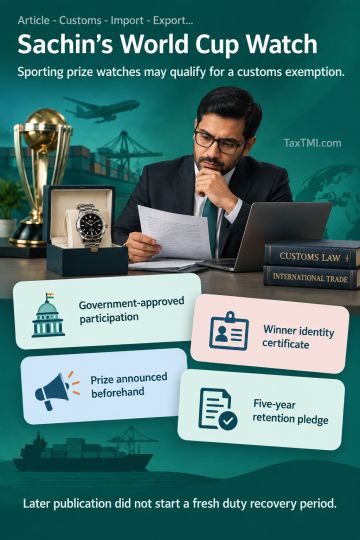
There was a lawful route. Serial No. 6 of Notification No. 146/94-Cus., dated 13 July 1994, exempted prizes won by members of Indian teams in international competition, subject to conditions. The team's participation had to have Government approval. At clearance, a certificate from an officer of at least Deputy Secretary rank had to confirm that the importer was the team member who won the prize and that the organisers had announced it before the competition. The importer also had to undertake to retain possession, control and use of the prize for five years without selling or parting with it.(3)
The separate entry for medals and trophies required Customs to be satisfied that the article had no general utility. The prize entry contained no such restriction. A working watch could therefore qualify. Sections 77 and 147 of the Customs Act also provided a route for an authorised agent to declare it on the winner's behalf, subject to fulfilment of the notification's conditions. If the exemption was unavailable, duty would depend on the applicable baggage allowance and the value of the watch.[3] [4] [5]
What difference did eleven years make?
Assuming the watch entered India in 2003-04 and the relevant date fell in that period, even the extended five-year period under the then proviso to Section 28(1) would ordinarily have expired before the autobiography appeared. The publication of the book did not start a fresh period for recovery of duty. A preliminary check and a duty demand were two different decisions. The first could establish whether there was anything to pursue. The second depended on the facts and the statutory time limit. [4]
The question I came away with is simple. When Sachin's account became public in 2014, did anyone in Customs check how the watch had entered India? The answer might have been perfectly ordinary. It may have been declared and cleared as a sporting prize. What the memoir gave Customs was a lead. The answer, if one was ever recorded, would have been in the department's files.
References
1. Sachin Tendulkar with Boria Majumdar, Playing It My Way, chapter 14, "World Cup 2003," PDF p. 138, two paragraphs before "The road to the final." See also the Pakistan Cricket Board scorecard.
2. Institute of Company Secretaries of India, faculty profile of Dr. K. N. Raghavan, confirming his tenure as Kochi Customs Commissioner from 2012 to 2017 and his international umpiring background. See also his Onmanorama review of Curtly Ambrose's autobiography.
3. Notification No. 146/94-Cus., dated 13 July 1994, table, serial nos. 5 and 6.
4. Customs Act, 1962, sections 28, 77, 79 and 147.
5. Baggage Rules, 1998, Appendix A. The increase to Rs. 25,000 was made by Notification No. 13/2004-Cus. (N.T.), dated 3 February 2004.
6. Indian Super League, Tendulkar's ISL club named Kerala Blasters. See also the Mathrubhumi Books catalogue listing for the DC Books Malayalam edition.
--------
Adv. G. Jayaprakash, Former Superintendent of Central Excise