 TaxTMI





 07 Nov 2026

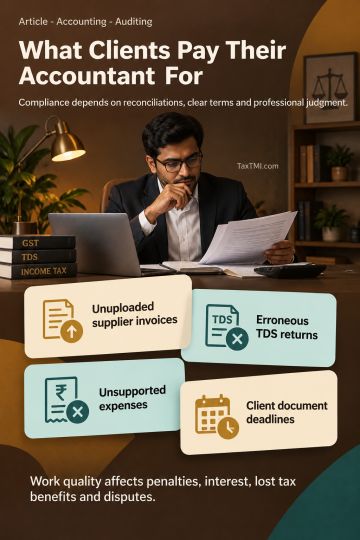
Clients can see the monthly fee. They can't see the penalties avoided, the credits protected and the notices that never arrived. Practitioners need to make that value visible.
In 2001 Arthur Andersen ranked among the five biggest accounting firms in the world, with tens of thousands of staff in dozens of countries.
Within months of its client Enron collapsing, the firm was finished. Its 2002 conviction for obstruction of justice was overturned by the US Supreme Court in 2005 - but by then the clients had gone and the firm had effectively stopped practising.
The Andersen story is usually taught to auditors. It carries a lesson for clients too: an adviser who becomes too eager to please the person paying the fee isn't protecting that person - they're endangering them.
The "small fee" that wasn't
An owner mentions, with some pride, that accounting and compliance cost almost nothing: "Just a small monthly fee. They file everything."
Then a notice lands. Input tax credit was claimed on invoices the supplier never uploaded. TDS was deducted but returns were filed with errors. Expenses were booked without proper documents. Returns went in, but nobody checked whether they matched the books.
The fee was small. The cost wasn't.
Lesson from history: why professions exist
In 1854 a group of accountants in Edinburgh received a royal charter as the Society of Accountants in Edinburgh - often cited as the first professional body of accountants. Institutes followed worldwide, including the Institute of Chartered Accountants of India, created by an Act of Parliament in 1949.
Professions exist because clients usually can't judge specialist work themselves, so society needed standards, ethics and accountability to protect them. That protection works best when clients understand what they're actually buying.
What the fee really buys
Many owners see accounting as data entry and form-filling: find someone cheap and the job's done. Good professional work is about far more:
- Accuracy - transactions recorded correctly, with evidence.
- Judgement - knowing what the law requires and how it applies to the facts.
- Anticipation - catching problems before they become notices.
- Advice - structuring decisions to be compliant and efficient.
- Insight - turning numbers into information owners can act on.
A fee either pays for all five - or for the first alone, done poorly.
Clients don't pay a CA for hours spent. They pay for the mistakes they never make.
The hidden costs of poor accounting
- Penalties and interest - late or wrong filings and mismatches that can exceed years of fees.
- Lost tax benefits - missed deductions, unclaimed credits, poor regime choices and weak structuring.
- Notices and disputes - time, money and management attention, sometimes for years.
- Bad decisions - late or inaccurate reports leave pricing, hiring and investment to guesswork.
- Weaker credit - unreliable statements cut borrowing capacity and investor confidence.
- Fraud exposure - without reconciliations, errors and fraud go unnoticed.
In a nutshell
Essence: the price of advice shows on the invoice; the price of poor advice arrives later, bigger and usually labelled as something else.
Signs an arrangement is under-scoped
- Financial statements arrive once a year.
- Nobody explains the numbers in plain language.
- Returns get filed but reconciliations are never shared.
- Deadlines become visible only when penalties arrive.
- Questions are answered with "it's always been done this way."
- Every client suggestion is agreed to - including risky ones.
- Notices are handled late or without a strategy.
- Nobody discusses structure, planning or growth.
The uncomfortable reality
Some owners pick low-cost advisers deliberately, hoping for someone who'll "adjust" things without awkward questions. It feels convenient until the day those adjustments must be defended.
An adviser who never says no isn't protecting the client. They're protecting the fee.
The SCOPE Test
Clients can use it to choose an adviser; firms can use it to audit their own service.
S - Specialisation
A proprietorship, a growing private company, a funded startup, an exporter and a group with cross-border transactions need different expertise. Relevant experience in the client's industry matters.
C - Controls and process
How are accounts reconciled? How are deadlines tracked? Are GST and TDS data matched with the books? Who reviews work before filing?
O - Openness
Are legal changes, deadlines and risks raised before the client asks? Is everything explained plainly? Will the adviser say "no" - and show the lawful way to the goal?
P - Professional standing
Qualifications and membership of the relevant body, plus independence where the law requires it - for instance, rules on statutory auditors also providing accounting services in specified situations.
E - Engagement letter
A written engagement letter stating exactly what's included - bookkeeping, filings, reconciliations, advisory, notices - what isn't, fees and timelines.
For practitioners: making value visible
- Issue engagement letters for every client. Define scope, exclusions, client responsibilities and document deadlines; it protects both sides and frames fees.
- Share a monthly compliance status sheet. Filings done, reconciliations completed, mismatches found and actions needed - clients see the work that prevents notices.
- Hold a quarterly review meeting. Thirty minutes on numbers, risks and upcoming changes turns a filing relationship into an advisory one.
- Document advice declined. When a client rejects a recommendation, confirm it in writing.
- Invest in quality control. Review checklists, peer review readiness and continuing education are what clients are ultimately paying for.
Choosing the right level of support
| Stage | Typical support |
| Very small | Bookkeeping plus compliance filings by a qualified firm |
| Growing | Monthly management reporting, reconciliations, tax planning |
| Scaling | A part-time or virtual CFO plus specialist tax and audit advisers |
| Established | In-house finance team supported by external specialists |
Indicators of success
Good accounting shows in what doesn't happen:
- No surprise notices or penalties.
- Timely, accurate monthly reports used for decisions.
- Proactive advice - warnings and opportunities raised unprompted.
- Clean audits with few adjustments.
- Clear records of what was filed, when and on what basis.
Outlook: the coming decade
AI and automation will keep making basic bookkeeping and return filing cheaper. A professional's value will shift further towards judgement, advice, controls, planning and handling data-driven scrutiny from tax authorities. Tomorrow's cheapest accountant will be software; the most valuable will be the professional who explains what the numbers mean and what to do next.
Immediate actions by role
- Owner: run the SCOPE Test on the current arrangement.
- Finance team: list every compliance task and its owner.
- Practitioner: prepare a short list of risks and improvement ideas for each key client.
- Both: sign an engagement letter defining scope, timelines and responsibilities.
Illustration from a smaller enterprise
Take an illustrative Rs. 10 crore business paying Rs. 15,000 a month - the lowest quote available. Returns get filed, but nobody reviews ITC mismatches, TDS defaults or the treatment of a large related-party loan.
Two years later notices arrive: credit disallowed, interest on TDS defaults and questions about the loan. The total bill exceeds Rs. 30 lakh. An experienced adviser at twice the fee would have cost roughly Rs. 3.6 lakh more over those two years. The cheap option turned out to be the expensive one.
The objection we hear most - and our response
The objection: "Every accountant files the same forms. A return is a return. Why pay three times more for identical output?"
The answer: The form is identical; what goes into it isn't. Two returns can look the same yet carry very different risk - one reconciled with books, supplier data and bank statements, the other filled from incomplete records. The difference shows only when a notice, an audit or a loan application tests it. Clients aren't buying a form. They're buying confidence that it will hold.
Practitioners' FAQ
"How often should the CA meet the client?"
At least quarterly for a small business, monthly during fast growth or cash pressure - even thirty minutes helps.
"Should all portal passwords be handed over?"
Use proper authorisations where portals allow, log who has access and change credentials when relationships end. No single person should control everything without oversight.
"Is changing accountants a bad idea?"
Not for good reason - but frequent changes lose continuity. Insist on a proper handover of records, working papers and pending matters, and on the professional courtesies the profession requires.
Position as at October 2026: In India, the Income-tax Act, 2025 took effect on 1 April 2026, the labour codes in November 2025 and the DPDP Rules in November 2025, while GST and TDS systems increasingly auto-match data. Advisers who are not actively updating their knowledge and processes for these changes may expose clients to avoidable mistakes. Ask yours how they have adapted.
How to be a good client
- Share complete, timely information.
- Keep business and personal transactions apart.
- Read the reports and ask questions.
- Respond to queries promptly.
- Never ask the adviser to do anything unlawful.
- Pay fairly for quality work.
Pitfalls
- Choosing advisers purely on the lowest quote.
- Handing over every credential without oversight or access logs.
- Never reviewing what's filed in your name.
- Switching advisers every year.
- Ignoring advice because it's inconvenient.
Terms explained
- Engagement letter - a written agreement setting out an accountant's scope, fees and responsibilities.
- Statutory compliance - filings and payments the law requires.
- Management reporting - reports that help owners make decisions, not just meet tax requirements.
Misconceptions clarified
- "Accounting is a commodity, so the cheapest fee wins." The cost of errors, notices and missed deductions usually dwarfs the fee saved.
- "Software has made the accountant unnecessary." Software records transactions; judgement, review and advice still need a professional.
- "If the returns are filed, the job is done." Filing is the minimum; reliable monthly numbers and planning are where most value lies.
Half-hour action exercise
Clients can put five questions to their accountant this month - and practitioners can answer them for each client unprompted:
1. Do our books reconcile with GST, TDS and income-tax filings?
2. What compliance risks do you see in the business?
3. Are we missing deductions or incentives?
4. Which deadlines and legal changes are coming in the next six months?
5. What would you improve in our financial controls?
Judge the answers on clarity and specifics. Vague answers are an answer in themselves.
Summary for busy professionals
- Accounting fees pay for accuracy, judgement, anticipation, advice and insight - not just data entry.
- Poor accounting brings hidden costs: penalties, lost benefits, notices, bad decisions, weaker credit and fraud risk.
- Warning signs include annual-only reporting, missing reconciliations, surprise penalties and advisers who agree with everything - Andersen's lesson in miniature.
- Use the SCOPE Test: Specialisation, Controls, Openness, Professional standing, Engagement letter.
- Make value visible with engagement letters, status sheets and regular reviews.
Good advice is an investment. Bad advice is a liability that hasn't been invoiced yet.
References
- Arthur Andersen LLP v. United States, 544 U.S. 696 (2005).
- Bethany McLean and Peter Elkind, The Smartest Guys in the Room: The Amazing Rise and Scandalous Fall of Enron (Portfolio, 2003).
- Institute of Chartered Accountants of Scotland - history (royal charter of 1854). icas.com
- Chartered Accountants Act, 1949 (India); Institute of Chartered Accountants of India. icai.org