 TaxTMI





 07 Nov 2026

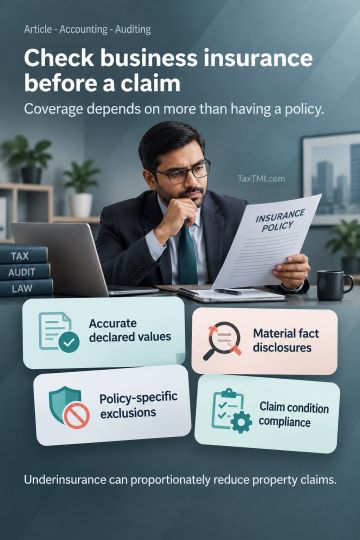
Insured on Paper, Exposed in Practice: Reviewing a Client's Business Insurance Before the Claim
A policy filed in a drawer isn't protection. Protection means knowing exactly what will be paid, when and on what conditions - and advisers are well placed to check.
In June 2017 a cyberattack known as NotPetya spread from Ukraine around the world, crippling computer systems at shipping lines, pharmaceutical companies and food manufacturers.
American snack maker Mondelez International said the attack damaged thousands of laptops and servers and disrupted operations. It claimed under its property insurance. Its insurer declined, relying on a "hostile or warlike action" exclusion since governments had blamed the attack on a nation state.
The dispute went to a US court and was settled only in 2022. Mondelez had insurance. What it lacked was certainty about what that insurance would actually pay for.
Relief that turns into disbelief
A fire guts a warehouse. The owner's first thought: "Thank goodness we're insured."
Then the claim begins. The surveyor finds the stock declared in the policy was far below the stock actually held, so the claim is cut proportionately. Some goods sat in a location the policy didn't cover. A fire-safety condition wasn't met. And business interruption - the profit lost while operations were halted - was never insured.
The policy existed. The protection the owner believed in didn't.
Lesson from history: insurance began in a coffee house
In the late 1600s merchants, ship-owners and underwriters met at Edward Lloyd's coffee house in London to swap shipping news and agree to cover the risks of voyages. Lloyd's of London grew from those conversations.
Even then, everything hinged on the wording of the promise and the honesty of the disclosure - what the ship carried, where it sailed and which perils were and weren't covered. Three centuries on, most insurance disputes still turn on those two things.
The uncomfortable reality
Many businesses renew insurance like a subscription: automatically, at the cheapest premium, barely reading it. The broker sends the renewal, the premium is compared with last year and the policy is filed.
Nobody checks whether the business has changed - new premises, more stock, new products, new risks, digital operations - since the cover was first written.
Insurance is a promise with conditions. Most disputes are about the conditions.
Why claims get cut or refused
1. Underinsurance. Where the sum insured is below the value at risk, many property policies apply an average clause that scales the claim down. Insure Rs. 50 lakh of stock for Rs. 25 lakh and a Rs. 10 lakh loss may yield only about Rs. 5 lakh.
2. Non-disclosure or misrepresentation. Wrong facts about the business, location, safety measures or claims history can reduce or void cover.
3. Exclusions. Flood, earthquake, terrorism, war, wear and tear, gradual deterioration, cyber, pandemics, contractual liabilities - it all depends on wording.
4. Breached conditions. Unmet requirements on extinguishers, alarms, storage standards or record-keeping.
5. Late intimation. Most policies require prompt notice of loss.
6. Weak documentation. Without stock records, invoices, asset registers and financial statements, proving the loss is very hard.
In a nutshell
Essence: claims fail on values, disclosures, exclusions, conditions, timing and evidence - every one of which can be checked before a loss rather than after.
Covers SMEs often overlook
Business interruption (loss of profits)
Property cover may rebuild a factory but usually won't pay the profit lost and fixed costs incurred while it's shut - unless interruption cover is in place. When severe floods hit Thailand in 2011, many global manufacturers' plants closed for weeks or months, and interruption losses were among the year's largest insured losses. For many businesses, downtime costs more than the physical damage.
Public and product liability
Third-party claims for injury, property damage or defective products.
Professional indemnity
For advisers, consultants, IT providers and professionals - CA firms included - whose errors could cause clients financial loss.
Directors' and officers' (D&O) liability
Cover for board members and senior officers facing claims over management decisions - more important as regulators look harder.
Cyber insurance
Ransomware, data breaches, payment-diversion fraud and outages can exceed many physical losses. Cyber policies vary widely, often require minimum security controls and - as Mondelez found - exclusions matter.
Key-person insurance
Protection against the financial impact of losing a founder or critical team member.
Trade credit insurance
Protection against customer default - useful for exporters and businesses with concentrated customer bases.
Marine and transit insurance
For goods in transit, with clear understanding of where risk passes under the agreed trade terms.
The CLAIM Check
Before every renewal, run the CLAIM Check:
- C - Cover what matters. List the key risks - assets, stock, people, liability, cyber, credit, interruption - and confirm each is covered or consciously retained.
- L - Limits correct. Use reinstatement or replacement value where suitable, update stock and asset values every year and base interruption cover on a credible recovery time.
- A - Assumptions disclosed. Inform the insurer of anything material that changes - additional premises, new products or processes, higher stock.
- I - Instructions followed. Study the policy conditions and warranties and check that day-to-day operations meet them.
- M - Make records claim-ready. Asset registers, stock records, invoices, photographs and off-site or cloud backups, plus a claims protocol naming who notifies the insurer and what evidence to preserve.
For practitioners: where the CA adds value
- Compare sums insured with the books. Match insured values to the fixed-asset register (at replacement cost) and to peak stock levels from inventory records; flag gaps in the management letter.
- Review interruption cover against the P&L. Work out standing charges and gross profit for a realistic indemnity period so cover reflects the numbers.
- Check policy conditions during internal audit. Test fire-safety, security and record-keeping conditions as part of the audit programme.
- Account for claims correctly. Recognise insurance claims receivable only when realisation is reasonably certain, and disclose contingent amounts appropriately.
- Mind the tax and GST angles. Confirm deductibility of premiums and the treatment of claim receipts, and note GST credit restrictions on certain insurance services.
Insurance isn't risk management
Insurance transfers some financial consequences of risk. It doesn't prevent the event, protect reputation, retain customers or satisfy regulators. Fire safety, cybersecurity, quality control, contracts, compliance and continuity plans remain essential - and insurers increasingly reward good risk management with better terms while penalising its absence.
Indicators of success
- Sums insured reviewed annually against current replacement values.
- Exclusions and conditions known to the people who must comply with them.
- Claims paid in full or close to it within a reasonable time.
- Gaps - interruption, cyber, product liability, D&O - consciously covered or accepted.
- Documentation - stock records, asset registers, maintenance logs - ready before any loss.
Outlook: the coming decade
Extreme weather, cyber incidents and supply-chain disruption are pushing losses up in both size and frequency. Underwriters are reacting with costlier premiums, tighter conditions and data-driven pricing using sensors, satellite imagery and claims history. Businesses with strong controls and clean data will secure better terms; those without will find cover dearer - or unavailable.
Immediate actions by role
- Owner: personally read the exclusions in the largest policy.
- CFO: compare sums insured with current asset and stock values.
- Operations head: confirm conditions - fire systems, security, maintenance - are actually met.
- Broker: ask for a written gap analysis of uninsured risks.
Illustration from a smaller enterprise
Take an illustrative garment manufacturer whose factory catches fire. The policy covers Rs. 5 crore of stock, but actual stock that day is Rs. 8 crore after a big seasonal order. Under the average clause the insurer pays only about five-eighths of the assessed loss.
Business interruption isn't covered, so salaries and EMIs continue through three months of closure with no income. The owner had insurance - just not enough of the right kind. After rebuilding he reviews cover quarterly in peak seasons and adds interruption cover.
The objection we hear most - and our response
The objection: "Insurance seldom pays out and insurers hunt for reasons to reject claims. We'd rather keep the premium and carry the risk."
The answer: Self-insuring small, predictable losses can make sense - higher deductibles often cut premiums. But catastrophic losses - a fire, a major liability claim, a months-long shutdown - can end a business that would have survived with proper cover. And most rejected claims trace back to preventable issues: underinsurance, non-disclosure and breached conditions. The cure for a badly bought policy is a well-bought one, not none at all.
Practitioners' FAQ
"How do we know the sum insured is right?"
Insure buildings and plant at reinstatement or replacement value, stock at today's value allowing for seasonal peaks, and interruption for a believable recovery period. Review annually or after any major change.
"Is cyber insurance worth buying?"
If the business depends on systems, holds customer data or makes digital payments, evaluate it - but read exclusions closely and strengthen basic security first, as insurers increasingly require it.
"Who should handle a claim?"
Name one person in advance, keep insurer contacts and policy numbers accessible and notify promptly.
Position as at October 2026: In India, the Insurance Regulatory and Development Authority of India (IRDAI) has issued customer-protection rules on claim settlement timelines and policy disclosures, and premiums for business insurance are generally deductible as business expenses, subject to tax rules. GST input tax credit on some insurance services is restricted. Confirm current positions with your broker and tax adviser.
Pitfalls
- Renewing without reviewing.
- Picking the cheapest premium regardless of cover.
- Under-declaring values to save premium.
- Assuming property cover includes interruption or cyber.
- Delaying claim notice while "assessing the damage."
Terms explained
- Sum insured - the most the insurer will pay under a policy.
- Average clause - a condition scaling claims down when assets are under-insured.
- Exclusion - an event or loss the policy doesn't cover.
- Business interruption cover - insurance for lost profit and fixed costs while operations are halted after an insured event.
Half-hour action exercise
Take the main property policy and answer:
1. What's the stock sum insured, and what was last year's peak stock?
2. Is business interruption included - and for how many months?
3. Which three exclusions could matter most?
4. Which three conditions must be followed - and are they?
5. Where would records survive if the premises burned down?
Each gap is a conversation with the broker before renewal, not after a loss.
Summary for busy professionals
- Many businesses find gaps only when a claim is cut or refused - Mondelez's NotPetya dispute shows how exclusions decide outcomes.
- Typical causes: underinsurance and average clauses, non-disclosure, exclusions, breached conditions, late notice and poor records.
- Covers frequently overlooked: interruption, liability, professional indemnity, D&O, cyber, key-person, trade credit and transit.
- Apply the CLAIM Check ahead of each renewal - Cover, Limits, Assumptions, Instructions, Make records claim-ready.
- Insurance complements risk management; it is never a substitute for it.
The premium buys the promise. The wording *is* the promise. Read it.
References
- Mondelez International, Inc. v. Zurich American Insurance Co., Circuit Court of Cook County, Illinois (filed 2018; settled 2022), as reported in business and legal press.
- Swiss Re Institute, sigma reports on natural catastrophes and man-made disasters (2011 edition, Thailand floods). swissre.com
- Lloyd's of London - history. lloyds.com
- Insurance Regulatory and Development Authority of India - regulations on protection of policyholders' interests. irdai.gov.in