 TaxTMI





 07 Nov 2026

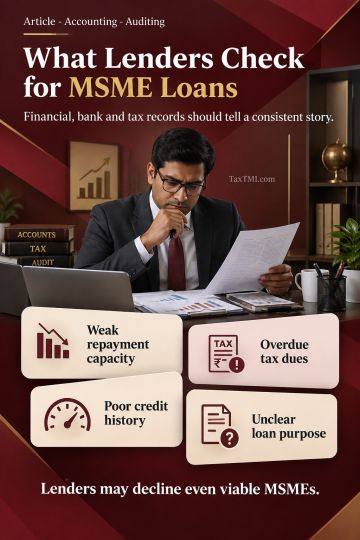
A rejection is rarely personal. Usually the lender simply read the client's numbers more carefully than anyone else did.
In February 2018 Punjab National Bank disclosed a fraud built on unauthorised letters of undertaking issued for companies linked to jeweller Nirav Modi. The sums involved exceeded Rs. 13,000 crore.
The case shook Indian banking, and over the following years lenders tightened verification, controls and documentation across the system.
If a loan file feels more demanding today than it did a decade ago, that's part of the reason: banks learned, painfully, to trust documents only when the documents agree with one another.
The frustration every client voices
"Business is good. Why did the bank say no?"
Sales are rising, customers are loyal, the promoter works hard and has never defaulted. Yet the proposal is declined - or sanctioned for a fraction of the amount, at a higher rate, against more collateral.
To the client it feels unfair. To the lender the decision usually comes down to one sentence: "The documents don't support the story."
Lesson from history: lend on evidence
In 1873 the British journalist-economist Walter Bagehot published Lombard Street, still read by central bankers. One enduring idea: sound lending rests on good security and reliable information - lend freely only against what can be trusted.
The instruments have changed in 150 years; the principle hasn't. Lenders lend to evidence, not enthusiasm.
How a credit officer thinks
The first question isn't "is this business growing?" It's "will we be repaid, on time, even if things go wrong?"
Bankers have long framed that around the five Cs of credit:
- Character - the integrity and track record of the borrower and promoters.
- Capacity - ability to repay from cash flow.
- Capital - how much the owners have put in and kept in.
- Collateral - security available if repayment fails.
- Conditions - the industry, the economy and the purpose of the loan.
Every document in the file is evidence for or against each C.
The Triangle of Truth
The most important idea here: lenders test a business against the Triangle of Truth - three independent records that must tell the same story.
1. Financial statements - turnover, profit, assets, liabilities.
2. Bank statements - the money that actually moved.
3. Tax data - GST returns, income-tax returns, TDS records.
When the three agree, the story is credible. When they don't - book turnover far above GST turnover, bank credits far below declared sales, business receipts landing in personal accounts - the lender sees inconsistency, not an explanation.
A loan file isn't judged on how good the story sounds, but on how closely the three records agree.
In a nutshell
Essence: lenders trust a business when its accounts, bank statements and tax returns tell one story - and doubt it when they don't.
Ten common reasons viable businesses get declined
1. Declared income won't carry the loan - profits minimised for tax become the ceiling on borrowing.
2. Bank statements don't match the accounts - especially when receipts flow through personal accounts.
3. GST data contradicts the books - lenders increasingly read GST returns directly.
4. Weak repayment capacity - low DSCR or thin interest cover.
5. Overdue statutory dues - unpaid taxes and PF suggest stress and create competing claims.
6. Poor credit history - late EMIs, card dues or guarantees given for others show up on business and promoter reports.
7. Over-leverage - borrowing already high relative to equity and cash flow.
8. Thin promoter contribution - little owner money at risk, or capital withdrawn as fast as it's introduced.
9. Late or weak financial statements - unaudited, delayed or poorly prepared accounts signal weak management.
10. Unclear purpose - a request without a credible use and repayment plan.
The uncomfortable reality
Many owners prepare for a loan the week before they apply. Lenders assess behaviour over years.
Creditworthiness isn't manufactured in an application. It's built in every filing, every payment and every set of accounts long before the money is needed.
A 24-month bankability plan
12-24 months ahead
- Separate business and personal finances completely.
- Route all business receipts and payments through business accounts.
- File GST, TDS and income-tax returns on time, reconciled with the books.
- Pay statutory dues and existing instalments on schedule.
- Pull business and personal credit reports and correct errors.
- Retain profits to build net worth.
3-6 months ahead
- Finalise audited or professionally reviewed statements.
- Build projections anchored to historical performance.
- Write a clear proposal: purpose, amount, repayment plan, security offered.
- For working-capital limits, prepare debtor, stock and creditor data in the lender's format - CMA data for larger facilities.
At application
- Present one consistent story across the Triangle.
- Explain unusual items before the lender finds them.
- Explore government-backed MSME schemes and credit guarantees where eligible.
- Compare banks, NBFCs and digital lenders on terms, flexibility and covenants, not just rate.
For practitioners: building a file that survives scrutiny
- Reconcile the triangle before submission. Prepare a one-page bridge from book turnover to GST turnover to bank credits, explaining every material difference.
- Prepare CMA data honestly. Projections should reconcile to historical ratios; aggressive assumptions become covenants the client later breaches.
- Check stock and book-debt statements. Ensure quarterly statements agree with the ledger and that ageing excludes debts the bank won't count for drawing power.
- Review the promoter's credit report. Guarantees given for relatives' loans or small overdue card balances can derail a proposal; fix them early.
- Document director and related-party loans. Unexplained movements in unsecured loans are a frequent query; support them with agreements and confirmations.
What lenders value but rarely say
- Owners who understand their own numbers.
- Monthly MIS available quickly.
- Candid disclosure of problems with a credible plan.
- Diversified customers and steady margins.
- A history of keeping small promises.
Indicators of success
- Approvals arrive faster, with fewer queries.
- Rates and collateral demands improve.
- Covenant compliance is comfortable, with headroom.
- Stock and debtor statements match the accounts.
- Banker meetings discuss growth, not explanations.
Outlook: the coming decade
Banks and NBFCs increasingly decide credit using account-aggregator data, GST returns, bureau scores and AI models, with many decisions partly automated. What a client's systems tell the lender will matter more than what the client says in the meeting. Clean, consistent, timely data will become the single biggest factor in borrowing.
Immediate actions by role
- Owner: ask the banker what would improve the rating or the limit.
- CFO: reconcile the stock and debtor statements filed with the bank to the books.
- Accountant: finalise audited accounts early, not on the last date.
- Sales: bring down overdue debtors - lenders discount them first.
Illustration from a smaller enterprise
Take an illustrative Rs. 25 crore trading business repeatedly refused a higher working-capital limit. A review shows its stock statements don't match its books, profits swing because of year-end adjustments and director loans move in and out without documentation.
The owner fixes all three within a year. At the next renewal the bank raises the limit by 40% at a lower rate. Nothing changed in the business except what the bank could trust.
The objection we hear most - and our response
The objection: "Banks are biased against small businesses. They want collateral for everything and ignore real potential. The system's the problem, not our documents."
The answer: There's truth in it. Small firms face a credit gap worldwide and collateral demands can be harsh - which is why governments created guarantee schemes and why cash-flow lending on digital data is growing. But those very schemes still rely on consistent, verifiable records. The quickest way past the system's bias is to give it nothing to doubt.
Practitioners' FAQ
"If one lender says no, should we apply to many?"
Multiple simultaneous applications can trigger several bureau enquiries and signal distress. Find out why the first lender declined, fix the cause, then apply selectively.
"Can profits be shown higher just for the loan?"
No. Inflating figures for a lender is misrepresentation, and the Triangle will expose it. Build real profit and declare it honestly.
"What DSCR do banks expect?"
It varies by lender and product. Many look for comfortably above 1 - often around 1.25 or more for term loans - but confirm with the bank.
Position as at October 2026: Indian MSMEs can access collateral-free loans backed by the Credit Guarantee Fund Trust for Micro and Small Enterprises (CGTMSE), and lenders increasingly use GST data, Account Aggregator-based bank data and the RBI's Unified Lending Interface for faster, cash-flow-based decisions. Credit bureaus provide MSME ranks and commercial reports. Eligibility and terms change - check current conditions.
Pitfalls
- Inflating stock or debtors in bank statements.
- Projections disconnected from historical reality.
- Diverting loan funds to undisclosed purposes.
- Ignoring covenants after sanction.
- Treating the bank as an adversary rather than a partner.
Terms explained
- Covenant - a loan condition, such as a minimum ratio, the borrower must meet.
- Drawing power - the amount available under a working-capital limit, based on stock and debtors.
- Interest cover - operating profit divided by interest expense.
- Collateral - assets pledged to secure a loan.
- Debt service coverage ratio - cash available for instalments and interest divided by those payments.
Misconceptions clarified
- "Banks only want collateral." Security matters, but lenders first ask whether cash flow can repay the loan and whether the numbers can be trusted.
- "A rejection means the business isn't viable." Many viable businesses are declined because their records, filings or banking conduct don't support the story.
- "Lower declared profit is always smarter." Understated income saves a little tax today and can cost far more in credit refused tomorrow.
Action checklist
Stock statements agree with the books
Audited accounts finalised early
Covenant headroom checked each quarter
Half-hour action exercise: test the triangle
For last financial year, put three numbers side by side:
1. Turnover in the financial statements.
2. Turnover in GST returns.
3. Total business credits in bank statements (excluding loans and capital).
If they differ by more than a few percent, write down why. Any gap that can't be explained in one sentence is a gap the lender will question.
Summary for busy professionals
- Lenders ask one thing: will we be repaid on time, even if things go wrong?
- The five Cs - character, capacity, capital, collateral, conditions - still frame every decision.
- Pass the Triangle of Truth: accounts, bank statements and tax data must tell one story.
- Common declines stem from under-declared income, mismatched records, weak DSCR, overdue dues, poor credit history, over-leverage, thin promoter capital, late accounts and vague purpose.
- Creditworthiness is built over years - start 12-24 months before the money is needed.
Banks lend to evidence, not enthusiasm.
References
- Punjab National Bank, stock exchange disclosures (February 2018), and subsequent public reporting on the fraud.
- Walter Bagehot, Lombard Street: A Description of the Money Market (1873), public domain.
- Reserve Bank of India - Master Directions on lending to MSMEs; Unified Lending Interface. rbi.org.in
- Credit Guarantee Fund Trust for Micro and Small Enterprises. cgtmse.in
- World Bank, SME Finance resources on the global small-business credit gap. worldbank.org