 TaxTMI










 06 Nov 2026

GSTN Introduces Important Changes in Composition Levy Functionality
The composition levy under GST was introduced to simplify tax compliance for eligible small taxpayers by allowing them to pay tax at prescribed concessional rates instead of following the normal taxation procedure. Over time, the scheme has been extended to various categories of suppliers, including manufacturers, traders, restaurants and eligible service providers. However, the statutory distinction between the composition schemes under Sections 10(1) and 10(2A) was not adequately reflected in the available portal categories.
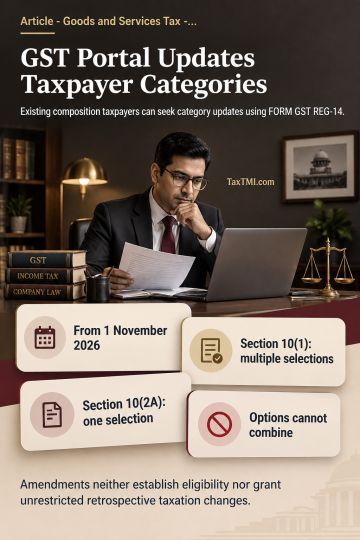
To address this difficulty, GSTN issued an Advisory on Enhancements Related to Composition Levy Functionality under GST dated 01.11.2026, introducing two important changes. First, a separate category has been created for persons eligible for the composition levy under Section 10(2A) of the CGST Act, 2017. Second, composition taxpayers can now change or update their selected category by filing an amendment application in FORM GST REG-14.
The revised functionality applies to applications filed through FORM GST REG-01, CMP-02, CMP-04 and REG-14. These changes are significant because they improve the identification of composition taxpayers, facilitate the correction of registration particulars, and help ensure consistency across GST registrations linked to the same PAN. Importantly, the advisory concerns portal functionality and does not independently amend the statutory eligibility conditions, turnover limits, or composition tax rates.
Sections 10(1) and 10(2A) Provide Two Distinct Composition Schemes
Section 10(1) of the CGST Act, 2017 provides the traditional composition levy to eligible manufacturers, suppliers making supplies referred to in clause (b) of paragraph 6 of Schedule II, and other eligible suppliers. The turnover ceiling was increased to Rs. 1.5 crore in the preceding financial year by Notification No. 14/2019-Central Tax dated 07.03.2019, subject to applicable lower limits for specified States and other statutory conditions.
Section 10(2A), inserted by the Finance (No. 2) Act, 2019 and brought into force from 01.01.2020, provides a separate composition option for registered persons not eligible under Sections 10(1) and 10(2), subject to an aggregate turnover ceiling of Rs. 50 lakh in the preceding financial year and prescribed restrictions. This provision primarily benefits eligible service providers and suppliers making a combination of goods and services who cannot avail themselves of the traditional composition scheme.
The distinction matters because both provisions operate under Section 10 but serve different categories of taxpayers. A person cannot freely select either provision merely because the tax rate or compliance requirements appear more convenient. Eligibility must first be determined under the relevant statutory provision, and the corresponding category must then be selected on the GST Portal.
The Earlier Composition Framework Was Extended to Service Providers in 2019
Before the introduction of Section 10(2A), the Government introduced a composition-like scheme for eligible service providers and mixed suppliers through Notification No. 02/2019-Central Tax (Rate) dated 07.03.2019, effective from 01.04.2019. The scheme prescribed an effective GST rate of 6%, comprising 3% CGST and 3% SGST, subject to the specified turnover ceiling and conditions.
Subsequently, Notification No. 09/2019-Central Tax (Rate) dated 29.03.2019 extended the relevant composition procedural provisions to persons opting under the earlier notification. CBIC also issued Circular No. 97/16/2019-GST dated 05.04.2019, clarifying aspects of exercising that option.
The subsequent statutory recognition of a separate composition category under Section 10(2A) necessitated the GST Portal distinguishing such taxpayers from those covered by Section 10(1). The advisory dated 01.11.2026 addresses this administrative requirement by providing a dedicated category for Section 10(2A) taxpayers.
A New Composition Category Has Been Introduced Under Section 10(2A)
The most significant change announced by GSTN is the introduction of a new portal category titled "Person eligible for composition levy under Section 10(2A)". Taxpayers opting for the composition scheme must now select the appropriate category from two options.
Option A includes the existing categories under Section 10(1), namely manufacturers other than those of notified goods for which composition is unavailable, Suppliers providing food or any other article for human consumption, or drinks other than alcoholic liquor for human consumption, whether supplied as part of a service or in any other manner, for cash, deferred payment or other valuable consideration, as specified in paragraph 6(b) of Schedule II to the CGST Act, 2017 and other suppliers eligible under Section 10(1). Multiple selections are permitted within this option where applicable.
Option B includes the newly introduced category for persons eligible under Section 10(2A). Only a single selection is permitted under this option. GSTN has expressly clarified that Option A and Option B cannot be selected together. This restriction reflects the distinction between the two statutory composition frameworks and prevents taxpayers from simultaneously declaring themselves eligible under both categories.
Key Differences Between Composition Categories Under Sections 10(1) and 10(2A)
The following table summarises the principal differences between the two options available on the GST Portal.
| Particulars | Option A | Option B |
| Relevant statutory provision | ||
| Principal categories | Eligible manufacturers, specified restaurant suppliers and other eligible suppliers | Eligible service providers and mixed suppliers not qualifying under Sections 10(1) and 10(2) |
| General preceding-year turnover ceiling | Rs. 1.5 crore, subject to applicable State-specific limits | Rs. 50 lakh |
| Number of category selections | Multiple applicable categories permitted | Single category only |
| Selection of both options together | Not permitted | Not permitted |
| Portal category | Existing composition categories | New Section 10(2A) category |
The table highlights an important distinction between selecting multiple options under Option A and selecting Options A and B simultaneously. GSTN permits the former but expressly prohibits the latter.
For example, an eligible taxpayer engaged in more than one activity covered by the existing Section 10(1) categories may select the applicable categories under Option A. However, a taxpayer eligible under Section 10(2A) must select Option B separately and cannot combine it with the existing categories.
Composition Tax Rates Continue to Be Governed by the Existing Law
The new category does not alter the composition tax rates prescribed under Section 10 read with Rule 7 of the CGST Rules, 2017. The applicable effective rates under the CGST and corresponding SGST provisions are generally 1% for eligible manufacturers and other suppliers, 5% for specified restaurant suppliers, and 6% for persons covered under Section 10(2A).
These rates are subject to the applicable statutory provisions and the relevant turnover base. An important distinction must be made regarding the turnover on which composition tax is calculated. In the case of traders and other eligible suppliers covered under Section 10(1)(c), composition tax at the effective rate of 1% is payable only on the turnover of taxable supplies of goods and services in the State or Union territory. However, in the case of manufacturers, specified food and drink suppliers covered under Schedule II, paragraph 6(b), and persons opting under Section 10(2A), composition tax is calculated on the turnover of supplies of goods and services, which may include both taxable and exempt supplies, subject to the applicable statutory provisions. Thus, the turnover base for calculating composition tax differs according to the category of taxpayer, even where the effective tax rate is the same.
The revised portal functionality should therefore be understood as a classification and compliance improvement. It neither creates a new composition levy nor authorises a taxpayer to change the applicable rate merely by selecting a different category. The correct rate must continue to be determined by the taxpayer's actual activities and statutory eligibility.
FORM GST REG-14 Can Now Be Used to Change the Composition Category
The second important enhancement introduces a facility for existing composition taxpayers to change or update their selected category through FORM GST REG-14. Previously, the absence of a convenient category-amendment mechanism could create difficulties when the taxpayer's registered composition category required correction or updating.
The revised functionality provides a formal electronic route for submitting the required amendment. A taxpayer who discovers that the selected category does not correctly reflect the applicable composition provision may now initiate the necessary correction through FORM GST REG-14, subject to the prescribed conditions and processing requirements.
However, the amendment facility should not be confused with an unrestricted right to change the statutory basis of taxation retrospectively. An amendment to registration particulars does not, by itself, establish eligibility under Section 10(1) or Section 10(2A). Where the proposed change involves an actual shift in the composition scheme, the taxpayer must separately examine the applicable statutory conditions, effective date and procedural requirements.
Substituted Rule 19 Provides the Legal Framework for Registration Amendments
The amendment facility must also be read with Rule 19 of the CGST Rules, 2017, which deals with the amendment of registration, as substituted by Notification No. 05/2026-Central Tax dated 26.10.2026. The revised rule expressly recognises changes to particulars furnished in FORM GST CMP-02 and provides for submission of an amendment application in FORM GST REG-14.
Under substituted Rule 19(1), taxpayers must report changes in relevant registration particulars within the prescribed period of 15 days from the occurrence of the change, along with supporting documents. The rule also distinguishes amendments requiring examination by the proper officer from those that may be processed electronically without such examination.
Where officer examination is required, the substituted rule prescribes time limits for approval, issuance of deficiency notices, submission of clarifications, and disposal of the amendment application. It also provides for deemed amendment in specified circumstances where the proper officer fails to act within the prescribed period.
The importance of this framework is that the GSTN advisory provides the operational facility, while Rule 19 governs the statutory amendment procedure. Both must be read together. The availability of a new portal option does not dispense with the requirement to furnish accurate particulars or to comply with the applicable amendment provisions.
All GST Registrations Linked to the Same PAN Must Reflect a Consistent Category
The GSTN advisory specifically instructs taxpayers to ensure that the selected composition category is updated consistently across all GSTINs linked to the same PAN. This requirement is particularly important for businesses operating in more than one State or Union territory.
The provisos to Sections 10(2) and 10(2A) contain corresponding PAN-based restrictions. Where more than one registered person has the same PAN, the relevant composition option must be exercised consistently in accordance with the applicable statutory provision. A taxpayer cannot treat each GSTIN as an entirely independent entity when choosing an incompatible composition framework.
For example, where a business has GST registrations in Delhi, Haryana and Uttar Pradesh under the same PAN, the composition category must be examined across all three registrations. If the taxpayer is eligible under Section 10(2A), the appropriate category should be reflected consistently across the relevant GSTINs. The availability of a separate GSTIN in each State does not permit contradictory composition selections under the same PAN.
Four GST Forms Are Affected by the Revised Functionality
The advisory identifies four forms through which the revised functionality will operate. Their respective purposes are summarised below:
| GST form | Purpose | Relevance of the enhancement |
| Application for GST registration | Selection of the appropriate composition category at registration | |
| Intimation to opt for composition levy | Selection of the applicable category while exercising the composition option | |
| Intimation or application for withdrawal from composition levy | Updated composition-related functionality when withdrawing from the scheme | |
| Application for amendment of registration particulars | Facility to change or update the selected composition category
|
These forms serve different purposes. FORM GST REG-01 concerns initial registration, while FORM GST CMP-02 is used by an eligible registered person to exercise the composition option. FORM GST CMP-04 relates to withdrawal from the composition scheme, whereas FORM GST REG-14 concerns amendment of registration particulars.
Consequently, the new REG-14 facility should not be treated as a substitute for CMP-02 or CMP-04 wherever those forms are statutorily required. The correct form depends on whether the taxpayer is obtaining registration, opting for composition, withdrawing from composition, or correcting existing registration particulars.
Practical Illustrations on Composition Category Selection and Registration Amendments
The following illustrations explain the practical implications of the revised functionality:
| Particulars | Illustration 1 | Illustration 2 | Illustration 3 |
| Nature of business | Eligible trader | Eligible service provider | Composition taxpayer with multiple GSTINs |
| Applicable provision | Section 10(1) or 10(2A), as applicable | ||
| Appropriate category | Option A | Option B | Consistent category across all GSTINs |
| Multiple selections | Permitted within Option A, where applicable | Not permitted | Subject to the selected statutory framework |
| Relevant portal action | REG-14 for necessary category updates |
Illustration 1: A registered trader eligible under Section 10(1) must select the appropriate existing category under Option A. If more than one existing category genuinely applies to the business, the portal permits multiple selections within Option A.
Illustration 2: An eligible service provider having preceding-year aggregate turnover of Rs. 35 lakh, who does not qualify under Sections 10(1) and 10(2) but satisfies Section 10(2A), must select the new category under Option B. The taxpayer cannot simultaneously select any category under Option A.
Illustration 3: A composition taxpayer having GST registrations in Delhi and Haryana under the same PAN discovers that the composition category requires updating. The taxpayer may use FORM GST REG-14 to seek the necessary amendment and must ensure that the correct category is reflected consistently across both registrations, subject to the applicable legal requirements.
These illustrations demonstrate that the revised functionality is intended to improve the accuracy of composition registration particulars rather than create an independent entitlement to composition levy.
Composition Eligibility Must Be Verified Before Changing the Category
Although GSTN has simplified category selection and amendment, the statutory restrictions under Section 10 continue to apply. These include the relevant turnover ceiling, restrictions on inter-State outward supplies, notified exclusions, and other prescribed conditions. Restrictions relating to supplies through electronic commerce operators must also be read in their current amended form, rather than applying outdated restrictions mechanically.
Further, a composition taxpayer cannot collect tax separately from customers and is not entitled to input tax credit on inward supplies. The taxpayer must also comply with the prescribed return-filing and payment requirements, including FORM GST CMP-08 and FORM GSTR-4, wherever applicable.
Accordingly, a change in the selected category should be preceded by an examination of the taxpayer's business activities, turnover, existing GST registrations, and eligibility under the relevant provision. An incorrect category may create discrepancies between the taxpayer's registration particulars and the statutory basis for payment of composition tax.
Existing Notifications and Circulars Must Be Read in Their Proper Context
The principal statutory provisions relevant to the advisory are Sections 10(1) and 10(2A), Rules 3 to 7, and Rule 19 of the CGST Rules, 2017. The historical framework is supported by Notification No. 14/2019-Central Tax dated 07.03.2019, Notification No. 02/2019-Central Tax (Rate) dated 07.03.2019, Notification No. 09/2019-Central Tax (Rate) dated 29.03.2019, and Circular No. 97/16/2019-GST dated 05.04.2019.
The more recent Notification No. 05/2026-Central Tax dated 26.10.2026 is relevant to the revised registration-amendment procedure under Rule 19. However, the new Section 10(2A) portal category and its selection restrictions are specifically explained in the GSTN advisory dated 01.11.2026.
It is important to distinguish these sources. Earlier notifications and circulars explain the statutory evolution of the composition framework, whereas the latest advisory addresses the electronic functionality for selecting and updating the appropriate category. No change in the statutory composition turnover ceilings or tax rates should be inferred merely from the advisory.
Accurate Category Selection Will Improve Compliance and Reduce Registration Disputes
The enhancements announced by GSTN are a useful improvement in administering the composition levy. By introducing a separate category for Section 10(2A), the portal now provides clearer recognition of the statutory distinction between the traditional composition scheme and the scheme applicable to eligible service providers and mixed suppliers.
The additional facility to update composition categories through FORM GST REG-14 should also help taxpayers correct registration particulars without unnecessary procedural difficulty. However, the benefits of these changes will depend on correct category selection, compliance with the statutory eligibility conditions, and consistent reporting across all GSTINs linked to the same PAN.
The core message is that the GST Portal now offers greater flexibility in maintaining composition registration particulars, but the legal right to pay tax under composition continues to depend entirely on the conditions prescribed under Section 10 and the applicable rules.
***