 TaxTMI





 06 Nov 2026

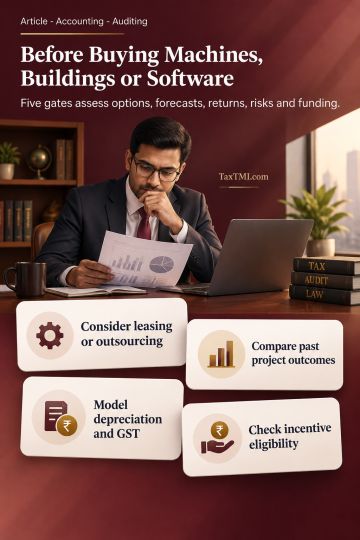
Each new asset feels like progress. Each also locks in cash, debt and fixed costs for a decade. A disciplined appraisal is one of the most valuable services an adviser can offer.
In 1957 the government of New South Wales approved a design for a new opera house in Sydney. Early estimates put the cost at about A$7 million, with completion expected within a few years.
The Sydney Opera House finally opened in 1973 - ten years late - at a cost of roughly A$102 million. It became one of the world's best-loved buildings and one of project management's most quoted examples of how far reality can drift from the first estimate.
Overruns are the rule, not the exception
Oxford professor Bent Flyvbjerg and colleagues have compiled data on more than 16,000 large projects across countries and sectors. In How Big Things Get Done (2023), he and Dan Gardner find that a mere 8.5% came in on time and within budget, and just 0.5% did so while also delivering the promised benefits.
A client's factory extension or ERP rollout is far smaller than an opera house. The forces at work are identical: optimism, underestimated complexity and a commitment that hardens as money is spent.
Why capital spending is uniquely risky
Operating costs come and go monthly. Capital expenditure behaves differently:
- It's hard to undo - selling specialised equipment or exiting a long lease is costly.
- It creates fixed costs - depreciation, maintenance, insurance, interest and staffing persist whether the asset is busy or idle.
- Cash goes out first while benefits trickle in slowly.
- It rests on forecasts - demand, utilisation and savings - that are easy to inflate.
Every capex decision is a bet on the future, paid for in the present.
Lesson from history: count the cost before you build
The Gospel of Luke asks which of us, planning to build a tower, wouldn't first sit down and count the cost to see whether we can finish - lest, having laid the foundation and run out of money, everyone who sees it mocks us.
Two millennia later, counting the cost remains the most neglected step in capital investment.
Common capex traps
1. Building ahead of demand - capacity sized for business that may never come sits unused and costly.
2. Overlooking whole-life cost - commissioning, training, upkeep, spare parts, power, insurance, upgrades and eventual disposal can together outstrip the sticker price.
3. Forgetting working capital - more capacity needs more raw material, stock and debtors; projects fail when the asset is funded but the working capital isn't.
4. Short money for long assets - every renewal becomes a crisis.
5. Ego and status - grand offices and showpiece equipment driven by image rather than economics.
6. Sunk-cost escalation - throwing good money after bad to justify earlier spending.
7. The planning fallacy - Kahneman and Tversky's finding that we underestimate time and cost for our own projects even when we know similar ones overran.
In a nutshell
Essence: capex goes wrong when hope writes the forecast, the sticker price hides the true cost and nobody checks afterwards whether the promise came true.
The Five Capex Gates
Every significant investment should clear five gates before approval - and one review afterwards.
Gate 1: Problem and alternatives
What problem does the investment solve? What are the alternatives - doing nothing, outsourcing, leasing, sweating existing assets? What evidence supports the demand or savings assumptions?
Gate 2: The outside view
Before trusting the client's own estimate, examine how comparable projects actually turned out - past projects, industry data, supplier references. Flyvbjerg calls this reference-class forecasting. Shift the estimate towards that reality.
Gate 3: More than one measure
- Payback period - time to recover the cash invested; simple and risk-sensitive, but blind to later years.
- Net present value (NPV) - discounted future cash flows less the investment, at a rate reflecting cost of capital and risk; positive NPV suggests value creation.
- Internal rate of return (IRR) - the rate at which NPV is zero; handy for comparison, unreliable when cash flows change sign more than once.
- Return on capital employed (ROCE) - the measure for tracking performance once the asset is running.
Gate 4: The downside test
Suppose volumes come in 30% below plan, commissioning slips six months, costs 20% over or interest rates higher? If the case only works in the optimistic scenario, it's a gamble, not an investment.
Gate 5: The funding match
Match funding to asset life - equity, term loans, leasing, government schemes, subsidies - and include the working capital the asset will need.
After approval: the post-investment review
Review each major project 12 and 24 months after commissioning, comparing actual cost, utilisation, revenue and savings with the original case. Feed the lessons into future decisions and hold proposers accountable for their assumptions.
Lease or buy?
Neither always wins.
- Purchase fits durable assets whose technology is settled and whose usage is predictable; ownership accrues, but so does the need for cash or borrowing.
- Lease or hire fits rapidly evolving technology, doubtful demand or scarce capital; flexibility is kept, even if the all-in cost ends up higher.
Under Ind AS 116 and IFRS 16 most leases appear on the lessee's balance sheet, so leasing doesn't make obligations disappear. Compare total after-tax cost, flexibility and risk.
Illustration
A manufacturer is weighing a Rs. 1.2 crore machine expected to save Rs. 30 lakh a year.
- Brochure payback: 4 years.
- With total cost of ownership: maintenance, energy and an operator cut net savings to Rs. 22 lakh payback about 5.5 years.
- With working capital: extra stock needs Rs. 15 lakh effective outlay Rs. 1.35 crore payback about 6 years.
- Downside at 70% utilisation: net savings around Rs. 15 lakh payback about 9 years, longer than the machine's eight-year useful life.
The four-year payback existed only in the brochure. The decision changes: lease for two years to test utilisation, or start with a smaller model.
For practitioners: what to put in the appraisal note
- A standard template covering all five gates, signed off by the proposer and reviewed by finance.
- Tax effects in the cash flows. Depreciation under the Income-tax Act, 2025 and GST input tax credit on capital goods change after-tax returns; model them explicitly.
- Scheme conditions. Where PLI, interest subvention or MSME technology-upgrade schemes apply, document eligibility conditions and clawback risks.
- Lender alignment. Make sure the project report given to the bank uses the same assumptions as the internal case.
- Post-investment review dates written into board minutes at approval.
Indicators of success
- Post-investment reviews happen for every major project one and three years after completion.
- Actual versus planned returns - the gap narrows as appraisal improves.
- Utilisation - new assets reach planned usage on schedule.
- Overruns - fewer projects breach budget or timeline.
- Cash impact - investments don't push the business into short-term funding stress.
Outlook: the coming decade
Capital decisions are getting harder because technology now moves faster than many assets last. A machine bought today may face automation, new energy sources or AI-driven processes within a few years, while carbon rules, tariffs and supply-chain shifts alter what plants and sites are worth. Adaptable, modular and leased choices will frequently outperform big irreversible commitments - and the restraint to say "not now" will count as much as the nerve to spend.
Immediate actions by role
- Owner or CEO: pull up each capex approval above a set limit from the past three years and check its actual results against the proposal.
- CFO: introduce a capex template built on the Five Gates.
- Operations head: identify assets running below 60% utilisation.
- Board: mandate post-investment reviews for every major project.
Illustration from a smaller enterprise
Take an illustrative printing company whose owner buys a Rs. 2.5 crore press because a large customer promises more work. Orders arrive for six months - then the customer shifts to digital printing.
The press runs at 40% capacity while loan instalments continue. Applying the Five Gates, the owner would have sought a volume commitment in the contract, considered leasing or a second-hand press and modelled the risk of losing that one customer. Next time he leases equipment for a new contract and links the lease term to the contract term, cutting his risk to a fraction.
The objection we hear most - and our response
The objection: "Wait for perfect analysis and competitors move first. Great businesses make bold bets; all this modelling kills ambition."
The answer: Bold bets aren't the problem - unexamined ones are. For most SME decisions the gates take days, not months, and they frequently turn up a better-designed version of the same idea - a trial run, a lease, a build in stages. Boldness that has done the sums is still boldness. Boldness that hasn't is simply hope attached to a big bill.
Practitioners' FAQ
"Buy or lease equipment?"
Weigh lifetime cost, flexibility and risk side by side; a lease limits exposure where demand or technology is unsettled.
"What return should an investment deliver?"
More than the cost of capital, with a margin for risk. Set the hurdle rate before reviewing proposals.
"Who should approve capital spending?"
Defined authority limits, with board approval for large or strategic projects.
Position as at October 2026: Indian businesses should check depreciation rules under the Income-tax Act, 2025, eligibility for input tax credit on capital goods under GST, and government incentives such as production-linked incentive schemes and MSME technology-upgrade or interest-subvention programmes - each with conditions that affect the business case. Verify current terms before finalising a decision.
Pitfalls
- Approving major investments on one optimistic spreadsheet.
- Ignoring maintenance, energy and staffing costs.
- Buying because a vendor offers a "limited-time" discount.
- Adding capacity without securing demand.
- Never checking whether investments delivered.
Terms explained
- Capital expenditure (capex) - spending on long-lived assets such as machinery, buildings or software.
- Payback period - how long an investment's cash benefits take to repay its cost.
- Utilisation - the share of an asset's capacity actually used.
- Post-investment review - a check after completion of whether the investment delivered what was promised.
Half-hour action exercise
Take the largest capital purchase of the past three years and answer:
1. What payback did we expect?
2. What payback did we achieve?
3. What did we underestimate - cost, time, utilisation or working capital?
Write the lesson down and apply it, as a rule, to the next proposal on the desk.
Summary for busy professionals
- Capital spending is difficult to undo, locks in fixed costs, absorbs cash up front and relies on hopeful projections - and big projects usually overrun.
- Cost the whole thing: lifetime ownership cost plus working capital, not only the quote.
- Pass the Five Capex Gates: problem and alternatives, outside view, multiple measures, downside test and funding match.
- Compare leasing and buying on after-tax cost, flexibility and risk.
- Review every major investment at 12 and 24 months - and learn.
Assets don't create value by existing. They create it by being used profitably.
References
- Bent Flyvbjerg and Dan Gardner, How Big Things Get Done (Currency, 2023).
- Daniel Kahneman and Amos Tversky, "Intuitive Prediction: Biases and Corrective Procedures" (1977/1979) - on the planning fallacy.
- Sydney Opera House Trust - history of construction. sydneyoperahouse.com
- Gospel of Luke 14:28-30.
- Ind AS 116 / IFRS 16, Leases.
- Richard A. Brealey, Stewart C. Myers and Franklin Allen, Principles of Corporate Finance (McGraw-Hill; multiple editions).