Loading...

⚠ ✕
❮ Top
☎ Help
☰
×

By creating an account you can:

Logo TaxTMI
Call Us / Help / Feedback✕

Contact Us At :

✉ E-mail: [email protected]

✆ To Call / Whatsapp, Check Contact Us

FAQs :

To know Frequently Asked Questions, Check FAQs

Most Asked Video Tutorials :

For more tutorials, Check Video Tutorials

Submit Feedback/Suggestion :

Email :
Please provide your email address so we can follow up on your feedback.
Category :
Description :
Min 15 characters 0/2000
╳
Add to...
You have not created any category. Kindly create one to bookmark this item!
✕
Create New Category
Hide
Title :
Description :
+ Post an Article
Post a New Article ✕
Title :
0/200 char
Description :
Max 0 char
Category :
Co Author :

In case of Co-Author, You may provide Username as per TMI records

Delete Reply

Are you sure you want to delete your reply beginning with ' ' ?

Delete Issue

Are you sure you want to delete your Issue titled: ' ' ?

Articles

Advanced Search ❮
Reset Filters
Search By:
Search by Text :
Press 'Enter' to add multiple search terms
Select Date:
From To
Category :
Sort By:
Relevance Date
Like 0 Bookmark Print or Download

Three phrases that make a GSTR-2B exception review more precise

Date 06 Nov 2026
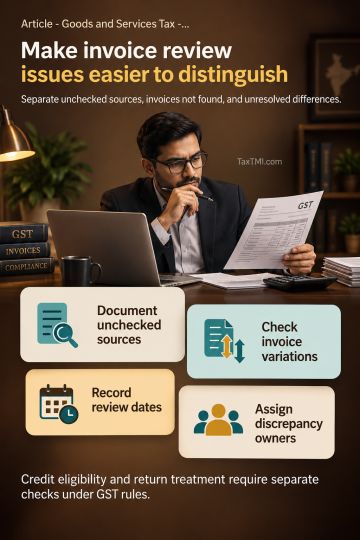
GSTR-2B exception reviews distinguish unchecked sources, invoices not found and unresolved differences, with separate verification of input tax credit eligibility.
Where source coverage has not been confirmed, reviewers should record the relevant business or GSTIN, period and required source; an incomplete review does not establish supplier reporting failure. Once an input has been compared, reviewers should retain its reference and review date, identify invoice fields searched, and consider reference variations or competing candidates. Where supporting records exist but a discrepancy remains open, reviewers should identify the differing field, evidence examined and confirmation needed, and assign the next step to an owner. These descriptions are suggested review language, not statutory classifications or product tab names; input tax credit eligibility and return treatment require separate verification under applicable GST rules. (AI Summary)

"Missing" can mean several different things in a reconciliation discussion. A source has not been checked, an invoice was not found in the checked data, or a difference remains unexplained. Giving each situation a clearer description helps the next reviewer act on the evidence.

1. Not yet checked

Use this when the relevant source or its coverage has not been confirmed. Record which business/GSTIN, period and source are required. An incomplete review does not establish a supplier reporting failure.

2. Not found in the checked input

Use this after identifying the specific input and carrying out the comparison. Preserve the source reference and review date. Explain which invoice fields were searched and whether possible reference variations or competing candidates still need investigation.

This wording describes the evidence available at that point. It avoids turning a limited comparison into a wider claim about every filing period or source.

3. Difference remains unresolved

Use this where supporting records exist but a question is still open. Identify the field that differs, the evidence already examined and the confirmation needed. Give the next step an owner.

A small example

Hypothetical: invoice KT-082 is in the purchase register, but the statement required for the review has not yet been attached. "Not yet checked" describes the position more accurately than "supplier has not reported it."

After the appropriate input is obtained and reviewed, the note can be updated with the actual finding. If a possible counterpart exists but the invoice reference differs, preserve both originals and document the remaining question.

Make the handover useful

Before sending a supplier reminder or closing an exception, ask: what have we actually established, which source supports it, and what decision comes next?

These phrases are suggested team-review wording, not statutory classifications or product tab names. Reconciliation findings support review; ITC eligibility and return treatment require separate verification under applicable GST rules.

0 answers
Sort by
+ Add A New Reply
Hide

No Replies are present.

Recent Articles