 TaxTMI





 06 Nov 2026

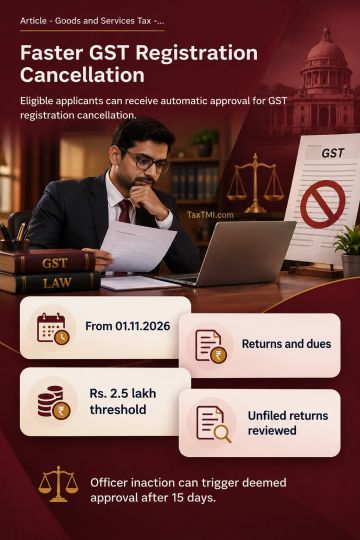
GST Registration Cancellation Moves Towards a Faster and More Transparent System
Cancellation of GST registration is an important statutory procedure for taxpayers who discontinue business, cease to be liable for registration or seek cancellation for other legally permissible reasons. However, applications filed in FORM GST REG-16 have often faced delays because of pending returns, verification requirements and prolonged departmental processing.
To simplify the procedure, the Central Government issued Notification No. 05/2026-Central Tax dated 26.10.2026, substituting Rule 20 of the CGST Rules, 2017 with effect from 01.11.2026. GSTN subsequently issued an advisory dated 01.11.2026 explaining the revised electronic approval process. The new framework introduces automated return verification, an output tax liability threshold, time-bound officer examination and safeguards against departmental inaction.
The reform seeks to ensure faster cancellation for compliant taxpayers while protecting revenue through appropriate verification. Its underlying objective is to simplify cancellation without compromising statutory compliance.
Section 29 and Rule 20 Establish the Legal Foundation for Cancellation
Section 29(1) of the CGST Act, 2017 permits cancellation of registration on an application filed by the registered person, including legal heirs in the event of death, in specified circumstances such as discontinuance or transfer of business, changes in business constitution and cases where registration is no longer required. Cancellation initiated by the proper officer on specified statutory grounds is separately governed by Section 29(2).
Under substituted Rule 20(1), a registered person seeking cancellation must submit FORM GST REG-16 within 30 days of the event warranting cancellation. The application must disclose the prescribed particulars of inputs held in stock, inputs contained in semi-finished or finished goods and capital goods held in stock on the day immediately preceding the application date or the proposed effective date of cancellation, as applicable. Details of the related liability, payments made and supporting documents must also be furnished wherever applicable. An important exception applies following the death of a sole proprietor. The normal 30-day application deadline does not apply in such cases.
Rule 20(13) extends the cancellation procedure to the legal heirs of the deceased proprietor, with necessary modifications. This relaxation recognises the practical difficulties faced by legal heirs in identifying business records and completing statutory formalities. However, it does not waive applicable tax liabilities or other compliance obligations.
Filing of Due Returns Becomes Essential Before Applying for Cancellation
Rule 20(2) requires taxpayers to furnish all applicable returns, including statements in FORM GST CMP-08 wherever relevant, that are due on or before the application date and relate to periods ending on or before the proposed effective date of cancellation. The GST Portal will verify compliance before permitting submission of FORM GST REG-16.
A further condition applies where outward supply details have been furnished in FORM GSTR-1 or through the Invoice Furnishing Facility (IFF). In such cases, the corresponding FORM GSTR-3B must also be filed, even if its normal filing due date has not arrived. Furnishing outward supply details alone will not satisfy the prescribed validation.
Taxpayers should therefore reconcile their return-filing position before applying for cancellation. Discontinuance of business does not automatically remove the obligation to furnish applicable returns.
Pending Returns Will Be Monitored Through a Separate System Stage
Rule 20(3) addresses returns relating to the relevant period that are not yet due when the cancellation application is submitted. The taxpayer must furnish such returns, including FORM GST CMP-08 wherever applicable, within their respective prescribed due dates. The GSTN advisory introduces a system stage called "Pending for Returns Filing" to monitor these obligations.
For example, where cancellation is sought with effect from 23.11.2026, the applicable return for November may not yet be due. The application may remain pending until the relevant return becomes due and is furnished. Once the taxpayer files the required return within the prescribed timeline, the application proceeds for further processing.
However, failure to furnish the required returns within their due dates will result in assignment of the application to the jurisdictional tax officer. The revised procedure therefore distinguishes between returns already due and those becoming due subsequently.
Registration Will Remain Suspended During Cancellation Proceedings
Under Rule 20(4), registration stands suspended upon submission of the cancellation application until completion of the proceedings. Suspension is an interim arrangement, whereas cancellation terminates registration from the effective date determined under the law.
During suspension, the taxpayer must observe the restrictions prescribed under the GST framework. However, suspension does not extinguish liabilities relating to earlier transactions or the return-filing obligations applicable during cancellation proceedings.
This arrangement provides an orderly transition from active registration to cancellation while preventing unnecessary continuation of normal taxable activities during the intervening period.
Automatic Cancellation Will Depend on Timely Compliance and Payment of Dues
Rule 20(5) permits electronic cancellation without intervention by the jurisdictional tax officer when the prescribed conditions are met. These include timely filing of applicable returns, payment of outstanding tax, interest, fees, penalties, and other payable amounts, and satisfaction of either the specified output tax liability condition or the alternative FORM GSTR-10 requirement.
Once these conditions are fulfilled, registration is cancelled electronically with effect from the date sought by the taxpayer. The cancellation is communicated through FORM GST REG-38.
This represents an important procedural improvement. However, automatic cancellation does not amount to a waiver of outstanding liabilities. Filing returns alone is insufficient where statutory dues remain unpaid. Taxpayers should therefore reconcile their electronic liability and payment records before seeking cancellation.
The Rs. 2.5 Lakh Threshold Applies Specifically to B2B Output Tax Liability
Rule 20(5)(a) prescribes an important monetary condition for electronic cancellation. The relevant output tax liability must not exceed Rs. 2.5 lakh in any month from the date of registration until submission of the cancellation application.
The liability comprises CGST, SGST or UTGST, IGST and Compensation Cess declared in FORM GSTR-1, as amended through FORM GSTR-1A wherever applicable, or through IFF, in respect of supplies made to registered persons. Consequently, the ceiling is not based on total turnover or the entire output tax liability arising from both B2B and B2C supplies.
The examination period is equally important. The threshold applies throughout the relevant registration period, not merely during the months immediately preceding cancellation. If the specified B2B liability exceeds Rs. 2.5 lakh in even one month, the taxpayer cannot qualify through this monetary condition. However, the alternative FORM GSTR-10 route may remain available.
Practical Illustrations Explain the Application of the Monetary Ceiling
The following illustrations explain Rule 20(5)(a), assuming that all other prescribed conditions are satisfied.
| Particulars | Illustration 1 | Illustration 2 |
| Highest monthly B2B output tax liability during the relevant period | Rs. 2,20,000 | Rs. 2,80,000 |
| B2C output tax liability during that month | Rs. 3,40,000 | Rs. 90,000 |
| Total output tax liability for that month | Rs. 5,60,000 | Rs. 3,70,000 |
| Prescribed B2B liability ceiling | Rs. 2,50,000 | Rs. 2,50,000 |
| Eligibility under Rule 20(5)(a) | Eligible | Not eligible |
Illustration 1: M/s Anish Ltd. has a highest monthly B2B output tax liability of Rs. 2.20 lakh during the relevant registration period. Although its total output tax liability for that month is Rs. 5.60 lakh, it satisfies the monetary condition because the specified B2B liability remains within Rs. 2.5 lakh.
Illustration 2: M/s Shreyans Ltd. recorded B2B output tax liability of Rs. 2.80 lakh in one month, although its liability remained below Rs. 2.5 lakh in subsequent months. It does not satisfy Rule 20(5)(a), because the ceiling was exceeded in one month. Nevertheless, electronic cancellation may be available through the alternative FORM GSTR-10 procedure.
The essential principle is that the Rs. 2.5 lakh ceiling applies to the specified monthly B2B output tax liability for the entire relevant registration period, not to total turnover or aggregate output tax liability.
Filing FORM GSTR-10 Within Three Days Provides an Alternative Route
Rule 20(5)(b) provides an alternative route for electronic cancellation where the monetary condition is not satisfied. Under this provision, the taxpayer may obtain electronic approval by furnishing FORM GSTR-10 within three days from the due date of furnishing the returns referred to in Rule 20(3), wherever applicable.
The GSTN advisory explains how this requirement operates through the "Pending for Returns Filing" and "Pending for Final Return" stages. Where returns under Rule 20(3) are pending, the three-day period is calculated from their applicable due date. Where no such returns are pending, the advisory provides for computation from the date of submission of the cancellation application. Failure to furnish FORM GSTR-10 within the applicable period results in forwarding of the application for officer-level examination rather than automatic rejection.
The special three-day condition must be distinguished from the ordinary statutory period under Section 45, which generally permits furnishing the final return within three months from the date of cancellation or the cancellation order, whichever is later. The shorter period concerns eligibility for automated approval and should not be described as a general replacement of Section 45. Its interaction with the ordinary final-return framework requires careful portal implementation.
Officer-Level Examination Will Continue Where Automated Conditions Are Not Satisfied
Under Rule 20(6), where the prescribed returns or statements in FORM GST CMP-08 referred to in Rule 20(3), or FORM GSTR-10 under the alternative approval procedure, have not been furnished, or outstanding tax, interest, fee, penalty or other payable amounts remain unpaid, the application is forwarded to the proper officer for examination. Failure to qualify for automated cancellation does not, by itself, amount to rejection of the application. The taxpayer continues to have an opportunity to obtain cancellation through officer-level processing.
Under Rule 20(7), the proper officer must examine the application within 15 days from the date of receipt of the application forwarded under Rule 20(6). Where it is found in order, cancellation is approved through FORM GST REG-19. Where the application is deficient, the officer may issue a notice in FORM GST REG-03 within the same period. Under Rule 20(8), the taxpayer must furnish the required returns, clarification, information or documents in FORM GST REG-04 within 15 days of receiving the notice.
Rules 20(9), 20(10) and 20 (11) prescribe three possible outcomes. A satisfactory reply may result in approval through FORM GST REG-19 within 15 days of its receipt. An unsatisfactory reply may lead to rejection through FORM GST REG-05 within the same period. However, failure to furnish any reply within the prescribed 15 days results in deemed rejection, communicated through FORM GST REG-05A. Thus, rejection after examining an unsatisfactory reply and deemed rejection for failure to reply are legally distinct situations.
Deemed Approval Protects Taxpayers Against Departmental Inaction
Rule 20(12) introduces an important safeguard against prolonged departmental delays. Where an application has been forwarded to the proper officer and no action is taken within 15 days of its receipt, cancellation is deemed approved.
Similarly, where the taxpayer furnishes a reply to a deficiency notice and the officer fails to act within 15 days of receiving that reply, deemed approval applies. The approval is communicated electronically through FORM GST REG-19.
The distinction between the two mechanisms is important. Rule 20(5) provides direct electronic cancellation through FORM GST REG-38, whereas Rule 20(12) provides deemed approval following officer-level processing through FORM GST REG-19. Both mechanisms seek to prevent genuine applications from remaining pending indefinitely.
Changing the Effective Date of Cancellation Requires a Fair and Time-Bound Procedure
Rules 20(14) and 20(15) provide for reconsideration of the effective date after registration has been cancelled. Where the proper officer has reasons to believe that cancellation should take effect from an earlier date, a show cause notice may be issued in FORM GST REG-34. The taxpayer may reply in FORM GST REG-35 within 30 days from receipt of the notice, explaining why the proposed change is unjustified.
An important drafting point deserves attention. Rule 20(14) refers to Section 29(3) while providing for reconsideration of the effective date. Since Section 29(3) principally preserves earlier liabilities and obligations notwithstanding cancellation, the statutory reference requires careful reading. The article therefore follows the express procedural language of Rule 20 without treating Section 29(3) as an independent source of power to retrospectively alter the cancellation date.
Rules 20(16) and 20(17) prescribe the consequences of examining the reply. Where the explanation is satisfactory, the officer must drop the proceedings through FORM GST REG-36 within 30 days of receiving the reply. Where it is unsatisfactory, the officer may change the effective date through FORM GST REG-37 within the same period. However, Rule 20(18) separately provides that where no reply is furnished within 30 days from issuance of the notice, the officer may change the effective date through FORM GST REG-37 within 60 days from issuance. The distinction between receipt under Rule 20(15) and issuance under Rule 20(18) deserves attention.
Rules 20(19) and 20(20) introduce two safeguards. Where the officer fails to issue an order within 60 days from issuance of the notice, the proceedings are deemed dropped, and the result is communicated through FORM GST REG-36. Further, once the effective date has been changed under Rule 20, it cannot be changed again under that rule. This provides finality and prevents repeated changes through the same procedure.
Different Commencement Dates Must Be Carefully Distinguished
Notification No. 05/2026-Central Tax introduces several changes with different effective dates.
| Relevant amendment | Effective date |
| Substitution of Rule 20 governing cancellation applications | 01.11.2026 |
| Electronic cancellation through FORM GST REG-38 | 01.11.2026 |
| Amendments to FORM GST REG-16 | 01.12.2026 |
| Related amendments to Rule 44 concerning cancellation particulars | 01.12.2026 |
| Introduction of FORMS GST REG-34 to REG-37 | 01.04.2027 |
The revised FORM GST REG-16 rationalises cancellation particulars, including reasons for cancellation, relevant returns, stock and related liabilities. The related amendments to Rule 44 also take effect from 01.12.2026. Taxpayers should therefore distinguish commencement of the revised legal procedure from implementation of the amended forms and connected provisions.
CBIC Circular No. 257/03/2026-GST dated 26.10.2026 primarily concerns documentary requirements and verification of new registration applications in FORM GST REG-01. It does not specifically prescribe the revised cancellation procedure. Accordingly, Notification No. 05/2026-Central Tax, substituted Rule 20 and the GSTN advisory dated 01.11.2026 remain the principal authorities on this subject.
Cancellation Does Not Extinguish Earlier Tax Liabilities
Section 29(3) expressly provides that cancellation does not affect liability to pay tax or discharge other obligations relating to periods before cancellation, whether determined before or after the cancellation date.
Further, Section 29(5) requires payment of the prescribed amount in respect of input tax credit on stock, semi-finished goods, finished goods and capital goods or plant and machinery, subject to the statutory computation.
Therefore, electronic cancellation should not be mistaken for final settlement or waiver of past liabilities. Taxpayers must preserve relevant records, discharge applicable dues and remain prepared to respond to lawful proceedings concerning earlier periods.
Faster Cancellation Must Be Supported by Compliance and Fair Implementation
The substituted Rule 20 represents a significant step towards simplifying GST registration cancellation through automated verification, electronic approval and time-bound departmental examination. The introduction of deemed approval also protects taxpayers against unnecessary administrative delays.
However, faster cancellation does not dispense with statutory obligations. Taxpayers must ensure timely filing of applicable returns, payment of outstanding dues and accurate disclosure of the prescribed particulars. The real success of the reform will depend upon effective portal implementation, fair departmental examination and timely disposal of genuine applications.
***