Loading...

⚠ ✕
❮ Top
☎ Help
☰
×

By creating an account you can:

Logo TaxTMI
Call Us / Help / Feedback✕

Contact Us At :

✉ E-mail: [email protected]

✆ To Call / Whatsapp, Check Contact Us

FAQs :

To know Frequently Asked Questions, Check FAQs

Most Asked Video Tutorials :

For more tutorials, Check Video Tutorials

Submit Feedback/Suggestion :

Email :
Please provide your email address so we can follow up on your feedback.
Category :
Description :
Min 15 characters 0/2000
Make Most of Text Search ✕
  1. Checkout this video tutorial: How to search effectively on TaxTMI.
  2. Put words in double quotes for exact word search, eg: "income tax"
  3. Avoid noise words such as : 'and, of, the, a'
  4. Sort by Relevance to get the most relevant document.
  5. Press Enter to add multiple terms/multiple phrases, and then click on Search to Search.
  6. Text Search
  7. The system will try to fetch results that contains ALL your words.
  8. Once you add keywords, you'll see a new 'Search In' filter that makes your results even more precise.
  9. Text Search
╳
Add to...
You have not created any category. Kindly create one to bookmark this item!
✕
Create New Category
Hide
Title :
Description :
❮❮ Hide
❮ Default View
Expand ❯❯
Close ✕
🔎 Filters / Advanced Search ❯
TEXT

Press 'Enter' to add multiple search terms. Rules for Better Search

Search In
Main Text + AI Text ❯
  • Main Text
  • Main Text + AI Text
  • AI Text
Law:
---- All Laws---- ❯
  • ---- All Laws----
  • Benami Property
  • Bill
  • Central Excise
  • Companies Law
  • Customs
  • DGFT
  • FEMA
  • GST
  • GST - States
  • IBC
  • Income Tax
  • Indian Laws
  • Money Laundering
  • SEBI
  • SEZ
  • Service Tax
  • VAT / Sales Tax
Types:
---- All Types ---- ❯
  • ---- All Types ----
  • Act Rules
  • Case Laws
  • Circulars
  • Manuals
  • News
  • Notifications
Sort By: ?
In Sort By 'Default', exact matches for text search are shown at the top, followed by the remaining results in their regular order.
Relevance Default Date
☰   Show Results ❯
    Export of Principal-to-Principal Support and Software Development Services under the IGST Act
    Refund of Unutilised Input Tax Credit by SEZ Units under Section 54 and Rule 89
    Case Laws Customs
    Private Bonded Warehouse Licence: Penalty-Based Disqualification under Regulation 3(2)(c)
    Refund of Accumulated Compensation Cess on Zero-Rated Supplies under Section 54 and Rule 89
    Penalty for Wrongful Availment of Input Tax Credit: The Distinction Between Sections 73 and 74
    Input Tax Credit on Resort Construction After Retrospective Substitution in Section 17(5)(d): Except...
    Shareholder Locus Standi under Section 61 in Challenges to Resolution-Plan Approval
    GSTR-2A Mismatch, Supplier Certification (of tax payment) and the Burden of Proving Input Tax Credit...
    Concessional GST on Works Contracts for Co-operative Spinning Mills: Government Entity Status and Pr...
    Case Laws Customs
    Abetment and Knowing Use of False Import Documents under Sections 112(a) and 114AA
    Subcontracted Services on Own Account and the Intermediary Exclusion under Section 2(13)
    Case Laws Customs
    Classification of Two-Ton Ductless Split Air Conditioners under Tariff Item 8415 82 10
    Case Laws Income Tax
    Transfer Pricing of Pre-Conversion Interest on Compulsorily Convertible Debentures
    Case Laws Customs
    Clubbing of Contrived Split Consignments under Rule 2(a) and Valuation of a Dismantled Motorcycle
    GST on Corporate Guarantees: Substantive Liability, Deemed Valuation and Judicial Relief
    Case Laws Income Tax
    Employee Secondment under the India-USA DTAA: Employment Rights, Reimbursements and Included Service...
    Pre-deposit Under Section 112 and Independent Compliance with Tribunal Filing Fees
    Case Laws Income Tax
    TDS on Interest Paid by Co-operative Banks to Non-Member Co-operative Societies under Section 194A(3...
    Input Tax Credit and Supplier Non-Payment: Statutory Limits on Mechanical Reversal Under Section 16(...
    Case Laws Customs
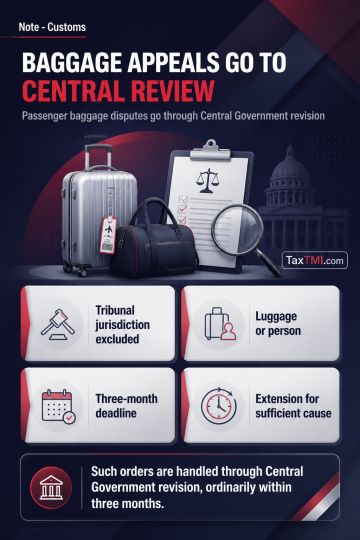
    Appellate Jurisdiction over Goods Imported as Baggage under Sections 129A and 129DD of the Customs A...
❮
❯
❯❯
Maximize Maximize Maximize
0 / 200
Expand Note
Add to Folder

No Folders have been created

+

Are you sure you want to delete "My most important" ?

NOTE:

Notes
Showing Results for :
Reset Filters
Results Found:
Show All Summaries Hide All Summaries
Case Laws GST
Show AI Summary
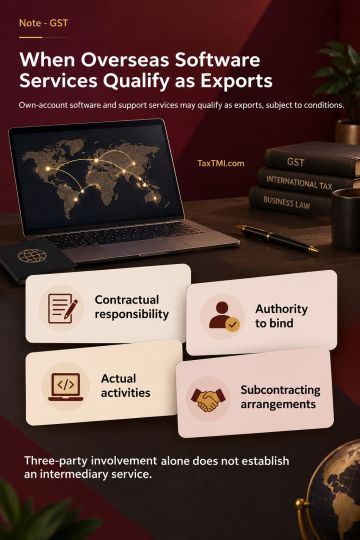
Principal-to-principal software development and support services may qualify as exports when supplied on own account and statutory conditions are satisfied.
Principal-to-principal software development and business support for overseas group entities are distinguished from intermediary services by examining the supply actually undertaken. Intermediation requires a separate service of arranging or facilitating a main supply between two other persons; the presence of three parties or benefits to end customers is insufficient. Development, sourcing assistance and call-centre or product support may be own-account services when the supplier is responsible for performing the work rather than arranging another person's supply. Contractual responsibility, authority to bind the overseas entity, actual activities and subcontracting arrangements are relevant. Cost-plus payment and an independent-contractor label are indicators, not conclusive tests; neither third-party contact nor group ownership alone determines classification.
Case Laws GST
Show AI Summary
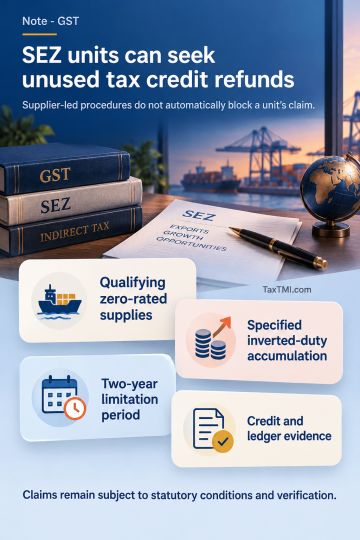
SEZ refund eligibility extends to unutilised input tax credit despite supplier-specific procedures, subject to statutory conditions and verification.
SEZ units are not categorically excluded from claiming refunds of unutilised input tax credit merely because Rule 89 prescribes a supplier-led procedure for supplies to SEZs. That procedure governs the supplier's claim for the relevant inward supply; it does not exclude a unit's own claim under the statutory refund framework. Section 54 of the CGST Act permits registered persons to claim refunds of unutilised credit subject to substantive conditions, including those governing zero-rated supplies made without payment of tax and specified inverted-duty accumulation. Refund applications must identify the applicable statutory basis, relevant date and two-year limitation period, and support the claim with evidence of qualifying supplies, credit sources, ledger balances and computation.
Case Laws Customs
Show AI Summary
Warehouse licensing disqualification requires more than a prior customs monetary penalty and depends on offence-based eligibility criteria.
Penalisation for an offence under Regulation 3(2)(c) is not established merely by the existence of a customs monetary penalty. The legal basis and character of the earlier proceedings must be examined against the distinction between adjudicatory penalties and the offences-and-prosecutions framework. The absence of conviction alone does not resolve every disqualification ground. Antecedent verification follows a centralised process, while a favourable eligibility assessment must be followed by the insurance, undertaking, indemnity and warehouse-keeper requirements under Regulation 4.
Case Laws GST
Show AI Summary
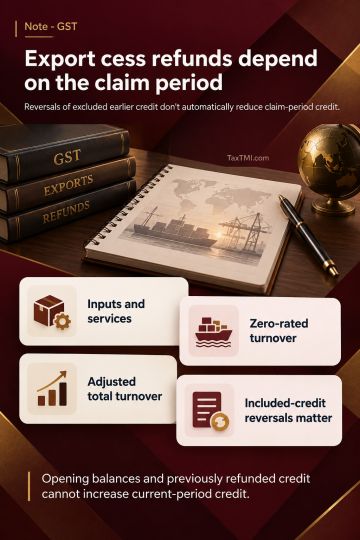
Compensation cess refunds on exports depend on period-specific credit attribution, not automatic deductions for unrelated earlier-period reversals.
Under Rule 89(4), the refund formula applies Net ITC to zero-rated turnover and adjusted total turnover. Period-specific Net ITC depends on credit availed on inputs and input services during the period for which the claim is filed. A reversal reported during that period does not automatically reduce Net ITC if it relates to residual earlier-period credit excluded from the current computation. Reversals affecting credit included in the computation remain relevant, and opening balances or previously refunded credit cannot be added to current-period Net ITC.
Case Laws GST
Show AI Summary
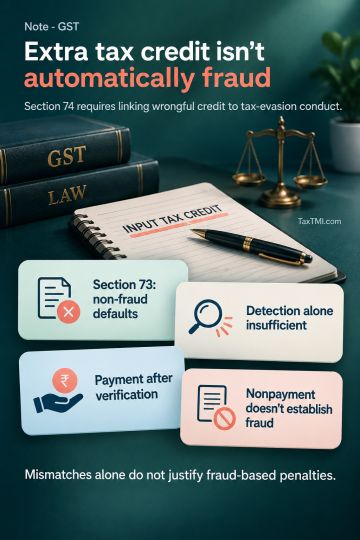
Input tax credit mismatches alone do not justify fraud-based penalties, even when excess credit is paid after verification.
Section 74 requires a factual connection between the wrongful credit and fraud, wilful misstatement or suppression of facts to evade tax; a mismatch or eligibility failure alone does not establish that connection. Section 73 covers defaults without those elements. Departmental detection, an admission of excess credit and payment after verification do not by themselves establish why the excess arose or prove the conduct necessary for Section 74. Failure to pay the pre-notice penalty cannot itself establish the fraud-related basis for Section 74.
Case Laws GST
Show AI Summary
Resort construction credit depends on immovability, own-account use, and the statutory distinction between buildings and plant and machinery.
Input tax credit on resort construction is subject to the blocked-credit restriction for goods and services received to construct immovable property on a taxable person's own account, including property used in the course or furtherance of business. The general business-use entitlement under section 16 does not displace this restriction in section 17(5)(d). The Finance Act, 2025 retrospectively substituted plant and machinery for "plant or machinery" from 1 July 2017, with the relevant provision commencing on 1 October 2025. The defined expression covers apparatus, equipment and machinery fixed to the earth by foundation or structural support and used for making outward supplies, including those foundations and supports. It excludes land, buildings and other civil structures, telecommunication towers and pipelines laid outside factory premises.
Case Laws IBC
Show AI Summary
Shareholder standing in insolvency appeals depends on legal capacity, not merely allegations of fraudulent changes to creditor-approved plans.
Individual shareholder standing to appeal against approval of a resolution plan is distinct from the legality of the plan itself. Under Section 61(1) of the Insolvency and Bankruptcy Code, 2016, an appellant must qualify as a person aggrieved. The applicable judicial interpretation restricts an appeal pursued exclusively in an individual shareholder capacity, even where equity interests are affected. Section 61(3) separately specifies permissible grounds of challenge: a plan's contravention of law and material irregularity in the resolution professional's exercise of powers are distinct grounds. Pleading either ground does not itself establish standing.
Case Laws GST
Show AI Summary
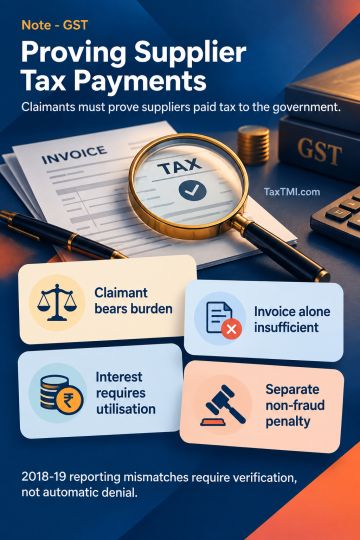
Input tax credit requires proof of supplier tax payment; reporting mismatches call for verification rather than automatic denial.
Supplier payment of tax to the Government is a condition of input tax credit eligibility under section 16(2)(c), and the claimant bears the burden of proving eligibility under section 155. Payment of the invoice and tax to the supplier, receipt of the supply and possession of an invoice do not themselves establish the supplier's remittance. For 2018-19, a GSTR-2A mismatch calls for verification and does not alone prove ineligibility. Interest under section 50(3) requires credit to have been both wrongly availed and utilised; its calculation follows Rule 88B(3). Non-fraud penalty operates under a separate statutory trigger and is not automatically excluded by the absence of fraud or utilisation.
Case Laws GST
Show AI Summary
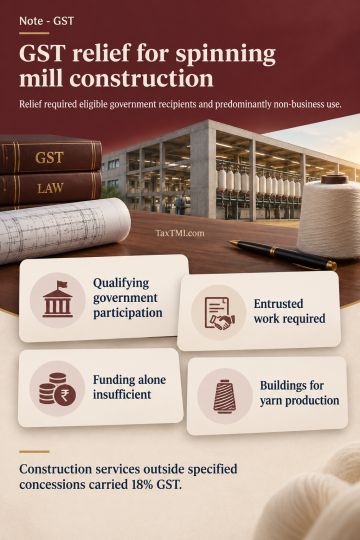
Non-business construction concessions for spinning mills require eligible recipient status and predominantly non-industrial use of the constructed buildings.
For the disputed period, the works-contract concession required both an eligible governmental recipient and structures predominantly meant for use other than commerce, industry, business or profession. Government Entity status required evidence of the recipient's constitution and qualifying governmental participation, while procurement had to relate to entrusted work. Project funding, tender approval and supervision did not by themselves establish governmental constitution or control. The spinning-mill factory buildings and allied works were intended for yarn production and related commercial activities. The residual construction-services entry carried aggregate GST of 18% for services outside the specified concessional entries.
Case Laws Customs
Show AI Summary
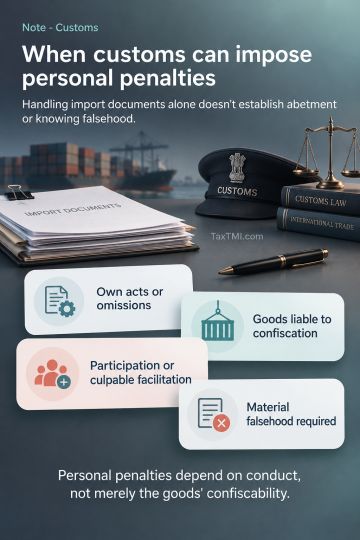
Import document handling alone does not establish customs abetment or knowing use of materially false declarations.
Personal customs penalties depend on the person's own conduct, not merely on the confiscability of imported goods. Under Section 112(a) of the Customs Act, 1962, liability may arise from a person's own act or omission rendering goods liable to confiscation or from abetment of such conduct. The direct limb can operate on a strict-liability basis where a person's own act or omission renders goods confiscable; an allegation of abetment instead requires evidence of participation or culpable facilitation. Section 114AA requires knowing or intentional making, signing or use, or causing the making, signing or use, of a declaration, statement or document that is materially false or incorrect in customs business.
Case Laws GST
Show AI Summary
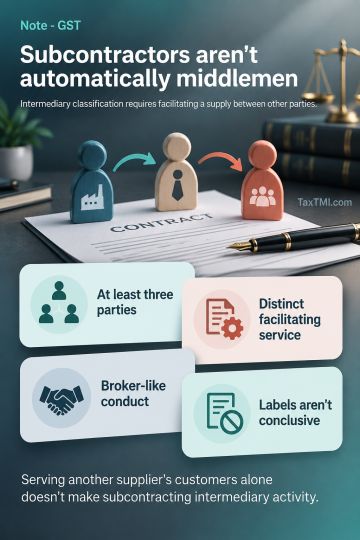
Subcontracted services performed on own account are not intermediary services merely because they support overseas recruitment and customer-facing activities.
Intermediary classification under Section 2(13) of the IGST Act distinguishes arranging or facilitating supplies between other persons from supplying services on one's own account. The intermediary framework requires at least three parties, a main supply and a distinct ancillary facilitating supply, with conduct resembling that of a broker or agent. Subcontracting the whole or part of a service is not intermediary activity merely because performance supports another supplier's business or involves its customers. Neither a bilateral agreement, contractual label nor remuneration method is conclusive.
Case Laws Customs
Show AI Summary
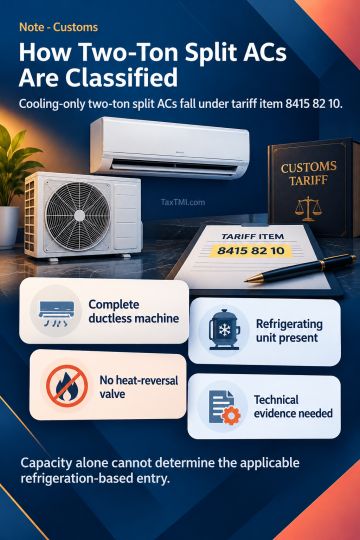
Split air conditioner classification requires capacity and refrigeration features to be assessed against the applicable tariff hierarchy.
Classification of ductless split air conditioners depends on the complete tariff description and the machine's technical characteristics. A complete, cooling-only, two-ton split air conditioner incorporating a refrigerating unit and lacking a heat-reversal valve falls within tariff item 8415 82 10 rather than the general split-system item 8415 10 10. Item 8415 82 10 inherits its parent subheading's refrigerating-unit requirement, while item 8415 83 10 requires the absence of such a unit. Capacity alone does not establish the applicable refrigeration-based entry. Technical evidence should establish whether the goods are a complete machine and identify their capacity and operating features.
Case Laws Income Tax
Show AI Summary
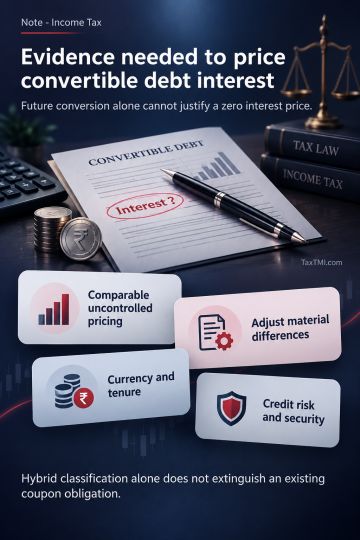
Convertible debenture interest requires evidence-based pricing before conversion; future equity conversion alone cannot establish a nil arm's length price.
Pre-conversion interest on compulsorily convertible debentures (CCDs) issued to a non-resident associated enterprise requires arm's length pricing. Compulsory future conversion and hybrid classification do not, by themselves, establish a nil price or extinguish an existing coupon obligation. Rule 10AB's Other Method requires a price charged, paid or expected in comparable uncontrolled circumstances, with reasonably accurate adjustments for material differences under Rule 10B. Currency, benchmark date, tenure, credit risk, security, non-redemption and conversion benefits affect comparability; a conventional bank lending rate is not automatically comparable to a long-tenor CCD.
Case Laws Customs
Show AI Summary
Split motorcycle consignments require evidence of deliberate fragmentation for composite classification, with valuation assessed independently of classification.
Clubbing of split consignments for customs classification depends on proof that apparently separate imports form one deliberately fragmented transaction, not merely on the possibility of assembly. Rule 2(a) extends a tariff heading to an incomplete article possessing the essential character of the complete article and also covers a complete article presented disassembled. A change of tariff heading alone does not establish that the transaction value is inaccurate; substantive misdescription of the goods requires separate evidentiary consideration. Replacement value must follow the prescribed sequence of methods.
Case Laws GST
Show AI Summary
Corporate guarantee taxation depends on distinguishing taxable supply from valuation, particularly for unpaid support between related businesses.
GST on corporate guarantees requires separate consideration of whether a taxable supply exists and how that supply is valued. Section 7(1)(c) and Schedule I encompass qualifying supplies between related or distinct persons without consideration when made in the course or furtherance of business. Rule 28(2) deems the value of a guarantee furnished to a banking company or financial institution for a related recipient in India to be one per cent of the guaranteed amount per annum or actual consideration, whichever is higher. Where the recipient is eligible for full input tax credit, the proviso treats the value declared in the invoice as the value of the supply.
Case Laws Income Tax
Show AI Summary
Employee secondment taxation depends on employment rights, service consideration and demonstrable transfer of technical capability to host entities.
Local operational control and a stated suspension of foreign employment do not, by themselves, resolve whether underlying foreign employment rights survive. Under Article 12(4)(b) of the India-USA DTAA, technical or consultancy services must make technical knowledge, experience, skill, know-how or processes available, or involve development and transfer of a technical plan or design. Under the knowledge-transfer limb, the recipient must acquire a capability it can use independently; the mere application of expertise or presence of qualified personnel is insufficient. Recovery at actual cost and absence of markup do not, by themselves, establish that a foreign enterprise's receipt is non-taxable.
Case Laws GST
Show AI Summary
GST appellate pre-deposits may be satisfied by verified earlier payments after demand reduction, but filing fees remain independently payable.
When the first appellate authority substantially reduces the disputed tax demand, an earlier deposit may be sufficient to satisfy the Tribunal-stage requirement, subject to verification. Sufficiency depends on the reduced liability, the applicable appellate requirements and the amount actually deposited; a first appellate payment does not automatically eliminate the additional obligation. Tribunal filing fees under Section 112(7) operate independently of pre-deposit. Where a fee shortfall and earlier deposit require verification, proof of fee payment and verification of the deposit precede consideration of admission.
Case Laws Income Tax
Show AI Summary
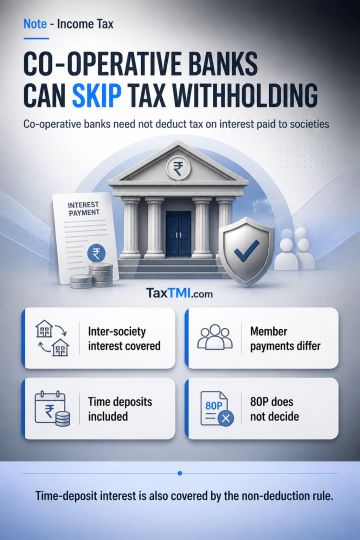
Inter-co-operative society interest exemption preserves non-deduction by co-operative banks when depositors are co-operative societies under the statutory withholding framework.
Section 194A(3)(v) separately addresses interest paid by a co-operative bank to a member and interest paid by a co-operative society to another co-operative society. The exclusion of co-operative banks is confined to the member-payment limb; a co-operative bank remains a co-operative society for the inter-co-operative society limb. Paragraph 42.7 of Circular No. 19/2015 preserves non-deduction, including time-deposit interest, where the depositor is a co-operative society. Section 80P does not determine this withholding obligation.
Case Laws GST
Show AI Summary
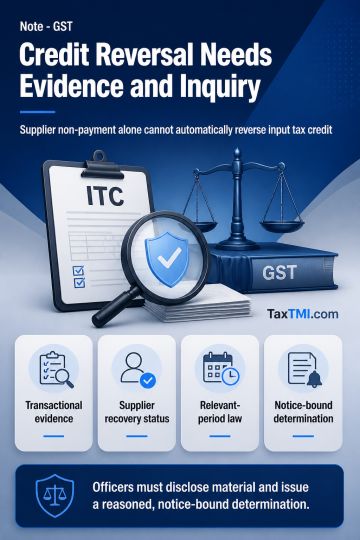
Input tax credit reversal requires evidence linking supplier non-payment to recipient ineligibility and a reasoned statutory inquiry.
Input tax credit under Section 16(2)(c) remains conditional on actual payment of tax to Government, but supplier non-payment or retrospective cancellation cannot by itself justify reversal. The recipient must establish eligibility through transactional evidence, while the proper officer must investigate the particular supply, disclose supplier-default and recovery material, apply the law applicable to the relevant period, and issue a reasoned, notice-bound determination. Supplier recovery status and protection against duplicate collection are material considerations.
Case Laws Customs
Show AI Summary
Baggage-related customs appeals proceed through statutory revision when the jurisdictional exclusion applies to passenger imports.
The first proviso to section 129A(1) excludes Appellate Tribunal jurisdiction over an order under section 128A relating to goods imported or exported as baggage. The decisive issue is the order's connection with baggage, not disputes concerning confiscation, declaration, duty, personal effects, concealment, concession, or penalty. Articles carried by an international passenger in luggage or on the person may constitute baggage. Section 129DD provides revision before the Central Government, ordinarily within three months, subject to a further period on sufficient cause.

TMI Notes

Back

All TMI Notes

Showing Results for :
Reset Filters
No Records Found

TMI Notes

Back

All TMI Notes

Export of Principal-to-Principal Support and Software Development Services under the IGST Act

26 November, 2026

Contents
Circulars
Acts
Plus +
Summary
Note

Note

-

Bookmark

(New) -

Download

Print

Print

This commentary provides doctrinal analysis and practical insights on the legal issue discussed below. The judgment is analysed in the context of its factual background, issues framed, and conclusions reached by the Court.

2026 (11) TMI 126 - GSTAT NEW DELHI

Introduction

An Indian company that develops software or performs business support for an overseas group entity does not become an intermediary merely because its work helps the overseas entity serve its customers. The classification turns on what the Indian company undertakes to supply: a service for which it is itself responsible, or the arrangement or facilitation of a separate supply between two other persons.

In 2026 (11) TMI 126 - GSTAT NEW DELHI, the Goods and Services Tax Appellate Tribunal (GSTAT) applied that distinction to contract software development and business support supplied on a cost-plus basis to overseas group entities. It held that the disputed services were supplied on a principal-to-principal basis and qualified as exports. The ruling concerns those supplies; it does not classify every service rendered by the appellant to its overseas group.

Legal & Statutory Context

Section 2(13) of the Integrated Goods and Services Tax Act, 2017 (IGST Act) defines an intermediary as "a broker, an agent or any other person, by whatever name called, who arranges or facilitates the supply of goods or services or both, or securities, between two or more persons, but does not include a person who supplies such goods or services or both or securities on his own account". The exclusion requires attention to the supply actually performed, not merely to the commercial benefit it creates for someone else.

Section 2(6) of the IGST Act imposes five cumulative conditions: the supplier must be located in India; the recipient must be located outside India; the place of supply must be outside India; payment must have been received in convertible foreign exchange or in Indian rupees wherever permitted by the Reserve Bank of India; and the supplier and recipient must not be "merely establishments of a distinct person" within Explanation 1 to Section 8. A finding that the supplier is not an intermediary does not, by itself, establish that all five conditions are met.

For a supply for consideration, Section 2(93)(a) of the Central Goods and Services Tax Act, 2017 (CGST Act) identifies the recipient as "the person who is liable to pay that consideration". The place where an end-user benefits from the work is therefore not a substitute for identifying the recipient of the particular supply. Where several establishments are involved, Section 2(14)(c) of the IGST Act identifies the recipient's location by reference to the establishment "most directly concerned with the receipt of the supply".

Section 13(1) and (2) of the IGST Act applies where the supplier or recipient is outside India. Subject to the specified exceptions, the place of supply is "the location of the recipient of services". If that location is not available in the ordinary course of business, the proviso uses the supplier's location. For the periods in dispute, former Section 13(8)(b) separately fixed the place of supply of "intermediary services" at the supplier's location. Section 157 of the Finance Act, 2026 omitted clause (b) with effect from 30 March 2026. The Tribunal decided the dispute under the rule applicable to the periods before it; the omission was not the basis on which it allowed the claims.

Section 16(1)(a) of the IGST Act treats export of services as a "zero rated supply". The appellant invoked the then-applicable Section 16(3)(a), which permitted a registered person to supply under bond or Letter of Undertaking without payment of integrated tax and claim refund of unutilised input tax credit (ITC), subject to prescribed conditions, safeguards and procedure. The claims were made under Section 54(1) of the CGST Act read with Rule 89 of the CGST Rules. The substituted Section 16(3) retains the route for claiming refund of unutilised ITC on zero-rated supplies made without payment of integrated tax under bond or Letter of Undertaking.

Interpretative Issues

Three parties are necessary, but their presence is not sufficient. The party alleging intermediation must identify two principals making and receiving a main supply and a distinct service by which the alleged intermediary arranges or facilitates that supply. The department identified the appellant, the overseas group entities and their end customers. That identified participants in the wider travel business, but not a distinct service by which the appellant brought about a supply between the overseas entity and a traveller, hotel or hotel operator.

The Tribunal read "any other person, by whatever name called" ejusdem generis with "broker" and "agent". It treated the appellant's inability to bind the overseas entity or undertake obligations on its behalf as an important indicator that it did not perform a comparable role. The inquiry remains functional: an independent-contractor clause is probative when the agreement and actual responsibilities support it, just as the absence of a formal agency label cannot settle the classification if the supplier in fact arranges another person's supply.

The recipient and corporate-identity inquiries are separate from the intermediary test. Explanation 1(i) to Section 8 of the IGST Act addresses a person with "an establishment in India and any other establishment outside India". Explanation 2 treats a business carried on through "a branch or an agency or a representational office" as an establishment in that territory. By contrast, Section 2(84)(c) and (h) of the CGST Act, read with Section 2(24) of the IGST Act, recognises a company and a body corporate incorporated outside India as persons. Common ownership does not make two separately incorporated entities establishments of the same person.

Detailed Commentary & Analysis

The appellant undertook software development for the overseas group's platforms and websites and performed business support functions, including supply-sourcing support, supervision of third-party call centres and product support. The agreements permitted subcontracting under clause 3, made each party liable to the other for direct damages under clause 11.1, and expressly excluded partnership, agency and employment under clause 13.4. Read together, these clauses showed that the appellant was responsible to the overseas entities for the services it had undertaken to perform.

For software development, the service purchased was the development work itself. Its use in platforms through which overseas entities conducted business with others did not convert that work into an arrangement of those transactions. For operational support, the distinction was less obvious: sourcing assistance and supervision naturally involve work connected with third parties. But the Tribunal found no contractual privity between the appellant and the overseas entities' customers and no authority for the appellant to create obligations on behalf of the overseas entities. It regarded any assistance to their travel business as a consequence of the support supplied, not as a separate service arranging a customer transaction.

Cost-plus remuneration reinforced that analysis because it was consistent with payment for performing the contracted work. It was not conclusive. The stronger question is what earns the fee: performance of the agreed service or arranging a distinct transaction between other parties. In the same way, permission to subcontract is consistent with an own-account supply where the appellant remains responsible for delivery. It would be a different case if the appellant undertook only to find a provider and arrange for that provider to supply the service directly to the overseas entity.

With former Section 13(8)(b) inapplicable to the disputed services, the place of supply followed the location of the overseas recipient. The Tribunal also found that the payment condition was met and rejected the department's contention that the appellant and the overseas entities were merely establishments of a distinct person. The finding of export thus rested on satisfaction of Section 2(6), not just on rejection of the intermediary classification.

Judicial / Administrative Perspective

CBIC Circular No. 159/15/2021-GST distinguishes a "main supply, between the two principals" from the "ancillary supply" of arranging or facilitating it. The first appellate authority relied on Illustration 1, in which a person identifies a buyer and helps finalise a machine sale. Illustration 2 is closer to the software work in dispute: a subcontractor that designs and develops a software module supplies that work on its own account, even if it needs to speak to the ultimate client. Illustration 4 makes the same distinction for outsourced customer care. Paragraph 5 cautions that the illustrations are indicative; neither software nor support attracts an automatic classification.

CBIC Circular No. 161/17/2021-GST addresses the separate condition in Section 2(6)(v). It clarifies that an Indian-incorporated subsidiary and a body corporate incorporated abroad are separate persons, unlike a company and its own overseas branch. The clarification removes the distinct-establishment objection in the former case; it does not dispense with the other export conditions.

The Tribunal treated the intermediary circular and the conclusions of a service-tax investigation concerning the appellant as corroborative, not binding on its adjudication. The investigation had distinguished among service lines rather than treating all group services alike. In discussing that investigation, the Tribunal expressly treated human-resource support and the identified lodging and marketing support streams as outside the dispute. Its ruling therefore should not be extended to those streams.

The Tribunal's earlier ruling on education support applied the same distinction to an Indian contractor that performed services for an overseas entity without authority to bind it. Its relevance here is that a subcontractor may perform a substantive service for the contracting recipient even when the work contributes to that recipient's wider business. In the separate chemical-sector ruling discussed by the Tribunal, the emphasis was on reading the residual words "any other person" in light of the agency or brokerage characteristics that precede them. That reasoning informed the weight given here to the absence of representative authority.

The education-consultancy judgment discussed by the Tribunal provides a further comparison. Assistance to prospective students, and payment described as commission, did not establish intermediation where overseas universities contracted and paid for the work and the supplier could neither bind them nor guarantee admission. The earlier recruitment-support judgment discussed there likewise distinguished incidental assistance to students from services owed to the universities. A separate university-referral judgment reached the same result where recommendations did not make students the recipients and refund remained subject to receipt of foreign currency. These decisions reinforce the distinction between a contractual recipient and an incidental beneficiary.

In 2025 (5) TMI 2139 - KARNATAKA HIGH COURT, the High Court treated market surveys, factory monitoring and shipment tracking as independent buying-support services. The supplier acted in its own name and could not bind the overseas recipient. The decision is particularly relevant to sourcing support: interacting with vendors and assisting a purchaser's commercial decisions are not, without more, the arrangement of a supply between purchaser and vendor.

In 2024 (8) TMI 1663 - KARNATAKA HIGH COURT, the High Court found that software development, support and project management were performed on the supplier's own account. It also rejected a separate objection to realisation of export proceeds because remittance advices, electronic bank realisation certificates and corroborative records established receipt despite discrepancies in the paperwork. The two findings illustrate distinct evidentiary tasks: proving who performed the substantive service and proving receipt of consideration for it.

In 2025 (6) TMI 88 - KARNATAKA HIGH COURT, the High Court examined a master services agreement for software development and found that the supplier performed directly for the overseas recipient on a cost-plus basis, without representing it in third-party dealings. The independent-contractor clause mattered because the scope of work and payment terms supported it. The court set aside the appellate reversal and restored the refund sanction for the periods at issue.

In 2025 (1) TMI 583 - GUJARAT HIGH COURT, the agreement covered organising consultations and meetings as well as substantive advisory and business support. The High Court considered the scope of work as a whole rather than treating coordination as decisive. Direct cost-plus payment and the Indian company's separate identity supported the finding that it rendered its own services to the overseas parent. The court directed that the refund claim be processed on that basis.

In 2025 (5) TMI 729 - BOMBAY HIGH COURT, the High Court found that periodic renewal of an education-support agreement did not distinguish an earlier, final service-tax ruling where the scope of services remained unchanged. The case shows why a comparison across tax regimes must establish continuity of both the legal test and the actual work. It also illustrates that a fee linked to a percentage does not displace the contractual and functional inquiry.

In 2022 (8) TMI 874 - CESTAT CHANDIGARH, backend maintenance and account creation were services performed for an overseas client, not liaison services arranging dealings with that client's customers. Applying the own-account distinction in Rule 2(f) of the Place of Provision of Services Rules, 2012 and the recipient-location rule in Rule 3, the tribunal found an export under Rule 6A of the Service Tax Rules, 1994. It remitted the Rule 5 Cenvat credit claims for computation. The classification reasoning is useful under GST; the remedy under the former refund mechanism should not be imported into the GST framework.

In 2025 (8) TMI 938 - Supreme Court, the Supreme Court declined to disturb non-perverse findings under the service-tax export rules. The contractual recipient, invoicing and receipt of foreign exchange supported the findings notwithstanding performance in India or benefit to Indian end-users. The decision is relevant to the distinction between recipient and beneficiary, but does not replace the express place-of-supply and payment conditions under the IGST Act.

Implications & Observations

For classification and refund purposes, each service line should be capable of being traced from the agreement to the actual work, invoice and remittance. Statements of work, delivery or acceptance records and provisions governing subcontracting and third-party authority help establish what the supplier undertook to perform. Where Rule 89(2)(c) is engaged, the correlation between export invoices and the relevant bank realisation or inward remittance evidence addresses the separate requirement of receipt. An intercompany invoice or a cost-plus clause cannot establish all of these matters by itself.

The forum also followed from the classification issue. Section 2(86) of the CGST Act refers the meaning of "place of supply" to Chapter V of the IGST Act. The first proviso to Section 109(5) of the CGST Act reserves cases in which "any one of the issues involved relates to the place of supply" to the Principal Bench. For the disputed periods, classification determined whether the supplier-location or recipient-location rule applied. The Tribunal therefore rejected the objection that the appeals concerned only classification or refund.

In one claim, the authorities also relied on alleged remittance mismatches, invoices not reflected in GSTR-2A and lack of input nexus without identifying the discrepancies with sufficient particularity. The Tribunal found that the rejection travelled beyond the notice and violated natural justice. It set aside the rejection orders and directed refund of the unutilised ITC with interest under Section 56 of the CGST Act. The decision does not dispense with documentary requirements; it requires an intelligible notice and reasoned findings if an alleged defect is to justify rejection.

Concluding Remarks

The controlling distinction is between performing a service for an overseas recipient and arranging a separate supply between that recipient and another person. Contract software development and business support fall on the own-account side where the Indian supplier undertakes and performs the work as principal. Export treatment then depends on proving the remaining conditions of Section 2(6), under the place-of-supply rules applicable to the relevant period. Neither group ownership, third-party contact nor the method of remuneration answers those questions on its own.


Full Text:

2026 (11) TMI 126 - GSTAT NEW DELHI

Topics

Acts Income Tax