 TaxTMI
Login

Login
Loading...
Press 'Enter' to add multiple search terms. Rules for Better Search

Press 'Enter' after typing page number.
Press 'Enter' after typing page number.


No Folders have been created
Are you sure you want to delete "My most important" ?
NOTE:
Press 'Enter' after typing page number.















Press 'Enter' after typing page number.

All TMI Notes
Press 'Enter' after typing page number.
Press 'Enter' after typing page number.
All TMI Notes

Note

Bookmark

Share


Download

This commentary provides doctrinal analysis and practical insights on the legal issue discussed below. The judgment is analysed in the context of its factual background, issues framed, and conclusions reached by the Court.
2026 (9) TMI 816 - PUNJAB AND HARYANA HIGH COURT
The jurisdictional controversy in reassessment is not merely about the electronic delivery of a notice. It concerns the legal source of authority to initiate the statutory sequence under sections 148A and 148 of the Income-tax Act, 1961. The central question is whether a jurisdictional Assessing Officer (JAO) could issue a reassessment notice once the statutory faceless framework required automated allocation, or whether that power vested exclusively in the officer selected through that mechanism.
In 2026 (9) TMI 816 - PUNJAB AND HARYANA HIGH COURT, the High Court held that notices issued by JAOs without randomised automated allocation and outside the faceless mechanism were illegal. It further declared Section 147A unconstitutional. The ruling treats automated allocation as a jurisdictional requirement, not a technical formality, and locates the issue within the broader constitutional limits on retrospective validating legislation.
The decision is particularly significant because it considers the competing JAO-versus-FAO constructions, the scope of the Section 151A scheme, the relationship between sections 130, 144B, 147, 148 and 148A, and the attempted retrospective clarification introduced by section 147A.
The starting point is the definition of an Assessing Officer. Section 2(7A) defines an "Assessing Officer" to include specified income-tax authorities vested with relevant jurisdiction by directions or orders under section 120 or another provision of the Act. The definition does not itself resolve which officer is competent for a particular statutory function; that depends upon the Act, valid directions and any governing statutory scheme.
Section 120 authorises directions for the exercise of powers and performance of functions by income-tax authorities. Section 120(5) also permits concurrent exercise of powers by two or more Assessing Officers where required for work management. Correspondingly, Section 124 provides the ordinary framework for territorial jurisdiction of an Assessing Officer. These provisions establish the general jurisdictional architecture; they do not displace a later and specific statutory requirement governing faceless allocation for reassessment.
Section 147 authorises assessment, reassessment or recomputation where income chargeable to tax has escaped assessment, subject to sections 148 to 153. Section 148A prescribes the pre-notice stage. Where the Assessing Officer has information suggesting escapement, section 148A(1) requires a show-cause notice accompanied by that information; the assessee may respond under section 148A(2); and section 148A(3) requires an order, with prior approval of the specified authority, deciding whether it is a fit case to issue a section 148 notice.
Under Section 148(1), the notice precedes assessment, reassessment or recomputation under section 147 and is expressly "subject to the provisions of section 148A". It must be accompanied by the section 148A(3) order and require a return within the specified period, which cannot be less than thirty days from the notice date and cannot exceed three months from the end of the month in which the notice is issued. Thus, sections 148A and 148 form a linked statutory sequence: the former determines whether reopening should proceed, and the latter initiates the reassessment process.
The faceless framework is anchored in Section 130, which permits a scheme for the exercise of powers, vesting of jurisdiction, transfer of cases and change of incumbency. Its stated objects include eliminating interface to the technologically feasible extent, optimising resources, and introducing team-based functioning with dynamic jurisdiction. The Faceless Jurisdiction of Income-tax Authorities Scheme, 2022 accordingly provides that the exercise of powers and vesting of jurisdiction shall be "in a faceless manner, through automated allocation", to the extent provided in the identified faceless regimes.
Section 144B makes assessment, reassessment and recomputation under section 147 faceless for covered cases. It requires the National Faceless Assessment Centre to assign a case to a specific assessment unit through an automated allocation system. Its Explanation defines that system as an algorithm for "randomised allocation of cases", using technological tools, including artificial intelligence and machine learning, to optimise resource use.
More specifically, Section 151A(1) authorises a scheme for assessment, reassessment or recomputation under section 147, issuance of notice under section 148, and conduct of enquiry, issuance of show-cause notice and passing of order under section 148A. The objectives are elimination of interface, functional specialisation and a team-based process with dynamic jurisdiction. Section 151A(2) permits exceptions, modifications or adaptations by notification for giving effect to the scheme, but its proviso states that no such direction may be issued after 31 March 2022.
The operative provision is paragraph 3 of the e-Assessment of Income Escaping Assessment Scheme, 2022. It covers assessment, reassessment or recomputation under section 147 and "issuance of notice under section 148". Both are to be through automated allocation, in accordance with the Board's risk-management strategy for notice issuance, and in a faceless manner to the stated extent. Paragraph 2 defines "automated allocation" as an algorithm for randomised allocation of cases using suitable technological tools, including artificial intelligence and machine learning.
The principal interpretative dispute arose from the phrase in paragraph 3: "in a faceless manner, to the extent provided in section 144B". The Revenue's construction was that the phrase confines facelessness to the post-notice assessment stage under section 147. On that view, the JAO may conduct section 148A proceedings and issue the section 148 notice, while the National Faceless Assessment Centre undertakes the ensuing reassessment.
The contrary construction is that paragraph 3 separately and expressly includes "issuance of notice under section 148". The phrase referring to section 144B is said to govern the manner of assessment or reassessment under section 147, not to erase the independent requirement that section 148 notices be issued through automated allocation. This construction gives independent work to both limbs of paragraph 3 and avoids treating paragraph 3(b) as redundant.
A related issue is whether section 148A can be artificially detached from section 148. The statutory language of section 148 makes the notice subject to section 148A, and the section 148A order determines whether issuance of the section 148 notice is warranted. The analysis accepted by the High Court is that the preliminary enquiry, opportunity, decision and consequential notice are components of one reassessment process. It follows that an interpretation which subjects only the final mechanical issuance of a notice to the faceless scheme, but leaves the indispensable decision under section 148A to the JAO, would substantially dilute the scheme's design.
A further issue concerns concurrent jurisdiction. Section 120 can permit concurrent authority in an appropriate case. However, the High Court held that a scheme requiring randomised automated allocation identifies the officer who may act in that case. The existence of general concurrent powers cannot permit a JAO to bypass the mandatory case-allocation process, because that would substitute local control for dynamic jurisdiction and nullify the prescribed mode of assignment.
The High Court's construction proceeds from ordinary principles of statutory interpretation. A provision and a notified scheme must be read as a whole, words must be given effect, and an interpretation that makes a material clause otiose must be avoided. On this approach, section 151A expressly authorises a scheme for both section 148A functions and section 148 notices. The notified scheme expressly includes issuance of notice under section 148. Automated allocation is not described as discretionary; paragraph 3 says that the identified functions "shall" be through that process.
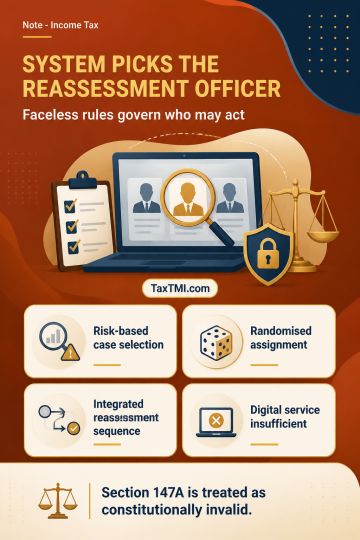
The distinction between risk selection and randomised officer allocation is important. The risk-management strategy determines which cases warrant action based on identified information. Randomised automated allocation determines which officer receives legal authority to deal with the selected case. Therefore, the fact that the system selects a case by risk criteria does not detract from the separate statutory requirement that the Assessing Officer be randomly allocated by algorithm.
The Court also treated procedural compliance as substantive where it determines jurisdiction. The settled principle is that where law prescribes that a power must be exercised in a particular manner, it must be exercised in that manner and not otherwise. A notice issued by an officer who was not allocated the case through the prescribed process is consequently not saved by an assertion that the assessee suffered no independent prejudice. The jurisdictional defect is complete when the authority acts contrary to the mandated statutory mode.
The decision also rejects the proposition that administrative memoranda or internal communications can override the Act or subordinate legislation issued under it. Such instruments may facilitate implementation, but cannot supplement the statute by creating an alternative source of jurisdiction or supplant a mandatory scheme. Section 120 directions, too, have to operate consistently with the specific statutory regime created by sections 130, 144B and 151A and the schemes framed under them.
The constitutional question arose from Section 147A, which declares, notwithstanding any judgment, order or decree, section 151A or any scheme framed under it, that an Assessing Officer for sections 148 and 148A means, and is always deemed to have meant, an officer other than the National Faceless Assessment Centre or an assessment unit under section 144B(3). The provision purported to operate retrospectively from 1 April 2021.
The High Court accepted the settled doctrine that a legislature having competence may enact retrospective validating legislation. It cannot, however, simply declare a binding judicial decision ineffective or replace the court's interpretation with a legislative assertion. A validating law must remove the legal defect or factual foundation on which the earlier judgment rested, so that the prior decision could not have been rendered in the altered legal circumstances. Retrospectivity must also remain constitutionally permissible and cannot be arbitrary.
On that test, section 147A failed. First, it did not amend section 151A or the e-Assessment of Income Escaping Assessment Scheme, 2022, even though those provisions continued to mandate automated allocation and faceless issuance of section 148 notices. Second, it did not address the scheme under section 130, which was also part of the reasoning supporting the faceless-jurisdiction view. Third, it was silent on the requirement of randomised allocation itself. The Court therefore held that the statutory basis of the earlier judgments had not been removed; instead, section 147A sought to negate their result while the legal premises on which they rested remained intact.
The consequence was not merely an inconsistency between two provisions. The Court found that section 147A directly conflicted with the continuing text of section 151A and the scheme framed under it, while purporting to override judicial rulings through a non-obstante clause. A non-obstante clause may resolve an otherwise valid statutory overlap, but cannot cure a constitutionally defective attempt to legislatively overrule a judgment without removing its foundation. Section 147A was therefore declared unconstitutional.
The judicial landscape was divergent before the primary ruling. The High Court noted that some decisions accepted the Revenue's bifurcated-process theory: the JAO could undertake the pre-assessment exercise and the faceless framework applied to the assessment stage. Other decisions treated the reassessment process as integrated and held that the faceless scheme governed the section 148A and section 148 stages as well.
2024 (8) TMI 559 - BOMBAY HIGH COURT held that the section 151A scheme required automated allocation for section 148 notices and left no room for concurrent JAO and FAO jurisdiction over their issuance. It separately reasoned that section 148A is inextricably linked to section 148, and that the absence of an exclusion under section 151A(2) prevented the JAO from conducting the preliminary proceedings outside the faceless mechanism.
2025 (3) TMI 1229 - RAJASTHAN HIGH COURT emphasised that randomisation concerns the assignment of the officer, not the risk-based selection of the case. It held that acceptance of concurrent JAO-FAO jurisdiction would undermine dynamic jurisdiction, create parallel channels and defeat the statutory purpose of section 151A.
2025 (4) TMI 1679 - MADRAS HIGH COURT analysed section 148A as a condition precedent and integral part of reassessment. It reasoned that a subordinate scheme cannot be interpreted to constrict the express remit of its parent provision, section 151A, which itself includes enquiry, show-cause and orders under section 148A. The reported disposition records that the matter was to be placed before an appropriate Division or Larger Bench; its interpretative observations must accordingly be understood in that procedural setting.
2025 (11) TMI 51 - ANDHRA PRADESH HIGH COURT held that notices and orders issued by the JAO outside the faceless mechanism were illegal and that the JAO lacked jurisdiction to issue them. The focus was the mandatory character of section 151A read with the notified scheme.
2025 (7) TMI 1239 - TELANGANA HIGH COURT applied the same approach even to central-charge cases. It held that, absent a specific exception to section 151A, the faceless automated-allocation requirement governs issuance of reassessment notices; an exception concerning assessment orders cannot be extended to notice issuance.
2025 (8) TMI 916 - RAJASTHAN HIGH COURT independently held a JAO-issued section 148 notice invalid for non-compliance with section 151A, while also deciding a separate limitation issue. Its jurisdictional holding confirms that the origin of the notice is a threshold question distinct from the merits of alleged escapement.
2025 (8) TMI 1754 - KARNATAKA HIGH COURT quashed JAO-issued notices and consequential proceedings outside the faceless regime, while reserving liberty to the Revenue to seek revival if the pending higher-court controversy were resolved in its favour. The decision illustrates the treatment of the issue as one of initial competence.
2025 (9) TMI 1632 - TELANGANA HIGH COURT held, on its facts, that a section 148 notice issued by the JAO was without jurisdiction under the faceless scheme. Although the ruling also concerned distinct transfer-pricing and approval questions, its JAO-versus-FAO conclusion rested on the continuing operation of the faceless framework.
2025 (1) TMI 1567 - JHARKHAND HIGH COURT granted interim protection against further proceedings on the prima facie view that a local officer had not been shown to have received the case through the automated allocation system. Since the reported order is interlocutory, it supports the seriousness of the jurisdictional challenge but does not constitute a final determination.
At the appellate level, 2026 (5) TMI 54 - SC Order (LB) set aside earlier High Court rulings and remitted matters for reconsideration after section 147A was enacted. It expressly left the validity, scope, retrospectivity and applicability of the amending provision open. The primary ruling answers those remanded questions by holding section 147A unconstitutional and by reaffirming the mandatory force of automated faceless allocation.
For reassessment litigation, the first factual enquiry must be jurisdictional: was the case assigned through the prescribed automated allocation process, and did the officer issuing the section 148A communication, section 148A order or section 148 notice derive authority from that allocation? Electronic service alone does not establish compliance. A proceeding may be digital in form but still not be faceless in the statutory sense if it originates from a JAO acting outside the allocated framework.
The documentation relevant to this issue will ordinarily include the notice trail, portal records, identification of the issuing authority, allocation records where available, the section 148A order, statutory approval and the section 148 notice. The challenge should distinguish lack of subject-matter or statutory competence from a routine territorial-jurisdiction objection. The former concerns whether the statutory scheme authorised that officer to initiate the proceeding at all.
The ruling also reinforces a hierarchy of norms. The Act and a validly notified scheme issued under it prevail over administrative instructions. General concurrent-jurisdiction directions cannot be invoked in a manner that defeats a specific statutory scheme requiring randomised assignment. Equally, risk-based case selection cannot be conflated with automated allocation of the officer who is to exercise jurisdiction.
From a constitutional perspective, the decision is a reminder that retrospective legislation is not inherently impermissible, including in fiscal matters. But a retrospective validation must be real rather than declaratory. Where a judgment rests on a statutory scheme and a mandatory allocation requirement, an attempted validation that leaves those foundations intact remains vulnerable. The legislative route cannot be used merely to pronounce the judicial interpretation incorrect.
The governing conclusion is that section 151A and the e-Assessment of Income Escaping Assessment Scheme, 2022 require section 148 notices to be issued through randomised automated allocation and in the prescribed faceless framework. The JAO cannot claim an alternative or concurrent power merely because of general jurisdictional directions under section 120. Section 148A, being an integrated and indispensable precursor to a section 148 notice, cannot be deployed to circumvent that framework.
Section 147A did not cure this defect because it did not amend or remove the continuing statutory and scheme-based requirements on which the contrary judicial view rested. Its retrospective declaratory formulation was consequently held unconstitutional. For practitioners, automated allocation is therefore a foundational jurisdictional inquiry in any reassessment proceeding initiated under this framework, rather than a peripheral issue of administrative procedure.
Full Text:

