 TaxTMI
Login

Login
Loading...
Press 'Enter' to add multiple search terms. Rules for Better Search

Press 'Enter' after typing page number.
Press 'Enter' after typing page number.


No Folders have been created
Are you sure you want to delete "My most important" ?
NOTE:
Press 'Enter' after typing page number.







Press 'Enter' after typing page number.

All TMI Notes
Press 'Enter' after typing page number.
Press 'Enter' after typing page number.
All TMI Notes

Note

Bookmark

Share


Download

This commentary provides doctrinal analysis and practical insights on the legal issue discussed below. The judgment is analysed in the context of its factual background, issues framed, and conclusions reached by the Court.
2026 (7) TMI 1106 - TELANGANA HIGH COURT
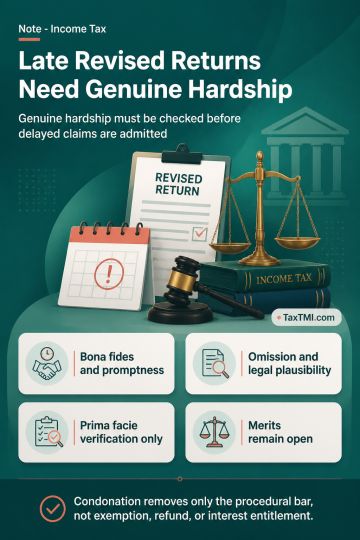
Condonation of delay for filing a revised return occupies a narrow but important space between the statutory finality attached to return-filing timelines and the remedial power conferred by Section 119 of the Income-tax Act, 1961. Where an assessee has already furnished a return but subsequently discovers an omission or an incorrect statement, the ordinary route is revision under Section 139(5). Once that statutory window has closed, the assessee cannot treat a condonation application as an automatic right to reopen the return. The controlling question is whether the competent authority should exercise the statutory power to avoid "genuine hardship".
The decision reported in 2026 (7) TMI 1106 - TELANGANA HIGH COURT addresses that issue in the setting of an assessee who sought permission to file revised returns after claiming that an amount originally offered to tax was exempt and that tax deducted at source was consequently refundable. The Court held that the request required a pragmatic and liberal examination, particularly because decisions of several Tribunal Benches in materially similar matters had granted relief and those decisions had not been challenged further. The rejection order was quashed, the matter was remitted, and the assessee was permitted to submit revised returns for consideration on merits.
The ruling is significant not because it treats every delayed revision as condonable, but because it identifies the proper character of the inquiry: genuine hardship must be assessed in the factual and legal setting of the claim; comparable decisions cannot be ignored; and the condonation authority must not convert the threshold inquiry into a final adjudication of taxability or refund entitlement.
Section 139 regulates the furnishing, revision and treatment of returns. The relevant language of Section 139(5) is that a person who has furnished a return under Section 139(1) or Section 139(4), and "discovers any omission or any wrong statement therein", may furnish a revised return, subject to Section 234-I, before the end of the relevant assessment year or before completion of the assessment, whichever is earlier.
The provision serves a corrective function. It permits an assessee to replace an earlier return where an omission or incorrect statement comes to light. However, it also contains an express outer limit. A filing made after that limit does not become a valid revised return merely because it is labelled as one. The assessee must therefore invoke an independent source of power where the delay has caused the ordinary revision mechanism to become unavailable.
The material part of Section 119(2)(b) authorises the Board, where it considers it "desirable or expedient so to do for avoiding genuine hardship in any case or class of cases", to authorise an income-tax authority, other than the specified appellate authorities, "to admit an application or claim for any exemption, deduction, refund or any other relief under this Act after the expiry of the period specified by or under this Act for making such application or claim and deal with the same on merits in accordance with law".
The provision is deliberately remedial, but it is not unrestricted. Its operation involves two connected stages. First, the competent authority must decide whether admission of the delayed application or claim is warranted to avoid genuine hardship. Secondly, if the delay is condoned, the claim must be dealt with "on merits in accordance with law". Condonation therefore removes the procedural barrier; it does not itself establish exemption, reduce taxable income, or mandate a refund.
Section 237 provides that where a person satisfies the Assessing Officer that tax paid by or on behalf of that person exceeds the amount properly chargeable for the relevant assessment year, the person "shall be entitled to a refund of the excess". Under Section 239, every refund claim under Chapter XIX must be made "by furnishing return in accordance with the provisions of section 139". These provisions explain why the validity and admissibility of the return or revised claim can be decisive for a refund claim.
Section 244A(1) states that where a refund becomes due under the Act, the assessee is entitled, subject to that section, to simple interest. For refunds out of tax treated as paid under Section 199, the rate specified is one-half per cent for every month or part of a month, with the commencement of the period depending, among other matters, on whether the return was furnished by the Section 139(1) due date. Interest is not an automatic consequence of a successful condonation application. It arises only if a refund becomes due and the statutory conditions governing its computation are met.
Circular No. 9/2015 lays down comprehensive guidelines for condonation of delay in refund claims and claims for carry forward of losses under Section 119(2)(b), superseding earlier instructions, circulars and guidelines on that subject. It allocates jurisdiction according to the amount involved for a single assessment year: the Principal Commissioner or Commissioner may decide claims not exceeding Rs.50 lakhs; the Chief Commissioner may decide claims exceeding Rs.50 lakhs but not exceeding Rs.2 crores; the Principal Chief Commissioner may decide claims exceeding Rs.2 crores but not exceeding Rs.3 crores; and claims exceeding Rs.3 crores are to be considered by the Board.
The Circular further states that no condonation application for a refund or loss claim shall be entertained beyond six years from the end of the relevant assessment year. It also records that such application should, as far as possible, be disposed of within six months from the end of the month in which it is received. In cases arising from a court order, the period during which proceedings were pending may be excluded, provided the application is filed within the stipulated post-order period described in the Circular.
Most importantly, paragraph 5 requires the authority to ensure that the income or loss declared and the refund claimed are "correct and genuine" and that the case is one of genuine hardship on merits. The authority may direct the jurisdictional Assessing Officer to conduct inquiries or scrutiny to ascertain correctness. Thus, the Circular aligns administrative verification with the statutory distinction between admission of a delayed claim and determination of its substantive merits.
Section 119(2)(b) does not employ the expression "revised return". Its operative breadth, however, extends to an application or claim for "any exemption, deduction, refund or any other relief" made after expiry of the prescribed period. Where a revised return is the procedural vehicle through which an assessee seeks to correct an omission and claim an exemption or refund, the substance of the request is for admission of a delayed statutory claim. The Court's direction permitting submission of revised returns confirms that the relief provision can be applied to such a situation, subject always to a merits examination thereafter.
This does not erase Section 139(5). The prescribed time limit remains the ordinary rule. Section 119(2)(b) operates exceptionally, where genuine hardship justifies relaxation and the claim is fit to be admitted for a lawful merits determination.
"Genuine hardship" is neither synonymous with mere inconvenience nor confined to physical impossibility of timely compliance. It requires real hardship, evaluated from the circumstances of the case, the conduct of the assessee, the nature of the default, and the consequence of refusing admission. A bona fide omission in the original return, coupled with a potentially sustainable claim that tax was not legally payable, may be relevant because the consequence of refusal can be retention of tax that may not be properly chargeable.
At the same time, a plea of ignorance of law is not, by itself, a universal answer to statutory limitation. Its significance depends upon whether the claim is bona fide, whether the assessee acted promptly after discovering the issue, whether the materials disclose an arguable statutory entitlement, and whether refusal would cause a real and disproportionate detriment. The inquiry must remain fact-sensitive rather than formulaic.
The condition in the Circular that the refund claim be "correct and genuine" does not permit the condonation authority to conduct a conclusive assessment at the admission stage. The authority may verify that the claim is not facially fictitious, untenable, or unsupported. It may call for an inquiry by the Assessing Officer. But a detailed and final adjudication on exemption, characterization of receipt, computation, or refund must ordinarily follow the admission of the claim.
This distinction is especially material where the request rests on decisions in comparable cases. Such decisions may demonstrate that the claim is arguable and bona fide; they do not mechanically decide the assessee's own entitlement. The assessment authority must still determine the claim under the applicable statutory provisions and facts.
In 2026 (7) TMI 1106 - TELANGANA HIGH COURT, the assessee had filed original returns and subsequently sought condonation to file revised returns for claiming refund of tax deducted at source. The claim proceeded on the assertion that ex gratia compensation received under a voluntary retirement scheme was in the nature of retrenchment compensation and exempt under the second proviso to Section 10(10)(b). The assessee asserted that the original returns had not claimed that position because of ignorance of law.
The Court did not decide whether the compensation was in fact exempt or whether any particular refund was payable. Its intervention was directed at the decision-making process under Section 119(2)(b). The material fact was that several Tribunal Benches had granted relief to identically placed retirees, and the Court noted that the rejection order did not disclose whether those decisions, including those that had attained finality, were considered in their proper perspective.
The Court held that the department ought to have appreciated the assessee's bona fides and considered genuine hardship through a more pragmatic and liberal approach. The order rejecting condonation was quashed. The matter was remitted to the competent authority; the assessee was permitted to submit revised returns; and the authority was directed to consider the case on merits. The carefully limited remedy preserves the statutory sequence: condonation and admission first, followed by independent merits consideration.
The ruling also illustrates the relevance of consistency in tax administration. Decisions in comparable cases are not substitutes for statutory adjudication, but their existence may materially affect whether the delayed claim appears genuine and whether a taxpayer's failure to claim the benefit earlier can fairly be regarded as bona fide. An authority cannot reject an application on a narrow assertion of delay while failing to engage with a consistent body of comparable adjudication placed before it.
In 2009 (12) TMI 36 - BOMBAY HIGH COURT, the Court held that genuine hardship must receive a liberal, justice-oriented construction. The authority cannot confine itself to a solitary inquiry whether some substantial cause physically prevented timely filing. It must also assess the broader circumstances and cannot presume that delay was deliberate, negligent, or mala fide. The decision additionally clarifies that the requirement of a prima facie correct and genuine refund claim does not authorise a detailed merits enquiry that prejudges the claim.
In 2024 (4) TMI 500 - ORISSA HIGH COURT, the Court considered a delayed revised return where an inadvertent failure to claim a set-off led to a substantial demand. The existence of material supporting entitlement to the set-off was sufficient to show genuine hardship for purposes of condonation. The Court also applied the settled administrative-law principle that an impugned order must stand or fall by its recorded reasons; fresh reasons in a counter affidavit cannot retrospectively cure an inadequate rejection order.
In 2014 (12) TMI 191 - BOMBAY HIGH COURT, the Court rejected an unduly technical refusal to condone delay in a refund-return case. It emphasised that scrutiny of a delayed claim is compatible with condonation. The possibility of verification cannot be converted into a reason to deny access to merits adjudication, particularly when the assessee is willing to undergo scrutiny.
In 2024 (1) TMI 950 - BOMBAY HIGH COURT, the Court held that where an assessee asserts that tax has been paid on an amount that may not be taxable, the resulting consequence can constitute genuine hardship. The delay in filing a revised return was condoned, while the underlying taxability issue was expressly left for determination on merits. That separation between procedural relief and substantive adjudication closely accords with the approach in the present ruling.
In 2022 (8) TMI 1031 - GUJARAT HIGH COURT, a short delay in filing a return was held to require a liberal and substantive assessment where the explanation involved illness, pandemic-related disruption, and work backlog. The Court recognised that Circular No. 9/2015 permits verification of the claim by inquiry, but that merits scrutiny does not displace the duty to assess genuine hardship correctly.
In 2007 (11) TMI 294 - KERALA HIGH COURT, the Court explained the procedural sequence for belated refund claims: a time-barred claim cannot be processed on merits unless delay is first condoned under Section 119(2)(b). Once condonation is granted, the Assessing Officer may examine tax liability and refund entitlement under Section 237. This reinforces that condonation neither forecloses scrutiny nor guarantees refund.
In 2001 (1) TMI 10 - GUJARAT HIGH COURT, the expression "genuine hardship" was held to warrant liberal construction in the context of delayed refund claims. The Court set aside a refusal founded solely on absence of hardship where the factual explanation for delay had been adequately offered, but remitted the actual refund claim for merits consideration.
Finally, 2024 (4) TMI 549 - BOMBAY HIGH COURT adds an important procedural safeguard. It holds that a condonation authority must adopt a liberal construction of genuine hardship and must not reduce the prima facie genuineness test into a final merits decision. Where a personal hearing is afforded by a member of the Board, the resulting order must also conform to the required decisional discipline identified by the Court.
These authorities do not formulate a rule that every bona fide error must be condoned. They do, however, establish that discretion under Section 119(2)(b) must be exercised rationally, on relevant material, with a clear distinction between admission of a delayed claim and assessment of its ultimate validity.
A legally sustainable order should record the relevant explanation, the nature of the hardship, the prima facie status of the claim, the effect of any material comparable decisions, and the applicable Circular No. 9/2015 conditions. A bare statement that hardship is not established, without engagement with these factors, risks being treated as an arbitrary or non-speaking exercise of discretion.
Where factual verification is needed, paragraph 5(ii) of Circular No. 9/2015 provides an institutional answer: the competent authority may direct the jurisdictional Assessing Officer to make inquiries or scrutinise the matter. Verification should not be confused with a justification for refusing to consider a claim that is otherwise bona fide and prima facie sustainable.
Care is also needed concerning interest. Circular No. 9/2015 states, in the specific context of a belated supplementary refund claim after completion of assessment, that no interest will be admissible. The scope of that condition must not be extended beyond its stated setting without statutory basis. Equally, an assessee cannot seek interest merely because delay is condoned; Section 244A governs the existence, rate and period of interest after refund becomes due.
Section 119(2)(b) is a statutory safety valve against genuine hardship, not a means to disregard return-filing limitation as a matter of routine. The proper approach is balanced: the assessee must demonstrate a real, bona fide hardship and a prima facie genuine claim; the authority must avoid pedantic reasoning, consider material comparability and relevant circumstances, and preserve merits scrutiny for the stage at which the claim is lawfully examined.
The ruling in 2026 (7) TMI 1106 - TELANGANA HIGH COURT gives practical content to that balance. A delayed revised return claiming exemption and consequential refund may be admitted where refusal would cause genuine hardship and the claim warrants merits consideration. But the eventual entitlement remains subject to statutory examination. That distinction is central to coherent administration of Section 139(5), Section 119(2)(b), and the refund framework under Sections 237, 239 and 244A.
Full Text:

