 TaxTMI
Login

Login
Loading...
Press 'Enter' to add multiple search terms. Rules for Better Search

Press 'Enter' after typing page number.
Press 'Enter' after typing page number.


No Folders have been created
Are you sure you want to delete "My most important" ?
NOTE:
Press 'Enter' after typing page number.












Press 'Enter' after typing page number.

All TMI Notes
Press 'Enter' after typing page number.
Press 'Enter' after typing page number.
All TMI Notes

Note

Bookmark

Share


Download

This commentary provides doctrinal analysis and practical insights on the legal issue discussed below. The judgment is analysed in the context of its factual background, issues framed, and conclusions reached by the Court.
2026 (8) TMI 1497 - Supreme Court
The distinction between Section 73 and Section 74 of the Central Goods and Services Tax Act, 2017 is not merely one of penalty or the length of limitation. It defines the jurisdictional basis on which a demand proceeding may be commenced. Section 73 governs cases arising for reasons other than fraud, wilful misstatement or suppression of facts to evade tax. Section 74 is confined to cases in which the tax short-payment, erroneous refund or wrongful availment or utilisation of input tax credit is alleged to have occurred by reason of those aggravated circumstances.
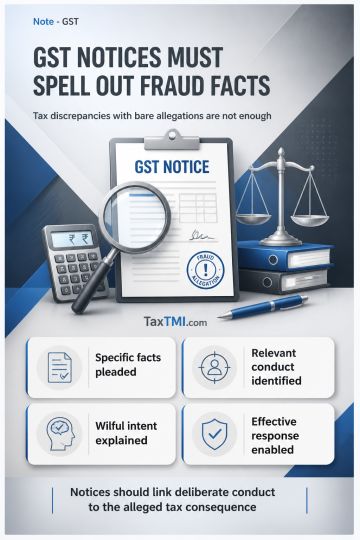
The consequence is substantial. A notice under Section 74 is issued within a framework carrying a longer period for adjudication, a six-month notice buffer before expiry of that period, and distinct penalty consequences. The extended route cannot therefore be adopted by merely reproducing statutory expressions. The notice must, on its own contents, disclose the material allegations from which fraud, wilful misstatement or suppression of facts may be inferred.
The governing principle is that validity of a show cause notice must be tested by what it states, not by explanations subsequently offered in pleadings before a court. In 2026 (8) TMI 1497 - Supreme Court, the notice was set aside because its bare reference to "fraud or concealment of facts" did not state how fraud was inferred or how concealment was detected. A counter affidavit could not supply the deficiency.
Section 73(1) applies where tax has not been paid or has been short paid, a refund has been erroneously made, or input tax credit has been wrongly availed or utilised, "for any reason, other than the reason of fraud or any wilful-misstatement or suppression of facts to evade tax." The provision requires a notice calling upon the taxable person to show cause against payment of the amount stated, interest under Section 50 and applicable penalty.
The limitation design is material. Section 73(2) requires notice at least three months before the deadline for the order. Under Section 73(10), the order must be issued within three years from the due date for furnishing the annual return for the relevant financial year, or within three years from the date of erroneous refund, as applicable. Section 73 also provides a statutory closure route: where tax and interest are paid within thirty days of the notice, no penalty is payable and proceedings are deemed concluded under Section 73(8).
Section 74(1) operates where the specified tax consequence or wrongful input tax credit has occurred "by reason of fraud, or any wilful-misstatement or suppression of facts to evade tax." It requires the proper officer to serve a notice stating the amount and requiring the taxable person to show cause against payment of tax, interest and "a penalty equivalent to the tax specified in the notice."
Section 74(2) mandates issuance of notice at least six months before the limitation for the order. Section 74(10) fixes the order deadline at five years from the due date for the annual return for the relevant financial year, or from the date of erroneous refund, as the case may be. Thus, the legislature has linked the longer period to a more serious and specifically identified factual foundation. The statutory terms are not surplusage; they are conditions precedent to the exercise of the extended jurisdiction.
Section 44 requires the prescribed registered persons to furnish an annual return electronically within the prescribed time and manner. Rule 80(1) prescribes FORM GSTR-9 and ordinarily fixes the due date as 31 December following the end of the financial year. Since Sections 73(10) and 74(10) use the due date of the annual return as their starting point, any valid extension of that due date correspondingly affects limitation computation.
The decision in 2026 (8) TMI 1497 - Supreme Court also illustrates that a court-directed exclusion of time must be factored into the computation. Yet, the availability of additional time does not itself justify Section 74. The authority must first establish, from the notice, why the case belongs to the fraud, wilful-misstatement or suppression category rather than the ordinary Section 73 category.
The phrase "by reason of" requires a pleaded nexus between the alleged conduct and the tax consequence. It is insufficient to assert both a tax discrepancy and, in a separate conclusory phrase, fraud or suppression. The notice must articulate the factual route by which the officer considers that the tax shortfall or wrongful credit arose from the particular aggravated conduct alleged.
Accordingly, an allegation of fraud, wilful misstatement or suppression should identify the factual act, omission, representation, non-disclosure or device attributed to the taxpayer; explain why it is said to be deliberate or wilful; and state its connection with the alleged evasion. This does not require the notice to finally prove the charge. It does require the notice to disclose a legally intelligible case capable of being answered.
A disjunctive recital such as "fraud or concealment of facts", without facts supporting either limb, reveals uncertainty rather than a reasoned invocation of Section 74. The officer cannot mechanically use the words "fraud, wilful misstatement or suppression of facts" as a gateway to the five-year adjudication period. The statutory description must be supported by foundational allegations contained in the notice itself.
There is an important distinction between the two stages. At the notice stage, the jurisdictional facts and the material basis for the allegation must be disclosed. At adjudication, the authority must consider the taxpayer's defence and determine whether the allegation is established. A notice which contains no foundational allegation cannot be sustained on the premise that evidence may later emerge. Conversely, a notice containing particulars is not, merely by reason of being issued, a conclusive finding of fraud or suppression.
In 2026 (8) TMI 1497 - Supreme Court, the ordinary Section 73 limitation, after giving effect to the relevant annual-return extension and exclusion of time, had expired. The department sought to sustain the later notice under Section 74. The court refused to examine the counter affidavit for the purpose of discovering the alleged fraud and suppression. It applied the established principle that requirements necessary to validate a notice or order must appear in that notice or order and cannot be supplemented through a counter affidavit in court.
The notice contained only the bland formulation "fraud or concealment of facts." It did not disclose how fraud was inferred or what facts were concealed. The use of "or" was treated as indicative that the assessing officer had not identified the basis on which the extended period was invoked. The court held that allegations leading to the inference of fraud, or attempted concealment resulting in suppression, must emanate from the notice. The notice and consequential proceedings were set aside.
The decision has a wider doctrinal significance. A later affidavit may explain the department's litigation position; it cannot retrospectively create jurisdiction that the issuing authority did not disclose when it invoked Section 74. This discipline serves both limitation law and natural justice: the taxpayer must know the actual case to be answered before the ordinary limitation is displaced.
Section 75(7) expressly provides that the amount demanded in the order cannot exceed the amount in the notice and that "no demand shall be confirmed on the grounds other than the grounds specified in the notice." This restriction reinforces the proposition that the notice is the source of the grounds of demand. A defect in the foundational allegation cannot be repaired by setting out new factual allegations in an adjudication order or litigation affidavit.
Section 75(2) provides that where an appellate authority, tribunal or court concludes that a Section 74 notice is not sustainable because charges of fraud, wilful misstatement or suppression of facts to evade tax have not been established, the proper officer shall determine tax by deeming the notice to have been issued under Section 73(1). This deeming rule addresses a notice that was validly founded and then fails on proof of the aggravated charge. It cannot be read to validate a purported Section 74 notice which, from inception, does not state the jurisdictional facts or grounds required to invoke that provision. Such a reading would undermine both Section 74(1) and the bar in Section 75(7).
The supplied authorities under analogous indirect-tax provisions consistently construe extended limitation strictly. In 2003 (1) TMI 107 - Supreme Court, an omission based on a clerical or mistaken assumption was held insufficient to establish wilful suppression. The extended period requires a positive and intentional act, not merely an error.
2013 (1) TMI 616 - Supreme Court similarly distinguished ordinary non-payment from deliberate default. The use of "wilful" imports a mental element; the revenue bears the burden of proving mala fide conduct. The decision also affirms that the notice must identify the particular commission or omission relied upon for extended limitation.
In 2007 (8) TMI 11 - Supreme Court, suppression was held to require deliberate conduct with an intent to evade duty. Mere omission or an incorrect statement did not suffice, particularly where the record disclosed genuine doubt arising from differing departmental positions. The burden lies on the revenue when it invokes the exceptional period.
2005 (9) TMI 331 - Supreme Court adds that non-disclosure is not, by itself, suppression where relevant facts were already known to the department. A deliberate positive withholding of correct information to evade duty is necessary. The departmental knowledge and disclosures on record were incompatible with an inference of suppression on the facts considered.
In 2024 (9) TMI 1753 - MADRAS HIGH COURT, the absence of even a reference to fraud, wilful misstatement or suppression in the assessment order was treated as fatal to the invocation of Section 74. The court characterised those ingredients as jurisdictional facts and held that failure to record their existence vitiated the proceedings. It also recognised that absence of jurisdiction is an exception to the ordinary rule of relegating a taxpayer to the appellate remedy.
2024 (9) TMI 1644 - ALLAHABAD HIGH COURT separately held that a notice alleging excessive input tax credit, without stating that it was availed by reason of fraud, wilful misstatement or suppression, lacked the essential averment necessary for Section 74. The notice itself must disclose the officer's prima facie satisfaction and the information or evidence on which it is founded. The decision further confirms that concluded Section 73 proceedings cannot be reopened through Section 74 without a pleaded prima facie basis of fraud-related conduct.
The principle of notice-specific allegations is longstanding. In 1996 (7) TMI 146 - Supreme Court, a notice issued beyond normal limitation failed because it did not specify any commission or omission falling within the extended-limitation proviso. Such specificity was held to be required both by the statute and by natural justice, since the assessee must have an opportunity to meet the exact allegation.
In 2003 (11) TMI 114 - Supreme Court, the question whether extended limitation applied was treated as jurisdictional and dependent on findings regarding positive acts of fraud, collusion, wilful misstatement or suppression. The authority could not assume applicability of the extended period without determining those statutory facts.
2021 (3) TMI 384 - Supreme Court confirms, in the customs context, that disclosure of material specifications and the department's opportunity to verify them negate an inference of wilful misstatement or suppression. Although that decision also addressed the competence of the issuing officer, its limitation analysis remains pertinent: the extended period does not follow merely because the department later takes a different view of taxability.
2026 (8) TMI 1587 - Supreme Court applies the same approach within the GST framework. A bald assertion of wrongful input tax credit and suppression, unsupported by foundational facts indicating a deliberate device to evade tax or avail excess credit, was held insufficient. An audit objection could not substitute the assessing officer's own satisfaction. The notice and consequential order were set aside, while leaving scope for fresh Section 74 action if a properly founded notice could be issued within the available period.
Procedurally, Rule 142 requires the proper officer to serve, along with a notice under Section 73 or Section 74, an electronic summary in FORM GST DRC-01. Before service of notice, the officer may communicate the ascertained tax, interest and penalty in Part A of FORM GST DRC-01A; the taxpayer may respond in Part B. These electronic steps facilitate communication and response, but they do not dilute the requirement that the Section 74 notice itself must disclose the factual basis for the exceptional jurisdiction.
Limitation should be computed first under the ordinary Section 73 framework, with careful reference to the annual-return due date, any valid extension, and any applicable exclusion of time.
If Section 74 is proposed, the notice should identify the precise statutory limb relied upon and state the factual materials that support the prima facie inference.
The notice should explain the causal connection between the alleged fraud, wilful misstatement or suppression and the tax consequence. A generic allegation appended to a tax computation is inadequate.
The final order must remain within the factual and legal grounds stated in the notice, consistently with Section 75(7).
A preliminary response should separately examine normal limitation, the Section 74 jurisdictional allegation, the particulars supporting it, and the causal nexus asserted by the department.
Where facts, returns, documents or explanations were already disclosed to the department, the response should identify those disclosures and explain why they negate a charge of deliberate suppression or wilful misstatement.
A taxpayer should distinguish between a factual disagreement on tax liability and the separate, aggravated allegation required to invoke extended limitation.
Where the notice does not disclose the jurisdictional foundation at all, the challenge concerns the authority to invoke Section 74, not merely the correctness of the proposed demand. The availability of an alternative remedy does not ordinarily bar scrutiny of a notice suffering from a jurisdictional defect.
The omission of the earlier statutory explanation defining "suppression", reflected in the text of Section 74, does not dispense with the need for a factual foundation. The inquiry remains governed by the operative words of Section 74(1), the settled requirement of deliberate conduct for exceptional limitation, and the officer's obligation to disclose the case in the notice.
Section 74 is an exceptional demand mechanism, not a residual provision available whenever the Section 73 period has expired. Its invocation depends on a notice that discloses the jurisdictional facts of fraud, wilful misstatement or suppression of facts to evade tax and explains how those facts caused the alleged tax consequence.
The central rule is clear: a show cause notice must be valid from its own contents. A bare statutory recital, a subsequent affidavit, an audit objection, or a later attempt to formulate reasons cannot supply what the notice did not state. This approach preserves the statutory distinction between Sections 73 and 74, ensures adherence to limitation, and gives meaningful content to the taxpayer's right to answer the case actually made.
Full Text:

