 TaxTMI
Login

Login
Loading...
Press 'Enter' to add multiple search terms. Rules for Better Search

Press 'Enter' after typing page number.
Press 'Enter' after typing page number.


No Folders have been created
Are you sure you want to delete "My most important" ?
NOTE:
Press 'Enter' after typing page number.











Press 'Enter' after typing page number.

All TMI Notes
Press 'Enter' after typing page number.
Press 'Enter' after typing page number.
All TMI Notes

Note

Bookmark

Share


Download

This commentary provides doctrinal analysis and practical insights on the legal issue discussed below. The judgment is analysed in the context of its factual background, issues framed, and conclusions reached by the Court.
2026 (8) TMI 1587 - Supreme Court
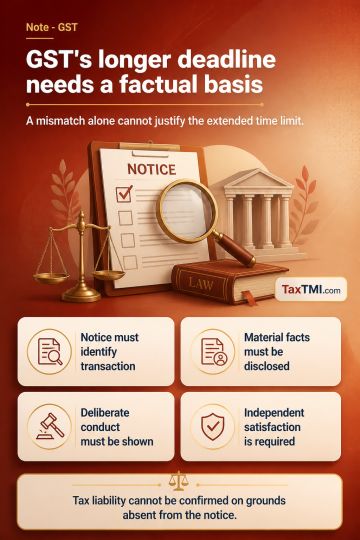
The distinction between the ordinary demand route and the fraud-based extended limitation route under the Central Goods and Services Tax Act, 2017 is substantive, not merely classificatory. Section 73 addresses non-payment, short payment, erroneous refund, or wrong availment or utilisation of input tax credit for a reason other than fraud, wilful misstatement or suppression of facts to evade tax. Section 74, applicable to periods up to Financial Year 2023-24, operates where the tax consequence occurred "by reason of fraud, or any wilful-misstatement or suppression of facts to evade tax".
The decision reported as 2026 (8) TMI 1587 - Supreme Court gives the distinction its necessary procedural content. A notice invoking the extended period cannot be sustained by mechanically reproducing statutory expressions. The foundational facts from which fraud, wilful misrepresentation or suppression can reasonably be inferred must appear in the show cause notice itself. This requirement protects both the statutory limitation scheme and the taxpayer's right to answer the precise case alleged.
Under Section 73(1), the proper officer may issue a notice where tax has not been paid or has been short paid, refund has been erroneously made, or input tax credit has been wrongly availed or utilised, "for any reason, other than the reason of fraud or any wilful-misstatement or suppression of facts to evade tax". Section 73(2) requires the notice to be issued at least three months before the order deadline. Under Section 73(10), the order must be issued within three years from the due date for furnishing the annual return for the relevant financial year, or within three years from the date of erroneous refund.
Section 74(1) is differently framed. It permits the fraud-based proceeding only where the tax shortfall, erroneous refund, or wrongful input tax credit is "by reason of fraud, or any wilful-misstatement or suppression of facts to evade tax". The notice must be issued at least six months before the order deadline under Section 74(2), and Section 74(10) permits the order to be issued within five years from the due date for furnishing the annual return for the relevant financial year, or from the date of erroneous refund. Thus, the statutory trigger has consequences both for limitation and for the penalty structure.
The annual-return benchmark is central to computing these limits. Section 44(1) requires the specified registered persons to furnish an annual return electronically within the prescribed time, form and manner. Rule 80(1) prescribes FORM GSTR-9 and, generally, the thirty-first day of December following the end of the financial year; Rule 80(1A) specifically prescribed 28 February 2022 for Financial Year 2020-21. The judgment also recognises that extensions of the annual-return due date affect the statutory starting point for Section 73 and Section 74 limitation.
Section 74 is expressly confined by Section 74(12) to determination of tax pertaining to periods up to Financial Year 2023-24. For Financial Year 2024-25 onwards, Section 74A establishes a unified notice mechanism: notice is to be issued within forty-two months from the annual-return due date, while the fraud-based distinction is reflected in Section 74A(5) through a penalty equivalent to the tax due. Its Explanation 2 defines "suppression" as non-declaration of information required in a return, statement, report or other document, or failure to furnish information sought in writing by the proper officer. That statutory definition does not displace the governing conclusion for a Section 74 notice issued after the omission of the earlier Explanation 2 to Section 74.
Three connected issues arise. First, whether an allegation of input tax credit mismatch or short payment alone permits recourse to Section 74. Secondly, whether a bare assertion that a taxpayer "suppressed facts" satisfies the statutory condition. Thirdly, whether an audit objection, departmental correspondence, or an impending limitation expiry can substitute the proper officer's independent satisfaction.
The answer to the first two questions lies in the causal language of Section 74(1): the tax consequence must arise "by reason of" fraud, wilful misstatement or suppression of facts to evade tax. The provision therefore requires more than a perceived tax discrepancy. There must be pleaded material connecting the alleged conduct of the taxpayer with the discrepancy and supporting the statutory inference of deliberate evasion.
Wilful misstatement necessarily imports a conscious misrepresentation. Suppression, in this context, is not synonymous with every omission, imperfect disclosure, erroneous claim, or disputed legal position. It concerns a deliberate withholding of material information in circumstances supporting an inference of intent to evade tax. Whether that threshold is met remains fact-dependent; however, the notice must disclose the factual foundation, rather than reserve it for the adjudication order.
In 2026 (8) TMI 1587 - Supreme Court, the demand notice covered three financial years and was described as one under Section 74. The ordinary Section 73 limitation, after taking account of the applicable annual-return timelines and the exclusion of limitation directed during the pandemic period, had expired before the notice. The question was therefore whether Section 74 could be invoked.
The Court held that proceedings under Sections 73 and 74 can begin only upon the assessing officer's satisfaction. An audit observation does not itself supply that satisfaction. For Section 74, the officer must be satisfied not merely that an input tax credit mismatch or short payment occurred, but that it occurred because of fraud, wilful misrepresentation or suppression. The Department's engagement with the audit objection before the Public Accounts Committee was treated as indicating the absence of departmental satisfaction even on the underlying mismatch or short payment, much less on suppression.
The decisive defect was in the contents of the notice. Apart from a general assertion that input tax credit had been availed without documentary evidence and facts had been suppressed, it did not set out foundational facts revealing a deliberate device to evade tax or to avail excess input tax credit. The Court held that "mere employment" of the words fraud, wilful misrepresentation or suppression does not demonstrate application of mind. Those expressions cannot be mechanically recited to obtain recovery beyond normal limitation.
The Court also rejected reliance on the former Explanation 2 to Section 74 because it stood omitted when the notice was issued. Even while noting that the extended two-year period remained available, the Court set aside the notice and the consequential order, while leaving liberty to initiate an appropriate Section 74 proceeding with foundational facts stated in the notice and an order passed within the remaining statutory time. The ruling is therefore not an immunity from a properly instituted fraud-based proceeding; it is a strict insistence that the exceptional route be initiated on its own pleaded factual footing.
Section 75 reinforces this discipline. Section 75(2) provides that, where an appellate authority, tribunal or court concludes that a Section 74 notice is unsustainable because fraud, wilful misstatement or suppression to evade tax has not been established, the proper officer shall determine tax payable as if the notice were issued under Section 73(1). However, this deeming mechanism does not erase the independent limitation architecture. Section 75(6) obliges the order to set out the relevant facts and basis of decision; Section 75(7) prohibits confirmation beyond the amount or grounds specified in the notice; and Section 75(10) deems adjudication concluded if the order is not issued within the prescribed statutory period. A defective fraud allegation cannot, therefore, be repaired by a new factual basis at the order stage.
2024 (9) TMI 1753 - MADRAS HIGH COURT treats fraud, wilful misstatement and suppression to evade tax as jurisdictional facts and conditions precedent for Section 74. Where the assessment order contained no finding on those matters, invocation of the extended period was held to vitiate the proceedings. The decision also recognises that absence of jurisdiction may justify writ review despite an alternative statutory remedy.
2024 (9) TMI 1644 - ALLAHABAD HIGH COURT similarly holds that the show cause notice must disclose the specific Section 74 ground and the prima facie information or evidence underlying it. An allegation of excess input tax credit without an assertion that it arose through fraud, wilful misstatement or suppression was insufficient to confer jurisdiction. The decision further treats reopening of concluded Section 73 proceedings as impermissible without a properly articulated fraud-based foundation.
2003 (1) TMI 107 - Supreme Court is instructive on wilfulness. It holds that an error or clerical mistaken assumption, without a positive dishonest act, does not establish fraud, collusion or wilful suppression. The extended period accordingly failed on the facts despite the underlying recovery provision being otherwise available.
2003 (11) TMI 114 - Supreme Court characterises extended limitation as jurisdictional and dependent on factual findings of positive acts of fraud, collusion, wilful misstatement or suppression. The failure to determine that threshold question required remand, demonstrating that a merits determination cannot bypass the limitation enquiry.
2011 (7) TMI 670 - Supreme Court holds that where the relevant discrepancy had already been brought to departmental notice and there was no finding of fraud, wilful misstatement or suppression, the extended period could not overcome ordinary limitation. Departmental knowledge is thus materially relevant to the inference of concealment.
2013 (1) TMI 616 - Supreme Court explains that the expression "wilful" introduces a mental element. Mere non-payment is not deliberate default. The revenue bears the burden of proving mala fides, and the notice must specify the particular omission or commission relied upon so that the taxpayer has a fair opportunity to respond.
2014 (12) TMI 36 - CALCUTTA HIGH COURT holds that a notice invoking extended limitation must disclose concrete particulars of the alleged suppression and cannot rest upon vague or mechanically adopted audit observations. Independent formation of the requisite jurisdictional belief remains essential.
2018 (2) TMI 23 - DELHI HIGH COURT reiterates that the revenue must establish deliberate suppression or intent to evade; bona fide belief and prompt regularisation upon awareness may negate that inference. Non-payment by itself does not establish the exceptional statutory condition.
1989 (8) TMI 80 - Supreme Court confirms that failure to obtain a licence or pay duty, where a bona fide belief is reasonably open, is not enough for extended limitation. Positive material of the statutorily specified misconduct is required.
1996 (7) TMI 146 - Supreme Court holds that a notice beyond the ordinary period must expressly state the particular fraud, collusion, wilful misstatement or suppression relied upon. Specific pleading is both a statutory requirement and a facet of natural justice.
1989 (2) TMI 116 - Supreme Court holds that something positive beyond inaction or an interpretative mistake is required. Where departmental officers knew the relevant facts and the taxpayer acted on a bona fide interpretation, extended limitation was unavailable.
2007 (8) TMI 11 - Supreme Court states that suppression and wilful misstatement require deliberate conduct directed at evasion, and places the burden of proving suppression upon the revenue. Genuine uncertainty arising from conflicting departmental positions may be inconsistent with a finding of mens rea.
2005 (9) TMI 331 - Supreme Court treats suppression as deliberate, positive withholding of correct information to evade duty. Where the department had inspected the process, obtained samples and received a flow-chart, mere absence of fuller particulars did not amount to suppression.
2021 (3) TMI 384 - Supreme Court shows the relevance of full disclosure at the assessment stage: where specifications and supporting material were available to the assessing authority and the goods were examined, wilful misstatement or suppression could not be inferred for extended limitation.
2023 (7) TMI 196 - Supreme Court holds that compliance with prescribed returns and a bona fide view founded on an existing judicial understanding cannot retrospectively become suppression merely because that view is later rejected. The revenue must identify a statutory disclosure obligation that was breached and prove a positive act of concealment.
1996 (11) TMI 84 - Supreme Court emphasises that fraud-related grounds cannot be treated as implicit in a late notice. The taxpayer must be informed of the allegation and its particulars; otherwise, the extended-period notice is invalid.
For the department, a sustainable Section 74 notice should identify the transaction or credit in question, state the material allegedly withheld or misstated, explain why the conduct was wilful or suppressive, and articulate the factual link between that conduct and evasion of tax. An audit objection may trigger enquiry, but cannot replace the proper officer's own satisfaction or the notice's pleaded factual basis. A "protective" demand merely because limitation is approaching has no identified statutory basis in the judgment.
For taxpayers, a limitation defence should be developed from the notice itself: absence of particulars, prior disclosure in returns or correspondence, departmental knowledge, audit access, a bona fide interpretative position, and the absence of a statutory disclosure obligation may each bear upon the alleged mental element. The response should separately address the underlying tax issue and contest the jurisdictional foundation for Section 74; an argument only on tax computation may leave the limitation challenge underdeveloped.
The drafting discipline has adjudicatory consequences. Section 75(7) bars confirmation on grounds other than those specified in the notice. Therefore, a notice that identifies only a mismatch cannot be converted, in the order, into a case of fraudulent design by adding factual allegations not disclosed to the taxpayer. Equally, a taxpayer's reply cannot be expected to cure the notice's failure to disclose the case to be met.
Extended limitation under Section 74 is an exceptional statutory consequence, available only when the alleged revenue loss is factually shown to be "by reason of" fraud, wilful misstatement or suppression of facts to evade tax. The controlling requirement is not formal invocation of those words but disclosure of foundational facts in the show cause notice from which the exceptional allegation may be tested. The distinction preserves the separate fields of Sections 73 and 74, ensures meaningful notice and hearing, and prevents limitation from being enlarged through assertion rather than demonstrated jurisdictional fact.
Full Text:

