 TaxTMI
Login

Login
Loading...
Press 'Enter' to add multiple search terms. Rules for Better Search

Press 'Enter' after typing page number.
Press 'Enter' after typing page number.


No Folders have been created
Are you sure you want to delete "My most important" ?
NOTE:
Press 'Enter' after typing page number.













Press 'Enter' after typing page number.

All TMI Notes
Press 'Enter' after typing page number.
Press 'Enter' after typing page number.
All TMI Notes

Note

Bookmark

Share


Download

This is a neutral professional article. The judgment is analysed in the context of its factual background, issues framed, and conclusions reached by the Court.
2026 (8) TMI 1284 - RAJASTHAN HIGH COURT
The bail application arose from a pending prosecution under the Rajasthan GST law. The allegations concerned substantial tax evasion through unaccounted purchases, storage and sale of taxable goods, absence of invoices, and discrepancies between physical stock, stock summaries and recorded sales. The revenue authority asserted that multiple notices had been issued, that the applicant had not cooperated with the investigation, and that prosecution sanction had been obtained. The investigation remained pending and the charge-sheet had not been presented.
The applicant disputed the allegations, asserting that transactions were reflected in regular audited books, that the department had made a unilateral valuation, and that there were errors in the quantity calculation adopted by it. The applicant also relied on custody, the maximum punishment of five years and the fact that the case was triable by a Magistrate.
In 2026 (8) TMI 1284 - RAJASTHAN HIGH COURT, the court declined regular bail without expressing an opinion on the merits of the proposed prosecution. The operative basis was the gravity of the alleged economic offence, the stated material concerning excess stock and unaccounted taxable goods, the allegation of non-cooperation despite notices, and the continuing investigation. At the same time, the court expected an early prosecutorial outcome and expeditious disposal by the trial court.
The decision illustrates an important distinction. A bail court does not finally determine whether the alleged tax demand or underlying valuation is correct. It assesses whether, at the relevant stage, release would be consistent with the statutory framework, the integrity of investigation and trial, and the protection of personal liberty under Article 21 of the Constitution of India.
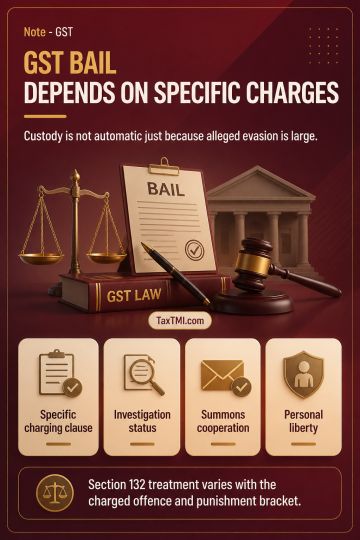
Section 132 of the Central Goods and Services Tax Act, 2017 identifies the criminal forms of GST contravention. The provisions relevant to the allegations include clause (a), which covers supply without an invoice, in violation of the Act or rules, with intent to evade tax; clause (h), which covers dealing with goods known or believed to be liable to confiscation; and clause (i), which concerns dealing with supplies of services known or believed to contravene the Act or rules.
Where the amount of tax evaded exceeds five hundred lakh rupees, Section 132(1)(i) prescribes imprisonment which may extend to five years and fine. Section 132(5) makes cognizable and non-bailable only offences under clauses (a), (b), (c) or (d), where punishable under Section 132(1)(i). By contrast, Section 132(4) states that all other offences under the Act are non-cognizable and bailable.
The order refers at different places to allegations under clauses (a), (h) and (i), read with Section 132(5). The exact text and classification of the corresponding Rajasthan GST provisions are not stated. Accordingly, while the supplied CGST text explains the statutory significance of the particular clauses, the precise bailability classification under the applicable State enactment must be verified from that enactment.
Section 69 of the Central Goods and Services Tax Act, 2017 permits arrest when the Commissioner has reasons to believe that a person has committed an offence under Section 132(1)(a) to (d), punishable under Section 132(1)(i) or (ii), and authorises an officer to arrest. For an arrest concerning an offence under Section 132(5), the authorised officer must inform the person of the grounds of arrest and produce that person before a Magistrate within twenty-four hours. These provisions are statutory safeguards, not merely procedural formalities.
Section 70 of the Central Goods and Services Tax Act, 2017 empowers the proper officer to summon a person to give evidence or produce documents. Persons summoned are bound to attend personally or through an authorised representative as directed, to state the truth during examination, and to produce required documents and things. The inquiry is deemed to be a judicial proceeding. In the bail context, the factual record regarding response to summons and cooperation can materially bear upon the court's assessment of custodial necessity and the risk of obstruction.
Section 134 of the Central Goods and Services Tax Act, 2017 provides that no court may take cognizance of an offence punishable under the Act without the previous sanction of the Commissioner; it also requires trial by a court not inferior to a Magistrate of the First Class. The order records that prosecution sanction had been issued. The text of the corresponding State GST provision is not stated.
Section 483 of the Bharatiya Nagarik Suraksha Sanhita, 2023 authorises the High Court or Court of Session to direct release on bail of a person accused of an offence and in custody. It also permits modification or setting aside of conditions imposed by a Magistrate. This was the jurisdiction invoked for regular bail.
Section 480 of the Bharatiya Nagarik Suraksha Sanhita, 2023 provides that a person accused of a non-bailable offence may be released on bail, subject to its stated limitations. The court or officer must record reasons in writing for release. Where the offence is punishable with imprisonment which may extend to seven years or more, Section 480(3) requires conditions relating to attendance, non-commission of a similar offence, and non-interference with witnesses or evidence. A five-year GST offence does not fall within that textual threshold, though appropriate conditions may still be relevant to secure attendance and preserve the process.
Section 479 of the Bharatiya Nagarik Suraksha Sanhita, 2023 creates a distinct undertrial-detention protection. Ordinarily, a person detained for one-half of the maximum imprisonment must be released on bail; a first-time offender is to be released on bond upon detention extending to one-third of the maximum term. Delay attributable to the accused is excluded. The provision is subject to its provisos, including recorded reasons after hearing the Public Prosecutor and the restriction where multiple offences or cases are pending. This statutory safeguard did not arise for decision in the present order.
The applicant's reliance on Magistrate-triability and a maximum five-year sentence addressed proportionality and the concern against unnecessary pre-trial detention. Those considerations are legally material. However, the court treated them as part of a cumulative exercise, rather than decisive criteria. It found that the allegations involved a substantial evasion figure, alleged unaccounted taxable goods, stock discrepancies, non-invoiced transactions and continuing investigation. It also noted the prosecution case that numerous notices had not resulted in cooperation.
The order therefore demonstrates that the severity of the statutory sentence must be assessed together with the actual investigational stage and the applicant's conduct. A court may refuse bail when it considers continued custody presently justified to protect investigation, notwithstanding that the charge is Magistrate-triable. Equally, the refusal was not a finding of guilt: the court expressly avoided commenting on the merits and directed expedition.
In 2026 (1) TMI 640 - SC Order, regular bail was granted in a GST prosecution notwithstanding the gravity of the allegation. The material factors were custody exceeding eight months, non-commencement of trial, absence of charge-framing, the unlikelihood of conclusion within the following year, Magistrate-triability and a maximum sentence of five years. It is directly relevant because it confirms that the same five-year sentencing framework can favour bail when delay becomes substantial, but does not prescribe release at an earlier stage regardless of the investigation record.
2020 (8) TMI 40 - MADHYA PRADESH HIGH COURT granted bail in a case alleging large-scale GST evasion after considering that the evidence was substantially documentary and that custodial interrogation was not shown to remain necessary. Conditions requiring cooperation, non-tampering and travel restrictions were used to address prosecutorial concerns. The authority supports the proposition that documentary cases may permit calibrated release, without converting the seriousness of an economic offence into an irrelevant consideration.
2025 (8) TMI 239 - PUNJAB AND HARYANA HIGH COURT holds that an accused facing a Section 132 complaint cannot be denied bail solely because investigation continues against a co-accused. It separately emphasises clean antecedents, full cooperation and the fact that documentary and electronic evidence was already with the investigating agency. Its relevance is that bail must be assessed person-wise and role-wise; however, those favourable factors were not found on the stated facts of the present order.
2022 (7) TMI 1022 - CHHATTISGARH HIGH COURT illustrates the contrary result. Bail was refused where the material prima facie indicated fraudulent input tax credit transactions, further investigation remained necessary, and interference with evidence or investigation could not be ruled out. The decision closely supports the relevance of a pending investigation and concrete investigational concerns in serious GST prosecutions.
2024 (2) TMI 766 - PUNJAB AND HARYANA HIGH COURT granted regular bail in tax-evasion prosecutions after investigation had concluded and charge-sheets had been filed. It applied the standard concerns of flight risk, evidence tampering and witness influence, while using passport surrender and undertakings as protective conditions. The authority reinforces that completion of investigation can materially alter the bail balance.
2011 (11) TMI 537 - Supreme Court holds that the seriousness of an economic offence is relevant but cannot alone justify denial of bail. The court must consider the severity of punishment, likelihood of absconding, repetition of offence and a real apprehension of witness tampering. The principle is consistent with the present outcome because the order rested not on gravity alone but also on alleged non-cooperation, continuing investigation and the material said to have been recovered or examined.
2021 (10) TMI 1296 - Supreme Court recognises economic offences as a distinct category for bail guidance, while preserving a case-specific exercise. It also makes cooperation during investigation material: the favourable process indicated for an accused who was not arrested during investigation is unavailable where summons were ignored or custody is necessary for further investigation or trial. This reasoning is particularly relevant to the adverse finding on non-cooperation in the present matter.
2022 (8) TMI 152 - Supreme Court reiterates that arrest is not automatic, that custody on filing of a charge-sheet is not invariably necessary, and that economic offences require a contextual assessment of seriousness and punishment. Its broader contribution is the insistence that liberty, proportionality, procedural compliance and trial delay remain integral to bail adjudication.
The constitutional authorities concerning stringent special-statute prosecutions are not direct precedents on the Section 132 GST classification, but their Article 21 reasoning remains relevant. 2023 (11) TMI 63 - Supreme Court recognises that prolonged custody and delayed trial may justify a renewed bail request, even where immediate release is not warranted. 2024 (9) TMI 1497 - Supreme Court confirms that stringent statutory bail thresholds cannot justify unreasonable pre-trial incarceration where trial completion is not realistically foreseeable. 2024 (8) TMI 650 - Supreme Court similarly treats bail as non-punitive and gives controlling significance to speedy-trial rights where incarceration has become prolonged.
These authorities do not dilute the statutory distinction between GST and special-law prosecutions. They do, however, affirm a general proposition: a refusal of bail at an early investigative stage does not foreclose reconsideration if custody lengthens, the prosecution does not progress, or the rationale of custodial necessity ceases to exist.
Entitlement to regular bail in a pending large-scale GST-evasion prosecution turns on a disciplined, fact-specific balance. The present decision confirms that a Magistrate-triable offence with a five-year maximum sentence does not automatically require release where serious allegations, an ongoing investigation and alleged non-cooperation indicate a present risk to the process.
At the same time, the statutory scheme and the supplied authorities reject a mechanical approach founded solely on the label of an economic offence or the quantum alleged. The correct inquiry remains whether continued custody is necessary and proportionate, having regard to the exact Section 132 allegation, statutory classification, evidence already secured, cooperation, individual role, trial prospects and the constitutional protection of personal liberty.
The order's direction for early prosecutorial action and expeditious trial is consequential. It preserves the distinction between permissible investigational custody and pre-trial detention that becomes punitive through delay.
Full Text:

