Customs-controlled cargo movement now includes GDL, subject to EXIM prioritisation, segregation, verification, reconciliation and enforcement safeguar...
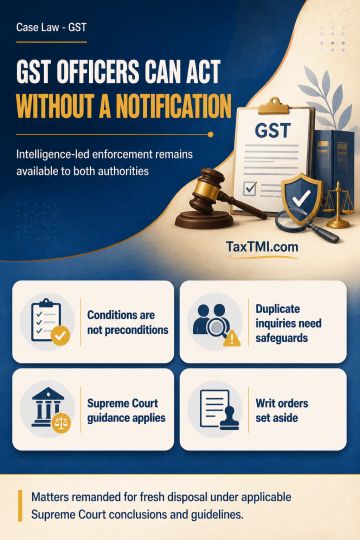
GST cross-empowerment remains effective without conditional notification, while duplicate proceedings require established safeguards against overlappi...
The case deals with the characterization of profit/receipts from the sale of land, whether it should be treated as business income or long-term capital gain. The Supreme Court in CIT vs. Madan Gopal Radhey Lal held that a trader may acquire an asset for personal purposes and hold it separate from their business stock. There is no presumption that every acquisition by a dealer is for business purposes; the intention must be determined based on the acquirer's conduct and dealings with the asset. In this case, since the assessee held the land for more than five years without developmental activity, and the Revenue accepted the treatment as long-term capital gain in preceding and succeeding years, the CIT(A)/NFAC correctly deleted the addition made by the AO, treating the profit as long-term capital gain. The Appellate Tribunal upheld this decision.
The case deals with the characterization of profit/receipts from the sale of land, whether it should be treated as business income or long-term capital gain. The Supreme Court in CIT vs. Madan Gopal Radhey Lal held that a trader may acquire an asset for personal purposes and hold it separate from their business stock. There is no presumption that every acquisition by a dealer is for business purposes; the intention must be determined based on the acquirer's conduct and dealings with the asset. In this case, since the assessee held the land for more than five years without developmental activity, and the Revenue accepted the treatment as long-term capital gain in preceding and succeeding years, the CIT(A)/NFAC correctly deleted the addition made by the AO, treating the profit as long-term capital gain. The Appellate Tribunal upheld this decision.
Note: It is a system-generated summary and is for quick reference only.
 TaxTMI
  TaxTMI