 TaxTMI
Login

Login
Loading...
Press 'Enter' to add multiple search terms. Rules for Better Search

Press 'Enter' after typing page number.
Press 'Enter' after typing page number.


No Folders have been created
Are you sure you want to delete "My most important" ?
NOTE:
Press 'Enter' after typing page number.

















Press 'Enter' after typing page number.

All TMI Notes
Press 'Enter' after typing page number.
Press 'Enter' after typing page number.
All TMI Notes

Note

Bookmark

Share


Download

This is a neutral professional article. The judgment is analysed in the context of its factual background, issues framed, and conclusions reached by the Court.
2026 (7) TMI 1196 - NATIONAL COMPANY LAW APPELLATE TRIBUNAL PRINCIPAL BENCH, NEW DELHI
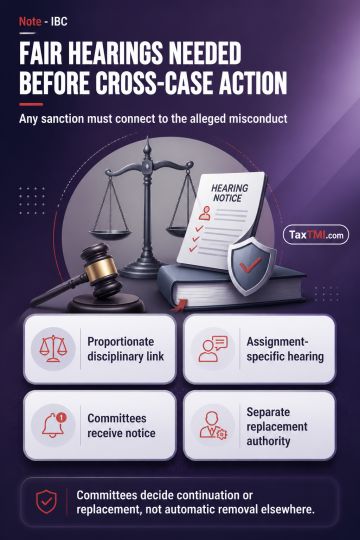
The central question is whether a disciplinary suspension imposed on an insolvency professional for alleged misconduct in one corporate insolvency resolution process may, without more, prevent that professional from continuing in every other ongoing assignment. The appellate tribunal granted limited interim protection against the suspension operating across the professional's other assignments, while leaving the disciplinary consequences in the assignment that generated the proceedings for consideration in the main appeal.
The ruling proceeds on a prima facie reconciliation of the Board's disciplinary authority under Section 220 of the Insolvency and Bankruptcy Code, 2016, the Committee of Creditors' statutory role in appointment and replacement, and the communication mechanism in Regulation 13 of the IBBI (Inspection and Investigation) Regulations, 2017. The decisive concerns were proportionality, assignment-specific hearing, and preservation of the respective statutory fields of the Board and the Committee of Creditors.
The order is interlocutory in character. It records a strong prima facie case for restricting the cross-assignment effect of the suspension at the interim stage; it does not finally determine either the validity of the disciplinary findings in the concerned assignment or the full amplitude of appellate scrutiny under Section 220(7).
A resolution professional was removed from one CIRP, following which disciplinary action was pursued. The disciplinary order suspended the professional's registration for a stated period. Its intended operation extended beyond the CIRP in which the alleged lapse arose and affected three other ongoing CIRPs in which the same professional had been appointed.
The appeal focused on the latter consequence. It did not require the tribunal, at the interim stage, to decide the merits of the alleged misconduct in the particular CIRP or the professional's removal from that assignment. The narrower issue was whether the disciplinary action could bar the professional from every other appointment when the charge related to one CIRP and no misconduct in the remaining CIRPs had been identified or put to the professional.
The statutory route of appeal is significant. Section 220(7) permits a person aggrieved by an order of the disciplinary committee under sub-sections (2) to (5) to appeal to the appellate tribunal within 30 days from receipt of the order. Under Section 220(8), a further period not exceeding 15 days may be allowed upon sufficient cause. The tribunal noted that the language of Section 220(7) contains no express limitation on the scope of appellate intervention, but reserved a final ruling on whether that jurisdiction permits full factual re-appreciation or is more limited in nature.
Section 218(1) authorises the Board, on a complaint or where it has reasonable grounds to believe that a service provider has contravened the Code, rules, regulations or directions, to order an inspection or investigation. The investigation culminates in a detailed report under Section 218(6).
Under Section 219, after an inspection or investigation, or on the basis of material available on record, the Board may issue a show-cause notice where it forms a prima facie opinion that sufficient cause exists for action under Section 220. The notice must provide the period for reply in the prescribed manner.
The operative disciplinary power lies in Section 220(2): after giving the service provider an opportunity of being heard, the disciplinary committee may, where it is satisfied that sufficient cause exists, impose a statutory penalty, suspend or cancel registration, or direct disgorgement. The phrase "after giving the service provider an opportunity of being heard" is central where a proposed consequence reaches assignments not covered by the charge.
The Code assigns an independent role to the Committee of Creditors in relation to the professional conducting its CIRP. Under Section 22(2), the Committee may, at its first meeting and by at least 66% of voting share, appoint the interim resolution professional as resolution professional or replace that person. Where replacement is proposed, Section 22(4) requires the Adjudicating Authority to forward the proposed name to the Board for confirmation and to appoint the person after confirmation.
Likewise, Section 27 permits the Committee, at any time during the CIRP, to replace the resolution professional. Section 27(2) prescribes a 66% voting threshold and written consent of the proposed professional; Sections 27(3) and (4) then require the proposed name to move through the Adjudicating Authority and the Board. The appointment architecture is therefore Committee-led, but subject to Board confirmation and the continuing statutory eligibility of the proposed professional.
For an interim resolution professional, Section 16 provides that appointment of a proposed person is conditional on no disciplinary proceedings being pending. The Board's recommendation under Section 16(4) must similarly concern an insolvency professional "against whom no disciplinary proceedings are pending." These provisions show the significance of disciplinary status to appointment, but do not expressly resolve the precise interim question concerning the effect of a disciplinary order on pre-existing, unrelated assignments.
Regulation 13(1) requires the disciplinary committee to dispose of a show-cause notice by a reasoned order after hearing the noticee. Regulation 13(3) permits measures including suspension or cancellation of authorisation for assignment and actions or directions under Section 220. Regulation 13(6) requires directions for discharge of pending obligations and, where necessary, continued functions only to enable stakeholders to shift to another service provider.
Most directly, Regulation 13(7) provides that, where the service provider is an insolvency professional, "the Board shall intimate the order to all the members of committee of creditors of the insolvency resolution processes" in which that person acts as interim resolution professional or resolution professional, and to the Adjudicating Authority. The dispute was whether this is merely a mandatory communication and stakeholder-protection provision, leaving each Committee to decide on continuation or replacement, or whether it itself operationalises an automatic removal from all other assignments.
The tribunal distinguished the existence of disciplinary authority from the manner of its exercise. Section 220(2) undoubtedly permits suspension of registration after hearing and satisfaction of sufficient cause. Yet the interim question was not simply whether the Board has a disciplinary power. It was whether an order founded on allegations in one CIRP could extend to other CIRPs without charges, evidence, or hearing concerning performance in those assignments.
The tribunal treated Regulation 13(7) as materially relevant to proportionality. On its prima facie reading, the Regulation requires the Board to inform the Committees of Creditors in the other assignments so that they may take an appropriate decision. This construction avoids treating the communication requirement as redundant. It also allows regulatory concerns to reach every affected Committee while respecting that each CIRP has its own Committee, stakeholders and operational circumstances.
Accordingly, the order considered that a blanket bar from all assignments, founded only on a charge concerning one CIRP, risked an excessive regulatory response. The consequence of misconduct must bear a rational and proportionate connection to the charge established and the proceedings in which the affected person has been heard. This was not expressed as a final restriction on the Board's statutory power; it was the basis for interim protection against a cross-assignment application of the suspension.
The reasoning gives substantial weight to audi alteram partem. The charge recorded in the disciplinary proceeding concerned a specific CIRP, with no reference to the other CIRPs. The tribunal therefore asked whether the professional had been heard on conduct in every assignment from which the professional was effectively excluded. It concluded, prima facie, that a person cannot be subjected to an adverse consequence of that breadth without an opportunity to answer the material relied on for that consequence.
This approach is supported by the general principle separately examined in 2025 (1) TMI 1622 - Supreme Court (LB). That authority distinguishes a complete denial of hearing from a mere inadequacy in the hearing process. Where a person is adversely affected without notice and opportunity at the original stage, the breach goes to the core of procedural fairness; a later proceeding does not ordinarily cure that foundational defect. Applied here, the point is not that a disciplinary proceeding can never affect other assignments, but that the scope and factual foundation of an adverse action must be disclosed and answered.
The Board's regulatory function is not displaced by the Committee's commercial authority. The statutory confirmation requirements in Sections 16, 22 and 27 demonstrate that a Committee cannot insist upon appointment of a person whom the Board does not confirm. Equally, a Committee's power under Section 27 is not illusory: it may replace a resolution professional by the prescribed 66% vote during the CIRP.
The decision in 2018 (7) TMI 2126 - NATIONAL COMPANY LAW APPELLATE TRIBUNAL, NEW DELHI individually affirms that the Committee's proposed professional should not be rejected merely because of empanelment with a creditor. Its relevance is that pending disciplinary proceedings were treated as a statutory obstacle to appointment, while the Committee retained the principal choice within the statutory scheme.
Similarly, 2019 (8) TMI 1551 - NATIONAL COMPANY LAW APPELLATE TRIBUNAL, NEW DELHI holds that the Committee may replace a resolution professional without recording reasons, and that an adjudicatory authority should not displace a bona fide Committee decision absent perversity or lack of jurisdiction. This supports the proposition that the replacement decision in an individual CIRP belongs, subject to the Code, to that CIRP's Committee.
The present order accordingly permitted the Board to communicate the disciplinary order to the other Committees under Regulation 13(7), but suspended the suspension insofar as it operated directly against the professional in those assignments. The respective Committees were left to decide their preference regarding continuation or replacement. This is a calibrated interim arrangement rather than a dilution of regulatory oversight.
2006 (5) TMI 191 - Supreme Court states the general principle that, in a civil regulatory penalty regime, mens rea need not be established where the statutory breach is proved and the statute does not make guilty intent a condition. It also recognises that the quantum of sanction involves adjudicatory discretion. That proposition reinforces the importance of compliance regulation, but it does not answer whether a sanction imposed for one assignment may be extended to all unrelated assignments without a corresponding hearing.
1998 (4) TMI 531 - Supreme Court is also instructive at the level of principle. It separates professional discipline from other jurisdictions and stresses that statutory disciplinary sanctions must be administered through the designated legal mechanism rather than by bypassing the prescribed process. The analogy between suspension of an insolvency professional's registration and suspension of an advocate's authority to practise was therefore not determinative; the relevant inquiry remains the structure and safeguards of the Code and the Regulations.
2019 (2) TMI 97 - Supreme Court recognises that meaningful participation in a CoC process requires disclosure of material relevant to matters for discussion, subject to confidentiality protections. While it concerns a different category of participant, it supports the broader procedural premise that stakeholders affected by insolvency decisions require the information and opportunity necessary to protect their legally affected interests.
There are divergent judicial views in the supplied authorities on the consequence of suspension across other assignments. 2026 (9) TMI 1602 - NATIONAL COMPANY LAW APPELLATE TRIBUNAL NEW DELHI holds that registration is the statutory basis for acting in every insolvency process and that suspension therefore makes the professional ineligible across all assignments. It treats Regulation 13(7) intimation as giving operational effect to that consequence, while maintaining that the Committee's Section 27 replacement power operates in a distinct field.
The same position is independently adopted in 2026 (10) TMI 478 - NATIONAL COMPANY LAW APPELLATE TRIBUNAL PRINCIPAL BENCH, NEW DELHI. That decision regarded consequential exclusion from other assignments as within the Board's disciplinary authority and held that possible replacement elsewhere was an ordinary consequence of suspension rather than irreparable injury for interim-relief purposes.
Those authorities are directly contrary to the prima facie approach adopted here. They do not displace the interim conclusion considered in this article, which governs the stated issue and holds that Regulation 13(7), at least prima facie, preserves a communication-and-Committee-decision mechanism rather than justifying an unheeded blanket exclusion. The full legal position on the scope of Section 220(7) and the merits of the disciplinary action was expressly kept open for final adjudication.
A show-cause notice and the disciplinary record should clearly identify whether the proposed sanction is intended to affect only the assignment under investigation or all existing assignments. If the latter consequence is asserted, the factual and legal basis should be specifically addressed.
Insolvency professionals facing suspension should distinguish the challenge to the findings in the concerned CIRP from the separate question of its effect on unrelated appointments. An interim application should address prima facie case, balance of convenience, irreparable injury, proportionality and absence of an assignment-specific hearing.
The Board may communicate a disciplinary order to the CoCs and Adjudicating Authorities in other ongoing CIRPs in accordance with Regulation 13(7). Committees receiving such intimation should consider the professional's continued suitability, the continuity of the CIRP, and the statutory replacement mechanism under Section 27.
Where replacement is proposed, the Committee must comply with the 66% voting threshold, written-consent requirement and the statutory process of forwarding the proposed name for Board confirmation.
An appeal under Section 220(7) must be filed within 30 days of receipt of the order. The maximum condonable extension is 15 days upon sufficient cause. Prompt consideration of interim relief is therefore essential where the order affects active CIRPs.
Section 220(2) grants substantial disciplinary powers, including suspension of registration, but the exercise of that power remains subject to statutory procedure, hearing and administrative-law controls.
Regulation 13(7) mandates intimation of the disciplinary order to CoCs in the professional's other assignments and to the Adjudicating Authority. On the prima facie view applied here, intimation enables those CoCs to decide; it does not automatically substitute for their role.
Proportionality requires careful scrutiny where a charge arising in one CIRP produces a disabling consequence in unrelated CIRPs.
Audi alteram partem is material not only to the finding of misconduct but also to the factual reach of the sanction imposed.
The appellate tribunal's protection was confined to other assignments and was interim. The disciplinary action in the CIRP from which the issue arose, and the final scope of appellate review under Section 220(7), remain open.
Full Text:
2026 (7) TMI 1196 - NATIONAL COMPANY LAW APPELLATE TRIBUNAL PRINCIPAL BENCH, NEW DELHI

