 TaxTMI





 05 Nov 2026

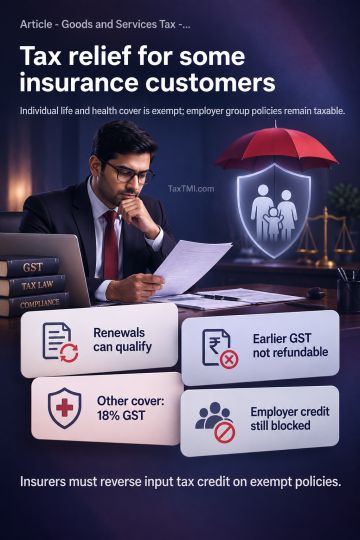
For years, the price of health insurance in India carried a quiet sting. A family floater quoted at Rs. 25,000 a year actually cost Rs. 29,500, because 18% GST sat on top of the base premium. You paid the tax, the insurer collected it, and most of us simply accepted it as part of the price.
That changed on 22 September 2025. From that day, GST on individual life and health insurance premiums is nil. If you buy or renew an individual health or term plan today, the premium you are quoted is the premium you pay. There is no tax line any more.
What changed, and when
The GST Council decided this at its 56th meeting on 3 September 2025, and the change was put into law through Notification No. 16/2025-Central Tax (Rate). It took effect on 22 September 2025, alongside the rest of the GST 2.0 rate restructuring.
The exemption covers individual policies - the ones families actually buy for themselves:
- Individual health insurance, including family floater plans, senior citizen plans and critical illness covers.
- Individual life insurance, including term plans, endowment plans, ULIPs and annuities.
- Reinsurance of these individual policies.
It applies to new policies and to renewals. If your renewal premium was paid on or after 22 September 2025, it carries no GST, even if the renewal date itself fell earlier. The change is not retrospective, though - GST already paid on earlier premiums is not refunded.
The maths: what a family actually saves
Here is where most people get the number slightly wrong. Removing 18% GST does not cut your bill by 18%. The tax was charged on the base premium, so the saving is 18/118 of the old total - about 15.25%.
Take a family floater with a base premium of Rs. 25,000 a year:
Base premium: Rs. 25,000. GST at 18%: Rs. 4,500 before 22 Sept 2025, Nil now. Total payable: Rs. 29,500 before Rs. 25,000 now. Saving: Rs. 4,500 a year.
On a Rs. 30,000 base premium, the saving is Rs. 5,400 a year. Kept flat over ten years, the Rs. 25,000 example saves Rs. 45,000 - though in practice base premiums do not stay flat, which brings us to the catch.
Who does not benefit
The exemption stops at the front door of the individual policy. It does not extend to group insurance. Employer-sponsored group health and group life policies still carry 18% GST, and so do motor, fire, marine, travel and other general insurance covers.
If your only health cover is the policy your employer buys for you, this change did not reduce your premium at all. The difference matters when you are comparing the two: an individual family floater you buy yourself is now taxed at nil, while the same cover routed through an employer still carries the full 18%.
The part nobody mentions: insurers lost their input tax credit
An exemption is not the same as a zero rate, and the distinction has a cost. When a service is exempt, the supplier cannot claim input tax credit on its own expenses. The CBIC clarified this in its FAQs when the new rates took effect: from 22 September 2025, insurers cannot claim input tax credit on GST paid on commissions, brokerage and other input services for individual health and life policies. That credit has to be reversed. Only reinsurance services stay exempt on the input side.
So the insurer still pays GST on its own costs - agent commissions, software, office services - and can no longer recover it. That cost sits with the insurer every year. It does not cancel the saving, but it pushes in the opposite direction, and it is one reason base premiums can still rise. The Department of Financial Services told insurers to pass the benefit of the tax cut on to existing and new policyholders, but the tax cut does not freeze the base premium. Medical inflation moves it, and the lost input credit gives insurers one more reason to nudge it up at renewal.
The latest update: October 2026 brings relief for employers
There is a second chapter to this story, and it arrived at the 57th GST Council meeting on 8 October 2026. The Council recommended amending Section 17(5) of the CGST Act so that employers can claim input tax credit on health and life insurance bought for their employees.
Until now, that GST has been blocked credit - a dead cost. An employer paying 18% GST on a group health policy could not set it off against anything. The employer group health segment is large: premiums crossed Rs. 68,000 crore in FY26, which means the GST component is roughly Rs. 12,240 crore. If the amendment goes through, that tax stops being a pure cost for GST-registered employers, and providing cover to staff gets cheaper - something that matters most to smaller businesses, which use group cover to attract and keep people.
Two cautions. First, the Council only recommended the change; it becomes law when the amendment is actually passed, so employers cannot claim the credit yet. Second, most group policies cover employees' families too, and it is not yet clear whether the credit will extend to the family portion of the premium or only to the employee. That question is likely to be argued over before the dust settles. The premium itself stays at 18% either way - what changes is whether the employer can recover the tax.
Renewal checklist: what to check before you pay
- The GST line should read nil. On an individual or family floater renewal, there should be no GST charged at all. If the notice still shows 18%, ask the insurer before paying.
- Look at the base premium, not just the total. Your total may still be lower than last year, but check whether the base premium quietly rose. The tax saving is real; a base hike can eat part of it.
- Check riders and add-ons. The exemption covers the policy itself. Confirm how any rider or add-on has been billed.
- Mind the grace period. For annual, half-yearly and quarterly policies the grace period is 30 days; for monthly premium modes it is 15 days. Cover continues if you pay within it, but do not test the edge.
- Keep the receipt for Section 80D. The deduction is claimed on the premium actually paid, and the limits have not changed - Rs. 25,000 for self and family Rs. 50,000 where a senior citizen is covered. A lower premium simply means a smaller deduction amount.
- If your cover is through your employer, expect no change. Group policies still carry 18% GST. The October 2026 recommendation helps your employer, not your payslip - at least for now.
What has not changed
- GST paid before 22 September 2025 is gone. There is no refund mechanism for it.
- Motor, fire, marine, travel and other general insurance still attract 18% GST.
- Section 80D deduction limits are unchanged, and the deduction is available under the old tax regime on the premium actually paid.
- Nothing about the cover itself has changed - sum insured, waiting periods, exclusions and claim rules are exactly as they were. This was a tax change, not an insurance change.
- Group health and life cover still carries 18% GST, pending the Section 17(5) amendment.
The honest summary is this: for a family buying its own health cover, the state has stopped taxing the premium, and that is worth roughly Rs. 4,500 a year on a Rs. 25,000 policy. It is real money, but it is not a price freeze. Check the renewal notice line by line - the GST line should be zero, and the base premium is the number to watch.
----
Vikram Singh