 TaxTMI





 05 Nov 2026

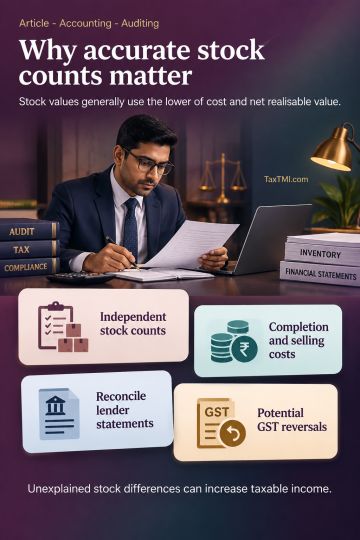
Inventory is where reported profit most often turns out to be imaginary - through shrinkage, obsolescence, sloppy records and hopeful valuation. Here is how practitioners can keep it honest.
In 1963 inspectors examining tanks at the Allied Crude Vegetable Oil Refining Corporation in New Jersey made a startling discovery. Many tanks supposedly full of soybean oil held mostly water, with a thin film of oil floating on top.
The owner, Anthony "Tino" De Angelis, had pledged the supposed oil as collateral for large loans. When the "salad oil scandal" unravelled, lenders and major financial firms - among them a subsidiary of American Express - suffered heavy losses.
Inspectors had visited those tanks for years. They had measured; they had never verified.
The comforting number
The ledger shows Rs. 50 lakh of stock. The owner is reassured, the bank accepts the stock statement for the drawing-power calculation and the P&L looks healthy.
Then somebody counts. Some items are missing, others damaged. Some haven't moved in three years. Some were sold but never invoiced. Some exist only because a purchase bill was posted twice.
The real saleable value is far lower - and part of last year's reported profit never existed.
Lesson from history: record-keeping began with goods
Archaeologist Denise Schmandt-Besserat's work on clay tokens from the ancient Near East suggests that some of humanity's earliest records, thousands of years before coinage, were tallies of goods - measures of grain, jars of oil, heads of livestock. Many scholars think writing itself grew partly from that need.
For as long as people have stored goods, they've needed to answer one question: is what we recorded actually there? It remains the core of inventory control.
Why inventory is so risky
Inventory sits where operations, accounting, tax and finance intersect, making it one of the easiest places for error and fraud to hide.
- Closing stock moves profit rupee for rupee. Overstate it and profit rises by the same amount.
- Stock secures borrowing. Many working-capital limits rest on stock statements submitted to banks.
- Stock absorbs cash. Money in slow movers isn't available for salaries, suppliers or growth.
- Stock is physical. It can be lost, stolen, damaged, expire or go obsolete.
Every unit on the shelf is cash that changed shape. Some of it never changes back.
Where inventory losses come from
1. Shrinkage - theft, pilferage, breakage, spoilage and recording slips.
2. Obsolescence - changing fashions and technology, spares for discontinued models, goods nearing expiry.
3. Recording errors - receipts not entered, dispatches without invoices, unrecorded returns, transfers booked twice or not at all.
4. Valuation errors - Ind AS 2 and IAS 2 generally require inventory at the lower of cost and net realisable value (expected selling price less costs to complete and sell). Carrying damaged or slow stock at full cost overstates assets and profit.
5. Deliberate inflation - boosting stock to show higher profit or secure larger limits, which can amount to misrepresentation to lenders and tax authorities.
The uncomfortable reality
Plenty of businesses value stock on hope: "it'll sell eventually," "those parts will come in handy," "we'll get a good price when the market turns." Sometimes it sells. Often it ties up cash and space for years before being written off in one painful entry.
In a nutshell
Essence: inventory is cash in physical form, and every gap between the books and the shelf is a gap between reported and real profit.
The COUNT Discipline
Five habits keep inventory honest - COUNT:
C - Custody kept apart from records
The person who looks after stock shouldn't be its only recorder and should never count alone.
Control: separate storekeeping, recording and counting; restrict godown access and use CCTV and security proportionate to value.
O - Observe through regular counts
- A full physical verification at least annually, ideally at year-end.
- Cycle counts - a rotating slice of items each week or month - for high-value or fast-moving lines.
- Counters independent of the custodians.
- Every difference investigated and approved before the books are adjusted.
U - Unmoved stock reviewed monthly
- A monthly ageing report.
- Items idle for 90, 180 and 365 days flagged.
- A decision for each: discount, return to supplier, rework, donate or write off.
N - Net realisable value tested
Compare cost with current selling price less costs to sell; write down where value has fallen, and be candid about damaged and expired goods.
T - Track through one system
- Goods received notes matched to POs and invoices.
- Delivery challans and invoices for every dispatch.
- Purchasing, stores, production and sales linked so movements update automatically.
- Barcodes or RFID where volumes justify them.
Stock statements and the bank
Stock statements given to lenders must agree with the books and with reality. Differences between quarterly statements and audited figures are a classic credit red flag - and the salad oil case shows why lenders verify collateral.
Control: reconcile stock statements to the ledger before submission and never "round up" stock to support a limit.
Tax and compliance angles
- Unexplained stock differences found during surveys or audits can lead to additions to taxable income.
- Under GST, input tax credit on goods lost, stolen, destroyed or written off generally has to be reversed.
- Stock records must be maintained under indirect-tax and company law.
Clean records protect against tax disputes as well as losses.
For practitioners: what auditors and advisers should do
- Attend the count. Observe physical verification, perform test counts both floor-to-sheet and sheet-to-floor, and document cut-off for goods in transit.
- Reconcile quarterly stock statements. Compare each statement submitted to banks with book records and explain material differences, as CARO reporting requires where limits exceed thresholds.
- Test NRV with evidence. Use post-year-end sales prices and ageing data; challenge management's "it will sell" assumptions in writing.
- Check ITC on write-offs. Confirm GST credit has been reversed on goods written off, lost or destroyed.
- Recommend cycle counting. Advise clients with recurring count differences to move to ABC-based cycle counts and quarterly reporting to management.
Manage inventory as cash
- Inventory days = average inventory / cost of goods sold x 365; rising days mean more cash trapped.
- ABC analysis: tightest control on the few items that make up most of the value.
- Reorder levels set on actual demand and lead times, not habit.
- Supplier terms: smaller, more frequent deliveries where practical.
Indicators of success
- Count accuracy within a small tolerance of system records.
- Inventory days falling without more stockouts.
- Slow and obsolete stock shrinking as a share of the total.
- Write-offs falling and explained.
- Unexplained shrinkage declining quarter after quarter.
Outlook: the coming decade
Barcode scanning, RFID, computer vision and AI demand forecasting are making real-time inventory tracking affordable for mid-sized firms. Auditors and lenders increasingly rely on system data, and GST and e-way bill records let tax authorities compare stock movements with returns. Stock that can't be counted will become stock that can't be financed or defended.
Immediate actions by role
- Owner: ask for the value of stock older than 180 days.
- Warehouse head: begin weekly cycle counts of the 20 highest-value items.
- Finance: reconcile stock records to the general ledger every month.
- Purchasing: stop reordering items with more than six months' cover.
Illustration from a smaller enterprise
Take an illustrative electrical-goods distributor whose books show Rs. 4 crore of stock. A full physical count finds Rs. 3.3 crore usable; the rest is damaged, obsolete or missing.
The owner introduces weekly cycle counts, a monthly slow-mover review and a rule that nothing leaves without a scanned invoice. Within a year accuracy exceeds 98% Rs. 60 lakh of old stock is cleared at a discount and working capital falls. Seeing reliable stock statements, the bank raises the working-capital limit.
The objection we hear most - and our response
The objection: "We know our stock. Our storekeeper has been with us fifteen years. Regular counting wastes time and disrupts operations."
The answer: Long-serving, trusted staff are exactly whom fraud research warns about - not because they're dishonest, but because nobody checks them. And cycle counting is designed to avoid disruption: a few items a week, rotating through the range over a quarter. It also protects honest storekeepers by proving their stock is right. Counting isn't an accusation. It's evidence.
Practitioners' FAQ
"How often should stock be counted?"
High-value items weekly or monthly through cycle counts; everything at least once a year.
"What should happen to obsolete stock?"
Identify it, sell or dispose of it, and correct its book value - holding it only adds cost.
"How do stock errors affect tax?"
Wrong values distort profit and can create mismatches with GST and income-tax records.
Position as at October 2026: In India, companies' auditors report on physical verification of inventory and on discrepancies in quarterly stock statements filed with banks for working capital limits above prescribed thresholds. GST rules on reversal of input tax credit for lost or written-off goods continue. Check current reporting requirements with your auditor.
Pitfalls
- Accepting the storekeeper's figures without independent checks.
- Ignoring small count differences - they compound.
- Carrying slow stock at full cost because "it might sell."
- Submitting inflated stock statements to banks.
- Bulk buying for discounts without weighing storage, obsolescence and cash cost.
Terms explained
- Cycle count - counting a small group of items regularly instead of everything once a year.
- Shrinkage - stock lost through theft, damage or errors.
- Inventory days - how many days of sales current stock would cover.
- Obsolete stock - items that can no longer be sold at normal prices.
- Stock statement - a periodic stock report given to banks to support borrowing limits.
Action checklist
Top 20 items by value counted weekly
Stock records reconciled with the ledger monthly
Items over 180 days old reviewed for clearance
Half-hour action exercise
1. Pull the ageing report: what share of stock value hasn't moved in 180 days?
2. Pick ten high-value items and count them this week with someone independent of the store.
3. Compare count with books and investigate every difference.
4. Calculate inventory days for two years - is the trend rising?
If more than 15-20% of stock is older than 180 days, cash - and probably profit - is tied up in hope.
Summary for busy professionals
- Inventory touches profit, borrowing, cash and tax, so losses and manipulation hide there easily - as the salad oil scandal showed.
- Losses stem from shrinkage, obsolescence, recording errors, overvaluation and deliberate inflation.
- Apply COUNT: Custody apart from records, Observe through counts, Unmoved stock reviewed, NRV tested, Track in one system.
- Reconcile bank stock statements with books and reality.
- Treat inventory as trapped cash - watch inventory days and use ABC analysis.
Stock that hasn't been counted is stock you're only assuming you own.
References
- Norman C. Miller, The Great Salad Oil Swindle (Coward-McCann, 1965).
- Denise Schmandt-Besserat, How Writing Came About (University of Texas Press, 1996).
- Ind AS 2 / IAS 2, Inventories.
- Companies (Auditor's Report) Order, 2020 (India), clause on inventory and stock statements. mca.gov.in
- Central GST Act, 2017, section 17(5) on blocked credits for goods lost, stolen, destroyed or written off.