 TaxTMI





 05 Nov 2026

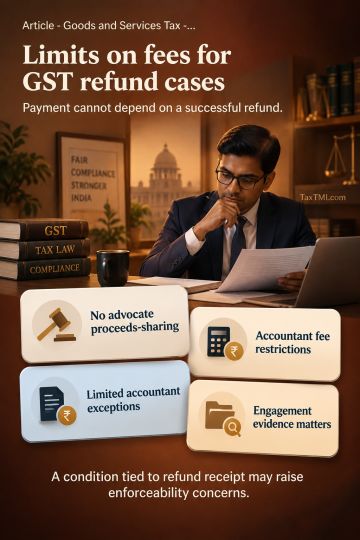
The District Court, Saket (South District), New Delhi in Mr Rajinder Kumar Sethi Versus M/s Miso Study India Pvt Ltd and Mr. Ashish Jacob - 2026 (10) TMI 2068 - DISTRICT COURT SAKET decreed the suit for recovery of professional fees of Rs. 5,25,000/- filed by an Advocate who had represented the assessee in GST refund proceedings up to the first appellate stage, and held that the assessee cannot, by way of an afterthought, make payment of the agreed professional fees contingent upon the refund being credited to its bank account when no such agreement existed between the parties.
Facts:
- Mr. Rajinder Kumar Sethi (“the Plaintiff”), an Advocate, was engaged in January 2021 by M/s. Miso Study India Pvt. Ltd. (“the Defendant”) to pursue a GST refund claim of Rs. 60,61,000/- pertaining to the Financial Years 2017-18, 2018-19 and 2019-20. As per the Plaintiff, the professional fee was agreed at Rs. 5,25,000/- for handling the matter up to the appeal before the Special Commissioner, Department of Trade and Taxes, Government of NCT of Delhi. A Power of Attorney was executed by the Director of the Defendant authorising the Plaintiff to represent the company in the GST refund case.
- Upon rejection of the refund claim by the Proper Officer, the Plaintiff filed an appeal under Section 107 of the Central Goods and Services Tax Act, 2017 (“the CGST Act”) in March 2021, appeared on various dates of hearing and concluded arguments on October 28, 2022. The appeal was disposed of by the Special Commissioner vide order dated January 30, 2023, which recorded the appearance of the Plaintiff as the Authorised Representative of the Defendant.
- The Plaintiff raised an invoice dated July 09, 2022 for Rs. 5,25,000/- and followed it up through e-mail, speed post and reminders. The Defendant, vide e-mail dated September 28, 2022, stated that the fee of Rs. 5,25,000/- would be paid only after the case was won and the refund was credited to its bank account, and only if the refund exceeded Rs. 50,00,000/-. The Plaintiff objected to this condition and issued a legal notice dated February 18, 2023. The Defendant, vide reply dated February 20, 2023, reiterated its refusal. Hence, the suit for recovery along with interest at 18% per annum and litigation costs of Rs. 35,000/- was filed.
- The Plaintiff contended that he was engaged directly by the Defendant, that the fee was a fixed fee, and that a fee contingent upon the result of the case is contrary to the standards of professional conduct applicable to Advocates.
- The Defendant contended that there was no privity of contract with the Plaintiff, as it had engaged M/s. Relan & Associates, Chartered Accountants, who in turn had engaged the Plaintiff; that the suit was bad for non-joinder of the said firm; that under its arrangement with the firm, fees were payable only upon credit of the refund; that the arrangement was terminated owing to an alleged demand for illegal gratification; and that the Plaintiff, holding only a Power of Attorney and not a vakalatnama, was merely an agent.
Issues:
- Whether the Defendant had directly engaged the Plaintiff for the GST refund proceedings on an agreed professional fee of Rs. 5,25,000/-?
- Whether the suit was bad for non-joinder of the Chartered Accountant firm as a necessary party?
- Whether the Plaintiff is entitled to recover the professional fee with interest when the Defendant asserts that the fee was payable only upon the refund being credited to its bank account?
Held:
The District Court, Saket (South District), New Delhi in Mr Rajinder Kumar Sethi Versus M/s Miso Study India Pvt Ltd and Mr. Ashish Jacob - 2026 (10) TMI 2068 - DISTRICT COURT SAKET held as under:
- Observed that, the Power of Attorney executed by the Director of the Defendant specifically authorised the Plaintiff, described therein as a lawyer, to represent the Defendant in its GST refund case, and its execution was admitted by the Defendant’s witness in cross-examination. Thus, the engagement of the Plaintiff by the Defendant stood established.
- Noted that, the order dated January 30, 2023 passed by the Special Commissioner recorded that the Plaintiff had appeared as the Authorised Representative of the Defendant on various dates and concluded the arguments. Thus, the rendering of services by the Plaintiff was firmly established.
- Noted that, the Defendant in its own e-mail dated September 28, 2022 acknowledged the fee of Rs. 5,25,000/-, while seeking to attach a condition of payment only after refund. Further, the Defendant’s witness admitted in cross-examination that there was no agreement between the Plaintiff and the Defendant providing that the fee would be paid only after the GST refund was transferred to the Defendant’s account.
- Observed that, the condition making the fee contingent upon refund or upon winning the case was clearly an afterthought. Relying upon the judgment of the Hon’ble Madras High Court in S. Ramasamy v. State of Tamil Nadu [W.P. No. 32337 of 2012], the Court reiterated that the relationship between a lawyer and a client rests more on trust than on contract, and that once the fee is agreed and the work is completed, the client cannot go back on its promise.
- Held that, the allegations of bribery raised by the Defendant were not established on record and the Defendant had not been truthful. Accordingly, all the issues, including that of non-joinder, were decided in favour of the Plaintiff.
- Directed that, the suit be decreed for Rs. 5,25,000/- along with pendente lite and future interest at 6% per annum from the date of filing of the suit till realisation, as against 18% claimed, in view of Section 34 of the Code of Civil Procedure, 1908 (“the CPC”) and the judgment of the Hon’ble Supreme Court in Central Bank of India Versus Ravindra - 2001 (10) TMI 1065 - Supreme Court. No order was made as to costs.
Our Comments:
Although the dispute is a civil recovery suit, the ruling is of direct relevance to every professional engaged in litigation, as it arises from a routine situation, namely a refund matter pursued up to the first appellate stage, an oral fee arrangement, and a client who declines to pay because the refund has not been received.
Section 116 of the CGST Act permits a person to appear before a GST officer or the Appellate Authority through an authorised representative, which under Section 116(2) includes, inter alia, an Advocate entitled to practise in any court in India and a Chartered Accountant holding a certificate of practice. Appearance before such authorities is on the strength of a letter of authorisation, and a vakalatnama is not the prescribed mode. The Defendant’s plea that the Plaintiff was a mere agent for want of a vakalatnama therefore does not sit well with the statutory scheme, and the Court, relying on the appellate order recording the Plaintiff as the Authorised Representative, treated the engagement as a professional one.
On the question of contingent fees, Rule 20 of the Bar Council of India Rules (Part VI, Chapter II, Section II) provides that an Advocate shall not stipulate for a fee contingent on the results of litigation or agree to share the proceeds thereof. The Hon’ble Supreme Court in In the matter of ‘G’, a Senior Advocate [AIR 1954 SC 557] held that an agreement by an Advocate to receive a share in the proceeds of litigation amounts to professional misconduct. Further, the Hon’ble Supreme Court in B. Sunitha Versus The State of Telengana And Anr. - 2017 (12) TMI 395 - Supreme Court held that a claim of fee based on a percentage of the subject matter of litigation is professional misconduct and that such an agreement is opposed to public policy and hit by Section 23 of the Indian Contract Act, 1872. Seen in this light, even if the Defendant had succeeded in proving an arrangement making the Advocate’s fee payable only upon credit of refund, the enforceability of such a condition would itself have been doubtful.
A similar restriction applies to Chartered Accountants. Clause (10) of Part I of the First Schedule to the Chartered Accountants Act, 1949 treats charging of fees based on a percentage of profits or contingent upon the findings or results of the professional employment as professional misconduct, except as permitted under Regulation 192 of the Chartered Accountants Regulations, 1988, which carves out limited exceptions. Success-fee arrangements for GST refund matters should therefore be examined against these provisions before being entered into.
It is also relevant that the Hon’ble Supreme Court in RD. Saxena Versus Balram Prasad Sharma - 2000 (8) TMI 1001 - Supreme Court held that an Advocate has no lien over the files and papers of the client for unpaid fees and that the remedy lies in legal proceedings for recovery. The present case is an illustration of that remedy being successfully invoked.
On the other hand, the judgment has certain limitations. First, the issues were decided collectively, and the plea of non-joinder of the Chartered Accountant firm and the alleged back-to-back arrangement between the Defendant and the firm were not separately analysed; where the documentary trail shows engagement only through an intermediary firm, the question of privity may be decided differently. Second, interest was restricted to 6% per annum as against 18% claimed. In terms of the proviso to Section 34 of the CPC read with Explanation II thereto, future interest above 6% may be awarded where the liability arises out of a commercial transaction, that is, one connected with the industry, trade or business of the party incurring the liability, and it is arguable that professional fees for a company’s tax litigation fall within this description. Third, being a judgment of a District Court, it carries persuasive value only and is appealable under Section 96 of the CPC.
As a matter of practice, professionals handling refund, adjudication and appellate matters would be well advised to record the engagement in a written engagement letter addressed to and accepted by the client directly, specifying the scope and stage of work, the fixed fee, the milestones for payment, reimbursement of expenses and interest on delayed payment. In the present case, the Plaintiff succeeded largely because the client’s own e-mail acknowledged the quantum of fee and its witness admitted the absence of any contingent arrangement.
(Author can be reached at [email protected])