

Loading...

⚠ ✕
❮ Top
☎ Help
☰
×

By creating an account you can:

Logo TaxTMI
Call Us / Help / Feedback✕

Contact Us At :

✉ E-mail: [email protected]

✆ Call / WhatsApp at: +91 99117 96707

For more information, Check Contact Us

FAQs :

To know Frequently Asked Questions, Check FAQs

Most Asked Video Tutorials :

For more tutorials, Check Video Tutorials

Submit Feedback/Suggestion :

Email :
Please provide your email address so we can follow up on your feedback.
Category :
Description :
Min 15 characters 0/2000
Make Most of Text Search ✕
  1. Checkout this video tutorial: How to search effectively on TaxTMI.
  2. Put words in double quotes for exact word search, eg: "income tax"
  3. Avoid noise words such as : 'and, of, the, a'
  4. Sort by Relevance to get the most relevant document.
  5. Press Enter to add multiple terms/multiple phrases, and then click on Search to Search.
  6. Text Search
  7. The system will try to fetch results that contains ALL your words.
  8. Once you add keywords, you'll see a new 'Search In' filter that makes your results even more precise.
  9. Text Search
╳
Add to...
You have not created any category. Kindly create one to bookmark this item!
✕
Create New Category
Hide
Title :
Description :
❮❮ Hide
❮ Default View
Expand ❯❯
Close ✕
🔎 Filters / Advanced Search ❯
TEXT

Press 'Enter' to add multiple search terms. Rules for Better Search

Search In
Main Text + AI Text ❯
  • Main Text
  • Main Text + AI Text
  • AI Text
Category: ?
Categorized by AI
---- All Categories ---- ❯
  • ---- All Categories ----
  • Income Tax
  • GST
  • Customs, DGFT & SEZ
  • FEMA & RBI
  • Corp. Laws, SEBI & IBC
  • PMLA, Black Money & ED
  • Budget
  • News and Press Release
  • PTI News
Month:
---- All Months ---- ❯
  • ---- All Months ----
  • January
  • February
  • March
  • April
  • May
  • June
  • July
  • August
  • September
  • October
  • November
  • December
Year:
---- All Years ---- ❯
  • ---- All Years ----
  • 2026
  • 2025
  • 2024
  • 2023
  • 2022
  • 2021
  • 2020
  • 2019
  • 2018
  • 2017
  • 2016
  • 2015
  • 2014
  • 2013
  • 2012
  • 2011
Sort By: ?
In Sort By 'Default', exact matches for text search are shown at the top, followed by the remaining results in their regular order.
Relevance Default Date
☰   Show Results ❯
    Recommendations of the 57th Meeting of the GST Council
    India Began Building Bridges When the World Was Building Walls: Union Minister of Commerce and Industry Shri Piyush Goyal
    CCI approves acquisition of sole control over Omega-Meyer Ltd and Meyer Organics by BCPE Wellbeing Holdco Two Ltd. and Integral Investments Asia IV Lt...
    CCI approves proposed acquisition of 100% shareholding of Vishavari Tollway Ltd and nine SPVs operating road assets in India by Concessoc 41 SAS
    CCI approves acquisition of certain shareholding in Prestige Hospitality Ventures Limited by CPP Investment Board Pvt. Holdings (4) Inc.
    CCI approves proposed combination related to internal restructuring of the JSW Group
    NLMC Organises Mock E-Auction Training Ahead of RINL Land E-Auction
    Central Bureau of Narcotics (CBN) conducts Jan Samvad at Malana in Kullu District to create preventive drug awareness and to promote development
    Adopted Joint Statement after the India-UK Financial Markets Dialogue 2026, held in London
    Commerce Secretary Shri Rajesh Agrawal Calls for Greater Utilisation of India-EFTA TEPA Opportunities
    Commerce and Industry Minister Shri Piyush Goyal Holds Meetings with Leading U.S. Companies in New York to Strengthen India–U.S. Trade and Investmen...
    Monetary Policy Statement, 2026-27 Resolution of the Monetary Policy Committee October 5 to 7, 2026
    An Approach Paper on Expanding the scope and coverage for the Index of Services Production
    DRI cracks down on cross-border gold smuggling along Indo-Bangladesh border; seizes over 8.3 kg foreign-origin gold; 4 arrested
    Secretary, DFS, Shri Sanjay Lohiya chairs review meeting on progress of Financial Inclusion Schemes with senior executives of Public Sector and Privat...
    Cabinet approves Commitment of Rs.10,000 Crore towards establishment of the SME Growth Fund for direct equity investments in Small and Medium Enterpri...
    Cabinet approves setting up of Integrated Transport & Logistics Authority
    IICA observed 3rd IICA CSR Day on Gandhi Jayanti with a Special Address by the DG & CEO to Participants of the IICA Certified CSR Professional Program...
    Preserving Financial Stability in an Evolving World - Special Address by Shri Sanjay Malhotra, Governor, Reserve Bank of India, at the Fifth Kautilya ...
    Central Bureau of Narcotics (CBN) Rajasthan Unit observes National Anti-Drug Addiction Day with awareness programmes and cleanliness campaigns across ...
❮
❯
❯❯
Maximize Maximize Maximize
0 / 200
Expand Note
Add to Folder

No Folders have been created

+

Are you sure you want to delete "My most important" ?

NOTE:

News
Showing Results for :
Reset Filters
Results Found:
Show All Summaries Hide All Summaries
October 8, 2026
Show AI Summary
GST process reforms propose automated registration, reconciled returns, risk-based refunds, and standardized adjudication to reduce compliance burdens.
GST process reforms propose automated registration amendments and cancellations, simplified registration for qualifying e-commerce sellers, return reconciliation tools, and electronic mechanisms for reverse-charge reporting and input tax credit correction. Risk-based automated refund processing is proposed for electronic cash-ledger, zero-rated, and inverted-duty claims. Input tax credit refunds would extend to specified input services and capital goods, while several blocked-credit restrictions are proposed for removal. Dispute reforms include notice standards, a minimum threshold for show-cause notices, revised penalties, and capped pre-deposits in penalty-only appeals.
October 8, 2026
Show AI Summary
Free trade agreement utilisation enables MSME market access, rules-of-origin awareness, export participation, and foreign investment opportunities while protecting sensitive sectors.
Free Trade Agreements are positioned to preserve sensitive domestic interests, particularly agriculture, fisheries and MSMEs, while widening market access for agricultural, marine, engineering, precision and electronic products and facilitating foreign investment. Proposed FTA utilisation desks across State Councils would assist MSMEs in using preferential arrangements, understanding rules of origin and market-access opportunities, participating in delegations and exhibitions, and presenting products and technologies to overseas markets.
October 8, 2026
Show AI Summary
Sole-control acquisition of nutraceutical and pharmaceutical businesses receives competition approval for Bain Capital-managed investment funds.
Competition Commission of India approval permits BCPE Wellbeing Holdco Two Limited and Integral Investments Asia IV Limited, funds managed or advised by Bain Capital, to acquire sole control over Omega-Meyer Limited and Meyer Organics Private Limited. The target businesses provide nutraceuticals globally and in India, while Meyer Organics Private Limited also produces and supplies certain over-the-counter and prescription finished-dose pharmaceuticals in India.
October 8, 2026
Show AI Summary
Highway asset acquisition approval covers full ownership transfer of a tollway operator and road-project special purpose vehicles.
Competition Commission of India approval covers the acquisition by Concessoc 41 SAS of the entire shareholding in Vishavari Tollway Private Limited and nine special purpose vehicles. The target entities operate designated national-highway stretches in Andhra Pradesh, Odisha and Gujarat, while Vishavari Tollway Private Limited provides operation and maintenance and engineering, procurement and construction services for those highway assets.
October 8, 2026
Show AI Summary
Competition clearance for hospitality share acquisition permits investment in a company owning and developing hotel and serviced apartment assets.
Competition Commission of India approved the proposed combination involving CPP Investment Board Private Holdings (4) Inc.'s acquisition of certain shareholding in Prestige Hospitality Ventures Limited. The target is an Indian public limited company within the Prestige group and owns and develops hospitality assets, including hotels and serviced apartments. The acquirer is incorporated in Canada and is managed by Canada Pension Plan Investment Board.
October 8, 2026
Show AI Summary
Internal group restructuring receives merger-control approval for amalgamating an integrated steel producer into the group's steel manufacturer.
Merger-control approval covers the proposed internal JSW Group restructuring through amalgamation of BMM Ispat Limited into JSW Steel Limited. The amalgamation would convert the group's majority interest in BMM into full ownership and is intended to enhance operational, financial and organisational efficiencies through economies of scale, resource pooling and capital rationalisation. BMM is commercially integrated in the group's supply chain through intra-group sales and procurements.
October 7, 2026
Show AI Summary
Transparent land e-auction procedures support bidder preparedness through mock training, registration and earnest-money requirements for phased asset monetisation.
National Land Monetization Corporation is facilitating a two-phase e-tender-cum-e-auction of 459 encumbrance-free land parcels of Rashtriya Ispat Nigam Limited through the RailTel E-Nivida e-Procurement Platform. Participation requires registration, fulfilment of prescribed requirements and submission of earnest money deposit within the applicable deadlines. Physical and online mock e-auction training familiarises prospective bidders with the bidding interface and participation procedure. Investor outreach provides information on plot details, eligibility requirements, registration and bidding conditions.
October 7, 2026
Show AI Summary
Preventive narcotics outreach promotes drug awareness, community participation, and sustainable livelihood alternatives to discourage illicit cannabis cultivation.
Preventive outreach in Malana village promoted drug awareness, youth engagement, community participation and alternative development in an area associated with illicit cannabis cultivation. Residents were sensitised to the harmful effects of cannabis, charas and hashish oil consumption and encouraged to pursue sustainable alternatives, including apiculture, animal husbandry, dairy activities and tourism. Community discussions addressed livelihood barriers, ecological concerns, and commitments to refrain from drug consumption and discourage illicit cannabis cultivation.
October 7, 2026
Show AI Summary
Cross-border financial cooperation guides work on market access, sustainable finance, fintech safeguards, and payment interoperability.
India-UK financial-markets cooperation covers capital-market connectivity, cross-border listings, investor access and development of GIFT IFSC as an international financial centre. Engagement also addresses insurance, pensions, asset management, sustainable-finance disclosures and cross-border investment. Fintech cooperation includes digital public infrastructure, central bank digital currencies, data exchange, responsible artificial intelligence, fraud prevention, cyber security and operational resilience. Cross-border payments work prioritises reduced frictions, transparency, efficiency and interoperability of electronic payment infrastructures.
October 7, 2026
Show AI Summary
Investment commitments and tariff predictability under India-EFTA TEPA support market access, supply-chain planning, and long-term bilateral trade.
India-EFTA TEPA establishes reciprocal market-access commitments, with EFTA coverage extending to most Indian exports and full coverage for non-agricultural products. Tariff predictability is intended to support investment planning, supply-chain development and longer-term business partnerships. Agricultural opportunities may arise where duties have been reduced to zero. Article 7.1 includes an investment commitment under which the EFTA States are to aim to increase foreign direct investment into India and facilitate employment generation within specified implementation periods.
October 7, 2026
Show AI Summary
Foreign investment engagement focuses on expanded partnerships across financial services, manufacturing, insurance, and emerging technologies in India.
India-U.S. trade and investment engagement was pursued through discussions with leading United States companies on expanding investment, partnerships and commercial operations in India. Financial-sector discussions addressed private equity, asset and wealth management, insurance, and financial services, including prospective engagement aligned with the objective of insurance access for all by 2047.
October 7, 2026
Show AI Summary
Policy repo rate recalibration responds to inflationary pressures, adopting calibrated tightening while future actions depend on growth and inflation conditions.
Monetary policy is recalibrated through an increase in the policy repo rate under the liquidity adjustment facility by 25 basis points to 5.50 per cent. The monetary policy stance shifts to calibrated tightening, indicating that near-term rate reductions are excluded and that subsequent action may consist of a rate increase or a pause, depending on evolving conditions and the outlook. Further rate action depends on growth-inflation developments, underlying inflation, broadening price pressures, second-round effects and demand impulses.
October 7, 2026
Show AI Summary
Index of Services Production expansion proposes broader service-sector coverage through education, health, residential care, public administration and defence.
The Index of Services Production is proposed to expand beyond its initial formal-sector coverage, which relies on high-frequency administrative data and GST outward-supplies data. Education, Human Health and Residential Care, and Public Administration and Defence are proposed for inclusion. Their incorporation would increase coverage of services-sector Gross Value Added and support aggregation of sub-sectoral indices into a unified measure of short-term services-sector movements. Stakeholder views are invited on the proposed methodology.
October 7, 2026
Show AI Summary
Cross-border gold smuggling enforcement addresses concealed foreign-origin gold transport through customs seizure, arrest, and investigation of organised networks.
Intelligence-led customs enforcement targeted cross-border gold smuggling through surveillance and interception of four persons travelling from a border route. Personal searches recovered foreign-origin gold biscuits concealed in specially tailored cloth waist belts. Seventy-two gold biscuits were seized under relevant provisions of the Customs Act, 1962, and the four persons were arrested. Investigation continues into organised networks and wider syndicates involved in the movement and distribution of smuggled gold.
October 6, 2026
Show AI Summary
Financial inclusion drives digital lending, insurance claim awareness, portal enrolment, and banking access for marginalised sections.
Banks were urged to expand brick-and-mortar branches and banking correspondent coverage in unbanked villages, strengthen digital outreach, and implement end-to-end digital loan processing. Working-capital lending for micro-enterprises through UPI-linked credit lines and credit cards was highlighted. Banks were also directed to increase awareness of insurance claim eligibility, exercise care in claim-related grievance handling, and enrol new PMJJBY and PMSBY beneficiaries through the Jan Suraksha portal.
October 6, 2026
Show AI Summary
SME growth equity fund targets scalable enterprises, prioritising manufacturing and industrial clusters to strengthen investment, productivity and competitiveness.
Union Cabinet approval commits Rs.10,000 crore towards establishment of the SME Growth Fund as an Alternative Investment Fund framework for direct equity investment in small and medium enterprises. The initiative is intended to catalyse long-term, patient growth capital for SMEs and address the identified shortage of equity financing for enterprises beyond the early stage, where existing equity-support funds predominantly serve micro and early-stage businesses.
October 6, 2026
Show AI Summary
Integrated transport planning framework establishes an SPV for national master planning, major-project appraisal, monitoring, and transport data analytics.
Integrated Transport & Logistics Authority will function as a special purpose vehicle for integrated transport and logistics planning, research, technical project appraisal, monitoring, policy support and data analytics. It will prepare a long-term National Transport Master Plan, assess sectoral and annual plans for alignment and multimodal integration, technically appraise and monitor specified major infrastructure projects, and undertake impact assessments. It will also maintain a unified transport data repository and support logistics-policy review, capacity building, training, skilling, research and innovation.
October 6, 2026
Show AI Summary
Corporate social responsibility should shift from statutory compliance to needs-based, evidence-led collaboration with impact assessment and technology-enabled monitoring.
CSR is grounded in trusteeship and in companies' responsibilities to employees, communities and the environment, rather than shareholders alone. The framework includes the Unspent CSR Account, multi-year projects, certification of fund utilisation and impact assessment. CSR is intended to leverage corporate resources, technology and expertise, rather than merely supplement public expenditure. Needs-based project selection, community participation, need and social-impact assessment, implementing-agency capacity, resource pooling and technology-enabled monitoring are emphasised to move from compliance and spending towards evidence-based transformation.
October 5, 2026
Show AI Summary
Financial stability requires targeted oversight and system-wide resilience against interconnected debt, leverage, cyber, technology, and cross-border shocks.
Financial stability is pursued by strengthening resilience rather than preventing every shock. The framework combines prudent regulation, risk-based supervision, stress testing, countercyclical macroprudential measures, targeted temporary liquidity assistance and resolution. Monetary policy remains directed to price stability, while financial-stability risks are addressed through regulatory, supervisory and macroprudential tools. System-wide resilience requires sound banks and NBFCs, reliable payment and technology infrastructure, robust data on interconnected exposures, scenario analysis, credible safety nets, and proactive proportionate oversight of cyber, model and third-party risks.
October 5, 2026
Show AI Summary
Drug-abuse prevention awareness promotes informed refusal, resistance to peer pressure, community participation, drug-de-addiction pledges, and healthy drug-free lifestyles.
Drug-abuse prevention awareness in opium-cultivation areas focused on the harms of opium, cannabis and other illicit drugs, informed refusal at first exposure, resistance to peer pressure, and prevention of progression from use to dependence. Programmes for students, cultivators and residents used interactive sessions, campaign banners, community pledges, Gram Sabha participation and cleanliness drives to promote healthy drug-free lifestyles, community participation and collective action against addiction.

News

Back

All News

Showing Results for :
Reset Filters
No Records Found

News

Back

All News

Recommendations of the 57th Meeting of the GST Council

October 8, 2026

Contents
Plus +
Summary
Note

Note

-

Bookmark

Print

Print

  • GST Council recommends removal of arrest provisions under GST
  • GST Council recommends raising prosecution threshold from ₹1 crore to ₹5 crore
  • GST Council recommends reduction in general penalty from ₹25,000 to ₹10,000
  • GST Council recommends wider eligibility for input tax credit and refunds
  • GST Council recommends further simplification of registration and compliance processes
  • GST Council recommends faster refunds to improve working capital for businesses
  • GST Council recommends common standards for GST notices and proceedings
  • GST Council recommends measures for smoother movement of goods across states
  • GST Council recommends intelligence-based and authorised interception of goods
  • GST Council recommends simplified GST registration for small sellers on e-commerce platforms
  • GST Council recommends measures to facilitate export of services
  • GST Council approves in-principle optional scheme for small consumer-facing businesses with turnover up to ₹5 crore

Posted On: 08 OCT 2026 7:03PM by PIB Delhi

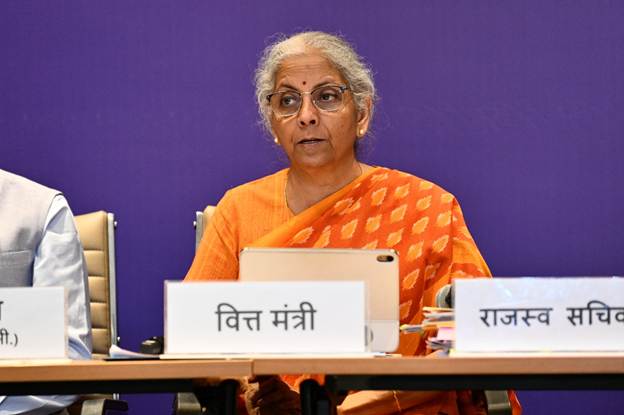
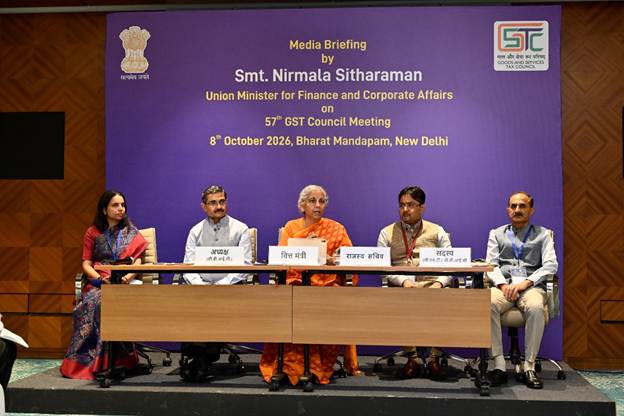
The 57th Meeting of the GST Council was held today in New Delhi, under the chairpersonship of the Union Finance & Corporate Affairs Minister Smt. Nirmala Sitharaman.
The participants included Chief Ministers of Delhi, Goa, Haryana, Jammu & Kashmir, Karnataka, Kerala, Maharashtra, and Meghalaya; Deputy Chief Ministers of Manipur and Telangana; the Finance Ministers and senior members of States/Union Territories with Legislative Assembly, Secretary, Department of Revenue; Chairman and Members of Central Board of Indirect Taxes & Customs and senior officials of the Ministry of Finance.
 

Next-Gen reforms made as per recommendations of the GST Council in its 56th meeting last year had focussed on rate rationalisation and reduction of rates. In the 57th meeting today, GST Council made recommendations relating to process reforms primarily covering registration, returns, refund and adjudication; clarifications regarding applicability of GST on supply of certain goods and services; and other measures for trade facilitation and streamlining compliances in GST. FAQs are being issued for clarification of doubts. Major recommendations made in the 57th GST Council meeting are as below:

A.       Process Reforms

A1.     Registration related reforms

1.        Streamlining registration process with clear guidelines on filing and processing

1.1      As per recommendations of GST Council made in 56th meeting, automatic registrations, without officer intervention, are being granted by the portal under rule 14A of the CGST Rules, 2017, in cases where the applicant does not intend to pass on ITC more than ₹2.5 lakh per month. To streamline processing of registration applications in remaining cases, the GST Council made the following recommendations in the 57th meeting:

  1. issuance of a comprehensive circular specifying the documents and information required for GST registration, along with frequently asked questions (FAQs), to simplify the filing and processing of registration applications.
  2. amendment in the registration application in FORM GST REG-01, to provide for drop boxes for selection of prescribed documents/information, so that both the taxpayer and the tax officer have clarity regarding the documents/information to be furnished.
  3. The GST portal to provide user-friendly interface, for filing registration application with clear navigational paths, drop-down lists, tool-tips and contextual guidance to facilitate correct filing of such applications.

1.2      This will reduce rejections and queries raised in respect of registration applications on account of lack of correct information/details and will expedite processing of registration applications by the tax officers.

2.        Rationalization of Procedure for Amendment in GST registration:

2.1      The GST Council recommended an amendment to rule 19 of the CGST Rules, 2017, to provide for automatic acceptance of amendments to all registration particulars on the portal, except those relating to the Principal Place of Business (PPoB). Further, for taxpayers registered under rule 14A of the CGST Rules, 2017 (automatic route), amendments of all registration particulars, including those relating to the PPoB, will be accepted automatically on the portal.

2.2      This will facilitate easy and almost real time updation of registration details on the portal in such cases, without interface with the tax officers.

3.         Rationalization of registration cancellation process under GST:

3.1       The GST Council recommended amendments in the CGST Act, 2017 and the CGST Rules, 2017, to simplify the registration cancellation process, as follows:

3.1.1    Automatic cancellation of registration on the application of the taxpayer

Phase 1: The applications for cancellation of registration in FORM GST REG-16 will be accepted automatically by the system, once all pending returns are filed and all dues are paid, in the following cases:

  1. where the taxpayer has not passed on ITC exceeding ₹2.5 lakh in any of the months since registration;
  2. where the taxpayer has passed on ITC exceeding ₹2.5 lakh in a month, but has filed the final return in FORM GSTR-10 within specified time period.

Phase 2: All the applications for cancellation of registration will be accepted automatically by the system, once all pending returns are filed and all dues are paid. FORM GST REG-16 will be amended so that the details of FORM GSTR-10 can be furnished in the said application itself.

3.1.2    Suo-moto cancellation of registration

  1. Amendment in rule 21 of the CGST Rules, 2017, to omit certain grounds of cancellation of registration by the tax officers.
  2. Amendment in rule 21A and rule 22 of the CGST Rules, 2017 and insertion of rule 23A in CGST Rules, 2017, to provide for a mechanism of system based cancellation and revocation of registration based on non-compliance and subsequent compliance of the defaults of non-filing return or non-furnishing of the details of the bank account, within specified time period.

3.2      These measures will simplify and expedite the process of cancellation of registration and will reduce officer interface and bring more transparency to the cancellation process.

4.        Simplified GST registration mechanism for small sellers on the Electronic Commerce Operators (ECO) platform:

4.1      The GST Council, in its 56th meeting had given an in-principle approval to provide a Simplified GST registration mechanism for small sellers on the Electronic Commerce Operators (ECO) platform. In continuity of the same, the Council in the 57th meeting recommended insertion of rule 14B in the CGST Rules, 2017, to provide for a simple mechanism for registration for small suppliers  making supplies of goods through ECOs, in States/UTs, where they do not have physical presence, and where they intend to pass on ITC not more than₹2.5 lakh per month, excluding stock transfers between distinct persons, by declaring the warehouse of an ECO in that State/UT, as their Principal Place of Business (PPoB). Registration in such cases will be granted automatically by the system, subject to certain conditions.

4.2      This will enable small sellers to expand their business to other States through e-commerce platforms without having to set up a place of business in each State and will give a significant boost to ease of doing business.

A2.     Return related reforms

5.        Alternate mechanism for making amendment of liabilities and input tax credit in returns to minimize mismatches and reduction of notices/intimations on account thereof:

5.1       The GST Council recommended inter-alia the following measures to streamline return filing process, so as to minimize mismatches in liability and input tax credit (ITC) in returns:

  1. Enhancements in FORM GSTR-1/1A/IFF to enable better reconciliation of the details furnished in these forms with the details reported in the return in FORM GSTR-3B.
  2. Insertion of a rule 86D in the CGST Rules, 2017, to provide for a facility namely, “Electronic Statement of tax paid on Reverse charge basis and input tax credit claimed” on the portal, to facilitate the taxpayers in correct reporting of tax liability and ITC on supplies liable to RCM in returns.
  3. Insertion of sub-rule (1A) in rule 61 of the CGST Rules, 2017 to provide a mechanism of correct reporting and correction/rectification of liability in the return, so that liability in the return in FORM GSTR-3B aligns with the details of liability furnished in FORM GSTR-1/1A/IFF.
  4. Amendment in FORM GST DRC-03, to declare the details of the underlying invoice for which payment has been made.
  5. Insertion of sub-rule (6A) in the rule 60 of the CGST Rules, 2017, in respect of the facility namely, Invoice Management System (IMS), to allow a recipient to accept, reject or keep pending a document pertaining to inward supply received on the portal, for the purpose of generation of statement of ITC in FORM GSTR-2B, subject to certain conditions, including the period for which a credit note can be kept pending on IMS.
  6. Insertion of rule 86C in the CGST Rules, 2017 to provide for a facility namely, “Electronic Credit Reversal and Reclaim Statement” on the portal, to facilitate the taxpayers in correct reporting of ITC reversed and reclaimed in FORM GSTR-3B.
  7. Insertion of sub-rule (1B) in the rule 61 of the CGST Rules, 2017, to provide a mechanism of correct reporting and correction/rectification of ITC in the return, so that ITC availed in the return in FORM GSTR-3B aligns with the details of ITC made available in FORM GSTR-2B.
  8. Issuance of a circular to clarify the manner of furnishing correct and proper information of ITC and reversal thereof in return in FORM GSTR-3B, in the context of IMS, Electronic Credit Reversal and Reclaim Statement and Electronic Statement of tax paid on Reverse charge basis and input tax credit.

5.2       The Council recommended that the provisions regarding alternate mechanism for amendment of liability and ITC in the GST return, may be brought into force from the return of April, 2027.These measures will considerably reduce mismatches in liability and ITC in returns, thus not only reducing demand notices and system generated intimations on account of such mismatches, but also improving the integrity of ITC across the supply chain, thereby facilitating taxpayers.

5.3       Further, the Council recommended placing the proposed revised mechanism in the public domain for a time-bound consultation. Union Finance Minister was authorized to approve requisite changes/modifications, as may be necessary, based on feedback received from the stakeholders.

A3.       Refunds related reforms

6.           Faster, system-based automated processing of refunds

6.1.     The GST Council recommended amendments in section 54 of the CGST Act, 2017 and the relevant CGST Rules, 2017, to provide for system-based processing and sanctioning of refund claims, pertaining to excess balance in electronic cash ledger, zero-rated supplies, and inverted duty structure, in the following two phases.

Phase 1:  

  1. Full refund claim of excess balance in the electronic cash ledger will be sanctioned automatically by the system, without officer intervention.
  2. Time limit for issuance of acknowledgement or deficiency memo to be reduced from 15 days to 10 days. Deemed acknowledgement by the system, where such acknowledgement or deficiency memo is not issued by the proper officer within 10 days of the application.
  3. For refund claims on account of zero-rated supplies and inverted duty structure, 90% of the amount claimed will be sanctioned on provisional basis automatically by the system, without officer intervention, on the basis of identification and evaluation of risk by the system.

Phase 2:

  1. System-based automated acknowledgment (without officer intervention) on due verification of the refund application by the system.  
  2. In such acknowledged cases, automated sanction of full refund claim by the system (without officer intervention), in respect of claims pertaining to zero rated supplies, after adjusting pending dues, if any, on the basis of identification and evaluation of risk by the system.


6.2      For expediting and streamlining the refund process, the Council further recommended amendments in the CGST Act, 2017 and the CGST Rules, 2017, to inter-alia provide for:

  1. Amendment in refund application in FORM GST RFD-01, to capture the details in the said application in a system-readable format and dispense with the requirement of uploading scanned documents in case of refund claims pertaining to zero rated supply and inverted duty structure.
  2. Amendment in rule 89(4)(C) of the CGST Rules, 2017, to remove the restriction for maximum amount of turnover of zero-rated supply of goods, as 1.5 times the value of like goods domestically supplied.
  3. Amendment in section 54(14) of the CGST Act, 2017, to add an explanation that the threshold of Rs. 1000 shall be applicable in respect of total refund amount, i.e. the amount under CGST, SGST/UTGST and IGST taken together.


6.3       With a view to ensuring greater clarity and certainty on the interest payable on refund of pre-deposit paid for filing appeals, the Council recommended, -

  1. amendment in section 115 of the CGST Act, 2017, to make it a standalone provision in respect of the rate of interest applicable for the refund of such pre-deposit amount, and
  2. issuance of a circular to clarify issues regarding rate of interest on refund of pre-deposit.

6.4.      These measures will streamline and expedite refund processing through greater automation and reduced manual intervention, thereby facilitating timely sanction of eligible refunds and reducing compliance burden for taxpayers as well as interface with the department. Introduction of automation will ensure transparency, certainty, and uniformity and will also improve cash flows for taxpayers.

A4.     Reforms related to dispute resolution

7.1      The GST Council recommended issuance of a circular to  provide comprehensive guidelines to the tax officers to streamline process of issuance of  demand notices, adjudication orders and appeal orders, inter alia, covering issues relating to, quality of demand notices and adjudication/appeal orders, timely issuance such notices/orders, proper invocation of grounds of fraud, wilful misstatement or suppression of facts only based on merits in each case, adherence to the principles of natural justice including the conduct of personal hearings.

7.2      Further, to reduce compliance burden and litigation, the Council further recommended amendment in section 73, section 74 and section 74A of the CGST Act, 2017, to inter-alia provide:

  1. minimum threshold of Rs. 10,000/- (CGST + SGST + IGST + Cess) for issuance of show cause notices. Thus, no notices will be issued if the tax amount involved is less than Rs. 10,000/-. The Council also recommended for a statutory provision to provide that any notices and appeals, involving an amount less than Rs. 10,000, and pending on date of the provision for the said minimum threshold coming into force, will be decided as if the said threshold of Rs. 10,000/- had been in force when the notice was issued.
  2. for deeming penalty amount as ‘charge’, where full tax amount is voluntarily paid, alongwith interest and penalty, within the specified time limit.
  3. for a reduced penalty of 5% in non-fraud cases, where tax along with interest is discharged within 30 days (under section 73) or 60 days (under section 74A) of the adjudication order.
  4. removal of condition of minimum penalty of Rs. 10,000/-, in non-fraud cases.

7.3       The GST Council recommended reducing the maximum general penalty under section 125 of the CGST Act, 2017 from Rs. 25,000/- to Rs. 10,000/-.

7.4       The Council recommended amendment in the provisos to section 107(6) and section 112(8) of the CGST Act, 2017 to provide an upper limit of ₹40 crore (Rs. 20 crore under CGST and Rs. 20 crore under SGST/UTGST) on the pre-deposit payable for filing an appeal before the Appellate Authority or the Appellate Tribunal, respectively, in cases where the order involves only penalty and no demand of tax. This will ease the financial burden on taxpayers and make it easier for them to access appellate remedies in such cases.

B.           Other major reforms under GST

B1.        Reforms for improving seamless flow of Input Tax Credit (ITC)

8.         Refund of accumulated ITC on account of capital goods and input services:

8.1         The Council recommended amendment in clause (ii) of proviso to section 54(3) of the CGST Act, 2017, and in the CGST Rules, 2017, to provide for refund of accumulated ITC on account of capital goods in case of refund pertaining to zero-rate supplies, and of accumulated ITC on account of input services and capital goods in case of refund pertaining to inverted duty structure.

8.2       The Council recommended that the refund of accumulated ITC on input services for refunds pertaining to inverted duty structure shall be available in respect of ITC availed on input services on or after 1st November, 2026.

8.3       In respect of refund of ITC on capital goods in refunds pertaining to zero rated supplies and inverted duty structure, the Council recommended that refund of ITC on capital goods will be spread over 60 months, and shall be available in respect of ITC availed on capital goods on or after 1st April, 2027.  

8.4         This will ease working capital constraints for taxpayers and remove blockage of ITC on account of input services and capital goods in such cases. 

9.        Rationalization of blocked ITC by amendment in section 17(5) of the CGST Act, 2017: The Council recommended amendment in section 17(5) of the CGST Act, 2017 to remove the restrictions on availment of ITC  inter-alia on the supplies of outdoor catering, health and life insurance, telecommunication towers, pipelines laid outside factory premises, free samples, goods destroyed or written off on expiry of shelf life as required by law. This will reduce the cascading of taxes and ensure a smoother flow of ITC across the supply chain.

B2.     Reforms relating to exports/zero rating of supplies of goods and services 

10.      The GST Council recommended:

  1. omission of sub-clause (v) of clause (6) of section 2 of the IGST Act, 2017, so as to remove the condition of supplier and recipient of services not being establishments of a distinct person, under Explanation 1 to section 8 of the IGST Act, 2017, for a supply of services to qualify as an “export of services”. This will facilitate refunds for Indian services providers in respect of services supplied to/through their foreign offices/branches and thus will promote export of services from India.
  2. issuance of a circular to clarify various issues related to receipt of payment in foreign exchange or Indian rupees as permissible, for export of goods and services.
  3. omission of clause (a) of section 13(3) of IGST Act, 2017, so that the place of supply for services in cases where goods are made physically available by the recipient of services to the supplier, will be determined as per the default provision under section 13(2) of the IGST Act, 2017 i.e. the location of the recipient of such services. This will facilitate access to export-related benefits under GST for Indian service providers providing such services to foreign recipients.
  4. insertion of an explanation to section 16(1) of the IGST Act, 2017 to provide that in the cases where goods are supplied to an overseas buyer, but the delivery of goods is made to the said buyer in an SEZ/FTWZ, and the payment for such supply is received in convertible foreign exchange or in Indian Rupees wherever permitted by the RBI, then such a supply will be deemed to be supply of goods to an SEZ/FTWZ. This will provide certainty regarding zero rating benefit to Indian manufacturers making supply of goods for overseas buyers by making delivery to them in an SEZ/FTWZ for warehousing or further processing.

B3.      Ease of living and doing business

11.      Rationalization of provisions relating to arrest and prosecution

11.1    The Council has recommended complete withdrawal of arrest powers under GST by omission of section 69 of CGST Act, 2017.

11.2    With a view to further strengthening a progressive and trust-based tax regime, while retaining effective deterrence against fraud and evasion, the Council recommended the following measures:

  1. The monetary threshold for prosecution to be raised from ₹1 crore to ₹5 crore.
  2. Omission of clause (i) of section 132(1) of the CGST Act, 2017, deletion of the words "evades tax" in clause (e) of section 132(1) and deletion of words "or in any other manner deals with" in clause (h) of section 132(1) of the CGST Act, 2017.
  3. Amendment in clause (c) of section 132(1) of the CGST Act, 2017, to cover only offence of fraudulent availment of ITC without receipt of goods or services or without invoice or bill.
  4. Rationalizing the amount of punishment for various offences under section 132 of the CGST Act, 2017.

12.       Rationalization of provisions relating to E-way Bill

12.1     The GST Council recommended amendments in section 68, section 129 and section 130 of the CGST Act, 2017 so as to inter-alia provide that, -

  1. a conveyance carrying goods can be intercepted only on specific intelligence and with the authorisation of an officer not below the rank of Joint Commissioner.
  2. Inspection and further action for detention or seizure can be taken when either the supplier, or the recipient, is located or registered in the State where interception is being made. No interception in the transit States.
  3. Where no e-way bill has been generated, or the conveyance is not carrying any document to show the origin or destination of the goods, as the case may be, the goods can be inspected, detained or seized, irrespective of the jurisdiction.
  4. Provision of confiscation of goods/conveyances under section 130 of CGST Act not applicable in respect of goods/conveyances in transit.

12.2     This will enable smooth movement of goods and conveyances and will improve businesses supplies and transportation efficiency.

13.       Treatment of transfer of title in Intellectual Property Rights (IPR): The Council recommended amendment in Schedule-II of CGST Act, 2017 to provide that transfer of title in IPRs, whether temporary or permanent, will be uniformly treated as supply of services. This will ease GST compliances and will facilitate smoother cross border transactions involving IPR.

14.      Amendment in rule 86A of the CGST Rules, 2017 to provide for opportunity of being heard to the taxpayer: The GST Council recommended amendment in rule 86A of the CGST Rules, 2017 to provide a mechanism for enabling a taxpayer to file an objection against blocking of any amount in electronic credit ledger and to avail a personal hearing before the proper officer takes a decision on such objection.

15.      Extending relief for small taxpayers on late fees: The GST Council recommended waiver of late fee on delayed filing of return under section 39(1) of the CGST Act, 2017, for taxpayers with an annual turnover up to Rs. 5 crore in the preceding financial year, if the said delayed return is filed by the end of the month in which it was due.

16.      Clarification in respect of various issues through circulars: The GST Council recommended issuance of circulars to provide clarity and to remove ambiguities arising due to varied interpretations by the field formations, in respect of the following issues:

  1. Issues relating to Input Service Distributor (ISD) mechanism for distribution of input service credit.
  2. Availment of input tax credit by banking companies and financial institutions including NBFCs who opt for section 17(4) of the CGST Act, 2017.
  3. Various issues relating to payment of pre-deposits.
  4. Admissibility of input tax credit in respect of demonstration vehicles in certain situations.
  5. Omission of rule 96 (10) of the CGST Rules, 2017 to be effective from 23.10.2017, in accordance with the Hon’ble Supreme Court decision.

17.      Concept note for an optional scheme for Annual Return Quarterly Payment (ARQP): The GST Council approved in-principle a concept note for an optional Annual Return Quarterly Payment (ARQP) scheme for taxpayers having an aggregate turnover equal to or less than Rs. 5 Crore in the preceding financial year and engaged exclusively in supplies to unregistered persons (B2C supplies).

18.       The Council also made the following recommendations to streamline compliances in GST:

  1. amendment in section 16, section 37 and section 39 of the CGST Act, 2017, to align provisions relating to furnishing of statement of outward supply under section 37 and the return under section 39 of the CGST Act, 2017 with the provisions relating to time limit for availment of input tax credit under section 16(4) of the CGST Act, 2017.
  2. amendment in section 9(5) of the CGST Act, 2017, to provide clarity regarding liability of the ECO to pay tax for the notified services, irrespective of the business models being followed by him.
  3. introduction of a validation clause in CGST Act, 2017, for validation of notices which have been held invalid by various courts on the ground of having been issued for multiple financial years.
  4. extending e-invoicing to domestic supplies received from an unregistered person where the tax is payable under reverse charge mechanism, as well as to the import of services, for taxpayers having aggregate annual turnover of Rs. 5 crore and above.

19.      The Council approved various amendments to the CGST Act, 2017 and the GSTAT (Appointment and Conditions of Service of President and Members) Rules, 2023 to align the provisions in respect of the GST Appellate Tribunal with the relevant provisions of the Tribunals Reforms Act, 2026 and the National Tribunals Commission and Qualification, Selection and Conditions of Service of Chairpersons and Members of Tribunals Rules, 2026.

C.       Changes/ Clarifications in relation to GST rates on Goods and Services:

C1.     Recommendations relating to goods

1.        To clarify that sublimation paper is classified under heading 4809. It has also been decided to regularise the past cases on “as is where is” basis.

2.        To clarify that the notification entries related to toys in the GST Rate Schedules also covers all other categories of toys (such as dolls, puzzles and other toys) mentioned in heading 9503 in the Customs Tariff Act, 1975 and is not restricted to tricycles, scooters, pedal cars only (Sr. No. 497 of Schedule I and Sr. No. 616 of Schedule II of notification No. 09/2025-CTR dated 17.09.2025).

3.        To provide clarity that sea-weed extract based bio-stimulants, which are registered under Schedule VI to the Fertiliser (Inorganic, Organic or Mixed) (Control) Order, 1985, are classifiable under heading 3101 as fertilisers. Further, it has been decided to regularise the past cases on “as is where is” basis (Explanation to be inserted in Sr. No. 237 of Schedule I of notification No. 09/2025-CTR).

4.        To clarify that the suppliers of second-hand vehicles, under the GST margin scheme, are allowed to avail Input Tax Credit (ITC) on various inputs (other than second-hand vehicles) or input services such as spares, repair and maintenance services, technology services, rent, marketing and advertisement services, etc. The restriction on availment of ITC under the said scheme applies only on the tax paid on the procured second-hand vehicles. [notification No. 8/2018-Central Tax (Rate), notification No. 9/2018-Integrated Tax (Rate) and notification No. 1/2018-Compensation Cess (Rate)].

5.        To bring waste and scrap of plastics, electrical and electronics waste and scrap, waste and scrap of tyres, and used cooking oil under Reverse Charge Mechanism (RCM) when the said waste and scrap is supplied by unregistered person to registered person provided that the supplier shall take registration as and when it crosses threshold limit and the recipient who is liable to pay under RCM shall pay tax even if supplier is under threshold. Further Tax Deducted at Source (TDS) @ 2% has been introduced when the said specified waste and scrap is supplied by registered person to registered person (B to B).

6.        To provide clarity on the tax treatment of supply of Psyllium seeds (Isobgul/ Isabgol) by prescribing NIL rate of GST on the same, irrespective of whether the seeds are fresh, chilled, frozen or dried.

7.        To correct the anomaly of GST treatment on re-treaded tractor tyres by aligning the GST rate thereon with that applicable on new tractor tyres.

8.        To exempt the Compensation Cess not levied by the Canteen Stores Department (CSDs) on two and four wheelers for the period 01.07.2017 to 30.09.2022, and by CSDs and Unit Run Canteens on aerated drinks for the period 01.07.2017 to 31.03.2022.

C2.      Recommendations relating to services

1.         Passenger transport and rental of motor vehicles using Electric Vehicles

  • To provide an option to pay GST at the rate of 5%, with restricted input tax credit, on passenger transport services and rental services of motor vehicles with operators, where the service is supplied using an electric vehicle, and the cost of battery charging is included in the consideration.

2.            Transportation and delivery services supplied through Electronic Commerce                Operators

  • To bring delivery services, other than courier and postal, supplied through an ECO under Section 9 (5) of CGST Act, 2017, where the person supplying such services is not liable for registration under Section 22 (1) of the CGST Act, 2017 and to prescribe GST rate of 5% without ITC for such delivery services;
  • To prescribe a GST rate of 5% without ITC for delivery services in relation to goods where such goods are supplied/ordered through an ECO;
  • To exclude the GST exemption on the services of transportation of goods to unregistered persons by GTA under Entry 21A of Notification No. 12/2017-Central Tax (Rate), where such services are in relation to goods which are supplied/ordered through an ECO.

3.            Motor vehicle leasing transactions

  • To clarify the GST treatment of certain statutory and ancillary recoveries such as registration charges, road tax, insurance and FASTag charges incurred by the lessor which are subsequently recovered from the lessee in connection with the leasing of motor vehicles.

4.            Input Tax Credit in the same line of business

  • To allow limited input tax credit in the same line of business, for the supply of restaurant/outdoor catering services, hotel accommodation services for value up to Rs. 7500 per unit per day, and gym/fitness services in the same manner as is currently available for passenger transportation services, tour operator services and renting of motor vehicles services.

5.            Transport of passengers by Helicopters from/to specified states

  • To exempt from GST, the services of passenger transportation by helicopter on seat-sharing basis from/to airports/helipads located in north-eastern states, Sikkim and Bagdogra in West Bengal.

6.            Storage or warehousing of seeds meant for sowing:

  • To exempt from GST, the services by way of storage or warehousing of seeds meant for sowing.

7.            Curing of coffee

  • To exempt from GST, the agricultural support services of curing coffee provided by the coffee curers to the cultivators.

8.            Taxability of the services of Seamen’s Provident Fund Organisation

  • To exempt from GST, the services provided by Seamen’s Provident Fund Organisation (SPFO) to persons governed by the Seamen’s Provident Fund Act, 1966.

9.            Research & Development Services

  • To provide for a simple mechanism of self-certification by the head of institution/organization undertaking research and development services, certifying that the activity is in the nature of research and development and not consultancy, for the purpose of determining eligibility for exemption under Entry 44A of Notification 12/2017 – Central Tax (Rate).

10.         Import of services by Indian establishments of foreign shipping lines

  • To exempt the import of services by an establishment of a foreign shipping company in India from a related person or any of its establishment outside India, when made without consideration;
  • To regularize the past period on “as is where is” basis.

11.         Upfront/concession amount paid to NHAI under Toll Operate Transfer Model for highway projects

  • To exempt from GST, the services of the grant of exclusive right, license and authority by the Government including local Authority, governmental authority and government entity to the concessionaire for highway projects to demand, collect and appropriate toll fee.

12.         Operation and Maintenance services for highway projects under TOT model

  • To provide a special procedure regarding the valuation and time of payment of GST on Operation and Maintenance (O&M) services provided by concessionaires to the concessioning authority for highway projects in TOT model.

13.         Fund Transfer Pricing mechanism in banks

  • To clarify that the notional amount regarded as “interest” in the books of accounts for the activity of notional transfer of funds between the branches of the banks by the head office as part of Funds Transfer Pricing transactions is covered by the definition of “interest”, given in Notification No. 12/2017-Central Tax (Rate).

Note: The recommendations of the GST Council have been presented in this release containing major item of decisions in simple language for information of the stakeholders. The same would be given effect through the relevant circulars/ notifications/ law amendments which alone shall have the force of law.

****

Topics

Acts Income Tax