 TaxTMI
 TaxTMI


 03 Nov 2026

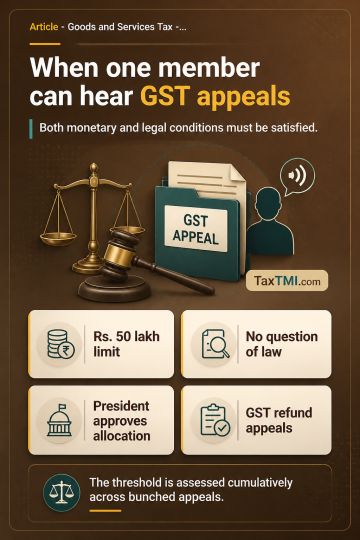
The Composition of a GST Appellate Tribunal Bench Is Governed by Statutory Conditions
Statutory requirements, rather than administrative convenience alone, govern the constitution of a Bench of the Goods and Services Tax Appellate Tribunal. Section 109(8) of the Central Goods and Services Tax Act, 2017, read with Rule 110A of the CGST Rules, 2017, sets out the conditions under which a Single Member may hear an appeal. The provision raises important questions concerning monetary jurisdiction, the nature of the dispute, and the distinction between matters involving factual determination and those requiring interpretation of law.
These questions become particularly significant when several appeals involving identical parties and a common legal controversy arise from different tax periods. Whether the monetary threshold should be examined separately or cumulatively, whether rejection of a refund claim constitutes an amount determined against the taxpayer, and whether interpretation of a beneficial amendment involves a question of law are matters that directly affect the composition of the appellate Bench.
The Chennai Bench of the GST Appellate Tribunal examined these issues in FIRESTREAM WORLDWIDE INC. Versus ADDITIONAL COMMISSIONER (REVIEW, APPEAL AND REVISION) EZHILAGAM, KAMARAJAR SALAI, CHEPAUK, CHENNAI - 2026 (11) TMI 121 - GSTAT CHENNAI. The Tribunal directed that a Division Bench hear eleven connected appeals involving refund claims aggregating Rs. 1,40,95,191. The decision is important for its interpretation of Section 109(8), particularly its treatment of cumulative monetary limits, rejected refund claims, and questions requiring legal interpretation.
The Background of the Dispute Reveals a Common Legal Controversy
The appellant, Firestream Worldwide Inc., had claimed refunds of Integrated Goods and Services Tax paid on the export of services for eleven tax periods from August 2017 to June 2018. The Original Adjudicating Authority rejected the refund claims, and the First Appellate Authority upheld those decisions. The taxpayer consequently filed eleven separate appeals before the GST Appellate Tribunal.
Although the appeals related to different tax periods and amounts, the parties and the underlying controversy were identical. The appellant contended that the dispute concerned the retrospective application of a beneficial amendment to Notification No. 15/2018-Integrated Tax (Rate), dated 26.07.2018. Determination of the refund entitlement therefore required consideration of whether the amendment was curative and retrospective or substantive and prospective.
The Tribunal had earlier, by order dated 08.09.2026, directed the Registry to bunch the appeals for consideration of the question of law. Both authorised representatives agreed that the appeals involved a question of law. The cumulative amount reflected in Form GST APL-04 was Rs. 1,40,95,191, although no individual appeal exceeded Rs. 50 lakh. The immediate controversy before the Tribunal was thus the appropriate constitution of the Bench, rather than the final admissibility of the refund claims.
The Jurisdiction of a Single Member Depends on Two Cumulative Statutory Conditions
Section 109(8) of the CGST Act provides the statutory framework for hearing appeals by a Single Member of the Appellate Tribunal. The provision takes into account the amount of tax or input tax credit involved, or the amount of fine, fee or penalty determined in the order appealed against, and subjects consideration by a Single Member to the prescribed monetary limit and the absence of a question of law. The President's approval is also necessary for such allocation.
Rule 110A of the CGST Rules, inserted with effect from 22.09.2025, prescribes a monetary limit of Rs. 50 lakh for this purpose. Reading the statutory provision and the Rule together, the Tribunal identified two cumulative requirements: the amount involved must not exceed Rs. 50 lakh, and the appeal must not involve any question of law. Therefore, satisfaction of the monetary condition alone is insufficient to justify hearing by a Single Member.
The word "and" connecting these conditions means both must be satisfied simultaneously. An appeal involving a question of law cannot be placed before a Single Member merely because its monetary value falls below Rs. 50 lakh. Equally, an appeal exceeding the prescribed monetary limit cannot qualify merely because the controversy is predominantly factual. The President's approval operates within these statutory restrictions and cannot dispense with either requirement.
Connected Appeals Involving an Identical Controversy May Be Heard Together
The Tribunal observed that when the appellant, respondent and issue for determination are common across several appeals, hearing them together serves the interests of judicial consistency. Separate consideration of substantially identical controversies could lead to divergent findings on the same legal question, particularly where the appeals differ only in their tax periods and monetary amounts.
In the present case, all eleven appeals concerned the rejection of IGST refunds paid on the export of services. The identity of the parties and the common legal issue justified their consolidation. The Tribunal accordingly considered bunching appropriate, even though each appeal arose from a separate refund period and appellate order.
This finding should not be understood as laying down an unrestricted rule that every appeal involving the same taxpayer must necessarily be combined. The Tribunal's reasoning rested on the particular circumstances of the case, namely identical parties, a common controversy and differences confined to tax periods and refund amounts. The governing consideration was the substantial identity of the dispute, rather than the mere existence of multiple appeals.
The Monetary Threshold for Bunched Appeals Must Be Examined Cumulatively
An important question was whether the Rs. 50 lakh threshold under Section 109(8), read with Rule 110A, should be applied separately to each appeal or to the combined amount when connected appeals are heard together. Each of the eleven appeals involved an amount below Rs. 50 lakh. However, their cumulative value was Rs. 1,40,95,191.
The Tribunal held that, for appeals bunched together for hearing, the prescribed monetary threshold must be reckoned cumulatively. Applying that approach, the combined amount substantially exceeded Rs. 50 lakh. The appeals consequently did not satisfy the monetary condition for consideration by a Single Member.
This interpretation is significant because the Tribunal looked beyond the individual monetary value of each appeal to the combined value of the connected proceedings. The decision establishes, in the context of these bunched appeals, that the monetary condition cannot be examined in isolation from the manner in which the common controversy is placed before the Tribunal. However, the judgment does not separately examine every possible situation involving consolidation of unrelated appeals or appeals presenting materially different issues. Its conclusion should therefore be understood in the factual context in which it was delivered.
Rejection of a Refund Claim Is Distinct from Determination of Tax Liability
A particularly important aspect of the judgment concerns the nature of the amounts contemplated by Section 109(8). The provision refers to tax or input tax credit involved and to amounts of fine, fee or penalty determined in the order appealed against. The Tribunal examined whether rejection of a refund claim falls within the class of matters contemplated for hearing by a Single Member.
The Tribunal distinguished between an amount determined against a taxpayer and an entitlement claimed by a taxpayer but denied by the authorities. In the present case, the Department had not determined an additional tax liability, disallowed input tax credit as a demand against the taxpayer, or imposed a fine, fee or penalty through the disputed orders. The controversy concerned the rejection of claims for refund of IGST already paid on the export of services.
On that basis, the Tribunal concluded that the rejected refund claims did not fall within the specified class of amounts contemplated for Single Member consideration under Section 109(8). This was an independent reason for directing Division Bench consideration, apart from the cumulative monetary value and the existence of a question of law. The finding is noteworthy because it treats the legal character of the disputed amount as relevant to Bench composition, rather than relying exclusively on its numerical value.
The Meaning of a Question of Law Extends to Interpretation of Statutory Instruments
The second statutory condition under Section 109(8) concerns the absence of a question of law. The Tribunal explained that a question of law arises when an issue requires the interpretation of legal principles, statutory provisions, notifications, circulars, or judicial precedents. Such questions cannot be reduced to ordinary factual disputes merely because their resolution ultimately determines a monetary claim.
A distinction must therefore be maintained between factual verification and legal interpretation. Verification of invoices, payment records, or the quantum of a refund may ordinarily involve factual examination. However, deciding whether a statutory notification applies to an earlier period requires determining its legal effect. Similarly, resolving competing interpretations of a statutory provision or examining the applicability of a judicial precedent involves a question of law.
In the present case, both authorised representatives accepted that the controversy required legal interpretation. The Tribunal independently examined the nature of the dispute and agreed that a question of law was involved. The decisive consideration was not merely the parties' agreement, but the necessity of interpreting the relevant notification and statutory provisions to determine the applicable legal position.
The Retrospective Operation of a Beneficial Amendment Raises a Question of Law
The substantive controversy underlying the eleven appeals concerned Notification No. 15/2018-Integrated Tax (Rate), dated 26.07.2018. The appellant contended that the amendment was beneficial and should operate retrospectively. The question was whether the amended position could govern refund claims for tax periods preceding the notification.
The legal distinction between a curative amendment and a substantive amendment is important in this context. A curative amendment may be intended to remove an existing difficulty, clarify the legal position, or remedy an unintended consequence. A substantive amendment, on the other hand, may introduce a new legal position or alter existing rights and obligations. Whether an amendment operates retrospectively depends on its language, purpose, statutory context, and applicable principles of interpretation. Its beneficial character alone does not automatically establish retrospective operation.
The Tribunal recognised that determining whether the notification was curative and retrospective or substantive and prospective required interpretation of the relevant statutory, notification, and circular provisions governing refund claims arising from the export of services. It did not decide the amendment's retrospective applicability or the ultimate entitlement to refund. Its finding was confined to recognising that the controversy involved a question of law requiring consideration by a Division Bench.
Agreement Between the Parties Cannot Replace Statutory Examination of Jurisdiction
An interesting feature of the proceedings was that both the appellant's and the Department's authorised representatives agreed that the appeals involved a question of law. The appellant filed a detailed paper book covering the eleven appeals, while the Department submitted its written position acknowledging the legal nature of the controversy.
The Tribunal nevertheless examined the records, the statutory framework and the nature of the dispute before accepting that submission. The Tribunal therefore supported its conclusion with its own assessment that the retrospective operation of the notification required legal interpretation. This approach reflects the principle that the proper constitution of an adjudicatory forum must rest on the applicable statute rather than the preferences of the litigating parties.
The significance of this aspect should not be overstated. The Tribunal did not pronounce a separate, elaborate ruling on whether consent could confer jurisdiction. Nevertheless, its reasoning demonstrates that agreement between the parties may identify the controversy, but statutory requirements determine the appropriate Bench. The Tribunal established a question of law by examining the substance of the appeals.
The Three Independent Grounds Requiring Division Bench Consideration
The Tribunal's reasoning is particularly important because it did not rest on a single ground. First, the eleven appeals were properly bunched because they involved identical parties and a common controversy. Their cumulative value of Rs. 1,40,95,191 exceeded the prescribed limit of Rs. 50 lakh, making Single Member consideration unavailable on the monetary criterion.
Second, the Tribunal held that rejecting a refund claim amounted to denying an asserted entitlement rather than determining one of the specified amounts against the taxpayer. It therefore considered the controversy outside the class of matters contemplated for Single Member hearing, independently of the monetary threshold.
Third, the dispute required interpretation of Notification No. 15/2018- Integrated Tax (Rate) and related legal provisions to determine whether the amendment operated retrospectively. This constituted a question of law and therefore prevented consideration by a Single Member. The combined effect of these findings was that the appeals required hearing by a Bench consisting of one Judicial Member and one Technical Member.
Proper Constitution of the Bench Must Precede Adjudication on Merits
The distinction between determining the appropriate Bench and deciding the substantive appeal is fundamental. In the present proceedings, the Tribunal examined the statutory conditions governing Bench composition without entering into the final merits of the refund claims. It did not determine whether the services qualified for the claimed refund, whether the notification applied retrospectively, or whether the earlier rejection orders were legally sustainable.
The Tribunal directed that a Division Bench consisting of one Judicial Member and one Technical Member hear all eleven appeals together. The Registry was instructed to list the leading Appeal No. APL/122/CHE/2026 along with the ten connected appeals for hearing on merits on 23.11.2026.
The Decision Has Important Implications for Future GSTAT Proceedings
The judgment provides useful guidance on determining the appropriate Bench in connected GST appeals. Where multiple appeals involve common parties and substantially identical issues, the possibility of bunching and its impact on the monetary threshold require careful consideration. Professionals should therefore examine not only the value of each appeal but also the cumulative value if the appeals are proposed to be heard together.
The decision also highlights the statutory description of the amounts covered by Section 109(8). A dispute concerning the rejection of a refund claim may require a different jurisdictional examination from an appeal against the determination of tax, the denial of input tax credit, or the imposition of a penalty. The Tribunal's interpretation on this aspect is significant, although its wider application may require consideration in future cases.
Equally important is identifying questions of law at the initial stage of appellate proceedings. Disputes concerning retrospective amendments, the interpretation of notifications, statutory exemptions, competing legal provisions, or the applicability of judicial precedents may raise questions of law irrespective of their monetary value. The proper approach is to examine the controversy's legal substance before determining whether Single Member consideration is permissible.
***