 TaxTMI
 TaxTMI


 02 Nov 2026

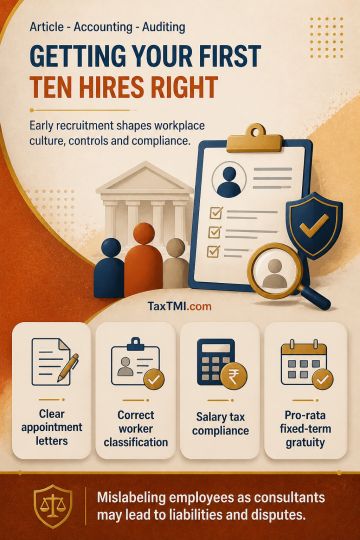
The first people a business hires don't just fill seats. They write the unwritten rules every later recruit absorbs - including how money and records are handled.
Two decades ago Google was notorious for interview brainteasers: how many golf balls fit inside an aircraft, how many piano tuners work in a city.
Later, its own people-analytics team checked whether those puzzles worked. In Work Rules! (2015), former people-operations chief Laszlo Bock wrote that they were essentially useless - they didn't predict who would perform. Google switched to structured interviews and job-based assessments.
If one of the most data-hungry companies on earth hired on instinct for years, the rest of us should probably examine how we hire.
Relief on the surface, architecture underneath
Early hiring feels like rescue. The founder is drowning, the work is piling up, and help is urgently needed. So the first recruits often arrive quickly:
- A friend between jobs.
- A cousin who is "good with figures."
- Whoever can start immediately.
- Whoever fits the budget.
For a while, the work gets done. But early recruits do something far more consequential than finishing tasks. They become the template. They define how work is done, how customers are treated, how errors are handled and what "acceptable" means. As the company grows they often become managers - and recruit in their own image.
Why the first ten outweigh the next hundred
In a five-person team, each person is a fifth of the company. A weak hire in a firm of five hundred is a problem; in a firm of five it's the culture.
Early employees:
- Set the informal rules of work.
- Shape what customers experience.
- Train everyone who joins after them.
- Acquire informal authority, title or no title.
- Hold knowledge that is seldom written down.
A small business can't absorb weak performance. There's nowhere for it to hide and nobody to cover for it.
The first ten people a business hires end up hiring the next hundred.
Lesson from history: choosing by merit
For over a millennium, from the Sui and Tang dynasties onwards, imperial China selected many officials through standardised civil-service examinations rather than family connections alone. The system had real flaws, yet it rested on a radical premise: select people on evidence of ability, assessed identically for everyone.
Modern selection research lands in the same place. Major reviews - from Frank Schmidt and John Hunter's influential 1998 meta-analysis to a 2022 re-analysis led by Paul Sackett - keep finding that structured interviews and job-related assessments predict performance better than free-flowing conversations. Researchers debate the precise rankings; nobody disputes the direction.
Six early-hiring errors
1. Choosing availability over ability
"Can join Monday" isn't a qualification.
Better: define what the role must deliver in six months before searching.
2. Hiring friends and family without clear terms
Personal ties can work in business, but they complicate feedback, accountability and exits.
Better: put role, expectations, reviews and exit terms in writing - and treat them like anyone else.
3. Hiring mirror images
A team of clones shares the same strengths and the same blind spots.
Better: recruit for the skills and temperament the business lacks.
4. Going too senior too soon
An executive from a large company is used to teams, budgets and systems; in a young firm they must often do the work themselves.
Better: early on, favour builders comfortable with ambiguity. Hire for the current stage and the next - not three stages ahead.
5. Overlooking character because skills are scarce
A gifted performer who belittles colleagues, bends rules or hides errors costs more than they produce.
Better: assess integrity, ownership and attitude as rigorously as technical skill.
6. Delaying action on a poor fit
Founders hope things will improve. Months pass, and good staff lose respect.
Better: a structured probation with clear goals, honest early feedback and a respectful, lawful exit if needed.
In a nutshell
Essence: early hiring mistakes are costly not because of one person's output but because that person becomes the model for everyone who follows.
The HIRE Scorecard
A lean method for small teams, grounded in the evidence:
H - Hypothesis of outcomes
Write a scorecard rather than a job description: three to five measurable outcomes for the first six to twelve months, plus the competencies and values required.
Example for an accounts executive: "Cut debtors over 60 days by half within six months while keeping customer complaints stable."
I - Interview with structure
Ask every candidate the same core questions in the same order and score answers against a written guide. Probe specific past behaviour: "Tell me about an error you found in your own work. What did you do next?"
R - Real work sample
Set a short, realistic task - reconcile a sample ledger, draft a reply to a customer query, solve a typical problem. Pay for it if it runs beyond an hour. A work sample reveals more than an hour of chat.
E - Evidence from others
Add a second interviewer to reduce bias, and check references with purpose: "Would you rehire them? In what role? Where would they need support?"
After the offer, onboard deliberately. The first thirty days heavily influence how long someone stays and how well they perform - give them a plan, a mentor and early wins.
The uncomfortable reality
Many founders spend longer choosing accounting software or office chairs than designing a hiring process. And many tolerate behaviour from early staff they'd never accept from later ones - because the person "has been here since day one."
Loyalty deserves respect. It doesn't earn permanent exemption from standards.
The standard you walk past is the standard you accept.
Compliance belongs in hiring from the first offer
Young businesses often skip employment paperwork, and the risk accumulates quietly:
- A written appointment letter covering role, pay structure, probation, notice, confidentiality and assignment of intellectual property.
- Registration under, and compliance with, applicable labour and social-security laws.
- Correct TDS on salaries, deposited and reported on time.
- Accurate worker classification - labelling a full-time employee a "consultant" to dodge obligations invites back liabilities and disputes.
- Attendance, wage and leave records.
Investors and acquirers scrutinise employment documents closely; unclear IP ownership by early staff is a frequent due-diligence finding.
For practitioners: what to set up for clients
- A standard appointment-letter pack aligned with the labour codes, including IP assignment and confidentiality clauses.
- Payroll structure review. Under the uniform wage definition, check that allowances don't push basic pay below the threshold that drives PF and gratuity calculations.
- Classification checks. Review "consultant" and "retainer" arrangements against the facts; reclassify where the relationship is really employment.
- Probation and exit templates. Clear probation goals and a documented exit process, with full-and-final settlement timelines built in.
- Your own practice too. Apply the HIRE Scorecard to article assistants and staff - a CA firm's early hires shape its quality control just as much.
Indicators of success
Good early hiring shows in year two, not month one:
- Retention - most of the first ten are still there after two years.
- Internal promotion - early hires grow into leaders.
- Shared values - new joiners describe the company the way the founders do.
- Referrals - early hires bring in strong candidates.
- Founder time - fewer hours spent redoing work.
Outlook: the coming decade
AI is changing what early hires do; small teams can now produce output that once needed many more people, which raises the stakes of every appointment. Remote hiring widens the talent pool but makes culture harder to build. The founders who win will hire fewer people, choose them more carefully and invest more in their growth.
Immediate actions by role
- Founder: write the three behaviours you'll never compromise on and use them in every interview.
- Hiring manager: add a work-sample test to the process.
- Early employees: join interviews - they know the culture best.
- Advisers or investors: review the next senior hire with the founder before the offer goes out.
Illustration from a smaller enterprise
Take an illustrative founder of a ten-person digital agency whose first five hires were friends and relatives - available and trusted. Two struggled with client work, and she spent her evenings redoing it.
For the next five, she introduces a paid trial project and a structured interview built on three values. Within a year client complaints drop sharply and she stops working weekends. Trust still matters; now it's earned through evidence.
The objection we hear most - and our response
The objection: "We're tiny. We can't afford long hiring processes. Good people get snapped up within days."
The answer: Speed matters, but structure needn't be slow. A one-page scorecard takes an hour; five standard questions take minutes; a work sample fits into one sitting. The real delay comes from a bad hire - months of lost output, damaged morale, a painful exit and a fresh search. Three extra days of discipline beat a six-month mistake.
Practitioners' FAQ
"Generalists or specialists first?"
Usually adaptable generalists with strong values, plus specialists for critical skills the founder lacks.
"How can cultural fit be tested fairly?"
Structured questions on past behaviour, work samples and references focused on values as well as skills.
"Should early employees get equity?"
Often yes, through a properly designed option plan that rewards long-term commitment - never promised verbally.
Position as at October 2026: In India, the four labour codes in force since 21 November 2025 introduce a uniform definition of wages, pro-rata gratuity for fixed-term employees after one year, and full-and-final settlement within two working days of exit. State rules continue to be notified. Build these into appointment letters and payroll from the first hire.
Pitfalls
- Verbal equity promises with no written plan.
- Titles you'll later need to take back.
- Hiring to fill a seat rather than achieve an outcome.
- Skipping references because the candidate "seemed great."
- Treating HR compliance as something for "when we're bigger."
Half-hour action exercise
Take the next role you plan to fill - or the last one you filled.
1. Write three measurable outcomes for the first six months.
2. Write five interview questions asking for past behaviour tied to those outcomes.
3. Design one 45-minute work sample.
4. Ask: "Would I be happy if the next twenty hires behaved exactly like this person?"
Without a confident yes to question 4, keep looking.
Summary for busy professionals
- Early hires set the culture, standards and habits that later hires copy.
- Avoid hiring for availability, unclear family hires, clones, premature seniority, ignoring character and slow action on poor fits.
- Use the HIRE Scorecard: Hypothesis of outcomes, structured Interviews, Real work samples, Evidence from others.
- Decades of evidence favour structured, job-related assessment over gut feel.
- Put employment, IP and labour compliance in place from the very first offer.
You're not just hiring a person. You're hiring the company's future culture.
References
- Laszlo Bock, Work Rules! Insights from Inside Google That Will Transform How You Live and Lead (Twelve, 2015).
- Frank L. Schmidt and John E. Hunter, "The Validity and Utility of Selection Methods in Personnel Psychology," Psychological Bulletin 124(2) (1998).
- Paul R. Sackett et al., "Revisiting Meta-Analytic Estimates of Validity in Personnel Selection," Journal of Applied Psychology (2022).
- Geoff Smart and Randy Street, Who: The A Method for Hiring (Ballantine, 2008).
- Ministry of Labour and Employment, Government of India - Labour Codes resources. labour.gov.in